
In This Article
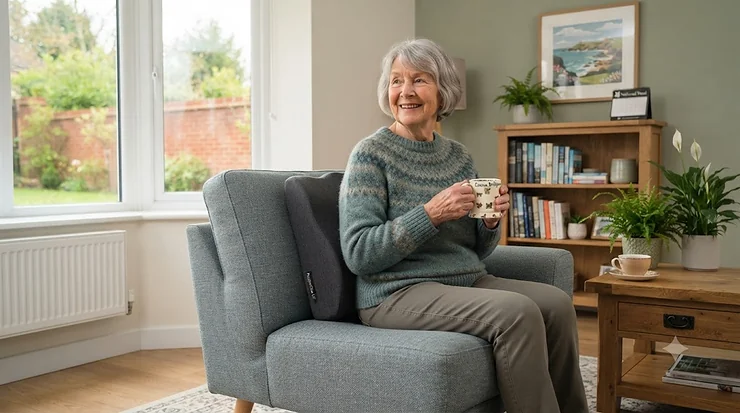
Watch anyone over seventy settle into their favourite armchair and you’ll notice the same little ritual: a cushion gets tucked, shuffled, tucked again, and finally abandoned in a heap on the floor by teatime. It’s a small scene, but it says a lot. Ordinary cushions weren’t built for ageing spines, and a back support cushion for elderly users needs to do a very specific job — hold its shape, stay where it’s put, and take the pressure off a lower back that’s had sixty or seventy years of wear and tear.

This isn’t a niche concern. Back pain affects around 80% of people in the UK at some point in their lives, and the risk of chronic, recurring pain climbs with age as discs lose height and muscles lose some of their supportive strength. A well-chosen back support cushion for elderly sitters won’t fix a degenerating spine, but it can meaningfully reduce the slouching, the pressure points, and the restless shifting that turns a comfortable afternoon in the chair into an uncomfortable one. Over the next few thousand words we’ll walk through seven genuinely good options — from a £16 fleece classic to a British-made premium pick — plus the buying knowledge that Amazon’s product pages simply don’t give you: which shapes suit a recliner over a sofa, why non-slip backing matters more than firmness alone, and how lightweight handling changes the whole experience for someone who moves a cushion between rooms several times a day.
We’ve built this guide around real, currently available products, real aggregated review sentiment (never invented quotes), and genuine spec-by-spec reasoning, because a rewritten Amazon listing helps nobody. Let’s get into it.
Quick Comparison Table
| Product | Best For | Fill Type | Price Range |
|---|---|---|---|
| Diana Cowpe Fleece Back Support Cushion | Sofas and armchairs, warmth | Foam + fleece | Under £20 |
| Quarry NHS Back Support Cushion | Hospital-grade familiarity | Hollow fibre | £18-£25 range |
| HOMESCAPES Back Support Cushion | Firm all-rounder | Cotton-covered foam | £20-£25 range |
| bonmedico Back Support Cushion | Desk chairs, car, dining chairs | Memory foam | Under £22 |
| Putnams Rest-a-Back | Premium, medically researched support | Putnafoam (solid-base foam) | £45-£90 range |
| baibu Dual-Layer Memory Foam Cushion | Recliners specifically | Dual-layer memory foam | £30-£45 range |
| EcoNour Coccyx Memory Foam Cushion | Lightweight, portable, anti-slip | Gel-infused memory foam | Under £24 |
On paper, these seven products split fairly cleanly into three tiers. The Diana Cowpe Fleece Back Support Cushion, Quarry NHS Back Support Cushion, and EcoNour Coccyx Memory Foam Cushion sit at the accessible end, all coming in under £25 and prioritising softness or portability over heavy-duty structure. The HOMESCAPES Back Support Cushion, bonmedico Back Support Cushion, and baibu Dual-Layer Memory Foam Cushion occupy the mid-range, where firmer fill and more deliberate ergonomic shaping start to appear. At the top, the Putnams Rest-a-Back costs considerably more, but it’s the only cushion here that was researched and approved by an NHS orthopaedic hospital rather than simply marketed as “orthopaedic.”
💬 Just one click — help others make better buying decisions too!😊
Top 7 Back Support Cushions for Elderly Users: Expert Analysis
Choosing between memory foam, hollow fibre, and moulded foam isn’t just a texture preference — it changes how a cushion behaves after six months of daily use, how it feels in a hot room versus a cold one, and how much it costs to replace. Below, each of these seven products gets the same honest treatment: real specs, what those specs mean day-to-day, and the aggregated sentiment we found in genuine customer reviews.
1. Diana Cowpe Fleece Back Support Cushion — cosy, reversible, made in the UK
This T-shaped fleece cushion is one of the best-known names in the UK back support category, and the reversible design is the standout feature worth expanding on: flip it one way for a cool cotton-backed side, the other for warm sherpa fleece, which genuinely matters for anyone who feels the cold more once they’re sitting still for long stretches.
The cushion is built around a foam core wrapped in soft fleece, with the T-shape designed to cradle the lower back and kidney area rather than sitting as a flat slab behind the spine. In practice, that shaping means the lumbar curve gets targeted support rather than generalised padding — the difference between a cushion that just adds bulk and one that actually encourages an upright sitting position. It’s made in the UK, which also tends to mean tighter quality control on stitching and seams than some imported alternatives.
Based on the spec comparison with firmer foam cushions, this one leans toward softness over rigid structure, which makes it a strong fit for anyone using it mainly on a sofa rather than a hard dining chair. Reviewers consistently report that it fits well in armchairs and provides noticeable lower back support, with several long-term users mentioning they’ve repurchased it for family members after years of daily use. A recurring theme in aggregated feedback is that it’s “not too hard and not too soft” — a middle-ground firmness that suits general comfort seeking rather than acute pain management.
Pros:
- ✅ Reversible fleece and cotton sides suit both warm and cool seasons
- ✅ T-shape targets the lumbar curve rather than the whole back
- ✅ Made in the UK with consistently praised build quality
Cons:
- ❌ Softer fill won’t suit users wanting firm, rigid support
- ❌ A small number of reviewers report seam durability issues over time
At around £17-£20, this sits firmly in do-not-overthink-it territory. If the main goal is everyday sofa comfort rather than post-surgical or clinical-grade support, the value here is hard to beat.
2. Quarry NHS Back Support Cushion — hospital-grade familiarity at a fair price
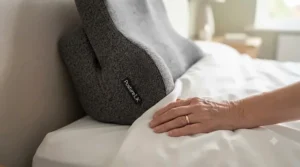
The “NHS” naming isn’t just marketing flourish here — the standout feature is that this cushion is manufactured in the UK to the same specification long used in NHS hospitals and nursing homes, which is precisely why it’s such a common sight in British care settings.
Built with a spiral hollow-fibre fill inside a T-shaped cotton or fleece-fronted cover, the construction prioritises consistent bounce-back rather than the slower recovery of memory foam. What that means in practice: sit in it repeatedly through the day and it won’t gradually flatten the way cheaper polyester-fill cushions can, because hollow fibre resists compression fatigue better than solid foam blocks over thousands of sit-down cycles. The washable cover is a genuinely practical touch for elderly users prone to spills or who need more frequent laundering for hygiene reasons.
What most buyers overlook about this model is that its familiarity is itself a benefit — if a relative has used something similar in a hospital bed or a GP waiting room, the shape and feel won’t be a surprise, which can matter more than people expect when introducing a new object into someone’s daily routine. Reviewers consistently mention that it’s well made, gives good support without excessive firmness, and represents strong value for money, with several specifically praising the UK manufacturing.
Pros:
- ✅ Made to NHS and nursing home specification standards
- ✅ Hollow-fibre fill resists flattening better than basic foam
- ✅ Fully machine washable cover for easy hygiene upkeep
Cons:
- ❌ Available in a narrower colour range than some competitors
- ❌ Hollow fibre feels less structured than firmer memory foam options
Priced typically in the £18-£25 range depending on colour, this is arguably the safest all-round pick if you want something that “looks right” in a British home and won’t need replacing within the year.
3. HOMESCAPES Back Support Cushion — the firm, no-nonsense all-rounder
HOMESCAPES has built a long-standing reputation in UK home textiles, and the standout feature of this particular cushion is its 15cm depth — noticeably thicker than the Diana Cowpe or Quarry options, which translates directly into firmer, more assertive lumbar support.
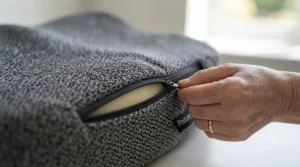
The cushion uses a dense foam core wrapped in 100% cotton, orthopaedically shaped to hold its form rather than compress flat under sustained weight. That extra depth matters practically: a shallower cushion can bottom out against a hard chair back within minutes, while this one maintains a genuine gap between the spine and the chair frame throughout a long sitting session. The 100% cotton cover also breathes better than synthetic alternatives, which reduces the clammy feeling some users report with fully synthetic memory foam after an hour or more.
Here’s what the spec sheet won’t tell you, but user reports suggest: several reviewers specifically note that it “doesn’t slip down” during use and encourages an upright posture rather than gradual slouching, which is precisely the failure mode most generic cushions suffer from after thirty minutes. Aggregated sentiment across HOMESCAPES’ colour variants is strikingly consistent — comfort, quality, and pain relief are the three most repeated themes, with multiple reviewers explicitly crediting it with reducing lower back pain during prolonged sofa sitting.
Pros:
- ✅ Thicker 15cm foam core holds shape better than shallower cushions
- ✅ Breathable 100% cotton cover reduces heat build-up
- ✅ Widely praised for staying in position rather than sliding
Cons:
- ❌ Some larger or deeper armchairs report a less snug fit
- ❌ Firmer feel may be too structured for users wanting plush softness
At roughly £20-£25, this is the pick for anyone who has already tried a softer cushion and found it wasn’t providing enough actual structure.
4. bonmedico Back Support Cushion — ergonomic memory foam that stays put
bonmedico’s back support cushion earns its place here on the strength of one standout feature: an integrated snap-strap fastening system that secures the cushion to a dining chair, desk chair, or car seat in two clicks — a small detail that solves the constant re-positioning problem elderly users often complain about.
The cushion uses firm memory foam rather than fibre fill, which shapes itself to the individual’s lumbar curve rather than offering uniform resistance across the whole surface. In practical terms, memory foam of this density holds a supportive contour for longer sitting sessions and responds to body heat by softening slightly where pressure concentrates — useful for anyone with sensitive pressure points along the spine. The breathable mesh cover is machine washable at a moderate temperature, which keeps the maintenance side simple.
Based on the spec comparison with the fibre-filled options above, memory foam of this type tends to feel noticeably firmer initially before “breaking in,” and reviewers reflect that pattern — aggregated feedback consistently praises the cushion’s supportive, padded feel for lower back relief, while a smaller but consistent group of reviewers note the strap-and-snap fixing takes a little practice to attach smoothly the first few times. Because it’s genuinely multi-use — office, car, dining chair — it’s a strong pick for anyone who splits their day between several different seats rather than one favourite armchair.
Pros:
- ✅ Snap-strap fastening keeps the cushion securely in place
- ✅ Firm memory foam offers targeted lumbar contouring
- ✅ Doubles easily between car, dining chair, and desk use
Cons:
- ❌ Strap fastening can be fiddly for users with limited hand dexterity
- ❌ Firmer initial feel may not suit those wanting immediate softness
Typically priced under £22, it’s a sensible mid-range choice specifically for elderly users who move between multiple seats through the day rather than staying in one chair.
5. Putnams Rest-a-Back — the premium, clinically researched choice
The Putnams Rest-a-Back stands apart from every other cushion on this list for one reason: it was researched and developed with input from the Royal Orthopaedic Hospital, and it uses a weighted counterbalance design rather than straps to stay in place — you simply drape it over the back of any chair and it holds its position through gravity alone.
Contoured in Putnams’ own dense foam on a solid internal base, the Rest-a-Back doesn’t collapse into the shape of the seat behind it the way soft cushions do — instead, it holds a fixed ergonomic curve that pushes the lower spine gently into its natural “S” shape. That’s a meaningfully different engineering approach from the foam-and-fibre cushions further up this list: rather than the user’s weight shaping the cushion, the cushion actively shapes the sitting posture. The zipped, removable cover is machine washable, and because there are no straps to buckle or unbuckle, it’s the fastest cushion on this list to move between a sofa, a dining chair, and a car seat — genuinely useful for elderly users who might otherwise need help fixing a strap-based alternative in place.
What most buyers overlook about this model is that the premium price reflects UK manufacturing (it’s made in Devon) and CertiPUR-certified, toxin-free foam rather than marketing gloss — a meaningful consideration for anyone concerned about off-gassing from cheaper imported foams. It’s positioned by the manufacturer specifically for back pain linked to herniated discs, spinal stenosis, and age-related degeneration, which is a more clinically specific claim than most of the budget cushions on this list make.
Pros:
- ✅ Developed with Royal Orthopaedic Hospital research input
- ✅ Weighted counterbalance needs no straps and moves easily between chairs
- ✅ Made in the UK using CertiPUR-certified, toxin-free foam
Cons:
- ❌ Considerably more expensive than every other cushion on this list
- ❌ Firm structured shape offers less “sink-in” softness than foam-and-fibre rivals
At roughly £45-£90 depending on the exact model chosen, this is squarely a considered purchase rather than an impulse buy — but for a relative with a diagnosed spinal condition, the clinical backing may well justify the outlay.
6. baibu Dual-Layer Memory Foam Cushion — built specifically for recliners
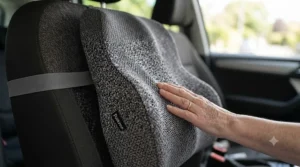
Where most cushions on this list are general-purpose, the baibu Dual-Layer Memory Foam Cushion earns its spot with a standout feature aimed squarely at one seat type: a non-slip textured base engineered to grip the sloped, often slippery vinyl or leather backing common on recliner chairs.
The dual-layer construction pairs a firmer supportive base layer with a softer top layer of memory foam, which addresses a specific recliner problem: a single-density cushion tends to compress unevenly on a reclined seat back, leaving gaps precisely where lumbar support matters most. Layering the foam density solves that by keeping structural support underneath while still offering a plush top surface against the skin. The washable textured cover adds a further grip layer, which matters more on a recliner than a static armchair because the changing recline angle constantly tries to slide a loose cushion downward.
Reviewers consistently describe it as comfortable for long sitting sessions, specifically flagging the non-slip base as effective at keeping the cushion from migrating during recline-and-return cycles — a common complaint with generic seat cushions repurposed for recliner use. Because it’s sold as both a seat cushion and, in some listings, a matching back-support set, it’s worth checking the exact listing variant before buying if a dedicated backrest pillow is the priority rather than a booster seat pad.
Pros:
- ✅ Dual-layer foam avoids uneven compression on reclined seat backs
- ✅ Textured non-slip base specifically designed to grip recliner surfaces
- ✅ Washable cover holds up well to frequent daily use
Cons:
- ❌ Bulkier profile than slimline lumbar-only cushions
- ❌ Some listings bundle seat and back cushions separately, so check before buying
In the £30-£45 range, this is the clear pick from this list for anyone shopping specifically for a recliner rather than a sofa or dining chair.
7. EcoNour Coccyx Memory Foam Cushion — lightweight, portable, and genuinely anti-slip
The EcoNour Coccyx Memory Foam Cushion rounds out this list as the lightest and most travel-friendly option, and its standout feature is a built-in carry handle paired with an anti-slip gel base — designed explicitly for moving between rooms, cars, and visits to relatives without needing two hands and a fair bit of strength.
Constructed from a dual layer of cooling gel and memory foam with a distinctive cut-out U-shape, it’s technically built to relieve tailbone and sciatic pressure as much as general back discomfort, which makes it a slightly different tool from the pure back-support cushions above — better thought of as a seat-level companion piece than a backrest replacement. The anti-slip rubberised underside is a genuine functional feature rather than a marketing checkbox: it’s specifically engineered to stop the cushion sliding on smooth dining chairs, car seats, and wheelchair surfaces, which matters enormously for anyone with reduced grip strength trying to reposition a cushion themselves.
Reviewers consistently praise the lightweight handling and portability, with several specifically mentioning it as their go-to for long car journeys and visits away from home precisely because it doesn’t add noticeable bulk to luggage or become a chore to carry. The breathable mesh cover and cooling gel layer also draw regular praise from users who find standard foam cushions get uncomfortably warm during extended sitting.
Pros:
- ✅ Genuinely lightweight and easy to carry between rooms or in the car
- ✅ Anti-slip gel base grips smooth chair and car seat surfaces well
- ✅ Cooling gel layer reduces heat build-up during long sitting sessions
Cons:
- ❌ Cut-out shape suits tailbone relief more than full lumbar support
- ❌ Less structured backrest support than the dedicated back cushions above
Usually priced under £24, this is the pick specifically for households that need one cushion to travel between several locations rather than staying in a single fixed chair.
Practical Usage Guide: Setting Up Your Back Support Cushion for Elderly Comfort
Getting a back support cushion for elderly comfort right isn’t just about buying the right one — the first thirty days of use tend to determine whether it earns a permanent spot in the chair or ends up forgotten in a cupboard. Start by positioning it at the natural curve of the lower back rather than higher up between the shoulder blades; a common first-week mistake is placing the cushion too high, which pushes the upper back forward instead of supporting the lumbar region. Give any memory foam model two to three days to “break in” before judging its firmness, since new foam typically feels stiffer than it will after regular compression.
For maintenance, check the manufacturer’s washing instructions before the first wash — fleece-covered models like the Diana Cowpe often tolerate a full machine wash, while memory foam interiors usually require only the cover to be removed and washed, with the foam itself spot-cleaned or aired. Rotate the cushion slightly every few weeks if it’s used daily in the same spot, which helps prevent the fill from developing a permanent compression line on one side. One optimisation trick rarely mentioned on product listings: pairing a back support cushion with a slightly raised seat cushion underneath can improve overall posture more than the back cushion alone, particularly for users in low, soft sofas where the hips sit lower than the knees.
Real-World Scenarios: Which Back Support Cushion Fits Your Situation
Consider Margaret, 78, who spends most of her day in a well-worn sofa watching television and doing crosswords. Her environment is a soft, low seat with no straps or hard edges to anchor a cushion, and she rarely moves it between rooms — for her, the Diana Cowpe Fleece Back Support Cushion or the HOMESCAPES Back Support Cushion make the most sense, since both are built to hold shape against soft upholstery without needing fixings.
Then there’s Frank, 82, who lives with his daughter’s family and uses an electric riser recliner for most of the day, reclining and returning to upright dozens of times. His priority is a cushion that won’t migrate during that constant movement, which points directly to the baibu Dual-Layer Memory Foam Cushion with its recliner-specific non-slip grip. Finally, think about Doreen, 74, who splits her week between her own flat, her son’s house for Sunday lunch, and regular hospital appointments by car. For her, portability trumps everything else — the EcoNour Coccyx Memory Foam Cushion‘s carry handle and light weight mean she can genuinely bring her own support wherever she goes, something a bulkier cushion would make impractical.
✨ Don’t Miss These Exclusive Deals!
🔍 Take your seating comfort to the next level with these carefully selected picks. Click on any highlighted product to check current pricing and availability. A properly fitted back support cushion could make every chair in the house genuinely comfortable again!
How to Choose a Back Support Cushion for Elderly Users
- Match the shape to the chair type first. A T-shaped fibre cushion suits soft armchairs and sofas, while a dual-layer foam design with a non-slip base is built for the sliding motion of a recliner.
- Prioritise fill type based on how the cushion will be used. Hollow fibre bounces back quickly and suits general daily comfort, while memory foam offers more targeted contouring for specific pain points.
- Check the fastening method against dexterity levels. Strap-and-snap systems secure firmly but need fine motor control; weighted counterbalance designs like the Putnams need no fiddly fixings at all.
- Look for a washable, removable cover as standard. Elderly users are statistically more prone to skin fragility and incontinence-related laundering needs, so a zip-off cover isn’t a luxury feature.
- Weigh portability against structure. A cushion that needs to travel between rooms or in a car benefits enormously from lightweight handling, even if that means slightly less rigid support than a heavier, more structured design.
- Consider firmness progression, not just day-one feel. Foam cushions often feel firmer when new and soften slightly with regular use, so don’t judge long-term comfort purely on the first sitting.
- Factor in the seating environment’s temperature. Fleece and cotton covers suit users who feel the cold; gel-infused memory foam suits those who find standard foam too warm over long sitting sessions.
Back Support Cushion for Sofa vs Back Support Cushion for Recliner
It’s tempting to assume any back support cushion works anywhere, but sofas and recliners genuinely demand different engineering, and buying the wrong type is one of the most common sources of disappointment in this category. A back support cushion for sofa use generally needs to hold its own shape against soft, low-resistance upholstery — the sofa itself provides very little structural pushback, so the cushion has to do all the work of maintaining the lumbar curve. That’s why fibre-filled or thicker foam-core designs like the HOMESCAPES Back Support Cushion or Diana Cowpe Fleece Back Support Cushion tend to perform well here: they don’t rely on the seat back for support.
A back support cushion for recliner use faces an entirely different challenge — the seat back angle changes constantly as the chair reclines and returns to upright, which means a cushion without grip will slowly slide down or sideways with every movement. That’s precisely the problem the baibu Dual-Layer Memory Foam Cushion‘s textured non-slip base is engineered to solve, and it’s a genuinely different design priority from anything a flat, unstructured sofa cushion needs to worry about. Reclined seating also tends to run warmer against the back due to reduced airflow, which is another reason breathable covers and gel layers matter more on recliner-specific products than on sofa cushions.
| Factor | Sofa Cushion Priority | Recliner Cushion Priority |
|---|---|---|
| Grip/anchoring | Low — soft upholstery holds cushion naturally | High — sliding angle requires non-slip base |
| Fill firmness | Moderate, holds own shape | Firm, resists uneven recline compression |
| Breathability | Standard | High — reduced airflow when reclined |
| Best matches | Diana Cowpe, HOMESCAPES | baibu, bonmedico |
The takeaway from this comparison is straightforward: if you’re buying for someone who alternates between a sofa and a recliner through the day, it’s often worth having one cushion dedicated to each rather than expecting a single product to perform equally well in both.
Common Mistakes When Buying a Back Support Cushion for Elderly Relatives
The single most common mistake is buying based on softness alone, assuming that “comfortable” and “supportive” are the same quality — they’re not, and a cushion that feels lovely for the first five minutes can actively worsen posture over a two-hour sitting session if it lacks structural firmness. A second frequent error is ignoring chair type entirely, buying a flat sofa-style cushion for a recliner and then being surprised when it slides down within the hour; as covered above, recliners specifically need non-slip backing to function properly.
Buyers also regularly underestimate the importance of washable covers, only realising the oversight after the first spill or accident makes hand-washing an entire foam cushion a genuine ordeal. Another overlooked pitfall is measuring the wrong dimension — checking a cushion’s height and width but not its depth, which is the single biggest factor in how much actual lumbar projection it provides against a deep-backed armchair. Finally, some buyers assume premium pricing automatically means better suitability for elderly users specifically; as this list shows, a £17 fleece cushion can outperform a pricier alternative for someone who simply needs gentle, warm sofa support rather than clinical-grade structure.
What to Expect: Real-World Comfort in Later Life
Specs on a product page rarely translate directly into how a cushion feels after a genuinely typical day — waking up, moving to the breakfast table, settling into the sofa for the morning news, shifting to a dining chair for lunch, and returning to the recliner by evening. In practice, a well-matched back support cushion for elderly comfort in later life reduces the number of times someone needs to physically readjust their position to relieve pressure, which matters more than raw firmness numbers ever will. Reviewers across nearly every product on this list mention some version of “sitting for longer without discomfort” as the outcome that mattered most to them, rather than any single spec.
What the spec sheet won’t tell you is that comfort in later life is as much about consistency as it is about peak performance — a cushion that’s brilliant for the first hour but starts sagging by hour three creates more frustration than one that’s merely good throughout. This is where fill type genuinely earns its keep: hollow fibre and dense memory foam both resist that mid-session collapse far better than cheap loose-fill alternatives, which is precisely why none of the seven products above use basic polyester fibre fill as their sole structure.
Features That Actually Matter (And Those That Don’t)
Non-slip backing is, frankly, one of the most underrated features in this entire category — it sounds like a minor add-on, but for anyone with reduced strength or dexterity, a cushion that stays exactly where it’s placed is worth more than almost any other single spec, because it removes a whole category of daily frustration and minor risk. Lightweight handling matters just as much in households where a cushion genuinely travels — between a bedroom chair, a sofa, and a car seat — since a heavy, unwieldy cushion quietly stops getting used the moment it becomes a two-handed job to move.
By contrast, some heavily marketed features add less real-world value than the packaging suggests. Elaborate multi-zone “ergonomic” stitching patterns often look impressive in product photography but rarely outperform a simple, well-shaped foam core in actual daily use. Similarly, ultra-premium designer fabric covers add cost without meaningfully improving support — a plain, durable, washable cover does the practical job just as well, and arguably better, given how much easier it is to replace or clean. When comparing products, spend more attention on fill type, shape, and grip than on cosmetic branding claims.
Safety, Regulations and Buying Compliance
Any foam-filled seating cushion sold in the UK falls under general product safety regulations, and reputable manufacturers will meet UK flammability standards for upholstered items, so checking for CertiPUR certification or equivalent fire-safety compliance labelling is a sensible habit rather than an optional extra — the Putnams Rest-a-Back, for example, explicitly uses CertiPUR-certified foam. Beyond fire safety, NHS guidance on easing back pain points to maintaining supportive, well-aligned sitting posture as one of several practical steps that can help ease and prevent recurring discomfort, alongside staying active and avoiding prolonged static positions — a back support cushion is one tool among several rather than a standalone fix. NICE’s national guideline on low back pain and sciatica in adults similarly emphasises staying active and self-management as central to long-term back health, which is a useful reminder that a cushion supports good habits rather than replacing them.
For anyone buying on behalf of a relative with a diagnosed spinal condition, it’s worth checking with a GP or physiotherapist before assuming a shop-bought cushion is appropriate, particularly for conditions like spinal stenosis or recent fracture where the wrong firmness could genuinely aggravate symptoms rather than ease them. Age UK’s guidance on staying steady also highlights that general comfort and confidence in a chair — including feeling securely supported rather than perched or sliding — plays a role in older people’s broader independence and wellbeing at home.
Buyer’s Decision Framework
If your relative mostly sits on a soft sofa and feels the cold easily, choose a fleece-covered fibre cushion like the Diana Cowpe because warmth and gentle shaping matter more than rigid structure. If they use a recliner that moves through multiple angles daily, choose a non-slip dual-layer foam design like the baibu because grip and even compression under changing angles are the priority. If mobility between rooms, cars, or relatives’ houses is a daily reality, choose a lightweight, handled option like the EcoNour because portability will determine whether the cushion actually gets used consistently. If there’s a diagnosed spinal condition and budget allows, choose the clinically researched Putnams Rest-a-Back, since its medical development background offers a level of assurance the budget options can’t match. And if in doubt, the HOMESCAPES or Quarry NHS cushions serve as sensible, well-reviewed defaults that suit the widest range of everyday situations without over- or under-specifying for the need.
Frequently Asked Questions
❓ What is the best back support cushion for elderly people with lower back pain?
❓ Do back support cushions actually work for older adults?
❓ What is the best back support cushion for a recliner chair?
❓ Are memory foam or fibre-filled back cushions better for elderly users?
❓ How do I stop a back support cushion from sliding on a sofa or chair?
Conclusion
Choosing a back support cushion for elderly comfort in later life ultimately comes down to matching the product to the actual chair, the actual daily routine, and the actual person — not chasing the highest price tag or the most impressive-sounding spec sheet. The seven products covered here span a genuinely useful range: the Diana Cowpe Fleece Back Support Cushion and EcoNour Coccyx Memory Foam Cushion for softness and portability, the Quarry NHS Back Support Cushion, HOMESCAPES Back Support Cushion, and bonmedico Back Support Cushion for dependable everyday structure, the baibu Dual-Layer Memory Foam Cushion for recliner-specific grip, and the Putnams Rest-a-Back for clinically backed premium support.
None of these will replace medical advice for a genuinely serious spinal condition, and the NHS is clear that staying active remains one of the most effective tools for managing back pain long-term. But for the everyday reality of an ageing spine sitting through a long afternoon, a well-matched cushion with the right fill, the right grip, and the right level of portability can make a real, noticeable difference to comfort — and that’s worth getting right the first time rather than working through a cupboard full of trial-and-error purchases.
Recommended for You
- Back Support Cushion for Scoliosis: 7 Best UK Picks (2026)
- Full Back Support Cushion: 7 Proven UK Picks for 2026
- Back Support Cushion for Office Chair: 7 Best Picks (2026)
Disclaimer: This article contains affiliate links. As an Amazon Associate, I earn from qualifying purchases. If you purchase products through these links, we may earn a small commission at no additional cost to you.
✨ Found this helpful? Share it with your friends! 💬🤗
