
In This Article
Picture the scene. You finally buy a footrest, slide it under the desk and plant your feet on it. Your heels hang off the back, your little toes dangle over the edge, and the whole thing wobbles like a see-saw. Not the ergonomic dream you were promised, is it?
If you have broad feet, big feet or a naturally wide sitting stance, most budget footrests are quietly designed for somebody else. That is why a large footrest for wide feet under desk deserves its own shopping guide. The gap between a platform that fits and one that doesn’t is the gap between sitting comfortably and fidgeting by 11am.
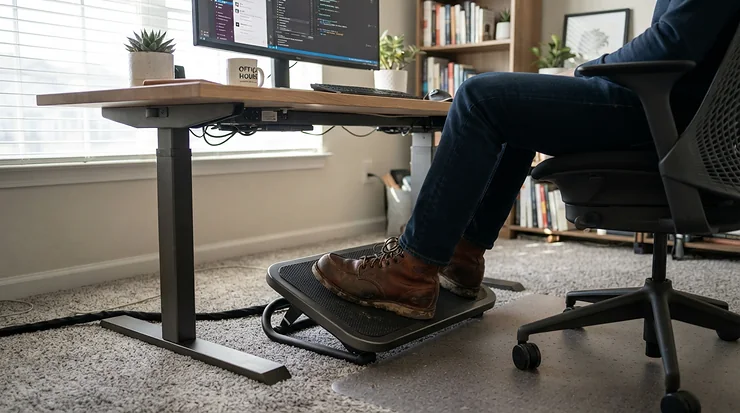
What is a large footrest for wide feet under desk? It is an adjustable platform, usually 45-56 cm wide and 30-35 cm deep, that sits beneath your desk and raises your feet so your knees, hips and lower back can settle. The extra platform width gives broader feet and wider stances a stable landing zone. A tilt and a non slip surface keep your ankles relaxed.
Why bother at all? The HSE’s display screen equipment workstation checklist asks whether your feet are flat on the floor, without too much pressure from the seat on the backs of your legs. If they aren’t, it says a footrest may be needed. This guide compares seven real, UK-available models and explains what each spec means in practice.
Quick Comparison: Large Footrest for Wide Feet Under Desk at a Glance
Here is the short version before we go deep. Dimensions come from manufacturer and UK stockist listings. Where listings disagreed, I’ve said so in the product sections.
| Product | Platform (W × D) | Tilt | Best For |
|---|---|---|---|
| Fellowes Professional Series Heavy Duty 8064101 | 56 × 35 cm | Rocking, up to around 25° | Widest stances and heavier users |
| Leitz Ergo 65030085 | 50.8 × 30 cm | Rocker, flat or curved side | Active sitters, small lifts |
| Kensington SmartFit SoleMate Plus 56146 | 45 × 35 cm | Up to 20°, lockable | Fine-tuners who want a locked angle |
| Kensington SoleMassage 56155EU | 45 × 34 cm | Up to 30°, five settings | Restless ankles, steeper angles |
| StarTech.com FTRST1 | 45 × 35 cm | 15° or 30° | Best-value large platform |
| Kensington SoleSaver 56152 | 45 × 35 cm | 10°, 15° or 20° | Tight budgets |
| ComfiLife Memory Foam Foot Rest | About 44 × 30 cm | Foam block, no tilt mechanism listed | Soft support, height-first buyers |
Look at the table and one thing jumps out: only the Fellowes Professional Series Heavy Duty 8064101 and the Leitz Ergo 65030085 go beyond 45 cm. If your feet sit well apart, that extra width matters more than any massage feature. For most average-to-large feet, the 45 × 35 cm group (the SoleMate Plus, SoleMassage, StarTech.com FTRST1 and SoleSaver) offers a more forgiving depth than the shallower Leitz Ergo and ComfiLife.
💬 Just one click — help others make better buying decisions too!😊
Top 7 Large Footrest for Wide Feet Under Desk Options: Expert Analysis
Every entry below follows the same pattern: what the specs mean, who it suits, what reviewers say where genuine review data exists, then pros, cons and value. I haven’t tested these personally, so the analysis is built from published specifications, UK stockist listings and the review evidence I could verify. Where reviews were thin, I’ve said so rather than papering over it.
1. Fellowes Professional Series Heavy Duty 8064101 — widest platform here, no contest
At 56 × 35 cm, the Fellowes 8064101 has the biggest standing area in this round-up. It is where I’d start if you are searching for an extra wide footrest for office desk use. The platform and frame are steel, with three height settings of 10.5, 12 and 13.5 cm and a rocking tilt of up to roughly 25°. Fellowes also says the platform was tested by FIRA International against the ergonomic requirements of EN ISO 9241-5.
What does that mean in practice? The weight of around 5 kg works in your favour, because it won’t skate across laminate when you push against it. The 56 cm platform width lets both feet sit hip-to-shoulder width apart with room to spare. The catch is that the height steps are only 1.5 cm apart, and the lowest sits at 10.5 cm. If you only need a modest lift, check that this minimum isn’t more than you want.
On reviews, evidence is thin but positive. Fellowes’ UK page showed a single five-star review at the time of research, and a Belgian retailer listed 9.1 out of 10 across 33 reviews. That’s encouraging rather than conclusive.
Pros:
- ✅ Widest platform in this round-up at 56 cm
- ✅ Steel build stays put on slick floors
- ✅ Tested against EN ISO 9241-5, according to Fellowes
Cons:
- ❌ Heavy at around 5 kg to move around
- ❌ Lowest height setting is still 10.5 cm
UK stockist listings sat roughly in the £55-£75 range at the time of research; check current price. For wide stances it’s the strongest value here, even at the top of this price band.

2. Leitz Ergo 65030085 — low-profile rocker with a 50 cm spread
The Leitz Ergo 65030085 measures 508 × 300 mm, offers two height settings (78 mm and 128 mm), and has a platform with a flat side and a curved side. The curved side rocks gently, and rubber anti-slip dots keep it planted. It weighs about 2.6 kg and carries a two-year guarantee.
The standout is that 78 mm minimum, which is a gentle lift rather than a podium. If your chair is only slightly too high, that’s useful. The 50.8 cm platform width is generous, too. But the depth is only 30 cm, so anybody with long feet should check whether their heels and toes will both land on the platform. On paper this is a footrest for people who like to keep their ankles moving, not for those who want a rigid shelf.
I couldn’t find verified UK customer reviews to summarise (one major stockist showed none), so I’m not going to pretend otherwise. Check the live Amazon reviews before buying.
Pros:
- ✅ Generous 50.8 cm width in a modest footprint
- ✅ Rocker action encourages ankle movement
- ✅ Rubber anti-slip dots hold it in place
Cons:
- ❌ Only 30 cm deep for very long feet
- ❌ Just two height settings
UK listings ranged from the mid-£40s to around £75. A fair price for a design-led rocker, but pricier than the StarTech.com FTRST1 for a smaller platform.
3. Kensington SmartFit SoleMate Plus 56146 — lockable tilt for set-and-forget comfort
The Kensington SoleMate Plus 56146 offers a 450 × 350 mm platform with a textured foot-grip panel, and its tilt locks in place. UK stockist listings describe tilt up to 20° and heights from roughly 82 mm up to somewhere between 127 and 160 mm. Those figures vary by listing, so confirm them on the page you buy from.
Why does a lockable angle matter? Foot-actuated tilts that don’t lock tend to drift as you shift your weight, and a drifting tilt is irritating over an eight-hour day. Locking lets you find your preferred foot angle once and then forget it. At around 3 kg, it also feels sturdier than the lighter plastic models. Based on the spec comparison, it suits fine-tuners who want a precise, repeatable setup.
I couldn’t verify enough independent review data to summarise customer sentiment, so I’ll stay silent rather than invent any.
Pros:
- ✅ Lockable tilt keeps your chosen angle
- ✅ Textured grip panel for feet
- ✅ Wide height range for different chairs
Cons:
- ❌ Listings disagree on maximum tilt and height
- ❌ Heavier than the SoleSaver at roughly 3 kg
Stockist prices ran from the mid-£40s to the mid-£60s. Good value if the lock matters to you; if it doesn’t, the cheaper models do much the same job.
4. Kensington SoleMassage 56155EU — steepest tilt options for restless ankles
The Kensington SoleMassage 56155EU has a 450 × 340 mm platform, five height settings from 76 mm to 160 mm, and tilt up to 30° in five steps. The platform has a textured, massaging surface and a gentle rocking mechanism. It weighs about 1.9 kg.
That 30° ceiling is the interesting number. Most footrests top out around 15-25°, so this is the one for people who find shallow angles leave their ankles bent. The rocking motion is aimed at circulation. Frankly, whether it helps is more about personal taste than proven benefit; some people love fidgeting on a rocker and others find it distracting. Note that one UK stockist lists a lower maximum incline, so double-check the listing you’re buying from.
No verified customer review summary was available to me for this model.
Pros:
- ✅ Five tilt steps up to 30°
- ✅ Five height settings from 76 mm to 160 mm
- ✅ Textured surface with gentle rocking motion
Cons:
- ❌ Rocking isn’t ideal if you want a fixed platform
- ❌ Priced above the StarTech.com FTRST1 for a similar footprint
Listings ranged from around £60 to £90 depending on stockist. Worth it if the tilt range or rocker appeals; otherwise it’s the least compelling value here.
5. StarTech.com FTRST1 — best-value large platform with rubberised grip
The StarTech.com FTRST1 is 18 × 14 in (45 × 35 cm), with two height settings of 3.7 in and 4.8 in (about 9.5-12.3 cm) and two tilt angles of 15° and 30°. The surface is rubberised, with rollers and bumps meant to stimulate circulation. StarTech backs it with a two-year warranty.
Two tilt choices sounds limiting, but it makes setup quick: gentle or steep, done. The rubberised top is the headline for anybody who dislikes feet sliding about in socks. The massage bumps are the debatable part. Some people find them pleasant, while those with sensitive soles may prefer a smoother surface. Based on the spec comparison, this is the sensible default for a broad-footed buyer who doesn’t want to pay premium prices.
I couldn’t verify genuine UK customer review data for this model.
Pros:
- ✅ Rubberised, grippy platform surface
- ✅ Simple 15° or 30° tilt choice
- ✅ Large 45 × 35 cm platform for the money
Cons:
- ❌ Only two height settings
- ❌ Massage bumps can feel busy underfoot
UK retailer listings sat around £37-£45. For most wide feet at a sensible price, it’s an excellent middle ground.
6. Kensington SoleSaver 56152 — lightest and cheapest of the Kensington trio
The Kensington SoleSaver 56152 has a 450 × 350 mm platform, height from about 63.5 mm to 114 mm, and tilt of 10°, 15° or 20° in UK listings. It weighs 1.18 kg and has a textured, non-skid surface.
Its very low 63.5 mm minimum is a plus if you only need a small lift. The maximum of about 11.4 cm is the limit, though: tall desks or high chairs may need more. The light plastic frame also means it feels less planted than the steel Fellowes 8064101.
Review evidence is mixed but useful. One reviewer described themselves as “of the larger persuasion”, keeping their feet a bit further apart, and had no issues with the width. Another felt it was poor value at its usual price, suggesting a basic footrest at roughly half the cost would be a better option. A third said it was alright in socks but not super comfortable. Take that as a small sample, not a verdict.
Pros:
- ✅ Lightest here at 1.18 kg
- ✅ Three tilt angles (10°, 15°, 20°)
- ✅ Lowest minimum height of the seven
Cons:
- ❌ Lighter plastic build feels less planted
- ❌ Maximum height of about 11.4 cm
Retail listings were around £34 inc VAT at the time of research. Fair for the platform width, but not a steal.
7. ComfiLife Memory Foam Foot Rest — soft alternative for height-first buyers
The ComfiLife Memory Foam Foot Rest takes a different route. It’s a cushioned foam stool with a 17.5 × 12 in (about 44 × 30 cm) surface, and its height can be built up to around 6 in (15 cm). It is not a tilting platform, so as far as the listing shows, you set height by stacking rather than adjusting a mechanical tilt.
That suits you if you want a soft landing and a big lift. But memory foam is a trade-off: feet can sink slightly, which isn’t ideal if you like a firm, planted base. At around 30 cm deep, long feet may overhang the back edge. It’s lightweight, which makes it easy to slide aside, though the downside is that it can creep on smooth floors.
Only a handful of reviews were visible on the retailer listing I found (13), which is too few to summarise.
Pros:
- ✅ Cushioned memory foam surface
- ✅ Up to about 15 cm of lift
- ✅ Light and easy to move aside
Cons:
- ❌ Only about 30 cm deep for long feet
- ❌ No tilt mechanism listed
At the time of research one UK listing sat in the low £60s, but pricing varies by seller. Check current price before deciding.
Specs and Price Ranges at a Glance
| Product | Height Range | Weight | Warranty (listed) | Typical UK Price Range |
|---|---|---|---|---|
| Fellowes Professional Series Heavy Duty 8064101 | 10.5-13.5 cm | About 5 kg | Up to 5 years | £55-£75 |
| Leitz Ergo 65030085 | 7.8 cm or 12.8 cm | About 2.6 kg | 2 years | Mid-£40s-£75 |
| Kensington SmartFit SoleMate Plus 56146 | About 8.2 cm up to 12.7-16 cm | About 3 kg | 1-2 years | £45-£65 |
| Kensington SoleMassage 56155EU | 7.6-16 cm | About 1.9 kg | 1 year | £60-£90 |
| StarTech.com FTRST1 | 9.5-12.3 cm | Not confirmed | 2 years | £37-£45 |
| Kensington SoleSaver 56152 | 6.35-11.4 cm | 1.18 kg | 1-2 years | £30-£40 |
| ComfiLife Memory Foam Foot Rest | Up to about 15 cm | Not confirmed | Not confirmed | Varies widely, check current price |
Warranty periods vary between stockists, so treat the table as a guide and confirm on the live listing. The Fellowes Professional Series Heavy Duty 8064101 gives the widest platform and the longest warranty at the top of the price scale. Meanwhile the StarTech.com FTRST1 undercuts the Kensington models for the same 45 × 35 cm footprint. If your budget is tight, that comparison alone tells you where the money is best spent.
Your First 30 Days: A Practical Setup Guide
Buying the right footrest is half the job. Setting it up properly is the other half, and Amazon listings won’t tell you how.
Day 1: set the chair first. Adjust your seat so your forearms are level with the desk and your thighs are roughly parallel to the floor. Only then should you add the footrest. Otherwise you are fixing the wrong problem.
Day 1: start low and flat. Put the platform at its lowest height and flattest tilt. Place both feet fully on it, with your heels and toes comfortably within the edges. If either overhangs, your platform is too small for your feet.
Days 2-7: raise in small steps. You are aiming for no pressure on the backs of your thighs and no pinching behind your knees. NHS Fife’s back and neck advice stresses that the spine needs to keep moving, so this isn’t about locking yourself into one position.
Weeks 2-4: vary your position. Move between flat and angled, or tuck one foot back, so you’re not frozen in one posture. If you have a rocker such as the Leitz Ergo 65030085 or Kensington SoleMassage 56155EU, use the movement in short bursts.
Common first-month mistakes include setting the footrest too high, which tips your pelvis backwards, and shoving it too far forward, which crowds your knees. A weekly wipe-down with a damp cloth keeps grip surfaces clean, because dust is the enemy of any non slip surface.
Real-World Scenarios: Three Buyers, Three Picks
Specs are easier to judge when they’re attached to a real person. These are illustrative profiles, not reviews.
The broad-footed home worker. Imagine someone working eight hours a day at a fixed-height desk, with feet planted well apart and a size 12 shoe. Budget is moderate and floors are laminate. The Fellowes Professional Series Heavy Duty 8064101 suits that profile best. Its 56 × 35 cm platform gives both feet space, and the steel weight stays put on slick floors.
The tight-budget graduate. Picture a first-job buyer with a standard desk, standard feet and about £40 to spend. The StarTech.com FTRST1 gives a 45 × 35 cm platform with a rubberised top at the lowest cost of the larger platforms. If the budget drops further, the Kensington SoleSaver 56152 is the next step down.
The fidgeter with stiff ankles. Think of someone who sits for long stretches and gets restless. The Kensington SoleMassage 56155EU offers tilt up to 30° and a rocker, which gives plenty of ways to change position. The Leitz Ergo 65030085 is the lower-profile alternative if you only need a small lift.
✨ Ready to Find Your Fit?
🔍 Take your workspace comfort to the next level with these carefully chosen models. Click any highlighted product name to check current pricing and availability. A properly sized platform could be the easiest upgrade your desk setup ever gets!
How to Choose a Large Footrest for Wide Feet Under Desk
Choosing the right model is simpler if you work through the decision in order.
- Measure your stance. Sit naturally and measure the distance from the outside of one foot to the outside of the other. Your platform should exceed that, ideally with a few centimetres spare.
- Check platform depth against shoe length. A 30 cm platform is tight for long feet, so aim for 35 cm or more if you wear size 11 or above.
- Pick your height range. Find the gap between your feet and the floor when your chair is set correctly. Choose a footrest whose minimum height is no more than that gap.
- Decide on tilt. Gentle tilts of 10-20° suit most people; steeper options only matter if you find shallow angles uncomfortable.
- Prioritise grip. Look for a rubberised or textured non slip surface plus a base that resists sliding on your type of floor.
- Check under-desk clearance. Measure your knee-hole width and the height from floor to underside of the desk before ordering.
Platform Width: The Spec That Decides Everything
If I could force one rule on every footrest shopper, it would be this: look at platform width first and last. Everything else, from massage bumps to colour, is secondary if your feet don’t fit.
Why does it matter so much? Wide feet and wide stances put your weight near the platform edges. A 45 cm platform can feel generous for neatly planted feet, but if your feet are well apart, you could find one foot half on, half off. At 56 cm, the Fellowes Professional Series Heavy Duty 8064101 gives roughly 11 cm more room than the 45 cm models, which is the difference between a comfortable stance and a perched one.
Platform width should also be read alongside depth. A 50.8 cm platform that is only 30 cm deep, like the Leitz Ergo 65030085, is wide but shallow. Conversely, the StarTech.com FTRST1 is narrower but deeper at 35 cm. Choose by how your feet actually sit, not by the biggest single number.
One more point worth knowing: some listings quote the overall frame width, which includes legs and edges, rather than the usable surface. Always look for “platform size” in the description, as this is the number that counts for your feet.
Extra Wide Footrest for Office Desk: Will It Actually Fit Under Yours?
An extra wide footrest for office desk use only helps if it fits beneath the desk. This is the bit most guides skip, and it’s where many returns begin.
Start with the knee hole. Pedestal desks, in particular, can have a knee space not much wider than the widest footrest here. Measure the clear gap from drawer unit to drawer unit, or leg to leg, at floor level. Then check the gap’s height, since some desks have modesty panels or cable trays that crowd the space at the back.
Next, think about depth. A footrest 35 cm deep needs about that much clear floor in front of your chair legs while still allowing your chair to roll. If your desk is shallow, a 30 cm model such as the Leitz Ergo 65030085 or ComfiLife Memory Foam Foot Rest may fit more comfortably.
Finally, consider weight. A heavy steel platform like the Fellowes Professional Series Heavy Duty 8064101 is hard to shuffle around, so it suits a fixed desk. At 1.18 kg, the Kensington SoleSaver 56152 is much easier to move if you share a desk or sit at a hot-desking station.
Oversized Footrest for Big Feet: Sizing by Shoe Size
For an oversized footrest for big feet, the numbers that matter are depth and the amount of overhang. A UK size 12 trainer is often around 31-32 cm long, though this varies by brand. Put that on a 30 cm deep platform and something has to hang off.
A sensible rule of thumb is to look for a platform at least 2-3 cm deeper than your longest shoe. That points firmly to the 35 cm group: the Fellowes Professional Series Heavy Duty 8064101, Kensington SmartFit SoleMate Plus 56146, StarTech.com FTRST1 and Kensington SoleSaver 56152. The 30 cm models, namely the Leitz Ergo 65030085 and ComfiLife Memory Foam Foot Rest, are better for smaller shoe sizes or for those who sit in socks.
Weight capacity is the other consideration for an oversized footrest for big feet. Manufacturer listings for most of these models don’t state a clear capacity, which is a genuine information gap. Steel construction, as on the Fellowes Professional Series Heavy Duty 8064101, is the safer inference for heavier users, but I’d still ask the seller if load matters to you.
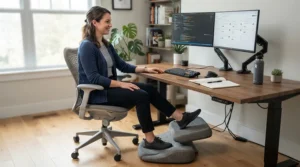
Non Slip Surface: Grip, Socks and Slippers
Not all grip is equal, and a non slip surface actually refers to two separate things: the top, where your feet sit, and the base, where the footrest meets the floor.
Top surfaces come in a few flavours. The StarTech.com FTRST1 uses rubberised material with bumps. The Kensington SoleSaver 56152, Kensington SmartFit SoleMate Plus 56146 and Kensington SoleMassage 56155EU use textured panels. The Leitz Ergo 65030085 relies on rubber dots, and the Fellowes Professional Series Heavy Duty 8064101 has an anti-slip platform surface.
What does that mean in practice? If you work in socks, a rubberised top gives more bite than hard plastic ridges. One reviewer of the Kensington SoleSaver 56152 said socks were alright but not super comfortable. That fits what you’d expect from a hard textured plastic top.
For the base, hard floors are the real test. The weight of a steel model helps a lot, while light plastic units may creep. If yours does, a thin rubber mat underneath is a cheap fix. A non slip surface also needs cleaning, so wipe it regularly, because dust turns grippy rubber slick.
Foot Angle: Getting the Tilt Right
Foot angle is the setting people most often get wrong, usually by pushing it too steep too soon. The goal is a relaxed ankle, roughly neutral, with no sense of your foot being pushed up or forced down.
Tilt options in this round-up range from 10° on the Kensington SoleSaver 56152 up to around 25° on the Fellowes Professional Series Heavy Duty 8064101 and 30° on the Kensington SoleMassage 56155EU and StarTech.com FTRST1. For most people, I’d start at the gentlest setting and increase only if your ankles feel cramped.
A locked foot angle, as offered by the Kensington SmartFit SoleMate Plus 56146, suits those who find a floating tilt irritating. A free rocker, as on the Leitz Ergo 65030085, suits people who want movement.
Crucially, don’t treat the footrest as a permanent position. Merseycare NHS guidance for desk-based jobs encourages regular breaks and movement, so the best foot angle is one you vary through the day.
Footrest vs Alternatives: What Else Could You Try?
Before buying, it’s fair to ask whether a footrest is the right fix. Here’s how it compares with other options.
| Option | Strength | Weakness | Best For |
|---|---|---|---|
| Large adjustable footrest | Adjustable height and tilt, fits wide feet | Takes floor space | Fixed-height desks and chairs |
| Lowering the chair | Free and instant | Puts the desk too high for your arms | Those with adjustable desks |
| Stack of books or boxes | Costs nothing | Unstable, no tilt, no grip | A temporary fix only |
| Sit-stand desk | Changes posture all day | Costs far more | Those who want to alternate positions |
A stack of books will technically lift your feet, but it won’t offer a non slip surface or a controllable tilt. A sit-stand desk is a bigger investment that solves a different problem. If your chair is correctly set and your feet still dangle, a large footrest is the cheapest properly adjustable answer.
Long-Term Cost and Maintenance
Footrests are one of the cheapest bits of workstation kit, so the economics are friendly. Assume a five-year life and roughly 230 working days a year, or about 1,150 days.
| Tier | Example Products | Approx Price | Approx Cost Per Working Day |
|---|---|---|---|
| Budget | Kensington SoleSaver 56152, StarTech.com FTRST1 | £35 | About 3p |
| Mid-range | Kensington SmartFit SoleMate Plus 56146, Leitz Ergo 65030085 | £60 | About 5p |
| Premium | Fellowes Professional Series Heavy Duty 8064101, Kensington SoleMassage 56155EU | £75 | About 6.5p |
These figures are approximate and based on price ranges seen at the time of research. Even the premium end works out at pennies per working day. The real question isn’t price but whether the platform width and foot angle suit you, because a cheap footrest you stop using costs more than a pricier one you use daily.
Maintenance is minimal: wipe the surface, check adjustment mechanisms aren’t clogged with dust, and replace any foam, such as the ComfiLife Memory Foam Foot Rest, once it flattens permanently.
Safety, Standards and UK Workplace Rules
If you work for an employer in the UK, display screen equipment rules apply. The HSE’s musculoskeletal disorders and DSE guidance explains how workstations should be set up to reduce strain, and the workstation checklist cited earlier flags a footrest as a possible fix where feet can’t rest flat.
If you’re based at home but employed, it’s worth asking your employer about a DSE assessment and whether they’ll supply or reimburse a footrest. I can’t give legal advice here, so check your own policy.
On the product side, only the Fellowes Professional Series Heavy Duty 8064101 lists independent ergonomic testing, against EN ISO 9241-5 via FIRA International. Treat that as a manufacturer claim to verify rather than proof. One stockist listing of the Kensington SoleSaver 56152 noted no CE marking, so if you’re buying for a workplace with strict procurement rules, check what documentation is required.
Finally, a safety basics note: don’t stand on any footrest, and don’t use a tilting model on a floor where it slides freely.
FAQ
❓ Does my employer have to provide a footrest in the UK?
❓ Can I use a large footrest with a sit-stand desk?
❓ Are rocking footrests good for circulation, or just a gimmick?
❓ How much should I spend on a footrest for big feet?
❓ Will a footrest help if my feet already touch the floor?
Conclusion
Finding a large footrest for wide feet under desk comes down to a simple idea: match the platform to your feet, not the other way round. If your stance is broad, the Fellowes Professional Series Heavy Duty 8064101 offers the most room, along with the heft to stay put. For sensible money, the StarTech.com FTRST1 is the value pick for a 45 × 35 cm platform, while the Kensington SmartFit SoleMate Plus 56146 suits anyone who wants a locked foot angle. The Kensington SoleMassage 56155EU and Leitz Ergo 65030085 are the choices for people who like to keep moving. The Kensington SoleSaver 56152 and ComfiLife Memory Foam Foot Rest cover tighter budgets and softer preferences.
Check three things before you buy: platform width, platform depth against your longest shoe, and the non slip surface on the top and base. Then set it up slowly, keeping the foot angle gentle at first.
Recommended for You
- Footrest For Standing Desk Anti-Fatigue: 7 Best Picks (2026)
- Footrest For Sciatica While Working At Desk: 7 Best Picks (2026)
- Gel Armrest Pads For Wrist Support: 7 Best Picks & Pitfalls (2026)
Disclaimer: This article contains affiliate links. As an Amazon Associate, I earn from qualifying purchases. If you purchase products through these links, we may earn a small commission at no additional cost to you.
✨ Found this helpful? Share it with your friends! 💬🤗
