
In This Article
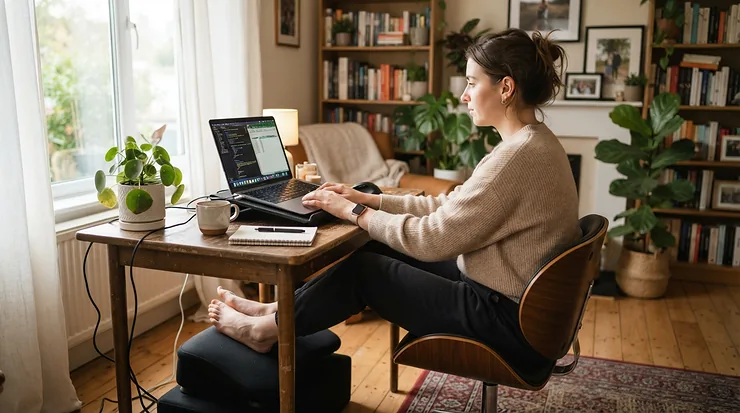
A footrest for sciatica while working at desk is a low platform, cushion or rocker that supports your feet so your hips, thighs and lower back sit in a more neutral position. It won’t cure sciatica, but by reducing pressure under the thighs and easing strain through the pelvis, it can make long sitting spells more bearable.
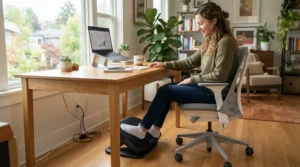
Sciatica has appalling timing. Your leg feels fine over breakfast, then by mid-afternoon a burning, tingling ache has crept from buttock to calf. The chair that seemed perfectly civilised at 9am now feels like a medieval punishment device. Sitting is a classic trigger, which is why desk workers so often end up searching for help.
Here’s the honest bit. The NHS sciatica guidance points people towards staying active, sitting properly at a computer and, if symptoms linger, self-referring to local physiotherapy. No credible source suggests a gadget alone will settle an irritated nerve. A footrest is a supporting actor, not the star. What it can do is take dangling-leg pressure off your thighs, help your pelvis settle and give your lower body something to do besides sit rigidly.
I haven’t tested these products myself, and I won’t pretend otherwise. What follows is spec-by-spec analysis of seven widely sold footrests, cross-checked against aggregated buyer-review themes and UK workplace guidance. The aim is to help you match the right footrest for sciatica while working at desk to your height, chair and pain pattern. Prices are ranges only, so check current listings before buying.
Quick Comparison: 7 Footrests at a Glance
Before the deep dive, here’s the short version. Foam models are softer and cheaper. Rigid models hold their angle and last longer. Rockers favour movement over stillness.
| Product | Style | Best For | Price Range |
|---|---|---|---|
| ComfiLife Foot Rest | Memory foam, stackable | Everyday value | £25-£35 |
| ErgoFoam Adjustable Foot Rest | Firm foam, flips to rocker | Foam plus movement | £25-£40 |
| Everlasting Comfort Adjustable Cloud Foot Rest | Soft foam with nodes | Shorter users, sensitive soles | £25-£40 |
| HUANUO Adjustable Footrest | Plastic, 3 heights, rocking tilt | Budget adjustability | £30-£40 |
| Eureka Ergonomic Tilt Adjustable Footrest | Metal frame, floating tilt | Stability, heavier use | £35-£45 |
| StrongTek Ergonomic Wood Foot Rest | Wooden rocker | Fidgeters, sit-stand users | £35-£55 |
| Kensington SmartFit SoleMate Plus | Lockable tilt, adjustable height | Control during flares | £45-£80 |
Looking at the table, the ComfiLife Foot Rest is the easiest all-rounder under £40, while the Kensington SmartFit SoleMate Plus justifies its premium only if lockable tilt matters to you. Anyone who wants a stable fixed platform should look at the Eureka Ergonomic Tilt Adjustable Footrest. If you’re someone who can’t sit still, the StrongTek Ergonomic Wood Foot Rest and the ErgoFoam Adjustable Foot Rest offer movement built in.
💬 Just one click — help others make better buying decisions too!😊
Top 7 Footrests for Sciatica While Working at Desk: Expert Analysis
Each pick below is judged on what its specs mean in practice, what reviewers consistently report, and who it genuinely suits.
1. ComfiLife Foot Rest — washable memory foam, the crowd-pleaser
Few footrests are bought as often as the ComfiLife Foot Rest, and the appeal is easy to read from the spec sheet. It’s a teardrop block of high-density memory foam, about 44.5 × 30.5 cm and up to roughly 15 cm tall. A detachable base layer of around 5 cm lets you change the height. That generous footprint lets you shift your feet around, which matters because holding one frozen position is often what sets sciatic symptoms off. On paper, it suits anyone with a fixed-height desk or a chair that won’t drop low enough, particularly shorter users whose feet hover. Reviewers broadly praise the firm-but-forgiving feel and the machine-washable cover. A recurring complaint is that the foam compresses and loses some height over months, and a few expected it to lift higher.
Pros:
- ✅ Wide foam surface lets you shift positions
- ✅ Two height settings via detachable base
- ✅ Washable cover and non-slip base
Cons:
- ❌ Foam compresses and loses height over time
- ❌ Top height may disappoint on tall desks
Expect around £25-£35 at the time of research (check current price). For a foam all-rounder, that’s strong value.
2. ErgoFoam Adjustable Foot Rest — firm foam that flips into a rocker
The party trick of the ErgoFoam Adjustable Foot Rest is its two-piece build. A curved top section sits on a boxy base you can stack or remove, and the top can be flipped upside down to become a gentle rocker. Dimensions are roughly 44 × 29 cm, with a stacked height in the region of 15 cm, under a removable velvet cover. That rocker mode is interesting for leg symptoms, because small continuous ankle movement keeps the calves working without a conscious exercise routine. The brand markets it as chiropractor-endorsed, which is a marketing claim rather than clinical proof, so treat it as colour rather than evidence. Reviewers consistently describe the foam as firmer than typical memory foam and slow to flatten. Negatives include sweat absorption, a new-foam smell that fades, and a footprint that crowds compact desks.
Pros:
- ✅ Flips from fixed footrest to gentle rocker
- ✅ Firm foam resists flattening in reviews
- ✅ Removable velvet cover for washing
Cons:
- ❌ Bulky under compact or shelved desks
- ❌ Foam can hold sweat and odours
Budget around £25-£40, which is good value if you want stability and movement in one product.
3. Everlasting Comfort Adjustable Cloud Foot Rest — plush foam with pressure-point nodes
The Everlasting Comfort Adjustable Cloud Foot Rest takes a softer line. It uses high-density memory foam, roughly 43 × 25 cm and about 15 cm tall at maximum. The surface has raised pressure-point nodes and the cover is washable polyester. The nodes add a gentle texture under the soles.
At around 25 cm deep, it’s shallower than the ComfiLife Foot Rest, which is fine for a neutral posture but tighter if you like to splay your feet. For sciatica, the plush surface helps if hard platforms make your soles or calves ache. The catch is that softness gives less stable support if you rest real weight through your legs.
Across tens of thousands of ratings averaging in the mid-4s out of 5, reviewers repeatedly praise comfort and the benefit for shorter users. A minority find it too narrow or too soft, and some mention the edges rising into little dips.
Pros:
- ✅ Soft nodes ease pressure under the soles
- ✅ Washable cover and non-slip base
- ✅ Very large pool of buyer ratings
Cons:
- ❌ Shallow depth for larger feet
- ❌ May feel too soft for firm-support fans
Typically around £25-£40, a comfortable pick if your priority is softness over precision.
4. HUANUO Adjustable Footrest — three heights and a rocking tilt on a budget
For hard-plastic adjustability without ergonomic-supplier prices, the HUANUO Adjustable Footrest is the obvious candidate. UK listings describe three height positions of roughly 11, 14 and 17 cm, a rocking tilt of up to ±30°, a textured massage surface and a weight of about 2 kg. That 17 cm top setting is taller than most foam rivals manage, a realistic fix for tall desks and fixed-height chairs. The tilt floats rather than locks, so it suits people who benefit from changing position. It may frustrate anyone wanting a rigid angle. Buyer feedback is largely positive on easy adjustment. Critics mention the lack of a fixed tilt option, a plastic feel, and some instability for people wanting to rest full leg weight.
Pros:
- ✅ Three heights up to about 17 cm
- ✅ Rocking tilt encourages ankle movement
- ✅ Light, pre-assembled and easy to reposition
Cons:
- ❌ Tilt doesn’t lock into a fixed angle
- ❌ Hard textured plastic feels firm underfoot
Around £30-£40 at the time of research, which is fair value for genuine height adjustment.
5. Eureka Ergonomic Tilt Adjustable Footrest — all-metal frame that won’t flex
On paper, the first thing that stands out about the Eureka Ergonomic Tilt Adjustable Footrest is weight. It’s roughly 2.3 kg of metal frame with a rubberised, massage-textured top and rubber feet. It measures about 39 × 30 cm and sits around 8.5 cm high, with a floating tilt of 0-20°. That modest height means it suits people who need a gentle lift rather than a big one. The heft means it won’t creep across the floor when you push off. The tilt is non-locking, so it’s closer to a rocker than a fixed wedge. Reviewers, with an average around 4.5 out of 5 across thousands of ratings, praise sturdiness and build quality. The recurring criticism is that the height isn’t adjustable.
Pros:
- ✅ Metal frame praised for sturdiness
- ✅ 0-20° tilt for gentle ankle movement
- ✅ Rubber feet protect floors
Cons:
- ❌ Fixed height with no taller setting
- ❌ Floating tilt cannot be locked
Expect the mid-£30s to mid-£40s. It’s good value if the fixed height happens to match your desk.
6. StrongTek Ergonomic Wood Foot Rest — solid wooden rocker for movement lovers
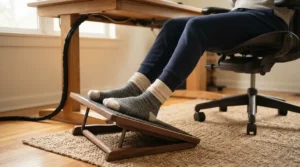
Think of the StrongTek Ergonomic Wood Foot Rest as a balance board in office clothing. It’s a wooden rocker platform of roughly 45 × 27 cm and 11 cm height, with a grip surface, no assembly and a quoted 350 lb (about 159 kg) capacity. The rocking action is deliberate: it invites constant, low-effort ankle movement, the closest any product here gets to passively encouraging leg circulation. The trade-off is zero cushioning and a fixed height. Reviewers like the sturdy build and how it works with sit-stand desks. Common complaints are a rough grip surface on bare feet and a tendency to creep on carpet. If your sciatica worsens when you’re stuck still, this is a smart choice. In an acute flare, or if balance worries you, a stable fixed platform is safer.
Pros:
- ✅ Encourages continuous gentle ankle movement
- ✅ Solid wood handles heavy loads
- ✅ No assembly required
Cons:
- ❌ Hard surface with rough grip on bare feet
- ❌ Can creep on carpet
Roughly £35-£55 at the time of research, which is fair for a durable, simple design.
7. Kensington SmartFit SoleMate Plus — lockable tilt and height adjustment, the premium pick
If you want the most controllable platform here, the Kensington SmartFit SoleMate Plus (model 56146) is it. Retailer specs list a 45 × 35 cm platform, height adjustment from roughly 9 to 13 cm, and a tilt of up to 20° with a lockable control. The non-slip massage-textured surface weighs around 3 kg, and some variants list up to 30° of tilt. Lockable tilt is the standout. You can set a fixed angle during a flare, then unlock it when you want to rock. The deeper 35 cm platform also gives your feet room to roam. I should be upfront: the review base for this specific model is thinner and more scattered than for the foam bestsellers, so I can’t give a reliable aggregate. What is verifiable is an established office-supplier brand and a manufacturer warranty on listings.
Pros:
- ✅ Lockable tilt up to 20°
- ✅ Larger 45 × 35 cm platform
- ✅ Height adjustable for different chairs
Cons:
- ❌ Premium price versus foam rivals
- ❌ Hard, non-cushioned surface
Around £45-£80 across UK retailers (check current price), worth it only if you’ll use the locking tilt.
Spec snapshot
| Product | Height | Tilt / Motion | Material | Rating Signal |
|---|---|---|---|---|
| ComfiLife Foot Rest | Up to ~15 cm | Fixed; flips to rock | Memory foam | ~4.6/5, 10,000+ ratings |
| ErgoFoam Adjustable Foot Rest | ~10-15 cm | Fixed or rocker | High-density foam | ~4.5-4.7/5, thousands |
| Everlasting Comfort Adjustable Cloud Foot Rest | Up to ~15 cm | Fixed | Memory foam | Mid-4s, tens of thousands |
| HUANUO Adjustable Footrest | 11 / 14 / 17 cm | ±30° floating | Plastic | Positive, volume unverified |
| Eureka Ergonomic Tilt Adjustable Footrest | ~8.5 cm fixed | 0-20° floating | Metal, rubber | ~4.5/5, thousands |
| StrongTek Ergonomic Wood Foot Rest | ~11 cm fixed | Rocker | Wood | Positive per roundups |
| Kensington SmartFit SoleMate Plus | ~9-13 cm | Up to 20°, lockable | Plastic | Limited review pool |
Height range is the spec that most separates these products, so check it before anything else. The HUANUO Adjustable Footrest reaches 17 cm, while the Eureka Ergonomic Tilt Adjustable Footrest is stuck at around 8.5 cm. Review volume strongly favours the foam trio, but a large rating pool tells you about comfort, not about sciatic outcomes.
✨ Ready to Upgrade Your Desk Setup?
🔍 Take your desk comfort to the next level with these carefully selected footrests. Click any highlighted product name to check current pricing and availability. A small change under the desk may make long working days feel noticeably kinder to your back and legs!
Practical Usage Guide: Setting Up Your Footrest Without Making Things Worse
A footrest placed badly can aggravate leg symptoms rather than ease them. Setup order matters.
Five-Minute Setup
- Set chair height first, so your forearms rest level with the desk.
- Check whether your feet reach the floor. If they hover or your thighs press into the seat edge, add the footrest.
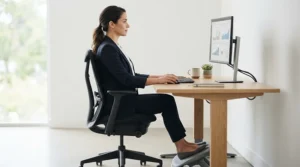
- Aim for thighs roughly parallel to the floor and knees around a right angle, or slightly more open.
- Leave a two-to-three-finger gap between the seat edge and the back of your knee.
- Keep your lower back touching the backrest.
The HSE’s DSE workstation guidance is a handy checklist for the whole set-up, not just the footrest.
The First 30 Days
In week one, use the footrest for 30 to 60 minutes at a time, then switch. Move your feet every 20 to 30 minutes, a rhythm commonly suggested in NHS patient leaflets. Wash fabric covers monthly and check non-slip bases for dust. The classic early mistakes are going too high (knees above hips), pushing the footrest too far forward, and treating it as a leg-lift recliner. If symptoms worsen, lower the height before concluding that footrests don’t work for you.
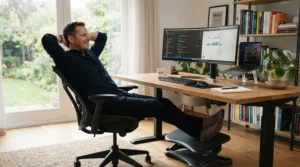
Real-World Scenarios: Which Footrest for Which Desk Day?
These are illustrative profiles, not case histories. They show how the specs map to real working lives.
The short-legged home worker. She’s around 5ft 2in, works at a fixed dining table for seven hours, five days a week, and has about £30 to spend. Her feet dangle and her thighs press into the seat. The ComfiLife Foot Rest or the Everlasting Comfort Adjustable Cloud Foot Rest solves the height gap cheaply, and soft foam is forgiving under bare feet.
The hybrid worker with afternoon flares. Three days at home, two in the office, with a budget up to £60. His symptoms peak after lunch. The Kensington SmartFit SoleMate Plus lets him lock a comfortable angle during a flare and unlock it on better days.
The student on a tight budget. Shared desk, a £30-£40 ceiling, and a habit of fidgeting. The HUANUO Adjustable Footrest gives three heights and a rocking tilt. If the desk is sit-stand, the StrongTek Ergonomic Wood Foot Rest adds movement while standing.
How to Choose a Footrest for Sciatica While Working at Desk: 7 Steps
The best choice starts with your body and desk, not the product page. Work through these in order:
- Measure your gap. Sit properly and note how far your feet fall short of the floor. That number sets the minimum height you need.
- Decide on adjustability. Fixed-height models only work if the number matches your gap, so adjustable ones are safer for shared or changing setups.
- Pick a surface. Soft foam eases sensitive soles but gives less stable support. Rigid surfaces hold position better.
- Check the footprint. Measure under-desk depth and width, because bulky foam models won’t fit every desk.
- Choose fixed or moving. If stillness worsens your symptoms, consider a rocking or floating tilt. If you need predictability, choose a lockable one.
- Think maintenance. Washable covers matter more than they sound, especially for foam.
- Check returns and budget. Prices run from about £25 to £80, and a good returns window protects you if the height turns out wrong.
Ergonomic Footrest for Sciatica Relief: What You Can Realistically Expect
Let’s be blunt: no footrest is a treatment. An ergonomic footrest for sciatica relief works indirectly, by changing the position your hips, thighs and pelvis spend hours in. It can’t shrink a bulging disc or calm an inflamed nerve root.
What it plausibly does
By supporting your feet, it reduces pressure from the seat edge on the backs of your thighs. By keeping the knees closer to hip height, it can reduce the stretch on the nerve pathway for people whose symptoms flare when their legs hang. And by giving you somewhere to shift weight, it breaks up static sitting.
What it doesn’t do
It won’t replace movement breaks, exercise or professional assessment. Most sciatica settles with time and activity, as the NHS information suggests. Think of an ergonomic footrest for sciatica relief as comfort infrastructure that helps you stay at work while you recover. Judge it by whether your afternoons become easier rather than by dramatic claims.
Footrest for Hip and Leg Pain at Desk: Getting Height and Angle Right
If your pain sits in the hip, buttock or thigh, a footrest for hip and leg pain at desk is mostly an angle problem. Hips flex when you sit. Too much flexion, with knees rising above hip level, compresses the front of the hip and rounds the lower back.
Height
Aim for thighs close to parallel with the floor. If your knees sit higher than your hips, the footrest is probably too tall. Foam stackers such as the ComfiLife Foot Rest and ErgoFoam Adjustable Foot Rest let you fine-tune by adding or removing a layer.
Angle
A slight forward slope can open the ankles and ease calf tension. A floating tilt, as on the Eureka Ergonomic Tilt Adjustable Footrest, lets you change position constantly. A lockable one like the Kensington SmartFit SoleMate Plus holds a position when your pain demands consistency. For footrest for hip and leg pain at desk use, avoid wide splayed stances that stress the hips, and alternate crossed or tucked positions only briefly.
Pelvic Tilt: How Your Feet Influence Your Sitting Spine
Pelvic tilt is the forward or backward rocking of your pelvis, and it governs how curved your lower spine is. When you slump, the pelvis rolls backwards, the lumbar curve flattens and the discs take more load. Research on workspace design has examined exactly this link. A University of Cape Town doctoral thesis on spinal and pelvic angles reported that hip-muscle length predicted backward pelvic tilt in sitting, and that providing a footrest significantly altered lumbar and pelvic angles.
Why your feet matter
Raise your feet too far and your knees climb, which tilts the pelvis backwards. Leave your feet dangling and you may slide forward and slump. The sweet spot is a footrest that supports your legs without pushing the knees above the hips.
A gentle seated check
Sit tall, then slowly rock your pelvis forward and back a few times to find a neutral midpoint. Stop if it provokes leg symptoms, and ask a physiotherapist to tailor it. Better pelvic tilt control often matters more than any single product.

Leg Circulation: Why Small Movements Beat Perfect Posture
Leg circulation depends on your calf muscles squeezing blood back towards the heart, and static sitting switches that pump off. The seat edge can also compress tissue behind the thighs. Add a nerve irritated by sitting and you’ve got a recipe for heaviness, tingling and cold feet.
How footrests help
A footrest lifts your feet away from dangling and lets you shift pressure. Rocking designs, such as the StrongTek Ergonomic Wood Foot Rest and the HUANUO Adjustable Footrest, encourage ankle flexing that supports leg circulation passively. The Everlasting Comfort Adjustable Cloud Foot Rest and ComfiLife Foot Rest offer a softer surface that doesn’t dig into the soles.
The limits
Product claims about boosting leg circulation are mostly marketing language, with little product-specific trial evidence. Treat movement as the real intervention: stand, walk and stretch regularly. If a leg becomes swollen, hot or painful, don’t blame the footrest. Seek medical advice promptly.
Lumbar Support: Where Your Footrest Fits Alongside Your Chair
A footrest and lumbar support are teammates, not substitutes. The chair’s backrest curve fills the gap behind your lower spine, while the footrest manages the other end of the leg. Get one wrong and it can sabotage the other.
The slide-forward problem
If a footrest is too high or too far forward, you’ll tend to slide towards the seat edge and lose contact with the lumbar support. Check by sitting back fully: your lower back should touch the backrest while your feet still rest comfortably.
Practical pairing
If your chair has an adjustable lumbar support, set it so it fills your curve without pushing you forward. If not, a small rolled towel or lumbar cushion can help. Then add a footrest to close the leg-height gap. Reviewers of the ComfiLife Foot Rest and Everlasting Comfort Adjustable Cloud Foot Rest often describe the benefit as lifting their lower body into a better position, which only works if the chair and lumbar support cooperate.
Common Mistakes When Buying a Footrest for Sciatica While Working at Desk
Most disappointments come from avoidable errors. Here’s what to watch for.
- Buying by review count alone. A huge rating pool shows broad satisfaction, not that it suits your height or pain pattern.
- Ignoring depth. A tall footrest under a low desk can trap your knees.
- Choosing soft when you need stable. Very soft foam can feel lovely and still let your legs sink out of position.
- Choosing rigid when your soles hurt. Hard platforms like the Kensington SmartFit SoleMate Plus and Eureka Ergonomic Tilt Adjustable Footrest are stable but unforgiving on bare feet.
- Expecting a cure. If your symptoms are severe, worsening or accompanied by weakness, a footrest is the wrong first step.
- Never moving. Even the perfect footrest for sciatica while working at desk fails if you stay frozen for three hours.
Footrest vs Other Fixes: Which Route Is Right for You?
A footrest is one of several ways to fix the feet-to-floor gap, and sometimes not the best one.
| Option | Where It Shines | Where It Falls Short | Best For |
|---|---|---|---|
| Dedicated under-desk footrest | Adjustable, stable, easy to move | Uses floor space and budget | Most desk workers with dangling feet |
| Stack of books or a box | Free and immediate | Slips, wrong angle, no movement | Testing the idea before buying |
| Adjusting chair and desk height | Needs no extra gear | Requires adjustable furniture | People with flexible setups |
| Sit-stand desk | Breaks up long sitting | Doesn’t fix seated posture; costly | Those who can alternate positions |
| Lumbar roll or cushion | Supports the lower-back curve | Does nothing for dangling legs | Slumpers with an unsupported lower back |
If your chair can drop low enough for your feet to reach the floor while your forearms still meet the desk, you may not need a footrest at all. When furniture is fixed and your feet hover, a dedicated footrest beats the book stack for stability and adjustability. Pair any of these with regular movement, as no piece of equipment replaces it.
Safety, Regulations and When to See a Professional
Your workplace rights
In the UK, the schedule to the Display Screen Equipment Regulations 1992 states that a footrest must be made available to any operator or user who wishes one. That applies to workers covered by the regulations, meaning those who use display screen equipment habitually as a significant part of their work. If that’s you, ask your employer for a workstation assessment, in writing, and mention the footrest. Homeworkers can generally ask for the same.
Red flags
This article is general information, not medical advice. Seek urgent medical help if you develop new numbness around the groin or buttocks, loss of bladder or bowel control, or progressive leg weakness. If self-help hasn’t eased your symptoms after a few weeks, or the pain is getting worse, speak to your GP. The NHS also notes you may be able to self-refer for physiotherapy without seeing a GP. Avoid electric heating pads under your desk unless a clinician has advised them, as numb legs can overheat unnoticed.
FAQ
❓ Is a foam or rigid footrest better for sciatica at a desk?
❓ Can I use a footrest with a sit-stand desk when my sciatica flares?
❓ How many hours a day should I keep my feet on a footrest?
❓ Will my employer pay for a footrest if I work from home?
❓ How much should I spend on a footrest for sciatica?
Conclusion
A footrest for sciatica while working at desk is a modest tool with a sensible job: closing the gap between your feet and the floor so your thighs, pelvis and lower back can sit more neutrally for longer. It’s not a cure, and anyone with worsening or alarming symptoms needs a professional, not a platform.
Within that remit, the choice is clearer than the market makes it look. The ComfiLife Foot Rest is the safest value pick. The ErgoFoam Adjustable Foot Rest adds a rocker mode, and the Everlasting Comfort Adjustable Cloud Foot Rest suits sensitive soles. The HUANUO Adjustable Footrest is the budget route to genuine height adjustment. The Eureka Ergonomic Tilt Adjustable Footrest is the sturdy fixed option, and the StrongTek Ergonomic Wood Foot Rest rewards fidgeters. The Kensington SmartFit SoleMate Plus is the premium choice if you’ll use its lockable tilt.
Whatever you buy, set your chair first, keep your knees near a right angle, protect your lumbar support and move often. Your sciatica won’t read the product listing, but it does respond to steady, sensible habits.
Recommended for You
- Gel Armrest Pads For Wrist Support: 7 Best Picks & Pitfalls (2026)
- Gel Armrest Pads For Office Chair: 7 Top Picks (2026)
- Memory Foam Armrest Pads For Gaming Chairs: 7 Proven Picks (2026)
Disclaimer: This article contains affiliate links. As an Amazon Associate, I earn from qualifying purchases. If you purchase products through these links, we may earn a small commission at no additional cost to you.
✨ Found this helpful? Share it with your friends! 💬🤗
