

In This Article
Every open-plan office has one: the colleague whose knee drums the underside of the desk like a tiny, caffeinated percussionist. Sometimes that colleague is you. Fidgeting isn’t a character flaw. It’s your body asking for movement, and a rocking footrest for under desk fidgeting gives that request somewhere sensible to go, quietly and rhythmically, without rattling your monitor.
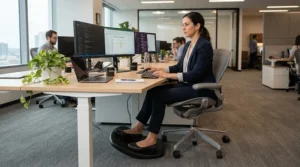
The science is more encouraging than your old teachers let on. In a small study, University of Missouri researchers had 11 healthy young adults sit for three hours. The leg that kept tapping showed increased blood flow, while the still leg’s flow dropped. The team was clear that fidgeting is no substitute for walking, and the sample was small and young. Treat it as a nudge, not a prescription.
That’s where this guide comes in. Based on a spec-by-spec comparison and the review evidence I could actually find, I’ve shortlisted seven real rocking models for UK desks, from budget plastic rockers to a premium option with a flat-and-curved platform. For each one you’ll get what the specs mean in practice, who it suits, and what reviewers keep mentioning.
I’ll also tackle the wobble footrest for restless legs at desk question, what an under desk rocker for ankle movement can realistically do, how active sitting fits in, and why the curved base matters more than most listings admit. Prices are ranges at the time of research (November 2026), so check the current price before buying.
Quick Comparison: 7 Rocking Footrests at a Glance
| Product | Movement style | Standout trait | Price range* | Best For |
|---|---|---|---|---|
| Fellowes Smart Suites Foot Rocker | Tilting platform | 49 × 30 cm platform, two heights | Roughly £25-£45 | Everyday all-rounder |
| Fellowes Professional Series Ultimate Foot Support | Tilting platform | Three heights, textured top | Roughly £30-£50 | Shared or hot-desk setups |
| Leitz Ergo Adjustable Foot Rest | Tilting, flat + curved platform | Heavy, stable build | Roughly £70-£90 | Premium, long-term use |
| Kensington Rocking Foot Rest | Rotating aluminium bar | 360° swivel, near-silent feel | Around £50 | Open-plan fidgeters |
| Manhattan Foot Rest/Rocker 462181 | Rocker | Lifetime warranty listed | Around £20 | Tight budgets |
| StarTech.com FTRST2 | Clamshell rocker | Power-bar storage | Mid-£20s | Cable-cluttered desks |
| HEETA Foot Rest with Roller Massager | Rocker + rollers | Beaded roller surface | Under £20 | A low-risk first try |
*Prices vary by seller and change often, so check current price.
Looking at the comparison above, the Smart Suites offers the best balance of platform size and price, while the Kensington is the one to pick if silence matters more than surface area. Budget buyers should note that the Manhattan 462181 and HEETA trade premium materials for a low outlay. The Leitz Ergo only earns its premium if you want a heavy, planted base that should last for years.
💬 Just one click — help others make better buying decisions too!😊
Top 7 Rocking Footrests for Under Desk Fidgeting: Expert Analysis
1. Fellowes Smart Suites Foot Rocker — big platform, two heights
The headline here is room: a 49 × 30 cm platform lets both feet rock without one sliding off the edge.
Flip the unit over and the height switches between 6.5 cm and 9.5 cm. That matters because the right lift depends on your chair height, not your ambition. At roughly 1.3 kg it’s light enough to nudge into place with your feet, and the textured top adds a little sole stimulation. Tilt comes from foot pressure alone, with no springs or ratchets to squeak.
Based on the spec comparison, this is the sensible default if your fidgeting is mostly heel-and-toe movement. The wide platform also suits people who shift between a flat foot and an angled one, which is how many restless sitters behave. If your feet barely reach the floor, use the higher side. If you’re tall, the lower side keeps your knees from climbing above your hips.
I couldn’t find a large, verifiable pool of independent reviews for this exact model, so I’m not quoting ratings. Most listings simply repeat the manufacturer’s claims.
Pros:
- ✅ Generous platform for two-footed rocking
- ✅ Two height settings by flipping it over
- ✅ Light enough to reposition easily
Cons:
- ❌ Little verifiable independent review data
- ❌ Warranty terms differ between sellers
Expect roughly £25-£45 depending on the seller, which is strong value at the lower end (check warranty terms, as listings vary).
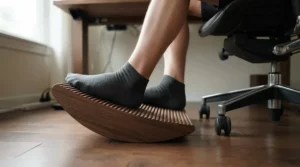
2. Fellowes Professional Series Ultimate Foot Support — three heights for every leg length
Where the Smart Suites offers two heights, this one gives you three, which is rare at this price.
The rocking action works through foot pressure, the surface is textured, and the platform is anti-slip. Fellowes lists a five-year warranty, though individual retailers differ. The extra height setting means fewer compromises across different desks and chairs, which is the real selling point rather than the massage-style texture.
Here’s what to weigh: this suits shared desks and hybrid working, where one person’s “right” height is another person’s calf cramp. Posturite describes the rocking as helping stimulate blood flow, but that’s retailer copy. The Missouri research supports leg movement in general, not any specific device.
Posturite lists 17 customer reviews for it, but I couldn’t confirm a verified average, so I won’t invent one.
Pros:
- ✅ Three height positions for varied desks
- ✅ Anti-slip platform keeps feet planted
- ✅ Long manufacturer warranty listed
Cons:
- ❌ Costs more than entry-level rockers
- ❌ Limited verified review detail available
Roughly £30-£50 depending on the seller, so good value if you move between desks and fair value if you don’t.
3. Leitz Ergo Adjustable Foot Rest — flat and curved platform, built to last
The standout is a platform pairing: one flat side and one curved side, so the same unit serves calm sitting and livelier rocking.
It measures 508 × 300 × 135 mm and turns over to switch between 78 mm and 128 mm heights. The ABS body weighs around 2.6 kg, and rubber dots keep it from creeping. That weight is the quiet hero. A heavier base stays put under vigorous fidgeting, whereas featherweight rockers can wander. Currys also describes it as usable as a footrest, ankle rocker or knee support.
On paper, this is the “buy once” pick for people who fidget all day and hate replacing things. Leitz states the product was tested and recommended by Germany’s IGR institute, but that’s a manufacturer claim I couldn’t verify independently. Warranty terms are listed as two or three years, depending on the retailer.
I found no meaningful review volume for it, so treat build quality as inferred from specs rather than proven by owners.
Pros:
- ✅ Heavy, stable base resists creeping
- ✅ Flat or curved platform options
- ✅ Two clear height settings
Cons:
- ❌ Most expensive option in this list
- ❌ Bulkier under shallow desks
Roughly £70-£90 at business suppliers, which is premium money that makes sense mainly for daily, multi-year use.
4. Kensington Rocking Foot Rest — near-silent 360° swivel bar
This one swaps the tilting platform for a rotating aluminium bar, and that changes the whole feel.
The bar swivels 360°, the unit measures about 61 × 24.8 × 12.5 cm and weighs 1.5 kg, and Argos lists support for up to 136 kg with a two-year guarantee. A ridged bar and rubber feet are meant to hold your feet and the unit steady. Because the bar rolls rather than clunks, it suits quiet offices.
Argos shows 10 reviews averaging 4.7 out of 5, but every reviewer received the product free, so read that score with a pinch of salt. Themes were consistent: sturdy build, grip on carpet and laminate, and silent operation. One reviewer said it removes their need to fidget (they mentioned having ADHD). Another found the bearing resistance a touch low, so it rocks at the slightest foot shift.
If you want controlled resistance, this isn’t it. If you want a quiet outlet for jiggly feet, it’s compelling.
Pros:
- ✅ Silent, smooth swivel action
- ✅ Rubber feet grip carpet and laminate
- ✅ Solid 136 kg weight rating
Cons:
- ❌ Low bearing resistance may feel twitchy
- ❌ Reviews were from free-product recipients
Around £50 at Argos, so mid-priced and worth it for noise-sensitive desks.
5. Manhattan Foot Rest/Rocker 462181 — budget rocker with a lifetime warranty listing
The hook is price-to-promise: a rocker at roughly £20 with a lifetime warranty listed by UK resellers.
It measures 277 × 502 mm, wide enough for both feet yet shallow enough for most desks. The listing mentions two rocking motions and a textured, non-slip surface. A wide, shallow footprint is a good match for restless sitters who swap between heel-first and toe-first movement. I’d still check the warranty terms before relying on “lifetime”, as such promises typically carry conditions.
This is the sensible first purchase if you’re unsure whether you’ll actually use a rocker. If it ends up gathering dust, you’ve lost the price of a pub lunch rather than a week’s groceries.
I found no review data for this exact model, so I can’t say how it holds up after months of daily use.
Pros:
- ✅ Very low entry price
- ✅ Wide platform for both feet
- ✅ Lifetime warranty listed by resellers
Cons:
- ❌ No review data found to confirm durability
- ❌ Likely lighter, so may creep on smooth floors
Around £20, which makes it excellent value for a trial run.
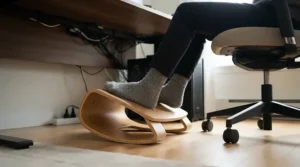
6. StarTech.com FTRST2 — rocker that hides your power strip
The unusual trick is storage: a clamshell body that houses a single-row power bar and cables.
The footprint is roughly 43 × 35 cm and up to about 10 cm high, with a non-slip rubberised surface, a tilt range around 30°, and adhesive pads for stability. StarTech lists a five-year warranty, although one reseller shows one year, so check before buying. The practical win is tidiness. Dangling cables are a classic source of foot-snagging, and a footrest that swallows the plug-strip solves two problems at once.
Analytically, it’s best for home offices where cables pool near your feet. The trade-off is that a box full of electrics under a rocking surface demands sensible placement and no heavy stomping.
I found no verified review pool for it, so my take rests on specifications and stockist data.
Pros:
- ✅ Built-in power bar and cable storage
- ✅ Non-slip rubberised surface
- ✅ CE-certified per the spec sheet
Cons:
- ❌ Warranty details conflict between sellers
- ❌ Only fits single-row power bars
Around the mid-£20s including VAT, which is fair value for the cable-tidying alone.
7. HEETA Foot Rest with Roller Massager — beaded rollers on a budget rocker
The hook is texture: a beaded roller surface on a rotating base for under £20.
The listing describes a 180° rotation, a non-skid base and easy assembly. In the handful of reviews I could access, buyers liked the beaded feel and said the rollers click into place in seconds. One called it a great rocking footrest. The same reviews were lukewarm on the massage claim, saying the rollers don’t achieve much, and one reported that it marked their carpet badly.
My honest read: it’s a cheap way to test whether you enjoy rocking at all, but don’t pay for the “massage” label. Put a thin mat underneath if you have light carpet.
Review volume was small, so treat the sentiment as indicative rather than conclusive.
Pros:
- ✅ Very low price
- ✅ Quick click-together assembly
- ✅ Pleasant beaded surface per reviewers
Cons:
- ❌ Massage rollers do little, reviewers say
- ❌ Reported carpet marking
Under £20, which is low-risk value if you treat the rollers as a bonus.
Spec Showdown: How the Seven Compare
| Product | Size | Height options | Warranty (as listed) | Review evidence found |
|---|---|---|---|---|
| Smart Suites | 49 × 30 cm | 6.5 / 9.5 cm | 1-5 years by seller | Thin |
| Ultimate Foot Support | Not verified | Three heights | 5 years (Fellowes) | 17 Posturite reviews |
| Leitz Ergo | 50.8 × 30 cm | 78 / 128 mm | 2-3 years by seller | None found |
| Kensington | 61 × 24.8 cm | Fixed | 2 years | 10 Argos reviews, 4.7/5 |
| Manhattan 462181 | 27.7 × 50.2 cm | Fixed | “Lifetime” listed | None found |
| FTRST2 | About 43 × 35 cm | Fixed | 1-5 years by seller | None found |
| HEETA | Not verified | Rotating base | Not verified | A few Amazon reviews |
This table makes one thing obvious: only the Kensington has a meaningful, if incentivised, review base, so the others rely on specs and brand track record. If height flexibility matters, the Leitz Ergo, Smart Suites and Ultimate Foot Support are the only ones with real adjustment. For a fixed-height desk, the choice comes down to noise, grip and budget.
How to Set Up Your Footrest: A 30-Day Practical Guide
A rocker only works if it’s set up properly. Here’s a month-long plan.
Day 1: position. Adjust your chair first, then place the footrest where your feet land naturally with hips and knees near 90°. Test it on your actual flooring. One HEETA reviewer reported carpet marking, whereas Kensington reviewers found their model gripped carpet and laminate.
Week 1: go gently. Rock for 10-15 minute blocks with slow heel-to-toe movements. Small arcs beat big swings, because the aim is background motion, not a leg workout.
Week 2: build a rhythm. Pair rocking with a timer. Every 30-45 minutes, stand, stretch or walk, since the Missouri researchers stressed fidgeting complements walking and doesn’t replace it.
Weeks 3-4: fine-tune. If you have a two-height model like the Leitz Ergo or Smart Suites, flip it and compare. Pick the side that keeps thighs resting comfortably on the seat.
Maintenance: wipe surfaces monthly, check rubber feet or adhesive pads (the FTRST2 includes pads), and vacuum under the desk so grit doesn’t erode the grip.
Common mistakes in the first 30 days: using it too high (which lifts your thighs off the seat), rocking aggressively, and treating it as an excuse to sit for hours.
Fidgeting Problems and Fixes: A Problem-Solution Guide
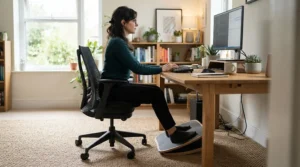
Problem 1: it creeps across the floor. Use a model with a grippy base, such as the Leitz Ergo with its rubber dots, or add the adhesive pads that come with the FTRST2. Lighter rockers like the HEETA may need a mat underneath.
Problem 2: it’s too noisy. Plastic can tap on hard floors. A swivelling bar like the Kensington was described by one reviewer as making no sound at all, so it’s the safer pick for quiet offices.
Problem 3: it rocks too easily. One Kensington reviewer wanted more bearing resistance. If you share that view, a tilting platform such as the Smart Suites, which relies on foot pressure, may feel more controlled.
Problem 4: marks on the carpet. The HEETA reviewer’s experience suggests slipping a thin mat beneath. It’s a cheap fix and it also reduces creeping.
Problem 5: cable chaos. If wires keep tangling around your feet, the FTRST2 can hold a single-row power bar and tuck the mess away.
Problem 6: dangling feet. If your chair is high and your feet float, use the taller 128 mm side of the Leitz Ergo or the three-height Ultimate Foot Support.
Real-World Scenarios: Matching a Footrest to Your Desk Life
Scenario 1: the open-plan office worker. Eight hours, Monday to Friday, within earshot of eight colleagues, and a budget around £50. The Kensington fits: silent swivel action and a sturdy build, and reviewers highlighted both. If your budget is tighter, the Smart Suites at the lower end of its range still gives you a large platform.
Scenario 2: the home-office freelancer. Long days, a tangle of cables, and fidgeting that spikes during deadlines. The FTRST2 earns its place by hiding the power strip, so you get tidiness and movement in one purchase. Budget: mid-£20s.
Scenario 3: the hybrid worker who hot-desks. Two or three days in the office, a different desk each time. The Ultimate Foot Support, with three heights, adapts best. If your employer is buying, the Leitz Ergo adds a heavy, stable base for daily use.
Scenario 4: the student on a budget. Under £20 and curious about rocking. The Manhattan 462181 or the HEETA lets you test the habit cheaply. If it sticks, you can upgrade later.
✨ Ready to Give Your Feet Something Better to Do?
🔍 Take your desk comfort to the next level with these carefully selected rockers. Click on any highlighted product to check current pricing and availability. A calmer, more comfortable workday could be one small purchase away!
What Is a Rocking Footrest for Under Desk Fidgeting?
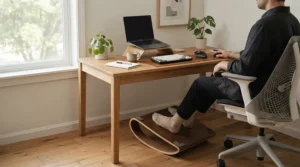
A rocking footrest for under desk fidgeting is a low platform or swivelling bar that sits beneath your desk and pivots under your feet, letting you rock your ankles back and forth while seated. It channels restless foot energy into quiet, controlled movement, supporting active sitting without leaving your chair.
There are three main types. Tilting platforms such as the Smart Suites and Manhattan 462181 rock on a curved underside. Swivel bars, like the Kensington, rotate under your feet. Clamshell designs, like the FTRST2, add storage to a rocking base.
A static footrest holds your feet still, which is useful for supporting short legs but does nothing for restless ones. A rocker, by contrast, gives your lower legs permission to move. Be realistic, though: it’s a comfort and habit tool, not exercise equipment, and the evidence for fidgeting’s benefits comes from small studies.
How to Choose a Rocking Footrest for Under Desk Fidgeting
- Fix your chair first. HSE’s workstation checklist suggests a footrest may be needed if you can’t sit comfortably once the chair is adjusted correctly. Don’t buy a footrest to fix a badly set-up chair.
- Measure your legroom. The Kensington is about 61 cm wide and 24.8 cm deep, while the Manhattan 462181 is about 50 cm by 28 cm. Check clearance before buying.
- Pick your motion style. A tilting platform feels familiar and controllable. A swivel bar is smoother and quieter. A clamshell adds storage.
- Check the height range. Two or three settings help if you’re very tall or short, or you share desks.
- Inspect grip and flooring. Rubber feet or dots matter more than marketing copy on carpet and polished floors alike.
- Think about noise. Open-plan offices punish clunky plastic.
- Weigh warranty and budget. Cheap rockers are fine for trials, but if you’ll use it daily for years, spend more on stability.
A final tip: write down which of these matter most before you browse. It stops a shiny feature, like massage rollers, from steering the decision.
Wobble Footrest for Restless Legs at Desk: What to Expect
Let’s be careful here. The NHS describes restless legs syndrome as a condition with a strong urge to move your legs, usually when resting at night. It advises things like walking, stretching or massaging your legs when symptoms flare. That’s a medical condition with its own treatment path, and a footrest isn’t part of it.
So what can a wobble footrest for restless legs at desk realistically offer? A discreet outlet for the urge to move during the working day. If your restless leg feelings are mild and show up while you sit, rocking gently may feel more comfortable than gripping your legs still. Based on the Missouri findings, movement in general is better than none, but that study looked at healthy volunteers, not people with the condition.
The Kensington reviewer who mentioned ADHD said rocking removed the need to fidget and stand up. That’s one person’s experience, not clinical evidence. If symptoms disturb your sleep, affect your mental health, or self-help isn’t working, the NHS advises seeing a GP.
Under Desk Rocker for Ankle Movement vs Traditional Alternatives
If your goal is ankle movement while you work, an under desk rocker for ankle movement isn’t the only way to get it. Here’s how the options compare.
| Option | Movement type | Noise | Space needed | Best For |
|---|---|---|---|---|
| Rocking footrest | Gentle ankle rocking | Low | Small | Constant light fidgeting |
| Static footrest | None | None | Small | Short-legged sitters |
| Under-desk pedal exerciser | Cycling motion | Usually moderate | Larger | Deliberate light exercise |
| Balance board (standing desk) | Whole-body balance | Low | Standing only | Stand-up workers |
| Walking breaks | Full-body | None | Free | Everyone, ideally |
The table shows that a rocker wins on simplicity and low noise, while a pedal exerciser delivers more effort but usually needs more room and attention. Walking breaks remain the gold standard, which is exactly what the Missouri researchers said. A rocker’s role is to fill the gaps between them.
In practice, a static footrest is a posture tool and a rocker is a movement tool. If your feet already dangle, you might need both functions, which is why height-adjustable rockers like the Leitz Ergo are appealing: you get support and motion from one unit.
Active Sitting and the Curved Base: Features That Actually Matter
Active sitting simply means letting your body move subtly while you’re seated, rather than freezing in one position. A rocking footrest is one of the easiest ways to practise it, because the movement is built into the product.
The curved base is the feature that shapes the experience. In a tilting rocker, the rounded underside decides how far the platform travels and how stable it feels. A deeper curve gives more travel but can feel wobblier. A shallower curve feels controlled but less lively. The Leitz Ergo offers a flat and a curved platform, which lets you choose between calm and lively. The Kensington bypasses the question by rotating a bar.
Features that matter: grip, platform width, height range, noise, and the feel of the curved base.
Features that don’t: marketing claims about productivity, and arguably massage rollers. The HEETA reviewers who said the rollers don’t achieve much make that point for me.
If you’re unsure, favour stability first and extras last. A rocker that stays put and moves smoothly will outperform one with extra features that fights you all day.
Long-Term Cost and Value Analysis
A footrest is a small purchase, but the cost-per-use is interesting. Assuming roughly 230 working days a year over three years (about 690 days):
| Tier | Product | Price range | Approx. cost per working day | Best For |
|---|---|---|---|---|
| Budget | Manhattan 462181 | Around £20 | About 3p | Trial buyers |
| Budget | HEETA | Under £20 | Under 3p | Testing the habit |
| Budget | FTRST2 | Mid-£20s | About 4p | Cable-heavy desks |
| Mid | Smart Suites | £25-£45 | 4-7p | Everyday users |
| Mid | Ultimate Foot Support | £30-£50 | 4-7p | Shared desks |
| Mid | Kensington | Around £50 | About 7p | Quiet offices |
| Premium | Leitz Ergo | £70-£90 | 10-13p | Daily, long-term use |
Even the priciest option costs pennies per working day. The real question is whether you’ll use it, so the cheapest model that suits your setup is usually the smartest. If you’re unsure, start in the budget tier and upgrade only if you’re hooked.
Maintenance costs are negligible: wipe, check the grips, and replace adhesive pads if they fail. Warranty terms vary by seller, so check them, especially for the Smart Suites and FTRST2, where listings conflict.
Safety, Regulations and Your Rights at Work (UK)
If you use a screen for an hour or more at a stretch, UK law covers you. The Health and Safety (Display Screen Equipment) Regulations 1992 set minimum workstation requirements, and employers must carry out suitable assessments for users. That includes many home workers.
Practically, that means you can ask your employer to assess your set-up, and a footrest may be part of the solution if your feet don’t rest comfortably on the floor. Don’t assume you need one by default. Ergonomic guidance often warns that using a footrest when it isn’t needed can take pressure off the thighs in the wrong places.
Safety tips for rockers: keep the unit fully under the desk so it isn’t a trip hazard, check the weight rating (the Kensington is listed at up to 136 kg, so confirm limits for other models), and keep cables clear. Look for CE or UKCA marking where relevant. The FTRST2 lists CE certification, and some Fellowes footrests are listed as tested against EN ISO 9241-5. As always, verify details on the product page at the time of purchase.

Frequently Asked Questions
❓ Is a rocking footrest for under desk fidgeting worth buying?
❓ Will an under desk rocker for ankle movement be noisy in an open-plan office?
❓ Can I use a rocking footrest with a standing desk?
❓ What's the cheapest rocking footrest worth buying in the UK?
❓ Do rocking footrests damage carpet or slip on laminate?
Conclusion
Fidgeting isn’t something to suppress. It’s something to redirect, and a rocking footrest for under desk fidgeting is one of the cheapest, simplest ways to do it. The research behind leg movement is encouraging but modest, so think of a rocker as a comfort tool that supports active sitting, not a fitness device.
If you want my shortlist: the Smart Suites is the best all-round value, the Ultimate Foot Support is best for shared desks, the Leitz Ergo is the premium buy-once option, and the Kensington is the quiet specialist for open-plan offices. On a tight budget, the Manhattan 462181 and HEETA make low-risk trials, while the FTRST2 is the tidy choice for cable-heavy desks.
Whatever you choose, set your chair up first, start with gentle rocking, and keep standing and walking breaks in your day. Your restless feet are trying to tell you something, and now you’ve got somewhere useful for them to go.
Recommended for You
- Adjustable Footrest For Short People At Desk: 7 Best Picks (2026)
- Large Footrest For Wide Feet Under Desk: 7 Best Picks (2026)
- Footrest For Standing Desk Anti-Fatigue: 7 Best Picks (2026)
Disclaimer: This article contains affiliate links. As an Amazon Associate, I earn from qualifying purchases. If you purchase products through these links, we may earn a small commission at no additional cost to you.
✨ Found this helpful? Share it with your friends! 💬🤗
