
In This Article
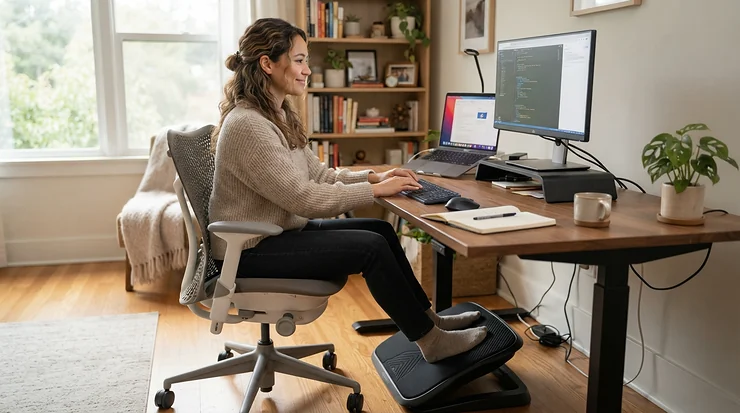
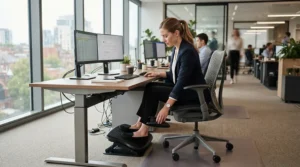
An adjustable footrest for short people at desk setups is a height- and often tilt-adjustable platform that sits under the desk and lifts your feet to a supported level when your chair, set correctly for typing, leaves them dangling. It restores the alignment that standard-sized furniture assumes you already have.

Here’s the problem it solves. Desks and chairs are built around an imaginary average adult. If you’re petite, you raise your seat until your elbows meet the keyboard, and your feet leave the floor. The seat edge then digs into the backs of your thighs, and you slide forward and slump.
The HSE’s display screen equipment workstation checklist asks whether your feet are flat on the floor without too much seat pressure on the backs of your legs. If they aren’t, it says a footrest may be needed.
I’ve compared manufacturer specifications, UK retailer listings and the themes in published customer reviews for seven real models. I haven’t handled any of them, so what follows is spec analysis and review synthesis, not hands-on testing. Along the way we’ll cover seat height mismatch, knee angle, tilt angle, finding a height adjustable footrest for short legs, and how to pick a petite footrest for office chair setups.
Quick Comparison: 7 Footrests at a Glance
Here is the one-glance version. Heights are approximate, taken from manufacturer and UK retailer specifications, and listings sometimes disagree, so always check the variant you’re buying.
| Footrest | Height range | Tilt angle | Best For |
|---|---|---|---|
| HUANUO Adjustable Footrest (HNFR3) | ~10 / 13.5 / 16.5 cm | Free rocking, about ±30° | Biggest lift on a budget |
| Fellowes Professional Series Ultimate Foot Support (8067001) | ~10 / 13.5 / 16.5 cm | Free-floating, roughly 25–30° | Large gaps, accredited build |
| Kensington SmartFit SoleMate Plus (56146) | ~9–13 cm | Up to ~20°, pedal-locked | Shared or hot desks |
| StarTech.com Adjustable Under-Desk Foot Rest (FTRST1) | 9.5–12.3 cm | Two stages, 0–15° or 0–30° | Roomy platform, long warranty |
| ComfiLife Adjustable Memory Foam Foot Rest | ~10 cm or ~15 cm (layers) | No fixed tilt, soft rock | Soft support, easy shifting |
| EUREKA ERGONOMIC Tilt Adjustable Footrest (DSN-03048) | ~8.5 cm overall | 0–20°, unlocked | Smaller gaps, sturdy frame |
| Humanscale FR500 Foot Rocker | ~11.5 cm, fixed | Curved-leg rocker | Design-led home offices |
Looking at the table, the HUANUO Adjustable Footrest (HNFR3) and Fellowes Professional Series Ultimate Foot Support (8067001) offer the tallest top settings, which matters most if your floor-to-foot gap is large. The Kensington SmartFit SoleMate Plus (56146) is the only one here you adjust by pedal without leaving your seat. The EUREKA ERGONOMIC Tilt Adjustable Footrest (DSN-03048) and Humanscale FR500 Foot Rocker suit smaller gaps.
💬 Just one click — help others make better buying decisions too!😊
Top 7 Picks: Adjustable Footrest for Short People at Desk Use, Analysed
The order runs roughly from budget to premium. Price ranges are approximate, based on UK retailer listings at the time of research. Check current prices before buying, as they change often.
1. HUANUO Adjustable Footrest (HNFR3) — tallest lift on a small budget
The top setting is the headline. Retailer listings quote three platform heights of roughly 10, 13.5 and 16.5 cm. That is rare at this price, and it can bridge a big gap under a fixed-height desk.
The platform rocks through about ±30° and doesn’t lock. In practice your feet are always gently moving, which suits fidgeters and irritates anyone who wants a static shelf. At around 43.5 × 33.5 cm and just over 2 kg, it fits two feet comfortably, though the light plastic shell can creep on hard floors.
Based on the spec comparison, this is the natural first stop if your measured gap is large, perhaps someone around 5ft 0in on a standard desk. Don’t expect the heft of a steel frame.
International listings average a little over four stars from thousands of ratings. Reviewers praise the rocking motion and the stepped heights. The recurring complaint is that it can’t be locked and feels unstable for people wanting a fixed platform.
Pros:
- ✅ Top setting around 16.5 cm
- ✅ Free rocking encourages ankle movement
- ✅ Light and ready to use
Cons:
- ❌ Tilt cannot be locked
- ❌ Plastic feels less solid than steel
Typically in the budget bracket, around £20–£40, it offers excellent value for large gaps.
2. Fellowes Professional Series Ultimate Foot Support (8067001) — big-gap height with an accredited build
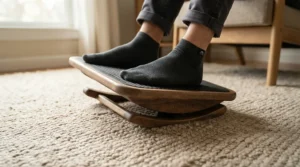
Fellowes lists three heights of roughly 100, 135 and 165 mm, changed with a scissor-style mechanism. The platform is free-floating, so it rocks with your legs. Listings quote a tilt of up to roughly 25–30°, and one specialist reviewer describes it as non-locking.
The platform measures about 39 × 34 cm, which is compact enough for narrow knee-wells. A UK dealer states it is accredited against BS EN ISO 9241 by FIRA International, an independent ergonomics accreditor. I’d verify that on the listing, but it’s a useful signal.
What most buyers overlook is that the top 165 mm setting makes this one of the few mainstream options that suits a larger gap without stacking anything. The massage bumps are a matter of taste. Wearing thin socks or bare feet, some people love them and others find them distracting.
I couldn’t verify a large pool of UK customer reviews for this exact model. Ergonomics specialists describe it as well built, and the non-locking design is the main caveat. Warranty terms differ between retailers, so check the one on your listing.
Pros:
- ✅ Three heights up to around 165 mm
- ✅ Free-floating platform allows rocking
- ✅ Independent ergonomic accreditation claimed
Cons:
- ❌ Non-locking tilt
- ❌ Massage bumps divide opinion
Around £40–£65, it is good value if you need the extra height.
3. Kensington SmartFit SoleMate Plus (56146) — adjust the tilt without leaving your chair
The standout feature is a locking foot-pedal. You change the tilt with a foot instead of crawling under the desk. UK retailer specifications list a platform of about 45 × 35 cm, heights from roughly 9 to 13 cm, and tilt up to about 20°. Some US listings quote 30° and different heights, so check your variant.
That large, non-skid platform gives you plenty of room to reposition. It weighs around 3 kg, so it stays put on hard floors. On paper, the pedal is the real differentiator, because adjustments you can make mid-call are adjustments you’ll actually make.
The limitation is height. With a ceiling around 13 cm, it may fall short for a larger gap. It is ideal for shared or hot desks, where several people of different heights take turns.
I couldn’t verify a large UK review pool for this exact variant. What is verifiable is the specification, the one-year warranty on retailer listings, and the pedal-lock design, which is its main selling point.
Pros:
- ✅ Pedal-lock tilt adjustment from your seat
- ✅ Large 45 × 35 cm non-skid platform
- ✅ Heavy enough to stay put
Cons:
- ❌ Top height only around 13 cm
- ❌ Variant specifications vary between listings
Around £50–£80, it is worth the premium if you value adjustability on the fly.
4. StarTech.com Adjustable Under-Desk Foot Rest (FTRST1) — roomy platform with a two-stage tilt
The platform is 45 × 35 cm, with height adjustment from 9.5 to 12.3 cm. A simple push sets the tilt to 0–15° or 0–30°. That two-stage design suits people who want a defined angle rather than endless wobble. At around 3 kg with an aluminium and plastic build, it is stable.
For petite users, the width is both a strength and a trade-off. Two feet fit with room to spare, but a large footprint can clash with chair bases under compact desks. Measure your knee-well depth first.
StarTech’s spec sheets list CE, RoHS and REACH compliance and a five-year warranty with free technical support. For a simple platform, I’d treat compliance as reassurance rather than a purchase driver.
Review pools I could find are small. One retailer shows a handful of top ratings. I’d treat that as encouraging but too thin to draw conclusions from.
Pros:
- ✅ Wide 45 × 35 cm platform
- ✅ Two defined tilt stages
- ✅ Five-year warranty listed
Cons:
- ❌ Max height around 12.3 cm
- ❌ Large footprint for tight desks
Around £40–£65, it is solid value for moderate gaps.
5. ComfiLife Adjustable Memory Foam Foot Rest — soft, layered support in two heights
Two stacked layers give roughly 10 cm without the base and 15 cm with it. Listings quote 17.5 × 12 × 6 in (about 44 × 30 × 15 cm). A removable, washable cover and a non-slip base complete the package. A foam piece this light moves easily when you shift position.
Foam does something rigid plastic can’t: it cushions pressure points, and it lets you rest one foot or both. The trade-off is stability. A roundup noted it feels less steady when fully stacked, and foam can compress over time, losing a little height.
Short reviewers say it lifts their legs usefully. A few wanted it taller, and some buyers feel it’s pricey for foam and fabric. One roundup cites a lifetime warranty, which I’d confirm on the listing.
Pros:
- ✅ Soft, pressure-relieving memory foam
- ✅ Removable washable cover
- ✅ Two heights by removing the base
Cons:
- ❌ Foam compresses and loses height
- ❌ Less stable fully stacked
Around £25–£45, it is good value if comfort matters more than precise angles.

6. EUREKA ERGONOMIC Tilt Adjustable Footrest (DSN-03048) — a steel frame that stays put
Listings give 39 × 30 × 8.5 cm, a 0–20° unlocked tilt, steel and rubber construction, and about 2.3 kg. Scratch-resistant rubber feet protect hard floors. It is the most compact model here, which suits tight spaces and smaller feet.
Height is where you need to read the listing carefully. One UK ranking site lists three positions, while a buyer on another listing says it isn’t height adjustable. At about 8.5 cm overall, I’d treat it as a low-profile footrest for smaller gaps.
The tilt is free, not locked, so expect a gentle rocking feel. Reviewers consistently praise its sturdiness, and international listings average around 4.4–4.5 out of five from several thousand ratings.
Pros:
- ✅ Sturdy steel frame
- ✅ Compact footprint for tight knee-wells
- ✅ Rubber feet protect flooring
Cons:
- ❌ Low height unsuitable for large gaps
- ❌ Tilt cannot be locked
Around £25–£45, it is great value for a modest gap.
7. Humanscale FR500 Foot Rocker — premium rocker designed to be seen
Listings give 425 × 310 × 115 mm, a hardwood or plywood platform on a steel frame, and curved legs that encourage rocking. Retailers list a single 115 mm height, not a range, so I’d treat it as fixed.
That rules it out for large gaps. For short users whose gap is small to moderate, it brings a calm, continuous rocking motion and a finish that looks at home in a considered home office.
Warranty information conflicts between retailer listings, so confirm before buying. Review evidence is thin. One UK retailer shows a single positive review, which isn’t enough to judge long-term durability.
Pros:
- ✅ Premium hardwood and steel construction
- ✅ Smooth curved-leg rocking
- ✅ Compact 42.5 × 31 cm footprint
Cons:
- ❌ Fixed height only
- ❌ Limited review evidence
Around £100–£130, it is a luxury choice, justified only if the fixed height matches your gap.
Specs Side by Side: Top 7 Compared
Here is how the platforms and builds stack up. Prices are approximate ranges, so check current price on the listing.
| Footrest | Platform size | Build | Approx. price | Best For |
|---|---|---|---|---|
| HUANUO Adjustable Footrest (HNFR3) | ~43.5 × 33.5 cm | Plastic | Around £20–£40 | Large gaps, tight budgets |
| Fellowes Professional Series Ultimate Foot Support (8067001) | ~39 × 34 cm | Plastic, scissor adjust | Around £40–£65 | Large gaps, ergonomic accreditation |
| Kensington SmartFit SoleMate Plus (56146) | ~45 × 35 cm | Plastic and rubber | Around £50–£80 | Shared desks |
| StarTech.com Adjustable Under-Desk Foot Rest (FTRST1) | ~45 × 35 cm | Aluminium and plastic | Around £40–£65 | Wide platform, long warranty |
| ComfiLife Adjustable Memory Foam Foot Rest | ~44 × 30 cm | Memory foam | Around £25–£45 | Comfort seekers |
| EUREKA ERGONOMIC Tilt Adjustable Footrest (DSN-03048) | ~39 × 30 cm | Steel and rubber | Around £25–£45 | Small gaps, compact desks |
| Humanscale FR500 Foot Rocker | ~42.5 × 31 cm | Hardwood and steel | Around £100–£130 | Premium, style-led setups |
The value story is clear. The HUANUO Adjustable Footrest (HNFR3) and Fellowes Professional Series Ultimate Foot Support (8067001) give you the most height per pound. The Kensington SmartFit SoleMate Plus (56146) and StarTech.com Adjustable Under-Desk Foot Rest (FTRST1) charge for adjustability and warranty. The Humanscale FR500 Foot Rocker is a style and build purchase, not a height solution.
How to Choose an Adjustable Footrest for Short People at Desk Work
Follow these steps in order and you’ll avoid the commonest buying mistakes.
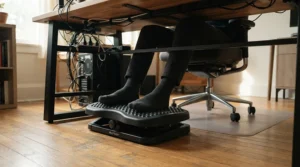
- Set your chair for typing first. Get your elbows roughly level with the desk so your forearms are comfortably horizontal. Only then measure what your feet need. A footrest should fix a gap, never hide a badly set chair.
- Measure the gap. With your shoes on, measure from the floor to the soles of your feet, hanging naturally. That number is your target footrest height.
- Match the height with a little spare. Choose a footrest whose range includes your gap, ideally with a setting slightly above and below, so you can fine-tune.
- Check the footprint against your knee-well. A large platform can hit the chair base, and I’ll return to that under petite footrest for office chair fit.
- Pick your movement style. Locked platforms feel stable, while rocking ones encourage ankle movement. Decide which sounds like you.
- Consider surface and cover. Textured bumps, plain plastic and foam all feel different through socks or soft shoes.
- Check warranty and returns. Listings disagree on warranty for several models, so confirm terms before buying.
Seat Height Mismatch: Why Standard Furniture Fails Petite Frames
Seat height mismatch is the root cause of the whole problem. A fixed-height desk forces you to raise your seat so your elbows reach the keyboard. Your feet then leave the floor.
Guidance from the University of Aberdeen’s workstation assessor guidance notes that when the seat is too high, the edge can press on the backs of the legs and knees. That pressure explains why petite desk workers so often report tingling, heavy legs and a creeping slump.
Three things happen together:
- Your thighs lose support.
- Your pelvis slides forward.
- Your lower back stops touching the backrest.
Ergonomics guidance often suggests bringing equipment down before raising it. Lowering a desk or chair is the cleanest fix, but if the chair can’t go lower and the desk can’t move, a footrest closes the gap. Think of it as the missing piece in a setup built for someone else.
Knee Angle: The Number That Quietly Decides Your Comfort
Knee angle is where a footrest either helps or hurts. UK guidance generally describes knees bent at roughly a right angle, and some osteopath-reviewed DSE checklists allow up to about 100 degrees. A seating and ergonomics leaflet from Cambridge University Hospitals says feet should be flat and your bottom roughly level with your knees.
A footrest that’s too high is as bad as none. It tips your knees above your hips, closes the knee angle and lifts your thighs off the seat. A footrest that’s too low leaves the gap and the thigh pressure in place.
The practical test is simple. Your thighs should rest on the seat, parallel or sloping very slightly down, with a small gap behind your knees. If your knees sit noticeably higher than your hips, drop a height setting.
If the knee angle starts out tight and your calves feel compressed, reduce the height or switch to a lower tilt. Small changes in knee angle make a surprising difference to how long you can sit comfortably.
Tilt Angle: Fixed, Rocking or Lockable?
Tilt angle shapes how your ankles feel over a long day. It also decides whether the footrest becomes an active tool or a static shelf.
There are three broad types here. The Kensington SmartFit SoleMate Plus (56146) locks, using a pedal. The StarTech.com Adjustable Under-Desk Foot Rest (FTRST1) offers two defined stages. The HUANUO Adjustable Footrest (HNFR3), Fellowes Professional Series Ultimate Foot Support (8067001) and EUREKA ERGONOMIC Tilt Adjustable Footrest (DSN-03048) rock freely.
Workstation guidance often notes that feet shouldn’t stay fixed for long periods. That favours rocking designs, which reward micro-movement. For smaller feet, though, steep angles can encourage sliding, so start flat and increase gradually.
The honest rule is to choose the tilt angle at which your ankles feel neutral and relaxed, not one that hits a number on a spec sheet. If you want to move your feet, pick a rocker. If you want to park them, pick a lockable or fixed design.
Height Adjustable Footrest for Short Legs: Getting the Range Right
A height adjustable footrest for short legs only works if its range covers your gap. Here’s a rough way to match them, using the specs above:
- A smaller gap (up to about 10 cm): the EUREKA ERGONOMIC Tilt Adjustable Footrest (DSN-03048), ComfiLife Adjustable Memory Foam Foot Rest (base removed) or Humanscale FR500 Foot Rocker.
- A moderate gap (about 10–13 cm): the Kensington SmartFit SoleMate Plus (56146) or StarTech.com Adjustable Under-Desk Foot Rest (FTRST1).
- A larger gap (about 13–16.5 cm): the HUANUO Adjustable Footrest (HNFR3) or Fellowes Professional Series Ultimate Foot Support (8067001).
These are guides, not guarantees. Shoes change the gap by a couple of centimetres, so measure in what you actually wear. Tilt also changes the effective height at your toes.
If your gap exceeds the top setting on a height adjustable footrest for short legs, don’t stack books on top. Fix it upstream with a lower seat, a lower desk or a keyboard tray, and use the footrest for the remainder.
Petite Footrest for Office Chair: Footprint, Clearance and Castors
A petite footrest for office chair use needs the right footprint, not just the right height. Many office chairs have a five-star base, and rolling castors can bump a platform that sits too close.
Measure your knee-well depth. The compact EUREKA ERGONOMIC Tilt Adjustable Footrest (DSN-03048), at around 39 × 30 cm, is the safest under cramped desks. The 45 × 35 cm platforms on the Kensington SmartFit SoleMate Plus (56146) and StarTech.com Adjustable Under-Desk Foot Rest (FTRST1) need more room.
Foam helps in another way. The ComfiLife Adjustable Memory Foam Foot Rest is light, so it moves easily if you need to reposition it, though it can also drift. Whatever you choose, test that the chair rolls and swivels freely without catching the footrest.
Footrest vs Traditional Alternatives
A footrest isn’t your only option. Here’s how it compares with the usual fixes.
| Option | What it fixes | Drawback | Best For |
|---|---|---|---|
| Adjustable footrest | Dangling feet, thigh pressure | Needs floor space, may creep | Fixed desks and chairs |
| Low seat-height chair | Dangling feet at the source | Chair replacement cost | Those who can swap their chair |
| Height-adjustable desk | Whole mismatch, root cause | Highest cost | Home offices with budget |
| Keyboard tray | Lowers the typing surface | Reduces legroom | Desks that can’t be lowered |
| Makeshift stack (box, books) | Temporary gap-filling | Unstable, no tilt | Short-term emergencies |
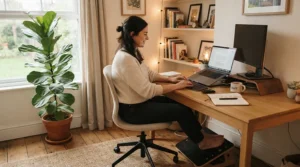
A low-seat chair or a height-adjustable desk fixes the cause, but both cost more and aren’t always possible, especially in rented spaces or shared offices. A footrest is the pragmatic middle path: cheap, portable and quick. A HUANUO Adjustable Footrest (HNFR3) costs a fraction of a new chair.
Step-by-Step: Set Up Your Footrest in Ten Minutes
A good footrest set up badly is wasted. Work through this order.
- Set the seat for typing. Elbows roughly level with the desk, shoulders relaxed.
- Place your feet. Sit back into the backrest and let your feet hang naturally. Measure the gap.
- Choose the starting height. Pick the nearest setting at or just below your gap.
- Do the two-finger check. You should fit about two fingers between the seat’s front edge and the back of your knee. If not, adjust the seat depth or backrest.
- Set the tilt. Start flat, then add angle only if your ankles feel stiff.
- Check your knee angle. Thighs roughly parallel, knees around a right angle.
- Test the footprint. Roll and swivel, and check nothing catches.
- Review at day three. Muscles adapt, so small changes often help.
Common mistakes in the first 30 days include setting the footrest too high, leaving the tilt steep, and forgetting to re-measure after changing shoes. Move your feet every so often, since no footrest is meant to hold you in one position.
Real-World Scenarios: Three Petite Desk Setups
Scenario one: the home worker. She works eight hours a day on a fixed-height table with a dining chair. Her budget is modest, and her gap is large. The HUANUO Adjustable Footrest (HNFR3) or Fellowes Professional Series Ultimate Foot Support (8067001) gives her the height she needs. The rocking motion helps through long days.
Scenario two: the hot-desker. He shares desks in a busy office and changes setup every morning. The Kensington SmartFit SoleMate Plus (56146) is the best match. The pedal lets him retune the tilt without kneeling, and the large platform copes with different seats.
Scenario three: the compact-desk student. She uses a small desk in a shared flat and sits for several hours at a time. The compact EUREKA ERGONOMIC Tilt Adjustable Footrest (DSN-03048) fits tight knee-wells. If she prefers softness, the ComfiLife Adjustable Memory Foam Foot Rest is lighter and easy to store. A design-led home office could justify the Humanscale FR500 Foot Rocker, provided its fixed height matches the gap.
✨ Ready to Find Your Fit?
🔍 Take your desk setup to the next level with these carefully selected footrests. Click on any highlighted product name to check current pricing and availability. A few minutes of adjustment could make your working day far more comfortable!
Problem → Solution: Fixing the Common Footrest Gripes
Problem: my feet slide off. Lower the tilt angle, add a non-slip surface, or switch to a flatter platform such as the StarTech.com Adjustable Under-Desk Foot Rest (FTRST1) on its lower stage.
Problem: my thighs still feel pressured. Your footrest may be too low, or your seat too deep. Raise the footrest one setting and check the two-finger gap.
Problem: my knees bump the desk. The footrest may be too high, closing your knee angle. Drop a height setting, or choose the lower-profile EUREKA ERGONOMIC Tilt Adjustable Footrest (DSN-03048).
Problem: it keeps creeping away. Light plastic can drift on smooth floors. A heavier model like the Kensington SmartFit SoleMate Plus (56146) stays put, or place a grippy mat beneath.
Problem: it feels wobbly. Free-rocking designs like the HUANUO Adjustable Footrest (HNFR3) move by design. If you prefer stability, choose a lockable or two-stage tilt.
UK Rules and Safety: What the DSE Regulations Say
In the UK, display screen equipment rules treat footrests as a standard option. The original display screen directive annex on legislation.gov.uk states that a footrest shall be made available to anyone who wishes for one. UK guidance applies the rules to home and hybrid workers as well, though employers often follow an assessment-led approach.
If you work for an employer, ask for a DSE assessment and raise your seat height mismatch. Your employer may supply a footrest, and you can then compare it with the options above. If you work for yourself, treat the same checklist as your own standard.
On safety, check stability, non-slip surfaces and trip hazards. The StarTech.com Adjustable Under-Desk Foot Rest (FTRST1) lists CE, RoHS and REACH compliance. For simple footrests, that’s reassurance rather than a deciding factor.
Long-Term Cost and Maintenance
A footrest is a low-cost purchase, but it still has running costs. Illustratively, a footrest costing around £45 and used for roughly 230 working days a year over three years works out at under 7p a day. A premium option like the Humanscale FR500 Foot Rocker at around £115 is about 17p a day, still modest.
Maintenance is simple:
- Wipe plastic and steel with a damp cloth.
- Wash the ComfiLife Adjustable Memory Foam Foot Rest cover as directed.
- Check rubber feet on hard floors for marks.
- Watch foam for compression, since it can lose height over time.
Warranties matter for longevity. The StarTech.com Adjustable Under-Desk Foot Rest (FTRST1) lists five years, while terms on the Fellowes Professional Series Ultimate Foot Support (8067001) and Humanscale FR500 Foot Rocker vary by retailer, so confirm before buying.
FAQ
❓ How high should an adjustable footrest for short people at desk work be?
❓ Can I use a rocking footrest all day?
❓ Is memory foam as good as a rigid footrest for short legs?
❓ Will my employer provide a footrest?
❓ What size footrest fits under a small desk?
Conclusion
A well-chosen adjustable footrest for short people at desk setups turns a chronic annoyance into a solved problem. Set your chair for typing, measure your gap, then match it to a footrest whose range covers it with a little to spare.
For large gaps, the HUANUO Adjustable Footrest (HNFR3) and Fellowes Professional Series Ultimate Foot Support (8067001) offer the most height. For shared desks, the Kensington SmartFit SoleMate Plus (56146) adds pedal-lock convenience. The StarTech.com Adjustable Under-Desk Foot Rest (FTRST1) gives you a roomy platform and a long warranty. For softness, choose the ComfiLife Adjustable Memory Foam Foot Rest. For compact desks, the EUREKA ERGONOMIC Tilt Adjustable Footrest (DSN-03048) fits best. And if style leads, the Humanscale FR500 Foot Rocker is the premium choice.
Whatever you pick, check your knee angle and tilt angle, and re-measure when your shoes change. A good setup should make you forget your feet entirely.
Recommended for You
- Large Footrest For Wide Feet Under Desk: 7 Best Picks (2026)
- Footrest For Standing Desk Anti-Fatigue: 7 Best Picks (2026)
- Footrest For Sciatica While Working At Desk: 7 Best Picks (2026)
Disclaimer: This article contains affiliate links. As an Amazon Associate, I earn from qualifying purchases. If you purchase products through these links, we may earn a small commission at no additional cost to you.
✨ Found this helpful? Share it with your friends! 💬🤗
