
In This Article
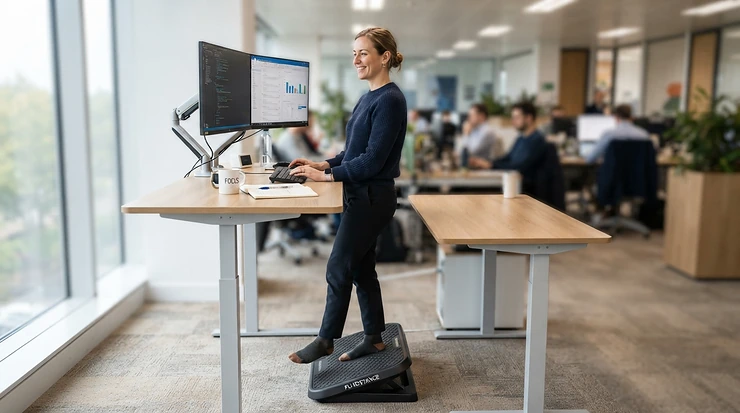
You bought the sit stand desk to escape the afternoon slump. Fair enough. Three weeks in, your calves feel like you’ve climbed Pen y Fan in work shoes, and your lower back is sulking. The plot twist is that standing itself is rarely the culprit. Standing still is.
A footrest for standing desk anti-fatigue use gives your legs somewhere to go. That might be a low perch for one foot, a gentle rocker or a rail to prop a toe on. Instead of locking both knees and letting blood pool in your lower legs, you get small, frequent weight shifting. UK law takes the idea seriously too: the Display Screen Equipment Regulations 1992 say a footrest must be made available to any user who wishes one.
Most buying guides then go quiet on a few awkward points. Most footrests are designed for seated heights, and some research suggests that forcing yourself to lift a foot on a timer doesn’t help. This guide does the unglamorous work instead, with real specs, honest trade-offs and aggregated review themes.
You’ll get seven real products from budget to premium. You’ll also get a plain-English look at calf fatigue, a decision framework and setup tricks the product pages skip. As an Amazon Associate, this site earns from qualifying purchases (see the disclaimer). I couldn’t confirm live amazon.co.uk stock for every model during research, so check availability before you buy.
Quick Comparison: Footrest for Standing Desk Anti-Fatigue Options at a Glance
| Product | Type | Price range (indicative) | Best For |
|---|---|---|---|
| Humanscale Foot Machine FM500 | Rocking platform | Around £100-£140 | Premium, all-day weight shifting |
| Fluidstance Level | Balance board | Around £200-£260 | Active movers standing 5+ hours |
| Kensington SmartFit SoleMate Plus | Height and tilt adjustable, lockable | £40-£60 range | Mixed sitting and standing |
| Fellowes Breyta Foot Rest | Adjustable wide platform | £35-£50 range | Office staff wanting a standards-led pick |
| Fellowes Breyta Foot Rest Cushion | Foam rocking cushion | £25-£35 range | Light users and home offices |
| Eureka Ergonomic Tilt Adjustable Footrest | Tilting metal platform | £25-£40 range | Best-value all-rounder |
| Focal Upright Foot Bar | Foot rail | Around £60-£90 range (varies by retailer) | Fixed standing posts and one-foot perching |
Looking at the table, the Eureka Ergonomic Tilt Adjustable Footrest and the Fellowes Breyta Foot Rest Cushion cover most home-office budgets. The Humanscale Foot Machine FM500 and Fluidstance Level are for people who stand for hours and treat movement as a daily habit. Prices drift with retailer and exchange rates, so treat every figure as a snapshot from November 2026.
💬 Just one click — help others make better buying decisions too!😊
Top 7 Footrest for Standing Desk Anti-Fatigue Picks: Expert Analysis
Every pick below pairs real specs with what they mean in practice. “Reviewers” always refers to aggregated, publicly available review themes. Where I couldn’t verify enough genuine reviews, I say so rather than invent any.
1. Humanscale Foot Machine FM500 — premium rocker for steady weight shifting
The curved legs let the platform roll under your foot, so even a “resting” foot keeps working.
It measures roughly 16.75″ × 12.25″ × 4.5″ (about 43 × 31 × 11 cm) and weighs around 1.2 kg. It has die-cast aluminium legs, a moulded plywood top, a steel foot stop and rubber pads. At 11 cm tall it is a low platform. At standing height that means a modest knee lift rather than a bar-stool perch. It works best as a rocker underfoot, which is exactly where the weight shifting comes from.
One retailer listing shows a 4.4 average from 71 reviews. Owners describe it keeping their legs active and easing cramping. One testing-lab site called it a standout in its category and noted how often staff borrowed it. The most common gripe is the price. I couldn’t verify a large UK-specific review pool.
Pros:
- ✅ Smooth rocking keeps lower legs gently active
- ✅ Aluminium and plywood build feels furniture-grade
- ✅ Stable rubber pads and a steel foot stop
Cons:
- ❌ Premium price for a low platform
- ❌ UK stock and delivery can be patchy
Expect to pay around £100-£140. It’s excellent if you stand most of the day, but overkill for occasional standers.

2. Fluidstance Level — premium balance board for constant micro-movement
Strictly speaking, this is an active platform rather than a footrest. It earns its place because it solves the same problem from the opposite direction.
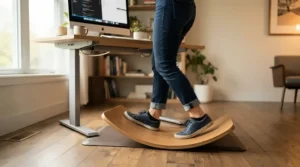
It weighs about 7 lb (just over 3 kg) and adds roughly 2.5-3 inches of height, so your desk needs enough range to compensate. It has an aluminium base, a wooden deck and a lifetime guarantee. The gentle slope means you find your balance quickly. Reviewers describe the board as encouraging small, constant shifts rather than a workout.
The brand’s own site shows ratings between 4.6 and 4.8 from 200+ reviews, so treat that as supportive rather than neutral. Independent reviewers repeatedly flag a slippery deck, especially in socks. One suggested it won’t transform standing on its own but does nudge you to move more. The brand cites Mayo Clinic research, which I couldn’t independently verify.
Pros:
- ✅ Keeps both legs moving without any effort
- ✅ Lifetime guarantee backs the high price
- ✅ Solid die-cast base with a wooden deck
Cons:
- ❌ Slippery top without grippy shoes
- ❌ Adds height and costs the most here
Expect around £200-£260. It’s best for confident movers standing five-plus hours daily.
3. Kensington SmartFit SoleMate Plus — adjustable tilt you can lock
The lockable tilt control is the clever bit. You can set a stable angle for resting, then unlock it for rocking.
Retail listings give height adjustment from about 82 to 160 mm, tilt up to 20° and a non-slip massage surface. The platform is roughly 45 × 35 cm and weighs around 3.4 kg, with a one-year warranty listed. That 16 cm maximum is taller than most budget rivals. It makes a real difference at standing height, where a flat 8 cm block barely changes your posture.
The weight helps too. It stays put while you shift on it.
I couldn’t find enough genuine review data for this exact model to summarise sentiment responsibly. Check recent verified-purchase reviews, paying attention to the lock mechanism and the surface texture.
Pros:
- ✅ Taller maximum height suits standing desks
- ✅ Lockable tilt gives rest or rock modes
- ✅ Heavy base resists sliding
Cons:
- ❌ Massage texture may feel harsh in socks
- ❌ Bulkier to move between rooms
Expect around £40-£60. Good value if you alternate between sitting and standing.
4. Fellowes Breyta Foot Rest — wide, standards-minded office platform
Width is its quiet strength, because a deck this broad gives you room to swap feet.
The manufacturer’s sheet lists 9.8 × 49 × 36 cm, a weight of 2.16 kg and reference to EN ISO 9241-5, the ergonomic standard for workstation layout and posture. Retailers describe adjustable height and portable carrying. At 36 cm deep and 49 cm wide, it suits sharing between desks.
The 9.8 cm height is the limitation. It’s fine for resting a foot slightly raised, but won’t give a bar-rail feel at a tall standing setting.
I couldn’t verify a meaningful sample of genuine reviews for this exact version, so I won’t summarise sentiment. Look for comments on stability and surface grip.
Pros:
- ✅ Wide deck for easy alternating legs
- ✅ Standards reference suits workplace assessments
- ✅ Portable between desks
Cons:
- ❌ Modest maximum height for tall standing desks
- ❌ Limited verified review data
Expect around £35-£50. A sensible, no-drama workplace pick.
5. Fellowes Breyta Foot Rest Cushion — soft foam, flip-to-rock, British-made
This one is the gentlest option. It suits people who find hard platforms unforgiving.
It measures 10 × 45 × 30 cm, weighs 1.73 kg and has a non-slip base with a carry handle. Flip it over for a rocking action. The foam is 93% recycled and the cover is hand-washable recycled polyester. UK retailers list it with a five-year guarantee and Great Britain as country of origin. The softness absorbs pressure but compresses, so it suits light foot-resting more than pushing hard.
Because it’s only 10 cm tall, think of it as a comfort pad rather than a perch. Retailer copy mainly emphasises comfort and portability. I couldn’t verify enough independent reviews to report sentiment.
Pros:
- ✅ Five-year guarantee listed by UK retailers
- ✅ Washable cover and recycled materials
- ✅ Flips over for gentle rocking
Cons:
- ❌ Foam compresses under heavy pushing
- ❌ Low height for standing desks
Expect around £25-£35. A low-risk starter for home offices.
6. Eureka Ergonomic Tilt Adjustable Footrest — metal frame, best-value all-rounder
Metal construction at this price is unusual, and it’s why this model has so many fans.
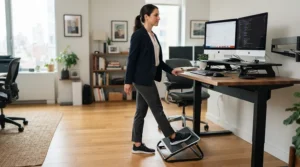
Listings give 39 × 30 × 8.5 cm, 2.34 kg, a steel frame with a rubber massage surface, rubber feet and a 0-20° tilt range. It’s a free-floating tilt, so it doesn’t lock. Retailer data shows roughly 4.4-4.5 stars from around 4,500 reviews. Reviewers praise the sturdy frame and the textured top, and say it can be nudged around easily. Complaints centre on its low height (some say it’s too low) and the tilt moving whenever weight shifts.
That is the trade-off for effortless rocking. If you want a locked angle, the brand also sells a lockable version.
Pros:
- ✅ Sturdy metal frame, with strong review volume
- ✅ Free-moving tilt encourages weight shifting
- ✅ Comes in at the best price here
Cons:
- ❌ Low platform for tall standing desks
- ❌ Tilt can’t be locked on this version
Expect around £25-£40. Hard to beat per pound.
7. Focal Upright Foot Bar — a proper foot rail for standing desk work
Rails work differently. Rather than a platform under both feet, you raise one foot onto a bar.
The maker lists roughly 26″ × 14″ × 3.5″ (66 × 36 × 9 cm), 3.2 lb and an extruded aluminium rail on non-marking rubber supports. The curved bar suits different foot positions. The idea is simple. Raising one foot reduces lower-back curvature and engages the lower-leg muscles that help return blood towards the heart.
Honest caveat: it’s more at home at fixed standing posts than at a mobile sit stand desk. I couldn’t verify UK retail availability or enough genuine reviews, so check stock before relying on it. If it isn’t listed, look for a similar foot bar from another maker.
Pros:
- ✅ Wide rail makes alternating legs effortless
- ✅ Lightweight yet sturdy aluminium
- ✅ Non-marking rubber supports
Cons:
- ❌ Availability and pricing unclear in the UK
- ❌ Doesn’t help if you want to rock
Expect around £60-£90 where available. A specialist pick for rail devotees.
| Product | Size (approx.) | Adjustment | Standout | Best For |
|---|---|---|---|---|
| Humanscale Foot Machine FM500 | 43 × 31 × 11 cm | Fixed height, rocks | Premium build | All-day standers |
| Fluidstance Level | Balance board | None, tilting | Constant motion | Active workers |
| Kensington SmartFit SoleMate Plus | 45 × 35 cm, 8-16 cm tall | Height + lockable tilt | Tallest height | Sit stand desk switchers |
| Fellowes Breyta Foot Rest | 49 × 36 × 9.8 cm | Adjustable height | Wide deck | Shared desks |
| Fellowes Breyta Foot Rest Cushion | 45 × 30 × 10 cm | Flip to rock | Soft and washable | Light use |
| Eureka Ergonomic Tilt Adjustable Footrest | 39 × 30 × 8.5 cm | 0-20° tilt | Metal value | Budget buyers |
| Focal Upright Foot Bar | 66 × 36 × 9 cm | Fixed | One-foot rail | Fixed standing posts |
The table shows how little vertical range most budget options offer. Only the Kensington SmartFit SoleMate Plus meaningfully clears 12 cm. If your desk sits high, taller models matter more than massage bumps. The Fluidstance Level and Focal Upright Foot Bar solve the same problem in opposite ways, through constant motion or deliberate one-foot perching.
What Is a Footrest for Standing Desk Anti-Fatigue Use?
A footrest for standing desk anti-fatigue use is a low platform, rocker, balance board or rail placed on the floor beneath a raised desk. It lets you rest, tilt or rock one foot at a time, encouraging weight shifting so your calves, hips and lower back share the load instead of tiring.
That sounds similar to a seated footrest, but the job is different. Under a seated desk, a footrest supports your feet so your thighs aren’t pressed into the chair. At a standing desk, it adds a second foot position, which breaks the rigid two-feet-flat stance. Think of it as a “change of gear” for your legs.
The practical difference is height. A seated footrest assumes a desk around 72-74 cm tall. Most standing setups are far higher, so a 10 cm block is a gentle upgrade rather than a game changer. Many people use a sit stand desk both ways, so a footrest that works at both heights tends to age better.
How to Choose a Footrest for Standing Desk Anti-Fatigue Support
- Measure at standing height first. Stand at your desk and check where your resting foot naturally lands with a slightly bent knee. If the footrest is shorter than that, it won’t change your posture much.
- Decide: platform, rocker, board or rail. Platforms suit light users, rockers suit people who fidget, boards suit active workers, and rails suit fixed posts.
- Check the footprint. A deck around 40-50 cm wide lets you alternate feet without hopping.
- Weigh stability against mobility. Heavier models stay put, while lighter ones move easily.
- Look at the surface. Grippy textures help in shoes but can feel harsh in socks.
- Match your standing schedule. Two hours a day rarely justifies a premium rocker.
- Check warranty and returns. A guarantee is cheap insurance on mechanisms.
Weight Shifting and Calf Fatigue: What the Research Actually Says
Calf fatigue is the ache that creeps in after an hour or so of static standing. Prolonged standing without movement lets blood pool in the lower legs, which is why ankles can swell. Weight shifting is the obvious fix, but the evidence is more nuanced than the marketing.
A laboratory study at Curtin University had 20 adults stand for two hours with and without a footrest while doing computer work. The footrest condition used forced five-minute foot-raising intervals. It found no advantage in discomfort or cognitive function, and some negative effects for ankle and foot discomfort. The authors suggested a different footrest design and protocol might do better.
My reading is that forced intervals are the weak link, not the footrest itself. Movement that you choose, when you feel the urge, is a different matter. That’s why rockers, rails and free-tilting platforms make sense, since they let you shift when your body asks rather than when a timer dictates.
Standing Desk Footrest for Alternating Legs: How to Do It Properly
A standing desk footrest for alternating legs works best when you treat it as a habit rather than a rule. Swap feet whenever you notice your weight settling, roughly every few minutes, rather than on a rigid timer.
Width matters here. A deck of 45 cm or more, like the Fellowes Breyta Foot Rest or Fellowes Breyta Foot Rest Cushion, lets you change feet without shuffling. A rail like the Focal Upright Foot Bar is even easier, since you simply lift and swap.
Keep your standing knee soft rather than locked. Rest the raised foot lightly, as you would on a bar rail, rather than pressing hard. And if a footrest only supports one foot at a time, spread the load by occasionally using the floor as well. Rocking models like the Humanscale Foot Machine FM500 and Eureka Ergonomic Tilt Adjustable Footrest quietly build alternation into the movement itself, which suits people who forget to swap.
Foot Rail for Standing Desk vs Footrest: Which Suits You?
A foot rail for standing desk setups is essentially the bar-room solution, a fixed bar you can prop a foot on. A footrest is a platform sitting beneath the desk. Both promote weight shifting, but they feel different.
A rail encourages a deliberate, raised-foot posture. It’s tidy, stable and doesn’t move, which suits fixed standing posts like the Focal Upright Foot Bar. The downside is limited variety, because you can’t rock it or change the angle.
A platform footrest invites small, continuous motion. The Kensington SmartFit SoleMate Plus, with its lockable tilt, can behave like either, resting when locked and rocking when free. If you share a desk or move between sitting and standing, a platform wins for flexibility. If you stand at one fixed spot all day, a foot rail for standing desk work may feel more natural.
My rule of thumb: pick a rail if you like stillness with a perch, and a rocker if you fidget.
Footrest vs Anti-Fatigue Mat: Benefits Compared
Anti-fatigue mats and footrests are often framed as rivals. They solve different problems, and many standing desk users end up wanting both.
| Option | Weight shifting | Calf fatigue | Typical cost | Best For |
|---|---|---|---|---|
| Footrest for standing desk anti-fatigue use | High (platform or rocker) | Moderate relief via movement | £25-£140 | Fidgeters and alternating-leg users |
| Anti-fatigue mat | Low (cushions static standing) | Moderate relief via cushioning | £30-£100 | Hard floors, long static standing |
| Foot rail for standing desk | High (one-foot perch) | Moderate relief via posture change | £60-£90 | Fixed standing posts |
| Balance board (Fluidstance Level) | Very high | Moderate relief via motion | £200-£260 | Active movers |
A mat cushions your feet but doesn’t ask your legs to move. A footrest invites movement but doesn’t cushion. Used together, they cover both, though one caution applies. Soft mats can make low footrests wobbly, so test the combination before settling. If you must choose one, choose by floor and habit. Hard floors and long static standing favour a mat, while fidgety posture favours a footrest.
Features That Actually Matter (And Those That Don’t)
Matter: total height, stability and footprint. If the footrest can’t lift your foot meaningfully at standing height, nothing else compensates. A non-slip base matters nearly as much, because a platform that skates away is worse than none.
Matter somewhat: adjustability. A lockable tilt, like the one on the Kensington SmartFit SoleMate Plus, adds a second mode. Build quality counts too, since metal and aluminium frames, as on the Eureka Ergonomic Tilt Adjustable Footrest and Humanscale Foot Machine FM500, outlast hollow plastic.
Don’t matter much: massage bumps. They feel pleasant in socks, but they’re rarely the reason a footrest helps your legs. Heated gimmicks and extra rollers are in the same category. Nothing in my research suggested massage textures deliver measurable fatigue benefits.
Surface material is a personal-comfort call. Soft foam, like the Fellowes Breyta Foot Rest Cushion, suits barefoot or sock-wearing home workers. Firm rubber and metal suit shoes. Check which you’ll actually use before paying extra for one.
✨ Don’t Miss These Exclusive Deals!
🔍 Take your standing setup to the next level with these carefully selected picks. Click on any highlighted product name to check current pricing and availability. A small footrest can make a big difference to how your legs feel by Friday!
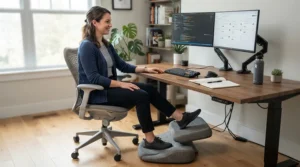
Practical Usage Guide: Setting Up Your Footrest for Standing Desk Anti-Fatigue Comfort
Calibrate at standing height. Set your desk so your elbows rest at roughly 90° with relaxed shoulders. Then stand naturally and note where your free foot wants to land with a slight knee bend. Choose or adjust your footrest to meet that spot.
Place it where your foot lands, not where it’s tidy. Slightly forward and off-centre works well for most people, because you step onto it rather than reach.
Build a routine. Research on sit stand desk schedules found that office workers preferred sit-to-stand ratios between 1:1 and 3:1, and that active break-time activities may help more with muscle fatigue and foot swelling than the schedule itself. So, after an hour of standing, a short walk probably beats another hour on a footrest.
First 30 days: start with 20-30 minute standing blocks, build slowly, and rotate feet whenever you notice stiffness.
Common mistakes: a footrest that’s too low, a smooth deck in socks, and treating it as a substitute for moving around. Check shoes too, because cushioned, supportive soles make a noticeable difference.
Real-World Scenarios: Matching Footrests to Real Setups
The home-working accountant (renting, small flat, around £30 budget, 3-4 hours standing). Floors are hard and space is tight. The Eureka Ergonomic Tilt Adjustable Footrest is the logical pick, with its compact metal body, free tilt and low price. Add a mat later if the floor is the real issue.
The office manager on a shared sit stand desk (workplace-funded, 5+ hours standing, moves between desks). Portability and an assessor-friendly spec matter. The Fellowes Breyta Foot Rest and Kensington SmartFit SoleMate Plus both suit this profile. If they stand long hours at one post, the Humanscale Foot Machine FM500 is the stretch upgrade.
The developer who fidgets (own home office, £200+ budget, 6 hours standing). They get restless after an hour. The Fluidstance Level matches that temperament, though they should start in 20-minute stints to avoid trading calf fatigue for something else. Grippy shoes help.
Notice that none of these scenarios suggests “buy the most expensive”. The right choice depends on desk height, floor type, and how restless you are.
Problem → Solution Guide for Standing Desk Footrests
Calf fatigue after 30 minutes. Shorten standing blocks, add a footrest for standing desk anti-fatigue support, and walk for a minute between blocks.
The footrest slides. Check the base for rubber contact and avoid slippery floors. A heavier model like the Kensington SmartFit SoleMate Plus helps.
The tilt moves when I shift weight. That’s normal for free-tilt models such as the Eureka Ergonomic Tilt Adjustable Footrest. If it annoys you, choose a lockable version.
The foot sits too low. At tall settings, move to a taller model, or consider a rail such as the Focal Upright Foot Bar.
Hard edges hurt. Switch to the softer Fellowes Breyta Foot Rest Cushion.
Knees ache. Keep a micro-bend in the standing leg and alternate feet more often. If pain persists, see your GP, because a footrest is comfort support, not treatment.
Long-Term Cost & Maintenance: What a Footrest Really Costs You
Value is easiest to judge per working day. Assume 230 working days a year. A £30 footrest used for three years works out at roughly 4p a day. A £120 premium rocker used for five years costs about 10p a day, and a £230 balance board over five years is around 20p. Premium models earn their keep only if you use them daily.
Maintenance is minimal. Wipe surfaces with a damp cloth, check rubber feet for wear and tighten tilt knobs occasionally. The Fellowes Breyta Foot Rest Cushion has a removable, hand-washable cover. The Humanscale Foot Machine FM500 and Eureka Ergonomic Tilt Adjustable Footrest use metal and plywood that should outlast hollow plastic, though I couldn’t verify long-term durability data for any of the seven.
Warranties are a useful tiebreaker. A five-year guarantee on the Fellowes Breyta Foot Rest Cushion and a lifetime guarantee on the Fluidstance Level are stronger signals than most budget alternatives offer. Always check the terms at purchase.
Safety, Regulations and Compliance Guide
For UK employees, the HSE’s guide to working with display screen equipment is the practical starting point. The Display Screen Equipment Regulations require workstations to meet minimum standards, including a footrest for any user who wants one. Standing and sit stand desk users should be included in workstation assessments, so ask your employer. If you’re self-employed or work at home, the same guidance is a sensible benchmark.
Some manufacturers reference EN ISO 9241-5, a workstation ergonomics standard, which is a helpful tick-box if your employer asks. It isn’t the same as UKCA or CE marking, so check what applies to each product.
Practical safety points:
- Avoid slippery surfaces and test grip in the shoes you’ll wear.
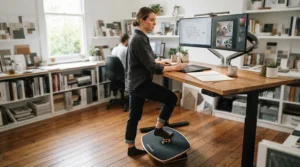
- Balance boards add a trip risk, so clear the floor around them.
- If you have balance problems, are pregnant, or have circulatory conditions such as varicose veins, speak to your GP before using a balance board.
- Keep cables clear of footrest paths.
FAQ
❓ Can I use a normal under-desk footrest at standing height?
❓ Is a rocking footrest worth paying more for?
❓ Can I put a footrest on an anti-fatigue mat?
❓ Should I wear shoes with a footrest?
❓ Does my employer have to provide one?
Conclusion
Standing is better than slumping, but standing still isn’t the answer. A footrest for standing desk anti-fatigue support works by giving you something to do with your legs: a perch, a rocker, a rail or a board. The research is mixed on forced routines, so choose gear that lets you move when your body asks.
For most people, the Eureka Ergonomic Tilt Adjustable Footrest is the sensible start, with the Fellowes Breyta Foot Rest Cushion a gentle alternative for home workers. If you share desks or switch positions often, the Kensington SmartFit SoleMate Plus and Fellowes Breyta Foot Rest make sense. If you stand all day, the Humanscale Foot Machine FM500, Fluidstance Level or Focal Upright Foot Bar are the premium and specialist routes.
Measure your standing height first and then buy. Rotate feet, take walking breaks and keep a soft bend in your knees. Your calves will thank you by Friday.
Recommended for You
- Footrest For Sciatica While Working At Desk: 7 Best Picks (2026)
- Gel Armrest Pads For Wrist Support: 7 Best Picks & Pitfalls (2026)
- Gel Armrest Pads For Office Chair: 7 Top Picks (2026)
Disclaimer: This article contains affiliate links. As an Amazon Associate, I earn from qualifying purchases. If you purchase products through these links, we may earn a small commission at no additional cost to you.
✨ Found this helpful? Share it with your friends! 💬🤗
