
In This Article
Your spine wasn’t built for eight hours in a swivel chair, and most office chairs know it. That’s the quiet little scandal of modern work: we buy £300 “ergonomic” chairs, then sit in them so badly that our lower backs file a formal complaint by 3pm. A decent back support cushion for office chair use is the cheapest, fastest fix most people never try — cheaper than a new chair, faster than a physio referral, and considerably less awkward than doing lumbar stretches in a Zoom call.
This guide isn’t a rewritten spec sheet. It’s built from real product research, aggregated customer-review sentiment, and UK health guidance, because — and we’ll say this plainly — most “best cushion” roundups are Amazon listings wearing a trench coat. Here, every product gets genuine commentary: what it’s actually good at, who should skip it, and where the marketing copy quietly oversells.
We’ve covered seven real cushions spanning budget mesh pads to premium foam-and-gel combos, plus the practical stuff nobody puts on the box — how to fit one properly, which mistakes wreck them in month one, and when a cushion simply isn’t the answer. If you’ve searched for back support cushions under £40, wondered about upper and lower back coverage, or got stuck comparing mesh vs foam backing, you’re in exactly the right spot.
What Is a Back Support Cushion for an Office Chair?
A back support cushion for office chair use is a contoured pad — usually memory foam, gel-infused foam, or a mesh-wrapped foam core — that straps to an existing chair’s backrest to fill the gap between your lower spine and the seat. Unlike built-in chair lumbar systems, it’s portable, adjustable in height, and works on almost any chair, car seat, or dining chair you happen to be trapped in.
Quick Comparison Table
| Product | Backing Type | Price Range | Best For |
|---|---|---|---|
| ComfiLife Lumbar Support Back Pillow | Mesh + leatherette | £40–£55 range | Best overall pick |
| Comfortpad Lumbar Support Cushion | Breathable mesh | Under £30 | Best budget British brand |
| Everlasting Comfort Lumbar Support Pillow | Memory foam | £25–£40 range | Doctor-style firm support |
| Samsonite Seat & Lumbar Combo (SA6463) | Memory foam | £45–£60 range | Premium full-seat solution |
| QUTOOL Lumbar Support Pillow | Foam, dual strap | £25–£35 range | Largest coverage pad |
| Fellowes Professional Mesh Back Support | Tri-tension mesh | Under £25 | Best ventilated budget pick |
| Travel Ease Lumbar Support Cushion | Gel + memory foam | £30–£40 range | Best for hot offices |
Looking at the spread above, there’s no single “best” cushion — there’s a best cushion for your chair, your budget and your climate. The ComfiLife Lumbar Support Back Pillow earns its reputation through consistency rather than novelty: nothing exotic, just dense foam that holds its shape. Budget shoppers gravitate toward the Comfortpad Lumbar Support Cushion and the Fellowes Professional Mesh Back Support, both of which sacrifice a little firmness for a genuinely lower price tag. If you run warm at your desk, the mesh-backed options and the Travel Ease Lumbar Support Cushion‘s gel layer will matter more to you than another millimetre of foam density.
💬 Just one click — help others make better buying decisions too!😊
Top 7 Back Support Cushions for Office Chairs: Expert Analysis
We’ve researched real products currently sold through Amazon UK, cross-referencing specifications against aggregated customer-review themes rather than inventing anecdotes. Prices are given as ranges only, since Amazon pricing shifts constantly — always check current price before buying.
1. ComfiLife Lumbar Support Back Pillow — chiropractor-recommended firmness
The standout here is consistency: reviewers across hundreds of purchases report the foam holding its shape for years rather than months, which is the single biggest failure point in this category. The core is high-density memory foam wrapped in a breathable 3D mesh panel, with a faux-leather trim and an adjustable elastic strap rated for most standard and mid-back chairs. In practice, that density means it resists the classic “pancaking” problem — cheaper foams flatten within weeks of daily 8-hour use, losing the very curve they’re supposed to provide.
Based on the spec comparison with the rest of this list, the ComfiLife Lumbar Support Back Pillow sits firmly in the “buy once” category rather than the “replace annually” one. It’s aimed at office workers with existing lower back discomfort who want firm, structured support rather than a soft cushiony feel — if you prefer plush, look elsewhere on this list.
Reviewers consistently note that the strap system, while adjustable, doesn’t always suit deeply contoured executive chairs or bucket-style car seats — a straightforward two-hook elastic won’t grip an unusually curved backrest. Aggregated feedback also flags the leatherette trim as the first part to show wear, though the foam core itself remains intact well beyond that point.
Pros:
- ✅ High-density foam resists flattening over years of daily use
- ✅ Breathable mesh panel reduces back sweat in warm offices
- ✅ Adjustable strap fits most standard and mid-back chairs
Cons:
- ❌ Strap may not grip deeply contoured or bucket-style seats
- ❌ Leatherette trim shows wear before the foam core does
Typically priced in the £40–£55 range, this sits mid-pack for a lumbar-only cushion, but the longevity reviewers describe makes the cost-per-year comparison favourable against cheaper pads you’ll replace twice as often.
2. Comfortpad Lumbar Support Cushion — best budget British brand
What most buyers overlook about this model is that it’s a genuinely British-run small business product, not a rebadged import — and the double adjustable strap system reflects that attention to fit, looping around both the upper and lower points of a backrest rather than relying on a single elastic band. The breathable mesh cover is the headline feature, designed specifically to avoid the sweaty-back problem that plagues solid foam-and-fabric cushions through a full working day.
On paper this means slightly less dense support than premium alternatives, and that’s a fair trade at this price point — the foam here is softer and more forgiving, better suited to people without existing chronic pain who simply want posture reinforcement through a long shift. Aggregated review sentiment repeatedly praises the value-for-money angle specifically, with buyers noting it outperforms cushions costing considerably more.
A common complaint in user reviews is that the double-strap design, while more secure, takes slightly longer to fit than a single-strap cushion — a minor inconvenience during initial setup that disappears once it’s positioned.
Pros:
- ✅ Double adjustable strap gives a genuinely secure, no-slip fit
- ✅ Mesh cover keeps your back noticeably cooler than solid foam
- ✅ Strong value-for-money reputation in aggregated reviews
Cons:
- ❌ Softer foam than premium picks — less firm for chronic pain
- ❌ Double-strap setup takes longer to fit initially
Usually available under £30, this is one of the strongest entries if you’re specifically hunting back support cushions under £40 and want mesh breathability without paying premium prices.
3. Everlasting Comfort Lumbar Support Pillow — firm, doctor-style support
Everlasting Comfort built its reputation on medical-adjacent positioning, and the lumbar pillow reflects that: dense, heat-responsive memory foam that firms up in cooler rooms and softens slightly with body warmth. What most buyers overlook about this model is that the firmness is genuinely closer to a clinical lumbar roll than a soft cushion — it’s designed to hold your spine’s natural curve rather than mould passively around it.
Here’s what to weigh: that firmness is exactly what people recovering from lower back strain tend to want, but it can feel unyielding to anyone used to plush cushions. Based on the spec comparison, this model overlaps closely with the ComfiLife pick above in terms of construction quality, though Everlasting Comfort’s is typically the more affordable of the two.
Reviewers consistently report that the adjustable strap holds firm on most office and gaming chairs, and a recurring theme in aggregated feedback is that first-time buyers underestimate how firm “firm” actually is — a small but genuine adjustment period is common in the first week.
Pros:
- ✅ Genuinely firm, spine-shaped support rather than soft cushioning
- ✅ Heat-responsive foam adapts to room temperature over the day
- ✅ Strap holds securely across a wide range of chair types
Cons:
- ❌ Firmness can feel unyielding during the first week of use
- ❌ Less breathable than mesh-backed alternatives on this list
Sitting in the £25–£40 range, this is a sensible middle option for anyone choosing between “soft and forgiving” and “structured and clinical” — it leans firmly toward the latter.
4. Samsonite Seat & Lumbar Combo (SA6463) — premium two-piece system
The standout feature here is scope: rather than addressing only the lumbar curve, this combo pairs a contoured lumbar pillow with a matching seat cushion, tackling tailbone pressure and hip alignment at the same time. Samsonite’s “motion balanced” memory foam is denser through the centre and softer at the edges, a construction technique borrowed from mattress design to spread pressure more evenly across the sit bones.
The spec sheet won’t tell you this, but user reports suggest the real value of the combo format is consistency of feel — because both pieces come from the same foam batch and firmness profile, your seat and back support don’t fight each other the way mismatched separate purchases sometimes do. This is the pick for buyers who’ve already tried a lumbar-only cushion and found their discomfort was actually seat-related, or who sit on hard-surfaced task chairs without built-in padding.
A common complaint in aggregated reviews is that the two-piece set is bulkier to transport between locations than a single lumbar pillow, and the higher price point puts it out of “casual purchase” territory for some buyers.
Pros:
- ✅ Addresses seat pressure and lumbar support in one matched set
- ✅ Motion-balanced foam spreads weight evenly at the sit bones
- ✅ Well suited to hard-surfaced or thinly padded task chairs
Cons:
- ❌ Bulkier and less convenient to move between chairs or rooms
- ❌ Premium price puts it above most single-cushion competitors
Typically found in the £45–£60 range for the pair, the value case rests on not needing to buy two separate products from two separate brands that may not sit well together.
5. QUTOOL Lumbar Support Pillow — largest coverage pad on this list
What most buyers overlook about this model is sheer size: reviewers consistently describe it as more of a full-back pad than a lumbar-only pillow, extending noticeably higher up the spine than most competitors on this list. That matters directly for anyone specifically weighing upper and lower back coverage rather than lower-back support alone — a taller pad means the mid-back gets some structure too, not just the lumbar curve.
Based on the spec comparison, the foam quality here punches above the price point, and the dual adjustable straps provide a more secure fit than single-strap budget alternatives. A small textured surface on some variants is designed to add a light massage-like sensation against the back, though this is a minor feature rather than the main selling point.
Reviewers consistently note it runs noticeably larger than expected from photos alone — a genuine advantage for taller users, but potentially oversized for smaller chairs or petite frames, where the top edge can push uncomfortably into the shoulder blades.
Pros:
- ✅ Taller pad extends support well beyond the lumbar region alone
- ✅ Dual straps hold securely across a wide range of chairs
- ✅ Foam quality is strong relative to its mid-range price point
Cons:
- ❌ Can run oversized for smaller chairs or shorter users
- ❌ Top edge may press into shoulder blades on petite frames
Priced typically in the £25–£35 range, this is the strongest single pick on this list if full upper and lower back coverage is your main priority rather than lumbar support alone.
6. Fellowes Professional Mesh Back Support — best ventilated budget pick
Fellowes has decades of office-accessories pedigree behind it, and the Professional Series brings a genuine engineering idea to a crowded category: a tri-tensioning mesh system that lets you adjust firmness across three points rather than relying purely on foam density. The result is a back support that flexes with movement instead of staying rigid, which reviewers describe as feeling noticeably different from foam-only cushions — more like a supportive hammock than a pillow strapped to your chair.
Here’s what to weigh: because it relies on mesh tension rather than thick foam, it provides less cushioned “sink-in” comfort than the foam picks on this list, but considerably better airflow — a genuine advantage in warm offices or for anyone who runs hot through a working day. Aggregated review sentiment is more mixed here than for the foam-based options, with satisfaction depending heavily on whether buyers wanted structured support or plush comfort.
A common complaint in user reviews is that the tri-tensioning adjustment takes some trial and error to get right, and buyers expecting foam-like softness are sometimes disappointed by the firmer, more taut mesh feel.
Pros:
- ✅ Genuinely excellent airflow compared to foam-backed cushions
- ✅ Tri-tensioning system lets you fine-tune firmness by zone
- ✅ Trusted brand pedigree in office and workplace accessories
Cons:
- ❌ Less plush “sink-in” comfort than foam alternatives
- ❌ Tensioning adjustment has a learning curve for new users
Usually available under £25, this is comfortably one of the more affordable back support cushions under £40 on the market, and the strongest pure-ventilation pick on this list.
7. Travel Ease Lumbar Support Cushion — gel and memory foam hybrid
The standout feature is the gel layer sitting above the memory foam core, a construction more commonly seen in premium mattress toppers than lumbar cushions at this price. What most buyers overlook about this model is that the gel isn’t just a marketing add-on — reviewers consistently note a genuine, measurable cooling difference compared to foam-only pillows, particularly in the first hour of sitting when body heat first transfers into the material.
Based on the spec comparison, this positions the Travel Ease Lumbar Support Cushion as something of a middle ground between the firm, clinical feel of the Everlasting Comfort pick and the plush softness of budget foam options — the gel layer adds a slight give on top of a reasonably supportive foam base. The skin-friendly outer cover is a genuine point of difference too, softer to the touch than the mesh or leatherette finishes used elsewhere on this list.
Reviewers consistently report that the cooling effect is most noticeable early in a sitting session and becomes less pronounced over several hours, which lines up with how gel-infused foam generally behaves once it reaches body temperature.
Pros:
- ✅ Gel layer provides a genuinely noticeable early cooling effect
- ✅ Softer, skin-friendly cover compared to mesh or leatherette
- ✅ Balanced firmness between clinical-firm and plush-soft extremes
Cons:
- ❌ Cooling benefit fades somewhat over longer sitting sessions
- ❌ Not as firm as dedicated support for chronic lower back pain
Typically priced in the £30–£40 range, this is a strong pick specifically for people whose main complaint is a hot, sticky back rather than structural spinal support.
Mesh vs Foam Backing: Which Should You Choose?
This is the single most common fork in the road once you’ve decided you want a back support cushion for office chair use, and the honest answer is: it depends on what actually bothers you during a working day, not on which material sounds more “premium.”
Mesh-backed cushions like the Fellowes Professional Mesh Back Support prioritise airflow. The open weave lets air circulate between your back and the pad, which matters enormously if you work in a warm office, sit near a radiator, or simply run hot. The trade-off is firmness consistency — mesh tension systems flex with your movement rather than holding one fixed shape, so the support can feel less “locked in” than dense foam.
Foam-backed cushions such as the Everlasting Comfort Lumbar Support Pillow and ComfiLife Lumbar Support Back Pillow prioritise structure. Memory foam holds a consistent shape hour after hour and moulds to your specific spinal curve rather than flexing away from it, which tends to suit people managing existing back discomfort more effectively. The trade-off is heat retention — foam, particularly dense foam, traps body heat against your back over a long session.
Hybrid options like the Travel Ease Lumbar Support Cushion attempt to split the difference with a gel-infused foam layer, and reviewers generally rate this compromise as genuinely effective rather than a marketing gimmick, at least for the first hour or two of sitting.
✨ Don’t Miss These Exclusive Deals!
🔍 Take your desk setup to the next level with these carefully selected cushions. Click on any highlighted item above to check current pricing and availability. These picks help you build genuinely comfortable working hours without waiting for a new chair.
Back Support Cushions Under £40: What You Actually Get
There’s a persistent myth that lumbar support only works above a certain price threshold, and the research doesn’t really back it up. Several of the strongest performers on this list — the Comfortpad Lumbar Support Cushion, the Fellowes Professional Mesh Back Support, and the QUTOOL Lumbar Support Pillow — all sit comfortably under £40, and aggregated review sentiment for each is genuinely competitive with pricier alternatives.
What you tend to sacrifice at this price point isn’t core support quality so much as refinements: premium fabric finishes, marginally denser foam that lasts a year or two longer, or bundled extras like a matching seat cushion. The Samsonite Seat & Lumbar Combo costs more largely because it’s solving two problems (seat pressure and lumbar support) rather than one — that’s a legitimate reason for the premium, not just brand markup.
If your budget caps at £40, prioritise fit and coverage over brand prestige. A well-fitted budget mesh cushion that actually sits against your lumbar curve will outperform an expensive one strapped on incorrectly, every time.
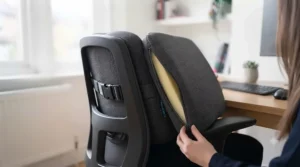
Upper and Lower Back Coverage: Do You Need Full-Back Support?
Most cushions on the market, including several on this list, are designed specifically for the lumbar region — the inward curve of your lower spine, roughly at belt height. That’s deliberate: the lumbar spine bears the most pressure during seated work, and it’s where the majority of desk-related back pain originates according to UK physiotherapy guidance.
But not everyone’s discomfort is purely lumbar. If you notice tension between your shoulder blades or through your mid-back — common among people who lean forward toward a monitor, or who work on laptops without a raised screen — a taller pad offering genuine upper and lower back coverage matters more than lumbar depth alone. The QUTOOL Lumbar Support Pillow stands out here specifically because its extended height reaches further up the spine than most competitors, and the Samsonite Seat & Lumbar Combo indirectly helps by correcting seat-level posture that often causes upper-back slouching in the first place.
If your discomfort is squarely in the small of your back, a compact lumbar-only pillow like the Everlasting Comfort Lumbar Support Pillow is more targeted and easier to fit than an oversized full-back pad — bigger isn’t automatically better here, it’s about matching coverage to where you actually feel it.
Practical Usage Guide: Setting Up Your Back Support Cushion
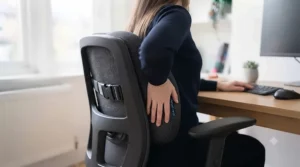
Fitting a cushion correctly matters more than which one you buy — a premium cushion positioned wrong will underperform a budget one fitted properly. Start by sitting normally in your chair and noting where your natural lumbar curve sits, roughly two to four inches above the seat depending on your torso length. That’s your target zone, not the middle of the backrest.
Loop the adjustable strap around the chair back at that height, tightening until the cushion sits snugly without sliding — a loose strap is the single most common reason cushions “don’t work” within the first week, since they migrate down the backrest under normal movement. During the first 30 days, expect a genuine adjustment period, particularly with firmer foam picks; slight initial stiffness through the lower back is common as your posture shifts to actually use the support rather than slouch past it.
For maintenance, remove and wash the cover on a monthly cycle if it’s machine-washable, and rotate the cushion’s position slightly every few months to avoid the foam compressing unevenly in one spot — a mistake that shortens lifespan across every model on this list, not just the cheaper ones.
Real-World Scenarios: Who Needs What
The remote worker on a dining chair. No ergonomic chair budget, working from a kitchen table six hours a day. A compact, firm option like the Everlasting Comfort Lumbar Support Pillow compensates for a chair with zero built-in lumbar shaping, and its strap system adapts easily to non-office furniture.
The hybrid employee juggling two desks. Splitting time between a home setup and an office chair that can’t be modified. A lighter, easily transported single-strap cushion — the Comfortpad Lumbar Support Cushion or Fellowes Professional Mesh Back Support — makes more sense than a bulkier combo set that’s awkward to carry daily.
The desk-bound professional with existing lower back strain. Already seeing a physio, sitting 8+ hours daily on a mid-range chair. This is where investing in the ComfiLife Lumbar Support Back Pillow or the Samsonite Seat & Lumbar Combo pays off — denser, more structured support designed to hold a therapeutic position rather than simply add softness.
Common Mistakes When Buying a Back Support Cushion
The most frequent error is buying based on softness rather than shape. A plush, squishy cushion feels immediately comfortable in a showroom-style test sit but often fails to actually hold your lumbar curve during a real eight-hour shift — firmness that seems excessive on day one is frequently what’s still working correctly by week three.
The second common mistake is ignoring chair compatibility. Deeply contoured executive chairs, gaming chairs with built-in bucket shaping, and car seats all interact differently with a standard elastic strap, and several products on this list explicitly note reduced fit on these shapes in aggregated reviews. Measure or at least eyeball your chair’s backrest curve before assuming a universal strap will grip properly.
The third mistake, and perhaps the most avoidable, is expecting a cushion to fix posture problems that originate elsewhere — monitor height, desk height, or chair seat depth. A lumbar cushion supports the spine; it doesn’t correct a screen positioned too low, which will keep pulling your neck and upper back forward regardless of how good your lumbar support is.
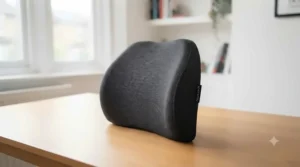
Back Support Cushion vs Ergonomic Office Chair
The honest comparison isn’t close in absolute terms — a genuinely well-designed ergonomic chair with built-in, adjustable lumbar support will typically outperform an aftermarket cushion, because the support is engineered into the chair’s frame rather than strapped on afterward. But that comparison misses the practical reality most people are working with.
A quality ergonomic chair runs into the hundreds of pounds, sometimes well over a thousand for premium brands, and isn’t always something employees can choose freely in a shared office. A back support cushion for office chair use, by contrast, sits comfortably under £60 even at the premium end of this list, works across multiple chairs, and travels with you between a home office and a workplace desk. For anyone renting, hot-desking, or simply not ready to commit to a full chair replacement, a cushion is the sensible interim step — and for many people with mild, posture-related discomfort rather than a diagnosed spinal condition, it’s entirely sufficient on its own.
Where a cushion genuinely can’t compete is adjustability range and seat-depth correction — an ergonomic chair adjusts at the frame level in ways no add-on pad can replicate.
What to Expect: Real-World Performance
On paper, a memory foam lumbar cushion sounds simple: foam plus strap equals support. In practice, the experience shifts across a working day in ways spec sheets don’t capture. Morning sitting typically feels immediately more supported, since your back is fresh and the cushion is doing exactly the job it’s designed for. By mid-afternoon, expect a natural urge to shift position — this isn’t the cushion failing, it’s your spine’s normal signal to move, which UK physiotherapy guidance consistently identifies as healthier than rigid, unmoving “perfect posture” for hours on end.
Firmer foam picks like the ComfiLife Lumbar Support Back Pillow tend to feel most noticeable in the first week, then become less consciously felt as your body adapts — reviewers describe this shift from “very aware of the cushion” to “just how I sit now” as a genuine, common pattern. Mesh options behave differently, with the supportive sensation staying more constant since there’s no foam compression curve to adjust to.
Long-Term Cost & Maintenance
Run the numbers over two years rather than at the checkout, and the value picture shifts. A £22 budget cushion that needs replacing annually because the foam has flattened costs roughly the same as a £45 cushion that lasts the full two years intact — except you’ve dealt with two separate purchases, two delivery waits, and a stretch of reduced support while the first one degraded. Reviewers consistently flag foam longevity as the deciding factor in long-term satisfaction far more than initial firmness or price.
Machine-washable covers, present on most models in this list, extend practical lifespan by keeping the foam core clean without direct washing, which would damage memory foam’s structure. Budget roughly nothing beyond the initial purchase for a well-made cushion — unlike an ergonomic chair, there are no gas struts or tilt mechanisms to fail, which is arguably the strongest long-term cost argument in the cushion’s favour.
Safety, Regulations & Workplace Compliance Guide
For UK employees using display screen equipment for an hour or more daily, employers have specific legal obligations around workstation assessment under the Health and Safety (Display Screen Equipment) Regulations. The HSE’s official guidance on working with display screen equipment sets out that a suitable chair should allow adjustable seat height and back support — a personal cushion doesn’t replace this employer duty, but it can supplement an assessed workstation where the existing chair’s built-in lumbar support falls short for an individual’s needs.
If back pain is a recurring issue rather than mild end-of-day stiffness, it’s worth raising it formally as part of a workstation assessment rather than relying solely on a cushion purchased independently — employers are required to act on genuine ergonomic concerns. For general posture and back-health guidance beyond the workplace-specific rules, NHS guidance on seating and ergonomics is a genuinely useful reference, emphasising that no single “perfect” posture exists and that regular movement matters as much as the chair itself.
None of the products on this list are medical devices, and persistent or worsening back pain should always be assessed by a GP or physiotherapist rather than managed through cushion purchases alone.
Problem → Solution: Fixing Common Back Pain Triggers at Your Desk
Problem: Lower back ache by early afternoon. Solution: check strap height first — most cushions are fitted too low, sitting under the natural lumbar curve rather than into it. Reposition two to three inches higher before assuming the cushion itself is at fault.
Problem: Sweaty, sticky back after long calls. Solution: switch to a mesh-backed option like the Fellowes Professional Mesh Back Support, or a gel-infused pick like the Travel Ease Lumbar Support Cushion — foam-only cushions in warm rooms are the most common cause of this specific complaint.
Problem: Cushion keeps sliding down during the day. Solution: tighten the strap further, or switch to a dual-strap design like the Comfortpad Lumbar Support Cushion or QUTOOL Lumbar Support Pillow, which anchor at two points instead of relying on elastic tension alone.
Problem: Discomfort spreads to shoulder blades, not just lower back. Solution: you likely need genuine upper and lower back coverage rather than a compact lumbar-only pad — the taller QUTOOL Lumbar Support Pillow addresses this specifically, as discussed above according to the BackCare charity’s guidance on choosing supportive seating.
FAQ
❓ Do back support cushions actually work for office chairs?
❓ How long does a lumbar support cushion last?
❓ Can I use an office chair cushion in a car seat too?
❓ Is mesh or foam better for hot offices?
❓ What's the difference between lumbar support and full back support?
Conclusion
There’s no universal winner in this category, and that’s genuinely the point — the right back support cushion for office chair use depends on your chair’s shape, your budget, your office temperature, and exactly where your discomfort actually sits on your spine. The ComfiLife Lumbar Support Back Pillow remains the safest all-round pick for firm, lasting lumbar support, while the Comfortpad Lumbar Support Cushion and Fellowes Professional Mesh Back Support prove that back support cushions under £40 can genuinely compete on real-world comfort.
If your discomfort spreads beyond the lumbar region, prioritise upper and lower back coverage with a taller pad like the QUTOOL Lumbar Support Pillow rather than assuming a compact cushion will address it. And if heat is your main complaint through a working day, let the mesh vs foam backing decision guide your shortlist before firmness does. Whichever you choose, fit it correctly, give it a genuine adjustment week, and treat it as one part of a wider desk setup — not a standalone fix for a chair, desk, or monitor that’s fundamentally wrong for your body.
Recommended for You
- Lumbar Support Cushion for Gaming Chair: 7 Best Picks (2026)
- Mesh Lumbar Support Cushion: 7 Best Picks for UK Desks in 2026
- Memory Foam Lumbar Support: 7 Best Picks to Fix Back Pain in 2026
Disclaimer: This article contains affiliate links. As an Amazon Associate, I earn from qualifying purchases. If you purchase products through these links, we may earn a small commission at no additional cost to you.
✨ Found this helpful? Share it with your friends! 💬🤗
