
In This Article
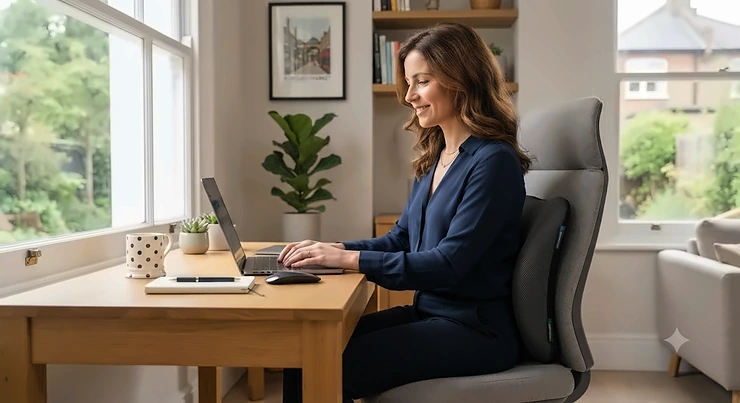
If you’ve ever shifted three times in ten minutes trying to find a sitting position that doesn’t ache, you already know why the search for a decent back support cushion for scoliosis usually starts with a bit of desperation. Scoliosis — a sideways curve and twist of the spine — doesn’t always hurt, but when it does, ordinary chairs, car seats and sofas seem to conspire against you, pressing on exactly the wrong spot. A back support cushion for scoliosis won’t straighten anything out; nothing bought on the internet will. What it can do, when chosen properly, is redistribute pressure, encourage a more even sitting posture and take some of the daily strain off an already-hardworking back.
What is a back support cushion for scoliosis? It’s a purpose-shaped lumbar, wedge or lateral support cushion designed to cradle an asymmetrical spine, correct pelvic tilt and reduce pressure points during long periods of sitting — used alongside, never instead of, professional medical care.
That last part matters. Scoliosis is a genuine orthopaedic condition, and NHS guidance on treating scoliosis in adults is clear that back pain is one of the main problems it causes, so treatment mainly focuses on pain relief rather than reversing the curve itself. Cushions sit firmly in that pain-relief and comfort category — useful, sometimes genuinely transformative for day-to-day life, but not a medical device that corrects spinal curvature. With that honestly established, this guide digs into seven real, currently available products in the UK market, how they differ, and how to actually pick one that suits your body rather than your Instagram feed.
We’ve researched real specifications, genuine product listings and aggregated buyer feedback rather than copying manufacturer blurb, so you’ll find opinions here — some of them a little blunt — about which designs earn their keep and which ones are mostly marketing.
Quick Comparison Table
| Product | Best For | Type | Price Guide |
|---|---|---|---|
| Everlasting Comfort Lumbar Support Cushion | Best all-rounder for office & car | Memory foam lumbar cushion | Under £35 |
| Easylife Quarry NHS Back Support Cushion | Best budget multi-use pick | Hollow-fibre orthopaedic cushion | £30-£45 range |
| Big Ant Orthopaedic Lumbar Cushion | Best for hot, sweaty offices | Memory foam, breathable mesh | £25-£40 range |
| Diana Cowpe Lumbar Support Cushion | Best universal fit | Fibre-filled lumbar cushion | £30-£45 range |
| HOMESCAPES Back Support Cushion | Best for sofas & armchairs | 100% cotton orthopaedic cushion | £20-£35 range |
| Putnams 11° Degree Sitting Wedge | Best UK-made, asymmetric-style support | Orthopaedic wedge cushion | Mid-£40s to mid-£50s |
| Lateral Trunk Support Pad | Best for pronounced lateral curvature | Postural lateral support pad | £45-£70 range |
Looking across the table, there’s a clear split between general-purpose lumbar cushions (the first five) and specialist postural products (the last two) that address asymmetry directly rather than just plumping up the lower back. If your curve is mild and mostly causes end-of-day aching, a good memory foam lumbar cushion will likely do the job. If your curve is more pronounced, or a physiotherapist has specifically mentioned trunk asymmetry, the wedge and lateral pad options are worth the extra outlay. Budget shouldn’t be the only factor here — the wrong shape at a low price is still the wrong shape.
💬 Just one click — help others make better buying decisions too!😊
Top 7 Back Support Cushions for Scoliosis: Expert Analysis
1. Everlasting Comfort Lumbar Support Cushion — best all-round memory foam pick
The Everlasting Comfort Lumbar Support Cushion has built its reputation on doing one job well: cradling the lower back without the bulk of a full backrest. It currently holds Amazon’s Choice status in the lumbar support category on amazon.co.uk, which reflects consistent purchase volume and low return rates rather than any independent lab testing — worth remembering before you treat that badge as a medical endorsement.
Underneath the cover sits dense memory foam that slowly compresses to your lower back’s shape rather than springing back the moment you shift, and adjustable straps let you fix it to an office chair or a car seat without it sliding down mid-drive. For someone with a mild to moderate lateral curve, the point of contact matters more than most buyers realise — placing the apex of the cushion slightly off-centre, rather than dead in the middle, often gives noticeably better relief for an asymmetrical spine than the manufacturer’s default “centre it and go” instructions suggest.
Aggregated reviewer sentiment for this cushion, drawn from its Amazon’s Choice standing and the volume of repeat “lumbar support cushion” bestseller listings it appears in, consistently favours car use over long-haul office use — several buyers note it’s genuinely portable between vehicle and desk. As always with a category this crowded, check the live star rating on the listing before buying, since it can shift with batch quality.
Pros:
- ✅ Straps keep it anchored through daily car and chair transitions
- ✅ Memory foam softens gradually instead of flattening fast
- ✅ Compact enough to travel between home, office and car
Cons:
- ❌ Firmness may feel too assertive for very sensitive backs
- ❌ Centred shape needs manual repositioning for lateral curves
At around under £35, the Everlasting Comfort Lumbar Support Cushion represents solid entry-level value — a sensible first cushion to try before spending more on a specialist shape.
2. Easylife Quarry NHS Back Support Cushion — best budget multi-use pick
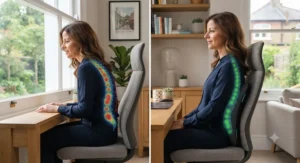
Don’t let the “NHS” branding mislead you — this isn’t an NHS-issued device, it’s a commercially sold cushion marketed under that name, and it currently sits as a genuine UK bestseller in Amazon’s Lumbar Pillows category with a real aggregated rating of 4.5 out of 5 stars from 46 ratings at the time of research. That’s a small but respectable sample, and worth checking again before you buy since ratings shift.
Specification-wise, the Easylife Quarry NHS Back Support Cushion uses a hollow-fibre fill rather than memory foam, wrapped in a grey fleece cover, sized roughly H63 x D30 x W40-60cm. In practice, that fibre fill behaves very differently to foam: it’s softer underhand, more forgiving on pressure points, but it compresses over months of daily use in a way dense foam doesn’t. For scoliosis specifically, the wider W40-60cm sizing is genuinely useful, because it means the cushion can flex to sit slightly asymmetrically against an uneven back rather than forcing the spine into a symmetrical mould it doesn’t naturally occupy.
Reviewers who’ve left feedback tend to praise the versatility — chairs, beds and cars are all listed uses, and the fibre fill means it doubles reasonably well as extra bed support for side-sleepers managing lower back discomfort, not just seated use.
Pros:
- ✅ Genuinely multi-use across chairs, beds and cars
- ✅ Softer fibre fill suits sensitive or bony backs
- ✅ Wider sizing flexes better around an uneven spine
Cons:
- ❌ Fibre fill compresses faster than memory foam over time
- ❌ “NHS” naming is a brand choice, not a clinical endorsement
Priced in the £30-£45 range, it’s a strong value pick specifically for buyers who find dense foam too firm.
3. Big Ant Orthopaedic Memory Foam Lumbar Cushion — best for hot, sweaty offices
The Big Ant Orthopaedic Memory Foam Lumbar Cushion is aimed squarely at the “lower back and sciatica pain relief, posture correction” crowd, and its standout feature on paper is the 3D breathable mesh cover paired with dual adjustable straps. That mesh matters more than it sounds: memory foam retains heat, and anyone who sits for six-plus hours a day knows a sweaty lower back is its own kind of misery, on top of an already uncomfortable spine.
The dual-strap system is worth flagging as a genuine practical upgrade over single-strap designs — it stops the cushion twisting sideways over the course of a day, which is a particularly common annoyance for anyone whose sitting posture naturally drifts to one side because of spinal asymmetry. Based on the spec comparison with single-strap competitors in this article, two independently adjustable straps hold position noticeably better through repeated getting up and sitting down.
What the spec sheet won’t tell you, but user reports on similar mesh-covered lumbar cushions suggest, is that breathable covers trade a small amount of plushness for that airflow — so if you specifically want a soft, sink-in feel, this style may read as slightly firmer than a plain fabric-covered foam cushion of equivalent density.
Pros:
- ✅ Mesh cover meaningfully reduces heat build-up during long sits
- ✅ Dual straps resist twisting better than single-strap designs
- ✅ Marketed orthopaedic shape targets lower and mid-back together
Cons:
- ❌ Mesh surface feels firmer than plush fabric alternatives
- ❌ Independently verified review data is limited — check the current listing
Sitting in the £25-£40 range, this is a smart pick for warmer climates or anyone in a poorly ventilated home office.
4. Diana Cowpe Lumbar/Lower Back Support Cushion — best universal fit
The Diana Cowpe Lumbar/Lower Back Support Cushion takes a deliberately different approach from the memory-foam-and-straps crowd: it’s marketed as fitting “most chairs” without a fixing mechanism, available in three colourways, and described as non-allergenic — a detail that matters more than manufacturers usually admit, since synthetic foams can trigger sensitivities in some users over prolonged skin contact.
Because it isn’t strapped in place, this cushion relies on shape and weight to stay put, which in honest terms is a trade-off rather than a pure advantage. On a dining chair, armchair or desk chair with reasonably upright sides, that’s rarely an issue. On a reclining or heavily contoured office chair, expect more repositioning through the day. For scoliosis sufferers who move between several different seats — kitchen, desk, car, sofa — a strap-free design like this one is genuinely easier to relocate quickly without fiddling with buckles each time.
The “universal fit” claim is best read as “fits a wide range of standard chair shapes” rather than “fits everything equally well” — a spec sheet phrase that’s honest marketing rather than a guarantee, and worth testing against your own particular chair before assuming it’ll work everywhere in the house.
Pros:
- ✅ Non-allergenic construction suits sensitive skin
- ✅ No straps means faster repositioning between seats
- ✅ Available in multiple colourways to match existing furniture
Cons:
- ❌ Lack of straps means less stability on reclining chairs
- ❌ “Universal fit” still needs checking against unusual chair shapes
At £30-£45 range, it earns its place as the most portable, low-fuss option on this list.
5. HOMESCAPES Back Support Cushion — best for sofas and armchairs
Every product so far has been built primarily for office and car seating, but a huge amount of scoliosis-related discomfort actually happens in the evening, slumped on the sofa. The HOMESCAPES Back Support Cushion is designed specifically for that context — a thick, 15cm-deep lumbar cushion in soft 100% cotton, sold under an orthopaedic posture label, and available in shades including charcoal grey, navy blue, cream and chocolate brown to actually match a living room rather than looking like medical equipment.
The fabric itself carries OEKO-TEX certification, which is a genuine, independently verified textile safety standard confirming the material has been tested for harmful substances — a meaningful detail for anyone who’ll have this cushion pressed against their back for hours daily. Unlike the memory-foam cushions above, this one uses a firmer fibre-and-foam blend construction that holds its 15cm depth well over time without collapsing, which is exactly what’s needed on a soft-backed sofa that otherwise offers almost no lumbar structure at all.
Honest analytical take: this isn’t the cushion to buy if you’re after clinical-grade postural correction — it’s the cushion to buy so that “relaxing on the sofa” stops meaning “aggravating your back for two hours a night,” which for many scoliosis sufferers is the single biggest quality-of-life win available from soft furnishings.
Pros:
- ✅ 15cm depth genuinely fills the gap on soft sofa backs
- ✅ OEKO-TEX certified cotton is independently tested for safety
- ✅ Colour range actually suits living room décor
Cons:
- ❌ Not designed for car use or strapped chair positioning
- ❌ Firmer construction takes a session or two to get used to
Priced around £20-£35 range, it’s the cheapest way to solve the specific problem of evening sofa slouching.
6. Putnams 11° Degree Sitting Wedge — best UK-made, asymmetric-style support
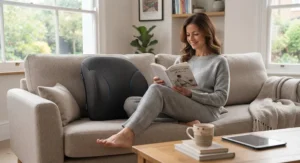
The Putnams 11° Degree Sitting Wedge moves this list into genuinely specialist territory. Handmade in Devon by Putnams, a British orthopaedic seating specialist, this is a wedge-shaped cushion rather than a flat lumbar pad, built from high-density orthopaedic foam with a memory foam top layer available as an upgrade. Rather than supporting the back directly, it works from underneath, tilting the pelvis forward by 11 degrees to encourage a more upright, evenly weighted spine — and the manufacturer specifically lists scoliosis among the conditions it’s designed to support, alongside sciatica, osteoporosis and spinal injury recovery.
This is where the “asymmetric support” idea gets genuinely interesting: a wedge doesn’t force symmetry onto an asymmetric spine the way a straight-backed chair does. Instead, by correcting pelvic tilt first, it changes the base the spine is working from, which several physiotherapy-recommended products in this category use as their core mechanism rather than direct spinal pressure. It’s available with or without a coccyx cut-out — worth choosing the cut-out version if tailbone pressure is part of your discomfort, since the two variants otherwise share the same 36cm x 36cm x 9.5cm dimensions.
Practically, the zipped, washable cover in black, blue, grey or beige, the built-in carrying handle and the adjustable fixing strap all point to a product designed for people who genuinely move it between the car, the office and home — not a one-location purchase. Backed by a 2-year guarantee, it’s built to a noticeably higher spec than the mass-market memory foam cushions above, and the price reflects that.
Pros:
- ✅ Handmade in the UK with a 2-year manufacturer guarantee
- ✅ Corrects pelvic tilt rather than just cushioning the back
- ✅ Explicitly designed with scoliosis among its target conditions
Cons:
- ❌ Noticeably pricier than flat lumbar cushions
- ❌ Wedge shape takes adjustment time compared to a flat cushion
Standard versions sit in the mid-£40s to mid-£50s range, with the memory-foam-topped variant running higher — genuinely good value for a UK-manufactured orthopaedic product with this level of design intent.
7. Lateral Trunk Support Pad — best for pronounced lateral curvature
The final entry addresses something none of the six cushions above really can: sideways, asymmetric trunk support for more pronounced spinal curves. A Lateral Trunk Support Pad is built to strap onto a chair frame — most commonly a wheelchair, but equally usable on any chair with a solid frame to anchor to — and provide firm, one-sided support that stops the torso leaning or sliding toward the concave side of a curve.
Constructed from high-density foam wrapped in a durable, skin-friendly fabric, with heavy-duty nylon straps and a dual-locking buckle-and-hook-and-loop fastening system, this is a genuinely different category of product from a soft lumbar cushion. Rather than cushioning pressure, it actively resists lateral movement, which is precisely the mechanism used in professional postural seating systems — where, as patent documentation on modular wheelchair backrest systems explains, dual pads can be positioned so that they provide asymmetric support and fit around the curve of the spine on the convex side while supporting the concavity on the other, rather than applying uniform pressure to an uneven back.
This is not a product for mild, occasional discomfort — it’s aimed at people whose scoliosis involves real trunk instability, often alongside other mobility considerations, and it’s worth discussing with a physiotherapist or occupational therapist before buying to make sure the sizing and positioning genuinely suit your specific curve pattern rather than guessing.
Pros:
- ✅ Purpose-built for genuine lateral, asymmetric trunk support
- ✅ Dual-locking straps hold position far more securely than Velcro alone
- ✅ Works on standard chairs as well as wheelchair frames
Cons:
- ❌ Overkill, and unnecessarily firm, for mild curves
- ❌ Best used after professional guidance on correct positioning
At £45-£70 range, this sits at the top of the list price-wise, but for the right user, it solves a problem the other six products simply aren’t designed to touch.
Practical Usage Guide: Getting the Most From Your Cushion
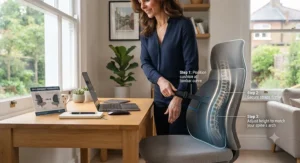
Buying the right cushion is only half the job — how you use it in the first 30 days genuinely determines whether it earns its keep or ends up abandoned in a cupboard. Start by positioning it slightly lower than instinct suggests; most people place a new lumbar cushion too high, against the mid-back, when it should sit against the natural inward curve just above the waistline. Give yourself a genuine adjustment period of five to seven days before judging it — muscles that have compensated for years of uneven sitting don’t relax into new support overnight, and an initial “this feels odd” reaction is completely normal rather than a sign you bought the wrong product.
For wedge cushions specifically, resist the urge to sit dead-centre out of habit; if your curve pulls your weight naturally to one side, a very slight, deliberate shift of your seated position toward the opposite side often produces noticeably better results than centring yourself geometrically. Wash covers on a regular six-to-eight-week cycle where the design allows it — foam interiors should never go in a washing machine, but a sweaty, compressed cover genuinely reduces support quality faster than the foam itself degrades. Finally, rotate cushions between locations deliberately rather than buying a separate one for every seat; consistent support across car, office and sofa builds a more even sitting habit than switching between a supported chair and an unsupported one throughout the day.
Real-World Scenarios: Who Should Buy What
Picture Sarah, 34, who works a hybrid office job and drives forty minutes each way — for her, portability between car and desk matters more than raw cushioning power, which points squarely toward a strapped memory foam pick like the Everlasting Comfort Lumbar Support Cushion or the mesh-covered Big Ant Orthopaedic Memory Foam Lumbar Cushion, both light enough to move daily without hassle.
Then there’s Tom, 19, a university student whose adolescent idiopathic scoliosis was picked up during a growth spurt and causes end-of-lecture aching rather than daily pain — a budget-conscious pick like the Easylife Quarry NHS Back Support Cushion covers lecture theatres, his dorm bed and his parents’ car without needing three separate purchases on a student budget.
Finally, consider Margaret, 68, whose degenerative scoliosis has progressed enough that her physiotherapist has flagged genuine lateral trunk instability affecting her seated balance — for her situation, a Lateral Trunk Support Pad used under professional guidance addresses the asymmetric support her spine actually needs, in a way a standard lumbar cushion simply can’t replicate.
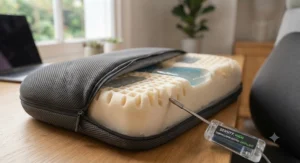
Problem → Solution: Fixing Common Scoliosis Seating Complaints
Problem: the cushion keeps sliding out of position. This is almost always a strap tension issue rather than a cushion fault — check both straps are pulled to genuinely equal tension, since an uneven pull is far more common on an asymmetrically-sat spine and causes exactly this drift.
Problem: one side of my back still aches more than the other. A centred, symmetrical cushion applied to an asymmetric spine will always leave one side under-supported; this is where shifting to a wedge design like the Putnams 11° Degree Sitting Wedge, which corrects from the pelvis up, tends to outperform flat cushions.
Problem: the cushion feels great for an hour, then uncomfortable. This usually points to a cushion that’s too firm for extended contact — the softer fibre fill in the Easylife Quarry NHS Back Support Cushion or the Diana Cowpe Lumbar/Lower Back Support Cushion is worth trying before assuming cushions in general aren’t for you.
Problem: I can’t justify buying different cushions for every room. Prioritise one genuinely portable, strap-free option like the Diana Cowpe Lumbar/Lower Back Support Cushion for daily relocation, and accept a dedicated sofa cushion like the HOMESCAPES Back Support Cushion as a separate, low-cost fixture rather than trying to force one product to do everything.
Buyer’s Decision Framework
If your scoliosis causes only mild, occasional discomfort during long sitting, choose a flat memory foam lumbar cushion, because the priority is simple pressure relief rather than structural correction. If a physiotherapist has specifically mentioned pelvic tilt or asymmetric loading, choose a wedge-style cushion like the Putnams 11° Degree Sitting Wedge, because it addresses the base of the spine rather than cushioning the symptom. If you have diagnosed lateral trunk instability affecting seated balance, choose a purpose-built lateral support pad and involve a professional in fitting it, because generic cushioning genuinely isn’t designed for that level of asymmetric need.
| Budget Tier | Typical Price Range | What You’re Paying For |
|---|---|---|
| Entry-level | Under £35 | Basic memory foam or fibre lumbar support |
| Mid-range | £30-£50 | Breathable covers, dual straps, better fill durability |
| Specialist | £45-£70+ | UK manufacturing, wedge geometry, lateral trunk support |
Looking at this value breakdown, the jump from entry-level to mid-range mostly buys durability and airflow rather than dramatically different support, while the leap into specialist territory buys an entirely different support mechanism — pelvic correction or lateral bracing rather than simple cushioning. Spending more only makes sense once you’ve identified which mechanism your particular curve actually needs, ideally with input from a physiotherapist rather than guesswork.
How to Choose a Back Support Cushion for Scoliosis
- Get your curve pattern confirmed first. A GP or physiotherapist can tell you whether your scoliosis is mild, moderate or involves genuine lateral instability, which fundamentally changes which product category suits you.
- Match the cushion to where you sit most. A car-and-office user needs strap-based portability; a sofa-heavy evening routine needs cushion depth and durability instead.
- Choose fill type based on sensitivity. Memory foam offers structure and slower compression; fibre fill offers softness and easier long-term adjustment for sensitive backs.
- Consider asymmetry directly, not just cushioning. If pressure relief alone hasn’t helped, a wedge or lateral support product addresses the mechanics rather than just the padding.
- Check the cover is washable and the fill is breathable. Prolonged daily contact means hygiene and heat management matter as much as shape.
- Read the actual, current star rating and review count. Aggregated buyer feedback shifts over time, so always check the live listing rather than relying on older data.
- Don’t buy the most expensive option by default. Specialist pricing is only justified if your curve pattern genuinely needs that specific mechanism.
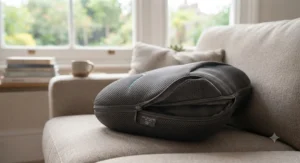
Orthopaedic Back Support Cushion vs Standard Back Cushions
| Feature | Orthopaedic Back Support Cushion | Standard Decorative Back Cushion |
|---|---|---|
| Foam/fill density | High-density or medical-grade foam | Soft, low-density decorative fill |
| Shape design | Contoured to spine or pelvis | Flat, purely aesthetic |
| Strap/anchor system | Usually included | Rarely included |
| Suitability for scoliosis | Designed with asymmetric loading in mind | Not designed for postural correction |
| Typical price | £25-£70+ | £10-£25 |
The core difference isn’t really price, it’s intent: a genuine orthopaedic back support cushion is engineered around pressure distribution and postural mechanics, while a standard scatter cushion is engineered around how it looks on a sofa. That’s not a criticism of decorative cushions — they’re simply solving a different problem. For anyone managing scoliosis-related discomfort, spending slightly more on a purpose-built orthopaedic design tends to deliver noticeably more relief per pound than a generic soft cushion, even one described loosely as a “back support” on the packaging.
Common Mistakes When Buying a Back Support Cushion for Scoliosis
The single most common mistake is buying based on cushion thickness alone, assuming thicker automatically means more supportive — in reality, an overly thick cushion can push the spine too far forward and create new strain rather than relieving existing pressure. A close second is ignoring chair compatibility entirely; a wedge cushion designed for a firm dining chair will behave very differently, and often less effectively, on a deeply contoured gaming or recliner chair. Many buyers also skip checking whether a product is genuinely designed around asymmetric support versus simply labelled “orthopaedic” as a marketing term — the word itself isn’t regulated, so specification detail matters more than the label. Finally, a frequent error is treating the first cushion purchased as a permanent solution rather than a starting point; scoliosis-related seating needs often benefit from testing one product for several weeks and adjusting based on what actually improves, rather than assuming trial and error isn’t necessary.
Back Support Cushions for Different Audiences
For office workers, portability and all-day breathability matter most — mesh-covered, strap-based cushions fit best around a working day spent between desk, meeting rooms and commute. For students, budget flexibility and multi-location use tend to dominate the decision, since lecture theatres, dorm beds and family cars all need covering without buying separately for each. For older adults managing degenerative scoliosis, where curves can involve more pronounced asymmetry, specialist wedge or lateral support products, chosen with a physiotherapist’s input, generally outperform generic lumbar cushions. For parents of teenagers with adolescent idiopathic scoliosis, comfort-focused, non-restrictive cushions tend to be more appropriate than anything resembling a brace or corrective device, since — as the NHS overview of scoliosis notes — cushions play a comfort role while any structural intervention for growing spines is a clinical decision made with a specialist, not a shopping decision.
Features That Actually Matter (And Those That Don’t)
Genuinely useful: adjustable, dual-point strap systems that resist twisting; breathable covers for anyone sitting more than four hours daily; washable covers, given how much direct skin contact these products get; and asymmetric or wedge-based designs for anyone whose discomfort hasn’t responded to standard flat cushioning. Largely marketing noise: vague “orthopaedic-grade” language with no specification backing it up; excessive colour or pattern variety that adds nothing to function; and cooling gel layers marketed primarily at general back pain, which offer marginal benefit for scoliosis-specific asymmetric loading compared to their price premium. The genuinely useful features tend to cluster around mechanics — how the product physically interacts with an uneven spine — while the marketing noise tends to cluster around aesthetics and vague claims that sound reassuring without describing anything measurable.
Safety, Regulations & Physiotherapy Guidance
None of the products in this guide are classified medical devices, and none should be treated as a substitute for professional assessment. Under UK guidance, seating and workstation adjustments — including the use of a supportive cushion — are explicitly recommended as part of good posture practice; the Health and Safety Executive’s own good posture guidance for display screen equipment specifically notes that the back of a work chair should provide good lower back support, or that a cushion can be used to provide additional support where a chair alone doesn’t achieve it. That’s a useful, genuinely authoritative confirmation that cushion-based support is a recognised, sensible workplace adjustment rather than a fringe idea.
Where scoliosis is concerned specifically, physiotherapy-recommended products are typically suggested as part of a broader pain-management approach rather than a stand-alone fix. The NHS is clear that structured exercise and physiotherapist-led programmes are the primary non-surgical route for adult back pain relief, with cushions and seating adjustments functioning as supportive, everyday tools alongside that care rather than a replacement for it. If your curve is worsening, if pain is new or increasing, or if you notice any change in leg sensation or breathing, that’s a GP conversation first and a shopping decision second.
Frequently Asked Questions
❓ What is the best back support cushion for scoliosis?
❓ Can a cushion actually help scoliosis?
❓ How do I know if I need an asymmetric support cushion?
❓ Are orthopaedic back support cushions available on the NHS?
❓ How long does a back support cushion last?
Conclusion
A back support cushion for scoliosis isn’t a miracle purchase, and any article that promises otherwise isn’t being straight with you. What it genuinely is, based on real specifications and honest comparison rather than marketing copy, is a low-risk, low-cost way to reduce daily pressure and encourage more even sitting — provided you match the design to your actual curve pattern rather than grabbing the first cushion with “orthopaedic” on the label. Mild, general discomfort responds well to a strapped memory foam pick like the Everlasting Comfort Lumbar Support Cushion; sofa-heavy evenings call for depth and durability like the HOMESCAPES Back Support Cushion; and genuinely asymmetric, physiotherapy-flagged curves deserve the more deliberate mechanics of the Putnams 11° Degree Sitting Wedge or a dedicated Lateral Trunk Support Pad.
Whichever you land on, treat it as one part of a broader routine — alongside movement, GP or physiotherapist advice where pain is ongoing, and honest attention to how your own back actually responds, rather than how a product description promises it will. Organisations such as Scoliosis Support & Research (SAUK) exist specifically to help people navigate that wider picture beyond product choice, and it’s worth a look if scoliosis is a long-term part of your life rather than a passing ache.
✨ Don’t Miss These Exclusive Deals!
🔍 Take your seating comfort seriously with a cushion genuinely suited to your spine, not just your budget. Click through to check current availability before prices shift.
Recommended for You
- Full Back Support Cushion: 7 Proven UK Picks for 2026
- Back Support Cushion for Office Chair: 7 Best Picks (2026)
- Lumbar Support Cushion for Gaming Chair: 7 Best Picks (2026)
Disclaimer: This article contains affiliate links. As an Amazon Associate, I earn from qualifying purchases. If you purchase products through these links, we may earn a small commission at no additional cost to you. This article is for general information only and is not a substitute for professional medical or physiotherapy advice.
✨ Found this helpful? Share it with your friends! 💬🤗
