
In This Article
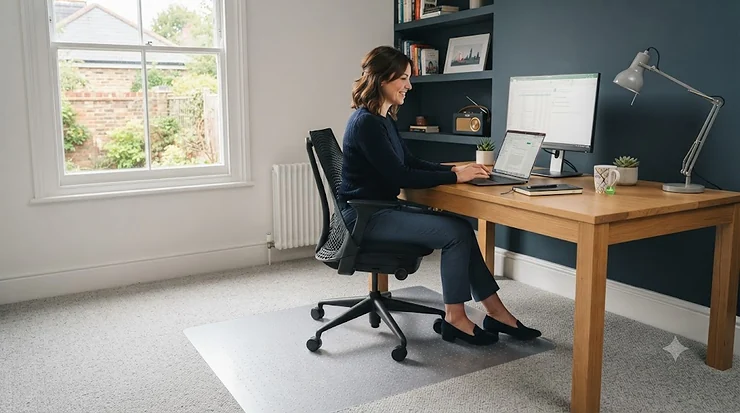
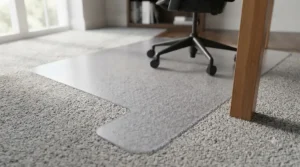
Somewhere between “I’ll just put a rug down” and “I’ll just live with the carpet dents,” most of us land on the same quietly sensible solution: a see-through slab of plastic under the desk chair. A transparent chair mat for office use is exactly what it sounds like — a clear polycarbonate, PVC, or glass panel that sits between your chair’s casters and your floor, stopping the slow grind of wheels from wearing a bald patch into your carpet or scuffing your laminate into oblivion, all without covering up the flooring you actually chose. That last part matters more than it sounds. Anyone who’s lived with an opaque black chair mat knows the low-grade visual irritation of a floating rectangle of “office” plonked in the middle of an otherwise nice room.
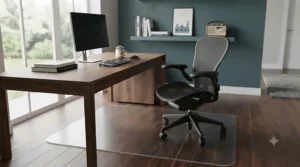
This guide is built around real, currently available products — polycarbonate options with genuine aircraft-windscreen-grade toughness, budget PVC mats that do a perfectly respectable job for under £20, and one glass mat that belongs in a boardroom. We’ll compare specs honestly, flag where reviewers consistently grumble, and match mats to actual UK home-office scenarios: box rooms with deep-pile carpet, hallway desks on laminate, and everything in between.
Quick answer: A transparent chair mat for office setups is a clear floor protector — typically PVC, polycarbonate, or tempered glass — placed under a rolling chair to prevent carpet wear or hard-floor scratching while keeping the original flooring fully visible underneath.
Quick Comparison Table
| Mat Type | Best Floor | Durability | Price Range | Best For |
|---|---|---|---|---|
| Floortex Cleartex Ultimat | Carpet (low/medium pile) | Excellent (5-10 yrs) | £45-£75 | Serious daily use |
| Floortex Cleartex Glaciermat | Hard floor & carpet | Outstanding (lifetime) | £150-£220 | Executive spaces |
| Kuyal Clear Chair Mat (Hard Floor) | Laminate, wood, tile | Fair (1-2 yrs) | Under £20 | Light budget use |
| Kuyal Studded Carpet Mat | Low-pile carpet | Fair (1-2 yrs) | £15-£25 | Budget carpet fix |
| HOMCOM Office Chair Mat | Low-pile carpet | Good (2-3 yrs) | £20-£35 | Family home offices |
| Marvelux Heavy Duty Polycarbonate | High-pile/plush carpet | Excellent (5+ yrs) | £55-£85 | Thick carpets |
| Gorilla Grip Chair Mat | Low-pile carpet | Good (2-3 yrs) | £25-£40 | Slip-prone setups |
Looking across the table, the split is really a three-way decision between polycarbonate longevity, PVC affordability, and glass permanence. Reviewers on the budget PVC options are honest about a shorter working life, while the polycarbonate mats — Floortex’s Ultimat range in particular — turn up again and again in long-term threads still doing the job after several years. If your carpet is genuinely thick or plush, note that only the mats explicitly rated for high pile (Marvelux, Glaciermat) will sit flat rather than dome upward at the edges.
💬 Just one click — help others make better buying decisions too!😊
Top 7 Transparent Chair Mats for Office: Expert Analysis
1. Floortex Cleartex Ultimat — aircraft-windscreen-grade clarity
The standout here isn’t really the clarity, impressive as it is — it’s the material itself. This mat is made from genuine Floortex polycarbonate, the same family of plastic used in aircraft windscreens and bulletproof glass, and that pedigree shows up in how it behaves under a chair rather than in how it looks. Floortex states its polycarbonate mats have twice the impact strength of vinyl, delivering a perfectly flat and rigid easy-glide surface, and critically, the company notes the mat lies instantly flat from delivery rather than needing days to relax out of its packaging curl — a genuinely useful detail if you’ve ever wrestled a curling PVC mat into submission with heavy books. Based on the spec comparison with cheaper alternatives, the rigidity here directly translates into smoother chair glide, which over an eight-hour working day is the kind of thing your hips and lower back quietly thank you for. Reviewers consistently report that the Cleartex Ultimat stays flat for years on low and medium pile carpets without the corner-curl that plagues thinner options, though a handful note it’s noticeably heavier to reposition than a PVC mat, which is really just the trade-off for rigidity. This is the mat for anyone who’s already bought a cheap one, watched it crack within a year, and decided to just do it properly the second time.
Pros:
- ✅ Twice the impact strength of standard vinyl mats
- ✅ Ships flat, no curling or settling period needed
- ✅ Compatible with underfloor heating systems
Cons:
- ❌ Noticeably heavier and stiffer than PVC alternatives
- ❌ Premium price puts it out of reach for casual buyers
Price range: £45-£75, depending on size. Genuinely excellent value if you calculate cost-per-year rather than cost-per-mat.
2. Floortex Cleartex Glaciermat — tempered glass with a 10-year warranty
If the Ultimat is the sensible choice, the Cleartex Glaciermat is the one you buy when you’ve decided the home office deserves to look properly finished. This is tempered glass, not plastic, and Floortex’s own material guide explains it has five times the strength of regular glass, tested to take weights of up to 1,000lb. What that means in practice: this mat will genuinely outlive your chair, your desk, and quite possibly your tenancy in the property. On paper this reads as overkill for a home office, but here’s what most buyers overlook — because it’s glass rather than plastic, it never develops the faint surface haze that PVC and even polycarbonate mats pick up after a couple of years of caster traffic, so the “invisible mat” effect actually holds up over time rather than degrading. Suppliers list a manufacturer’s 10-year limited warranty, and the mat is designed to work across both hardwood and all carpet piles. The trade-off is obvious: weight, cost, and the fact that dropping something heavy on a glass mat is a different kind of accident than dropping it on a plastic one.
Pros:
- ✅ Five times the strength of standard glass
- ✅ Ten-year manufacturer warranty as standard
- ✅ Never develops surface haze or scratches like plastic
Cons:
- ❌ Significant price jump versus polycarbonate options
- ❌ Heavy — awkward for one person to reposition alone
Price range: £150-£220. A genuine investment piece, best suited to a permanent, serious home office setup.
3. Kuyal Clear Chair Mat (Hard Floor) — budget entry point under £20
For hard floors — laminate, engineered wood, vinyl, tile — the Kuyal Clear Chair Mat is the mat most UK buyers actually end up with, largely because it turns up first in searches and does the fundamentals competently. The listing is explicit that it’s suitable for hard floors including vinyl, stone, tile, wood, laminate and concrete, and not recommended for carpet, which is worth taking seriously — this is not a dual-purpose mat, and reviewers who’ve tried it on carpet report it slides around more than it should. What most buyers overlook about this model is the installation orientation: the mat is smooth on one side and grinding on the other, and needs the smooth side facing down to stay in place — get that backwards and you’ll spend a week wondering why it keeps sliding. Aggregated review sentiment on this listing sits comfortably above 4 stars across thousands of ratings, and the recurring praise is simple: it does the one job it’s designed for, on hard floors, at a price that makes replacing it in eighteen months a non-event.
Pros:
- ✅ Genuinely budget-friendly at under £20
- ✅ Works well specifically on laminate, wood and tile
- ✅ Thin profile sits almost invisibly underfoot
Cons:
- ❌ Not designed for carpet — will slip around
- ❌ Shorter lifespan than polycarbonate alternatives
Price range: under £20. The obvious starting point for anyone testing the water before committing to a premium mat.
4. Kuyal Studded Carpet Mat — the carpet-specific budget pick
Where the hard-floor Kuyal mat falls short on carpet, this is Kuyal’s dedicated carpet version, and the difference comes down to the underside. Where the hard-floor version relies on a smooth base, the carpet edition uses a studded backing designed to grip into carpet fibres and resist the slow creep that plagues flat-backed mats on plush pile. This is squarely a PVC mat rather than polycarbonate, so don’t expect Floortex-level rigidity, but for a spare bedroom converted into a low-traffic desk corner, that’s rarely the deciding factor. Here’s what the spec sheet won’t tell you, but user reports suggest: the studs work best on genuinely low-pile carpet, and on anything approaching mid-to-high pile the mat can still ride up slightly at the edges over several months, which is the classic budget-PVC compromise. If your carpet is thin, this is a sensible, low-commitment fix; if it’s thick and plush, skip ahead to the Marvelux or Glaciermat instead.
Pros:
- ✅ Studded backing grips low-pile carpet effectively
- ✅ Considerably cheaper than polycarbonate carpet mats
- ✅ Easy to trim or reposition around desk legs
Cons:
- ❌ Can curl at edges on thicker carpet over time
- ❌ PVC surface shows scuff marks sooner than polycarbonate
Price range: £15-£25. A fair compromise for low-pile carpet on a tight budget.
5. HOMCOM Office Chair Mat — the family-friendly middle ground
HOMCOM occupies an interesting middle ground in this line-up: still PVC rather than polycarbonate, but manufactured to a noticeably more careful standard than the pure-budget end of the market. Clarity is good — better than some cheaper PVC competitors — and the non-slip studded underside grips low-pile carpet without the mat wandering across the room. Where it earns its place here is the safety certification: HOMCOM’s listing confirms the mat is BPA-free and phthalate-free, which reviewers with young children or pets specifically call out as reassuring, since desk corners in family homes tend to double as play areas. Based on the spec comparison with the two Kuyal options above, HOMCOM sits a rung higher on edge-finishing quality, which reduces the toe-catching curl risk that develops on cheaper mats after a year or so of daily traffic. You’re not getting polycarbonate-level toughness, but for a family home office this is the more conscientious £20-£35 choice.
Pros:
- ✅ BPA-free and phthalate-free certified material
- ✅ Better edge finishing than budget PVC competitors
- ✅ Available in two sizes to suit different desks
Cons:
- ❌ Still PVC — shorter lifespan than polycarbonate
- ❌ Studded backing less effective on medium-pile carpet
Price range: £20-£35. The responsible pick for family home offices where safety certification matters.
6. Marvelux Extra Thick Heavy Duty Polycarbonate Chair Mat — built for plush carpet
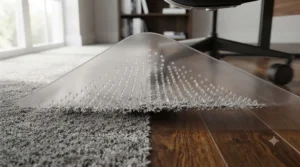
Thick, high-pile carpet is where most budget chair mats quietly fail — they either can’t sit flat over the pile or they buckle within months under repeated caster pressure. The Marvelux mat is specifically positioned to solve that, marketed as an extra thick heavy duty polycarbonate office chair mat for plush, high pile and all carpeted floors and hardwood flooring. What most buyers overlook is that “thickness” alone doesn’t solve high-pile carpet problems — rigidity does, and polycarbonate’s stiffness is what actually keeps the mat riding above the pile rather than sinking into it. Reviewers consistently note this as one of the few mats that stays put on genuinely deep carpet, the kind found in older UK homes with wool-mix flooring rather than modern low-pile office carpet tiles. The honest trade-off is size and heft: this is a substantial, rigid sheet of plastic, and manoeuvring it into a box room single-handedly is more of a two-person job than the packaging photos suggest.
Pros:
- ✅ Specifically engineered for high pile and plush carpet
- ✅ Polycarbonate rigidity resists sinking and buckling
- ✅ Works equally well if you later switch to hard flooring
Cons:
- ❌ Bulky and heavy to manoeuvre into position alone
- ❌ Overkill (and overpriced) for low-pile carpet setups
Price range: £55-£85. Worth every penny if your carpet is genuinely thick — a poor match otherwise.
7. Gorilla Grip Office Chair Mat — the slip-resistance specialist
Rounding out the list, the Gorilla Grip mat leans into exactly what the brand name promises: a heavy-duty clear PVC option engineered around slip resistance on carpeted floors. It’s marketed as a heavy-duty computer desk chair mat aimed at low carpeted floors, designed as a sturdy carpet protector that stays easy to glide and flat without curling. What most buyers overlook about mats in this category is that “slip resistant” cuts both ways — it stops the mat sliding across the carpet, but it can also add subtle resistance to how freely the chair itself glides, which some reviewers describe as a marginally firmer roll compared with polycarbonate. For anyone who’s previously had a mat migrate three feet across the room over a working week, that trade-off is an easy one to accept. This sits as a solid mid-tier PVC option, priced above the basic Kuyal mats but below the polycarbonate tier, and works best for anyone whose main frustration has been the mat moving rather than the mat wearing out.
Pros:
- ✅ Strong grip prevents mat migration on carpet
- ✅ Stays flat without curling at the edges
- ✅ Sturdier feel than entry-level PVC competitors
Cons:
- ❌ Slightly firmer chair roll than polycarbonate mats
- ❌ Still not rated for high-pile or plush carpet
Price range: £25-£40. A dependable pick specifically if mat-slide has been your recurring annoyance.
Practical Usage Guide: Setting Up and Maintaining Your Mat
Getting a transparent mat to actually behave — staying flat, gripping properly, and looking genuinely invisible rather than like a slightly grubby plastic sheet — comes down to a handful of habits most listings never mention. First, orientation matters more than people expect: several PVC mats, including the Kuyal hard-floor option, have a distinct smooth side and textured side, and installing it upside down is the single most common cause of early “this mat won’t stay put” complaints. Second, give any PVC mat 24-48 hours flat under moderate weight (a stack of books works fine) before full use if it’s arrived rolled — polycarbonate and glass mats skip this step entirely, which is part of what you’re paying for.
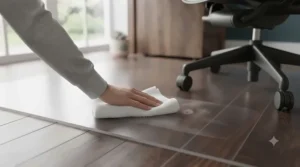
For maintenance, a weekly wipe with a damp microfibre cloth and mild soap keeps clarity genuinely clear rather than gradually filming over with dust and static-attracted debris — avoid ammonia-based glass cleaners on PVC and polycarbonate, as they can cause micro-clouding over months of repeated use. On carpet mats specifically, lift and rotate 90 degrees every few months; this evens out wheel-track wear patterns that otherwise concentrate in the same two spots and cause premature clouding exactly where you look most. A common first-30-days mistake is placing the mat too small for actual chair movement range — measure your full swivel-and-roll radius, not just where the chair sits stationary, before ordering.
Real-World Scenarios: Who Should Buy Which Mat
Picture three genuinely different UK home offices. First, the box-room convert: a spare bedroom with original 1990s carpet, budget-conscious, desk used four or five days a week for standard desk work. Here, the Kuyal Studded Carpet Mat or HOMCOM option makes sense — low investment, adequate protection, and neither will feel like a waste if the room gets repurposed in a year or two. Second, the dedicated home-working professional: someone on video calls daily, using the desk eight-plus hours, on a modern low-pile office carpet tile. This is the sweet spot for the Floortex Cleartex Ultimat — the durability pays for itself well within its lifespan, and the smoother glide genuinely reduces daily physical strain. Third, the plush-carpet household: an older property with thick wool-mix or shag-style carpet where thin mats visibly buckle. This is squarely Marvelux territory, or the Glaciermat if budget genuinely isn’t the constraint and the room doubles as a client-facing space.
How to Choose a Transparent Chair Mat for Office Use
- Identify your floor type first. Hard-floor mats and carpet mats are not interchangeable — a smooth-backed hard-floor mat will slide on carpet, and a studded carpet mat can scratch delicate hard flooring.
- Measure your actual movement radius. Stand at your desk and roll the chair through its full range; undersized mats are the most common regret in reviews.
- Match material to carpet pile. Thin PVC copes fine with low-pile office carpet; plush or high-pile carpet genuinely needs polycarbonate or glass to avoid buckling.
- Decide your realistic lifespan expectation. Budget PVC options typically manage one to two years of daily use; polycarbonate and glass are five-year-plus investments.
- Check the underside finish. Studded backing suits carpet, smooth backing suits hard floors — using the wrong one undermines grip entirely.
- Factor in weight for repositioning. Glass and thick polycarbonate mats are excellent but genuinely heavy to move solo.
- Confirm size against your desk footprint, not just the chair — mats that stop short of the desk edge leave a gap where casters still hit bare flooring.
PVC vs polycarbonate: Which Material Actually Wins?
This is the comparison that actually decides most purchases, so it’s worth being specific rather than vague about “quality.” PVC mats — the Kuyal, HOMCOM, and Gorilla Grip options above — are lighter, cheaper, and arrive already reasonably flexible, which makes them easier to trim or fit into awkward spaces. Their weakness is longevity: under daily caster pressure, PVC develops surface scuffing and can crack or curl at the edges within one to two years. Polycarbonate mats, by contrast, use the same material family as aircraft windscreens, and Floortex is explicit that this gives them twice the impact strength of vinyl with a perfectly flat, rigid surface that won’t crack, sink, curl, cup, discolour or smell under normal use. The honest verdict: PVC wins on upfront cost and flexibility for irregular spaces; polycarbonate wins decisively on cost-per-year once you factor in replacement cycles. For anyone doing genuinely heavy daily desk work, the maths tends to favour polycarbonate within about two replacement cycles of a budget PVC mat.
| Factor | PVC (e.g. Kuyal, HOMCOM) | Polycarbonate (e.g. Floortex Ultimat) |
|---|---|---|
| Upfront cost | £15-£40 | £45-£85 |
| Typical lifespan | 1-2 years | 5-10 years |
| Rigidity | Moderate — can curl | High — stays flat |
| Best for | Light use, tight budgets | Daily heavy use |
The table underlines a point that’s easy to miss when shopping on price alone: a £20 PVC mat replaced three times over five years costs more than a single Floortex Cleartex Ultimat, before even accounting for the hassle of reordering. For anyone using their desk more than 25 hours a week, polycarbonate is very likely the cheaper option over time, not just the nicer one.
Transparent Chair Mats and minimalist office design
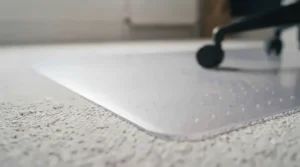
There’s a design logic to transparent mats that goes beyond simple floor protection. In a minimalist office design, every object either earns its visual presence or it doesn’t, and an opaque black or grey chair mat — however functional — sits in the room as a hard-edged rectangle that draws the eye and breaks up flooring continuity. A transparent mat, by contrast, effectively disappears: your engineered oak, your pale carpet, your polished concrete all read as continuous, uninterrupted surface right up to (and under) the chair. This matters more than it might seem for smaller UK box-room offices, where every visual break makes the room feel more cluttered and compartmentalised. Reviewers of the clearer polycarbonate and glass options frequently mention this exact effect — the sense that the mat has “vanished” once the chair is in place — which flat-toned opaque mats simply cannot replicate regardless of colour choice.
Top chair mats under £30: best budget picks
For anyone working to a genuinely tight budget, three mats from this list sit comfortably under £30: the Kuyal Clear Chair Mat (Hard Floor) at under £20, the Kuyal Studded Carpet Mat at £15-£25, and the lower end of the HOMCOM range around £20-£25. All three are PVC rather than polycarbonate, so the honest expectation should be a working life closer to twelve to twenty-four months of regular use rather than the five-plus years of premium options — but for a first desk setup, a temporary work-from-home arrangement, or simply testing whether a clear mat suits your space before spending more, any of these three does the fundamental job competently. The Kuyal hard-floor version edges ahead on pure value if your flooring is laminate or tile; the HOMCOM option is the better call if children or pets are regularly near the desk, purely on the strength of its BPA-free certification.
Floor visibility: why transparency matters more than you think
Floor visibility isn’t just an aesthetic nicety — it’s the entire functional premise of these mats, and the degree of clarity varies more between products than most buyers expect going in. Glass, as used in the Glaciermat, offers the highest and most stable long-term clarity because it simply doesn’t scuff or haze the way plastic does. Polycarbonate sits close behind — genuinely high clarity that holds up for years, with only minimal fine scuffing developing over extended heavy use. Budget PVC starts clear but, based on aggregated review patterns across the Kuyal and similar listings, tends to develop a faint surface haze within the first year of caster traffic, particularly directly under the chair’s resting position where wheel contact concentrates. If floor visibility is your primary motivation for choosing a transparent mat over an opaque one — rather than just wanting “not black” — that pushes the calculation firmly toward polycarbonate or glass, since a PVC mat that’s visibly hazed within a year rather defeats the purpose you bought it for.
Common Mistakes When Buying a Transparent Chair Mat
The single most frequent mistake is buying a hard-floor mat for carpet or vice versa — the smooth underside on hard-floor mats simply doesn’t grip carpet fibres, and the studded underside on carpet mats can mark delicate hard flooring finishes. A close second is undersizing: measuring only the chair’s stationary footprint rather than its full range of motion, which leaves casters running off the mat’s edge onto bare flooring during normal use. Buyers also frequently skip checking pile height compatibility, assuming any clear mat will work on any carpet — as the Marvelux section above makes clear, thin PVC genuinely struggles on plush or high-pile carpet regardless of price. Finally, many people underestimate weight and shipping bulk, particularly for glass mats, and end up needing help to position something they assumed would be a simple one-person job.
Long-Term Cost & Maintenance
Running the numbers properly changes the “budget vs premium” calculation considerably. A £20 PVC mat lasting roughly eighteen months, replaced three times over a five-year period, totals around £60 plus the ongoing hassle of reordering and disposal. A single Floortex Cleartex Ultimat at the upper end of its price range, lasting the better part of a decade, costs less overall and never needs reordering. Maintenance costs are minimal across all categories — a damp cloth and mild soap weekly is sufficient for any of the seven mats here — but polycarbonate and glass options need essentially zero care beyond that, while PVC benefits from the periodic 90-degree rotation mentioned earlier to spread wear evenly and delay the clouding that eventually undermines the whole point of buying clear.
Safety, Regulations & Workplace Compliance
For anyone working from home under an employer’s remote-working policy, chair mats sit at the edge of formal workstation guidance rather than the centre of it, but the underlying principle is directly relevant. The Health and Safety (Display Screen Equipment) Regulations 1992 define a “workstation” broadly, including any disk drive, telephone, modem, printer, document holder, work chair, work desk, work surface or other item peripheral to the display screen equipment, and the immediate work environment around it — chair mats fall squarely within that immediate environment. Guidance on the regulations covering workstation minimum requirements doesn’t mandate chair mats specifically, but it does require chairs to allow easy freedom of movement, which a slipping or curling mat can actively undermine. HSE’s own guidance on homeworking and display screen equipment confirms that employers must ensure homeworkers can achieve a comfortable, sustainable posture, and a stable, properly gripping mat is a small but genuine contributor to that. Material safety is worth a quick check too — look specifically for BPA-free and phthalate-free labelling, which HOMCOM and Kuyal both confirm on their listings, particularly relevant in shared family spaces.
FAQ
❓ Are transparent chair mats actually worth it over opaque ones?
❓ What's the cheapest way to protect carpet under an office chair?
❓ Does PVC vs polycarbonate really make a noticeable difference?
❓ Will a clear chair mat work on thick or plush carpet?
❓ How do I stop a transparent chair mat sliding on carpet?
Conclusion
A transparent chair mat for office use solves a genuinely mundane problem in a way that doesn’t compromise how the room looks — and once you’ve narrowed the choice down by floor type and carpet pile, the material decision really comes down to how long you want it to last. Budget PVC from Kuyal, HOMCOM, or Gorilla Grip covers casual or short-term needs perfectly well for under £40. For daily, heavy desk use, the Floortex Cleartex Ultimat earns its higher price through sheer longevity, and the Marvelux polycarbonate mat solves the plush-carpet problem that budget options simply can’t. At the top end, the Cleartex Glaciermat‘s tempered glass and ten-year warranty make it less a purchase and more a permanent fixture. Whichever tier fits your budget, matching material to your actual floor — not just picking the cheapest clear rectangle you find — is what separates a mat that lasts years from one you’re reordering by next spring.
✨ Don’t Miss These Exclusive Deals!
🔍 Take your home office setup to the next level with these carefully selected chair mats. Click on any highlighted item to check current pricing and availability. These floor protectors will help you create a clean, functional workspace your back — and your floors — will thank you for!
Recommended for You
- Glass Chair Mat vs Plastic Chair Mat: 7 Proven UK Picks (2026)
- Chair Mat for Carpet: 7 Best Picks That Actually Stay Put (2026)
- Chair Mat For Hard Floors: 7 Best Picks to Stop Scratches (2026)
Disclaimer: This article contains affiliate links. As an Amazon Associate, I earn from qualifying purchases. If you purchase products through these links, we may earn a small commission at no additional cost to you.
✨ Found this helpful? Share it with your friends! 💬🤗
