
In This Article
Your office chair is the most punishing thing you’ll ever park on a floor. It has five hard castors, a grown adult on top and a few thousand small rotations every working day. Carpet fibres get crushed and torn, while oak and laminate collect fine scratches like a diary. So the glass chair mat vs plastic chair mat question isn’t really about looks. It’s about whether your floor is still intact when you sell the house.
The rivalry looks simple. Glass is heavy, rigid and built to outlive the chair above it. Plastic is light, cheap and easy to carry upstairs. But “plastic” is a catch-all for PVC, polycarbonate and murky “enhanced polymers” that age at wildly different rates. A fair glass chair mat vs plastic chair mat comparison therefore has to ask which plastic you’re really up against.
Below you’ll find seven real mats sold on Amazon.co.uk: four glass and three plastic. One honest note first. Nobody has put these through a caster test lab. Every verdict is built from manufacturer specifications, published material science and the aggregated star ratings visible in September 2026, and each is labelled that way. Prices are ranges only, so check current price before buying. Along the way we’ll dig into tempered glass durability and the truth about yellowing plastic mats. We’ll also cover sizing in a large chair mat review UK buyers can rely on, and where glass sits among premium office furniture.
What Is the Real Difference in a Glass Chair Mat vs Plastic Chair Mat?
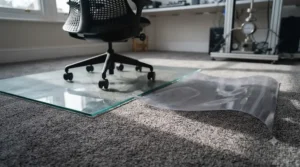
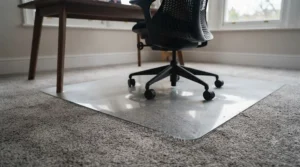
A glass chair mat is a rigid sheet of tempered (toughened) glass, usually 4–6 mm thick, that sits under a desk chair to protect flooring and give castors a smooth surface. A plastic chair mat does the same job in PVC or polycarbonate, but it is thinner, lighter and softer.
The gap between them is bigger than it looks. Wikipedia’s entry on tempered glass is a good primer on how the heat treatment works, and on its famously odd quirk, spontaneous breakage, which we’ll unpack shortly. Meanwhile, the three materials behave quite differently:
- 🪟 Tempered glass: dense and rigid, so it doesn’t dent or develop wheel tracks. A glazing-industry technical note puts it at roughly four to five times the strength of ordinary annealed glass of the same thickness.
- 🧴 PVC: the budget staple. It’s flexible and inexpensive, but the surface is softer, so it marks and tracks sooner.
- 🛡️ Polycarbonate: the tougher plastic. Makers claim around twice the impact strength of PVC, which lets them sell thinner sheets that still resist dipping.
Load ratings show the same pecking order. The maker behind the Floortex Cleartex Ultimat rates its heaviest polycarbonate range to 227 kg, while glass mat listings quote 450 kg or more. Treat every one of those figures as a manufacturer claim. Some listings also use fuzzy labels such as “enhanced polymer”, so ask what the polymer actually is before paying. In practice, glass buys permanence and glide, polycarbonate buys rigidity at low weight, and PVC buys the lowest price.
Quick Comparison: Glass Chair Mat vs Plastic Chair Mat at a Glance
Here are all seven picks side by side. Ratings are snapshots from the Amazon.co.uk listings at the time of research and will drift, so read them as directional.
| Product | Material | Size (cm) | Price range | Rating snapshot | Best For |
|---|---|---|---|---|---|
| Koonmi Tempered Glass Chair Mat | Tempered glass, ~5 mm | 120 × 100 | £70–£90 | 4.8 (347 ratings) | Best-rated glass; roomy home offices |
| GLSLAND Tempered Glass Chair Mat | Tempered glass, 5 mm | 90 × 120 | £85–£100 | 4.6 (1,778 global ratings) | Heavy chairs on plush carpet |
| CASSILANDO Glass Office Chair Mat | Tempered glass, 5 mm | 90 × 115 | £50–£80 | 4.5–4.6 (~110–140 ratings) | Cheapest way into glass |
| NeuType Glass Chair Mat | Tempered glass, ~4 mm | 91 × 91 | £100–£120 | Not verified | Compact square spaces |
| Marvelux Polycarbonate Chair Mat | Polycarbonate, ~2 mm | 75 × 120 | £35–£45 | 4.3 (239 ratings) | Hard floors on a sensible budget |
| Floortex Cleartex Ultimat | Polycarbonate, ~3 mm | 116 × 150 | £110–£130 | 4.2 (8 ratings); related listing 3.6 (996) | Deep-pile carpet |
| Kuyal Clear PVC Chair Mat | PVC, ~1.5 mm | 90 × 120 | Under £35 | 4.0–4.2 (thousands of ratings) | Renters and tight budgets |
Two things jump out. First, the Koonmi Tempered Glass Chair Mat posts the strongest rating in the table, while the CASSILANDO Glass Office Chair Mat undercuts it on price if you’re glass-curious but cost-wary. Second, the plastic trio spans a huge quality range: the Marvelux Polycarbonate Chair Mat is the sweet spot for hard floors, the Floortex Cleartex Ultimat earns its premium only on deep carpet, and the Kuyal Clear PVC Chair Mat costs about a third of the glass options but is the one most likely to be replaced first.
💬 Just one click — help others make better buying decisions too!😊
Top 7 Chair Mats: Glass Chair Mat vs Plastic Chair Mat Analysed
We’ll take four glass mats first, then three plastics. Each verdict rests on published specifications and aggregated review sentiment, not hands-on testing.
1. Koonmi Tempered Glass Chair Mat — the best-reviewed glass mat here
Nothing else on this list touches its scorecard: Koonmi holds a 4.8-star average from 347 ratings on the 120 × 100 cm Amazon.co.uk listing at the time of research.
The maker’s product pages describe roughly 5 mm of tempered glass, a load rating above 1,000 lb (about 450 kg), polished rounded edges and four silicone anti-slip pads. Translated: no denting under a heavy chair, no skating on laminate, and no sharp corners waiting to catch an ankle. The footprint matters too. At 120 × 100 cm, a swivel chair can pivot a full circle without a wheel escaping onto bare carpet, a familiar irritation with shallower mats.
Based on the spec comparison, this is the mat for someone who wants glass without a designer price tag. The catch is weight. Glass runs about 12.5 kg per square metre at 5 mm, so expect around 15 kg, which is a two-person lift. I couldn’t retrieve individual review text, so what buyers love or grumble about behind that 4.8 remains unverified. Read the newest three-star reviews before ordering.
Pros:
- ✅ Highest rating among the seven mats reviewed
- ✅ Generous 120 × 100 cm footprint
- ✅ Silicone anti-slip pads included
Cons:
- ❌ Roughly 15 kg, so awkward to position alone
- ❌ Cannot be trimmed to fit awkward spaces
Expect the £70–£90 range at the time of research (check current price). For a mat that could be your last, that’s solid value.
2. GLSLAND Tempered Glass Chair Mat — the most-rated glass mat on the list
Popularity is a signal, and GLSLAND has plenty of it: 4.6 stars from 1,778 ratings on the 90 × 120 cm listing. One caveat is that the listing showed no UK-specific reviews at the time of research, so treat the average as directional rather than local.
The spec sheet reads 1/5 inch (5 mm) tempered glass, four anti-slip pads and a maker-claimed 1,200 lb load rating. The 90 × 120 cm size is the UK workhorse. It sits neatly under a standard 120–140 cm desk and weighs about 13.5 kg by simple density arithmetic. On plush carpet, where thin mats let castors sink, a rigid glass sheet gives a hard, level track. One overseas reviewer said a heavy chair now moved easily on thick carpet, but also that the mat was heavy to carry and the courier offered no delivery-time choice.
What most buyers overlook is that you’re paying for evidence, not extra glass, because the sheet is the same 5 mm as cheaper rivals. Reviewers of the brand’s 46 × 36 inch version on a US retailer praise its sturdiness, minimalist look and easy chair movement, which fits the UK rating.
Pros:
- ✅ Largest pool of ratings of any glass mat here
- ✅ Suits heavy chairs on plush carpet
- ✅ 90 × 120 cm fits standard desks
Cons:
- ❌ No UK-specific reviews visible on the listing
- ❌ Around 13.5 kg, so heavy to position
Budget the £85–£100 range (prices may vary). It’s fair value if review volume reassures you.
3. CASSILANDO Glass Office Chair Mat — the cheapest way into glass
At the time of research, CASSILANDO ranked among the carpet chair mat best sellers on Amazon.co.uk, and its price swung between the low £50s and about £80 across snapshots. That volatility is worth watching, and it’s worth checking current price on the day you buy.
The mat measures 90 × 115 cm, is 5 mm thick, has rounded corners and is marked for multiple surfaces. Rounded corners matter more than they sound. A square-cornered glass sheet has four vulnerable points that get clipped by chair legs and vacuum cleaners, and chips are where glass failures tend to start. Edge profile also affects usability. A US reviewer of a different glass mat wished for bevelled edges so the chair rolls back on more easily, and I saw no bevel claim here. The sheet is 5 cm shallower than the 120 cm options, so measure your chair’s roll zone first.
The honest take is that this is the “try glass” purchase. A 4.5–4.6 average across roughly 110–140 ratings is good, but the pool is smaller than GLSLAND‘s and I couldn’t verify review text. Reviewers of near-identical 5 mm glass mats on Amazon.co.uk mention smooth gliding and good value, alongside a tendency to creep on carpet.
Pros:
- ✅ Lowest entry price for glass on this list
- ✅ Rounded corners reduce chipping risk
- ✅ Strong average rating for the money
Cons:
- ❌ Smaller review pool than the leading rivals
- ❌ May creep on carpet, as similar mats do
At around £50–£80 (check current price), it’s the best entry ticket into glass here.
4. NeuType Glass Chair Mat — compact square for tight spaces
The 91 × 91 cm (36 × 36 inch) NeuType is the odd one out: a square built for corner desks and study nooks rather than sprawling workstations.
The listing describes 1/6 inch (about 4 mm) tempered glass, four detachable anti-skid pads, polished rounded edges and a load rating above 1,000 lb. At about 4 mm it’s the thinnest glass here. On a flat, fully supported floor that’s plenty, but in principle it leaves a slimmer margin against edge knocks than a 5 mm sheet. It’s also sold through Amazon’s Global Store, so check delivery times, returns and any import charges before ordering.
On paper, the value case is thin. At this price the cost per square metre is roughly double that of Koonmi, and I couldn’t verify a rating count on the listing I found, which leaves it unproven. It earns its place only if the square footprint is exactly what your space needs. At around 8 kg by density arithmetic, it’s also the easiest of the four glass mats to reposition, a genuine plus if you move furniture about.
Pros:
- ✅ Compact 91 × 91 cm square footprint
- ✅ Four detachable anti-skid pads included
- ✅ Polished rounded edges
Cons:
- ❌ Highest cost per square metre of the glass mats
- ❌ Thinner glass and sparse review evidence
Expect the £100–£120 range (check current price). Buy it for the shape, not the bargain.
5. Marvelux Polycarbonate Chair Mat — UK-made polycarbonate for hard floors
Made in the UK, the 75 × 120 cm Marvelux hard-floor mat is the pick for people who want plastic done properly without paying Ultimat money.
The listing gives a thickness of about 2 mm, a smooth back for hard floors and 100% polycarbonate construction. The maker also sells a studded version for carpets up to 12 mm pile, plus 90 × 120 cm and 120 × 150 cm sizes. That smooth-versus-studded split is the detail most buyers skip. A studded underside is designed to grip carpet, and third-party guides warn it can mark hardwood, so buy the variant that matches your floor. A sister listing of the Marvelux eco line uses the label “enhanced polymer” at a similar price, so read the material line carefully.
Here’s what to weigh: polycarbonate is rigid enough to resist the dipping and cupping that softer sheets suffer, at a fraction of glass’s weight. The catch is UV, which we’ll cover in the yellowing section. On feedback, this listing averages 4.3 stars from 239 ratings, and a US editorial round-up named a Marvelux polycarbonate mat its “upgrade pick”.
Pros:
- ✅ Made in the UK by a specialist
- ✅ Rigid polycarbonate resists dipping and cupping
- ✅ Light enough to reposition easily
Cons:
- ❌ Hard-floor version only; carpet needs the studded one
- ❌ Polycarbonate can yellow under strong sunlight
Around £35–£45 (prices may vary). That’s strong value for a hard floor.
6. Floortex Cleartex Ultimat — heavyweight polycarbonate for deep pile
The maker positions the Floortex Cleartex Ultimat as its flagship, and the 116 × 150 cm version targets carpets deeper than 12 mm, where thin mats simply get swallowed.
Listing data gives about 3 mm thickness, a gripper back and PVC-free polycarbonate. The manufacturer claims twice the impact strength of vinyl and says it won’t crack, curl, discolour or smell under normal use. It also states compatibility with underfloor heating, a genuine plus in UK new-builds. Read those as maker claims, but the extra millimetre over cheaper polycarbonate is what stops castors sinking into plush pile.
The mixed feedback is the caution flag. This listing shows 4.2 stars from just eight ratings, while the related 120 × 150 cm deep-pile listing showed 3.6 from 996 ratings and was unavailable at research time. US retail reviewers describe colour holding up, though some report cracking. One buyer of a glass mat on high-pile carpet said their earlier polycarbonate mats hadn’t lasted two years, which is anecdotal but worth knowing. Sort by most recent before buying.
Pros:
- ✅ 3 mm rigidity suits deep-pile carpets
- ✅ Gripper back locks it in place
- ✅ PVC-free polycarbonate from a specialist brand
Cons:
- ❌ Priciest plastic option on this list
- ❌ Mixed ratings on closely related listings
Expect roughly £110–£130 (check current price). At that money, glass becomes a serious rival.
7. Kuyal Clear PVC Chair Mat — the budget benchmark
The hard-floor 90 × 120 cm Kuyal is the most-reviewed plastic mat here. One listing shows about 4.0 stars from roughly 16,000 ratings, and another about 4.2 from 3,100.
It’s PVC, listed at roughly 1.5 mm thick and weighing about 1.8 kg, with an anti-slide coating and no gripper, so it’s for hard floors only. That featherweight build is the whole appeal: easy to carry, easy to cut to size and cheap to replace. The maker says it won’t crack, curl, scratch or discolour under standard use. Independent material sources say PVC can cloud and yellow with UV, heat and depleted stabilisers, so treat that as a claim rather than a guarantee.
UK reviewers give a mixed picture. One says it does the job without curling. Another, reviewing the carpet version, found it so tightly rolled it was nearly impossible to flatten. Neither surprises me, because rolled PVC generally needs warmth, weights and patience. For a spare room or a short tenancy, that’s a fair price of admission.
Pros:
- ✅ Cheapest option and simple to replace
- ✅ Huge review base for reassurance
- ✅ Light at about 1.8 kg
Cons:
- ❌ Soft PVC can mark and cloud with time
- ❌ Ships rolled, so may take days to flatten
Under £35 (prices may vary). The value is in low risk, not longevity.
Tempered Glass Durability: How Tough Is It Really?
Tempered glass durability is where the marketing gets loudest, so let’s separate physics from hype. Toughening heats the sheet and cools it rapidly, leaving the surface in compression and the core in tension. The result is roughly four to five times the strength of ordinary annealed glass. That’s why 1,000 lb ratings (about 450 kg) are plausible for an evenly supported sheet lying flat. Unlike a window pane clamped in a frame, a mat is supported across its whole area, so bending stress stays low. When it does fail, it breaks into small pieces rather than long shards.
The weak point isn’t the middle, it’s the edge. Industry guidance notes that most unexplained breakages trace back to chipped edges or surface damage. The exotic culprit is nickel sulphide inclusion, a microscopic impurity that can trigger spontaneous breakage months or years later. UK glazier Glazing Vision reports that heat-soak testing filters out about 95% of at-risk panes and puts residual risk at roughly one in 400 tonnes of glass. Chair-mat listings rarely say whether their glass is heat-soaked, so it’s a fair question for the seller.
Two practical points follow. BS EN 12150 covers thermally toughened glass for buildings, and the listing snippets I could see didn’t cite it, so treat “safety glass” wording as a manufacturer statement. And toughened glass can’t be cut or drilled afterwards, according to the Glass and Glazing Federation’s standard, so buy the right size first time. Choose polished, rounded edges, keep the floor flat beneath the sheet, and don’t let a heavy chair ram a corner.
Yellowing Plastic Mats: Why It Happens and How to Dodge It
Yellowing plastic mats are the number-one gripe pushing buyers towards glass, so it’s worth understanding the mechanism. Clear polymers age through photo-oxidation: ultraviolet light and heat break chemical bonds, and the breakdown products absorb blue light, which we see as yellow. The Madison Group’s plastics-engineering note says this is mainly a surface effect about 25 micrometres deep, and that polycarbonate’s high transparency exaggerates the tint. PVC ages similarly. As one PVC-film manufacturer explains, skimpy stabilisers and migrating plasticisers can turn it cloudy first, then yellow.
Sources disagree on who wins. Retailer Mat Stores advises keeping any plastic mat out of direct sunlight but calls clear polycarbonate the safer choice in bright rooms. The Floortex Cleartex Ultimat and Marvelux Polycarbonate Chair Mat listings describe their polycarbonate as non-discolouring under normal use. Yet one engineering-flooring write-up reported untreated polycarbonate samples yellowing after two summers outdoors while UV-stabilised PVC coped. Indoors behind UK glazing, exposure is far lower, so the risk zones are south-facing bays, conservatories and desks beside patio doors.
Your defences are simple. Keep the mat out of direct sun, use blinds, and wipe with mild soapy water rather than solvents. If your room is sun-soaked, choose glass, an inorganic material that doesn’t photo-degrade this way. Glass isn’t perfectly colourless either. One glass-mat maker’s own guidance notes that standard clear glass carries a faint green undertone that shows on pale floors, so check the edge in photos before you buy.
Glass Chair Mat vs Plastic Chair Mat: Head-to-Head Verdict
| Factor | Glass | Plastic (PVC / polycarbonate) |
|---|---|---|
| Durability | Doesn’t dent or wheel-track; grit can still leave fine marks | PVC marks sooner; polycarbonate holds up better |
| Clarity over time | Stays clear; faint green tint from day one | Can cloud or yellow with UV, heat and age |
| Weight | About 8–15 kg at these sizes | About 1.8–3 kg (per listings) |
| Upfront cost | Roughly £50–£120 | Roughly £25–£130 |
| Glide | Very smooth, can feel “fast” | Smooth, slightly textured |
| Best For | Koonmi, GLSLAND, CASSILANDO: long-term owners, premium look | Marvelux, Kuyal: renters, budgets, easy carrying |
Read the table as a trade between permanence and portability. Glass wins on ageing and surface stability, which is why the three larger glass picks suit people who plan to stay put. Plastic wins on weight and entry price. Among plastics, polycarbonate such as the Marvelux Polycarbonate Chair Mat is a clear step above the bendier Kuyal Clear PVC Chair Mat on rigidity.
In real use, glide is the difference you’ll feel first. Amazon’s own summary of a comparable 5 mm, 90 × 120 cm glass listing (224 ratings) shows ease of movement praised by ten of fourteen customers who mentioned it, with quality praised by ten of eleven. Others describe the roll as so free it feels odd at first, and a US reviewer called their chair almost fast. If you tend to push off from the desk, that free roll may take getting used to. Plastic’s slight texture gives a little more friction. Neither is wrong; it’s a question of how much control you want under a chair.
Large Chair Mat Review UK: Which Sizes Actually Work
A proper large chair mat review UK buyers can use starts with your chair, not the mat. Measure your desk width, then add your chair’s full roll zone. A five-star base is typically 60–70 cm across, and you need room to push back and pivot without a wheel leaving the sheet.
Sizes vary by material. The Marvelux Polycarbonate Chair Mat range runs from 75 × 120 to 120 × 150 cm, and the Kuyal Clear PVC Chair Mat covers roughly the same span. The Koonmi Tempered Glass Chair Mat goes up to 122 × 152 cm at around £100 on its listing. Here’s the catch with glass: a 122 × 152 cm sheet at 5 mm weighs about 23 kg by back-of-envelope arithmetic. Then it needs stairs, a doorway and two people.
For a large chair mat review UK verdict, plastic is the practical way to go big. A 120 × 150 cm Marvelux Polycarbonate Chair Mat or Kuyal Clear PVC Chair Mat can be carried alone. Choose large glass only if the floor beneath is truly flat, since a big sheet bridging a ridge or threshold is asking for stress. Check delivery as well, because one glass-mat reviewer complained the courier gave no time slot for a heavy parcel.
Premium Office Furniture: Where a Glass Chair Mat Earns Its Place
Think of the mat as part of your premium office furniture set-up rather than an afterthought. A polished-edge glass sheet reads like a coffee table under the chair: crisp, level and quietly expensive. It pairs naturally with an executive chair, a solid-wood desk and a good carpet. Plastic, by contrast, looks like what it is, a protective sheet.
Premium doesn’t have to mean pricey. The CASSILANDO Glass Office Chair Mat and Koonmi Tempered Glass Chair Mat sit at roughly £50–£90, which is less than many desk chairs cost to replace. There’s a practical angle too. The Floortex Cleartex Ultimat listing states that many flooring makers void warranties unless floor protectors are used, so check your own floor guarantee. A mat that outlasts the chair is cheap insurance for a premium floor.
Two design cautions apply. Standard glass reads slightly green on pale carpets, so darker floors flatter it more. And a mirror-smooth surface shows dust and footprints, so keep a microfibre cloth to hand. If your setup is more functional than showpiece, the Marvelux Polycarbonate Chair Mat protects just as well and all but vanishes on a wood floor.
✨ Ready to Protect Your Floor for Good?
🔍 Match your floor, chair and budget to one of the seven mats above, then click any highlighted product name to check current pricing and availability on Amazon.co.uk. A few minutes of comparing now can save you a replacement mat, or a re-laid carpet, later!
How to Choose Between a Glass Chair Mat vs Plastic Chair Mat
To choose between a glass chair mat vs plastic chair mat, match the material to your floor, footprint, sunlight and budget, then check thickness, edges and returns. Here’s the sequence:
- Start with your floor. Hard floor or carpet? On carpet, note the pile depth. Up to 12 mm suits most mats, while deeper pile favours rigid 3 mm polycarbonate or glass.
- Measure the roll zone. Add your chair’s turning circle and push-back distance to your desk width. Oversized beats undersized.
- Pick the material by lifespan. Buy glass if you’ll stay put for years, polycarbonate for a solid mid-term option, and PVC for short-term or rental use.
- Check the underside. Studded or gripper backs are for carpet, and smooth or anti-slip backs are for hard floors. Get this wrong and you’ll mark the floor.
- Inspect thickness and edges. Look for about 5 mm on glass with polished, rounded edges, and 2–3 mm on plastic.
- Consider sun and heat. In a bright bay window, avoid plastic or accept a shorter life. Ask about underfloor-heating suitability before buying.
- Confirm returns and delivery. Glass is heavy and fragile in transit, so check the return terms and whether delivery involves a courier slot.
Long-Term Cost and Maintenance: Which Mat Costs Less Over Ten Years?
Sticker price is only the first line of the bill. The table below uses my own illustrative assumptions about replacement cycles, not manufacturer guarantees or measured lifespans, so adjust them to your situation.
| Option | Upfront range | Assumed lifespan | 10-year outlay | Best For |
|---|---|---|---|---|
| Glass (Koonmi, GLSLAND, CASSILANDO) | £50–£100 | 10+ years if edges stay intact | £50–£100 | Long-term homeowners |
| Marvelux Polycarbonate Chair Mat | £35–£45 | About 5 years | About £70–£90 | Mid-term hard-floor users |
| Kuyal Clear PVC Chair Mat | Under £35 | 2–3 years | About £80–£160 | Temporary set-ups |
The arithmetic flips the sticker-price story. If the PVC mat needs replacing every couple of years, it can cost as much as a glass mat over a decade, and you’ll repeat the unrolling ritual each time. The Marvelux Polycarbonate Chair Mat sits in the middle: cheaper than glass upfront and plausibly cheaper than PVC over time if it doesn’t yellow.
Maintenance is light either way. Wipe glass weekly with glass cleaner, lift it monthly to vacuum underneath and check the pads. Wipe plastic with mild soapy water, rotate it 180 degrees every few months to spread wear, and avoid solvent sprays.
Practical Guide: Setting Up and Maintaining Your Chair Mat in the First 30 Days
Setup decides whether a good mat feels good. Follow this sequence:
- Prep the floor. Vacuum and wipe it. Grit trapped beneath any mat becomes sandpaper under load.
- Unpack safely. Glass needs two people and gloves, and it’s safest carried on its long edge. Plastic mats should be unrolled with weights on the corners. Reviewers say tightly rolled PVC can take days to flatten, and warming with a hairdryer helps.
- Fit the right pads or back. Use the included silicone pads on glass and confirm the underside suits your floor. If you have luxury vinyl tile, check your floor maker’s guidance first, because vinyl makers warn that rubbery backings can stain through plasticiser migration.
- Check your castors. Hard castors suit carpet, while soft-tread castors are gentler on hard floors and glass.
- Re-tune your posture. Glass glides so freely that your seat height and foot position may need a second look. The HSE’s guidance on good posture with display screen equipment is a handy baseline for feet, chair and screen.
- Run a 30-day check. Watch for creep (reposition pads), corner chips on glass, and any yellowing or cloudiness in plastic.
Common first-month mistakes include placing a mat where a chair leg can clip a corner and dragging heavy furniture over it. A mat is a floor protector, not a furniture skid.
Real-World Scenarios: Which Mat Matches Which Life?
If you rent a flat with oak-effect laminate and work from home three days a week on a £40 budget: the Marvelux Polycarbonate Chair Mat (hard-floor, smooth back) is the sensible choice. It’s light enough to lift when you move out, rigid enough not to dip, and within budget. Keep it away from a bay window to limit yellowing. If your budget is closer to £25, the Kuyal Clear PVC Chair Mat does the job for a shorter lifespan.
If you’re tall, heavy and sit 9–10 hours a day on plush 15 mm carpet with about £100 to spend: choose glass. The GLSLAND Tempered Glass Chair Mat has the deepest review pool and a 1,200 lb claim, while the Koonmi Tempered Glass Chair Mat offers extra width. If you prefer plastic, the Floortex Cleartex Ultimat is the deep-pile option, but read recent reviews first. On carpet, place glass on a flat area and monitor creep.
If you’ve carved a permanent study nook into a dining-room corner: the compact NeuType Glass Chair Mat suits a fixed 91 × 91 cm footprint and looks tidy. But if the mat must be lifted aside every evening, its roughly 8 kg makes the Kuyal Clear PVC Chair Mat the more practical partner.
Each case turns on the same three questions: how long will you stay, how heavy is your chair setup, and how much sun hits the floor?
FAQ
❓ Are glass chair mats worth the extra money in the UK?
❓ Does a glass chair mat slide around on carpet?
❓ Is polycarbonate better than PVC for a chair mat?
❓ Can I put a chair mat on underfloor heating?
❓ How heavy is a glass chair mat, and is delivery a problem?
Conclusion: Glass Chair Mat vs Plastic Chair Mat, Decided
So who wins the glass chair mat vs plastic chair mat contest? It depends on how long you’ll stay and how much sun your floor sees. Glass wins on permanence, glide and looks, and it’s the natural partner for premium office furniture. Among the seven, the Koonmi Tempered Glass Chair Mat leads on ratings, the GLSLAND Tempered Glass Chair Mat on review depth and the CASSILANDO Glass Office Chair Mat on entry price. The NeuType Glass Chair Mat is for compact squares only.
Plastic wins on weight, portability and upfront cost. Within plastic, polycarbonate beats PVC on rigidity, and the Marvelux Polycarbonate Chair Mat is the best-value hard-floor option here. The Floortex Cleartex Ultimat is for deep-pile carpet, and the Kuyal Clear PVC Chair Mat is the low-risk, short-term choice. Whatever you pick, keep it out of direct sun if it’s plastic and choose polished, rounded edges if it’s glass. Check current price and delivery before you buy.
🛒 Don’t Let Your Floor Take the Hit!
✨ Pick the mat that fits your floor, chair and budget, then click any highlighted product name to check current pricing and availability. Your carpet, your floorboards and your future self will thank you!
Recommended for You
- Chair Mat for Carpet: 7 Best Picks That Actually Stay Put (2026)
- Chair Mat For Hard Floors: 7 Best Picks to Stop Scratches (2026)
- Cervical Pillow For Side Sleepers: 7 Top UK Picks (2026)
Disclaimer: This article contains affiliate links. As an Amazon Associate, I earn from qualifying purchases. If you purchase products through these links, we may earn a small commission at no additional cost to you.
✨ Found this helpful? Share it with your friends! 💬🤗
