
In This Article
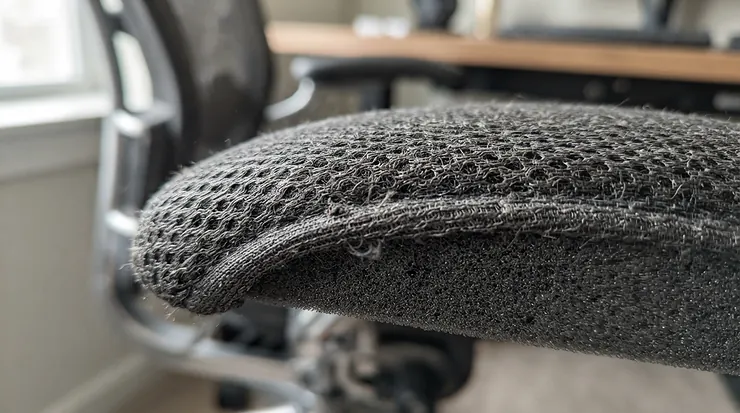
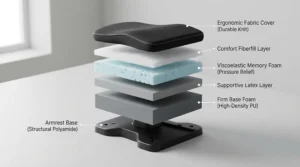
Memory foam armrest pads for office chair use are cushions filled with viscoelastic foam that slip or strap over a hard plastic or worn armrest. They spread pressure across your forearm and elbow and add a little height. Think of them as a mattress topper for your elbows. If your desk chair came with armrests as unforgiving as a park bench, memory foam armrest pads for office chair setups are the cheapest fix going.
Here’s the thing about hard armrests. You don’t notice them for the first twenty minutes. By hour four, your ulnar nerve is filing a formal complaint and you’re propping your arm on a rolled-up hoodie.
Memory foam is mostly polyurethane with added chemicals that raise its viscosity and density. It was developed in 1966 under a NASA Ames Research Center contract to make aircraft cushions safer. That slow, moulding behaviour is exactly why it suits elbows.
This guide covers seven real products, from budget to premium. It also covers what foam density actually means, how slow recovery foam armrest pads differ from ordinary sponge, and how to get memory foam desk chair comfort without wrecking your desk height. One note on method: I’m working from published specifications, retailer listings and aggregated reviewer feedback, not hands-on testing. Where a detail can’t be verified, I say so.
Quick Comparison: Which Pads Suit Which Sitter?
| Product | Standout trait | Fit style | Best For |
|---|---|---|---|
| Aloudy Ergonomic Memory Foam Office Chair Armrest Pads | Stretch-fit sleeve, removable cover | Elastic sleeve | General all-day sitting comfort on T-shaped arms |
| Everlasting Comfort Arm Pads | Cooling gel layer | Adjustable straps | Warm rooms and sweaty forearms |
| Foamula Office Chair Armrest Pads | Wipe-clean faux leather, chunky | Velcro straps | Budget buyers who want height |
| Betteron Chair Arm Pads | Dual-layer foam, 8-year warranty | Stretch edges | Ergonomic purists |
| ARMazing Memory Foam Arm Pads | Removable foam underlay | Elastic cover | Fine-tuning arm height |
| Mind Reader Memory Foam Armrest Pads | Washable cover, non-slip base | Velcro straps | Gaming chairs |
| Western Comfort Thick Armrest Pads | Slimmer 1.3-inch profile | Velcro straps | Tight desk clearance |
The table sorts the field by fit and feel, not by price. Sleeve-style pads like Aloudy and Betteron win on neatness, while strapped pads like Foamula and Mind Reader win on adaptability. If you’re unsure which camp you’re in, measure your armrest first, because fit decides more purchases than foam does.
💬 Just one click — help others make better buying decisions too!😊
Top 7 Memory Foam Armrest Pads for Office Chair: Expert Analysis
Each entry below covers specs with their real-world meaning, an honest read on who the pad suits, and aggregated reviewer sentiment where it could be verified. Prices are ranges only, so check the current price before buying.
1. Aloudy Ergonomic Memory Foam Office Chair Armrest Pads — stretch-fit, no straps needed
The standout feature is the elastic sleeve. Hook one end of your armrest, stretch the pad over the other, done. Listings describe pads of roughly 9.5 x 4.5 x 1.5 inches (about 24 x 11 x 4 cm) fitting arms from 6 to 10.5 inches (15–27 cm) long, with a velvet polyester cover and an invisible zipper.
That 3.8 cm of foam is the sweet spot. It’s thick enough to blunt a hard plastic edge but not so tall that your shoulders creep towards your ears. The zip lets you remove the foam for washing the cover, which matters after a year of coffee-fuelled desk life.
Based on the spec sheet, these suit anyone with conventional T-shaped arms. The sleeve needs a lip or contour to grip. Reviewers who liked them describe medium-firm, supportive foam that held its shape after months of daily use. A few questioned whether it is pure viscoelastic foam or a hybrid, and one reported slippage on armrests with nothing for the cover to hold.
Pros:
- ✅ Tool-free stretch fit in seconds
- ✅ Removable cover with a hidden zip
- ✅ Medium-firm foam that supports rather than swallows
Cons:
- ❌ Needs a gripping edge on the armrest
- ❌ Some reviewers doubt it is pure memory foam
Expect a budget-to-mid pair, typically under £30, so check current price. As a soft cushioned armrest upgrade for standard chairs, it’s the safest all-rounder here.

2. Everlasting Comfort Arm Pads — cooling gel layer for warm desks
The headline feature is a cooling gel layer paired with the memory foam. Standard memory foam softens in response to body heat, which feels great in winter and a bit swampy in July. Gel is meant to take the edge off that, and the cover is described as velvet with adjustable straps and a non-slip base.
Treat the cooling claim with measured optimism. The evidence I found is mostly manufacturer and affiliate-review language, not independent thermal testing. Still, if you work in a warm loft or a glass-walled office, a gel-topped pad is a reasonable bet.
The brand’s own product page shows an average of about 4.5 stars across roughly 1,250 ratings. That’s a self-reported figure, so weigh it accordingly. Third-party roundups praise the pressure relief and straps but note it may not suit every armrest size. One source says the pad isn’t removable from its cover, so check the listing’s washing instructions before you commit.
Pros:
- ✅ Cooling gel layer for warmer rooms
- ✅ Adjustable straps and non-slip base
- ✅ Strong brand-reported satisfaction
Cons:
- ❌ Cooling benefit lacks independent testing
- ❌ Fit may not suit every armrest size
Pricing sits in the mid range, probably in the £20s to low £30s, so check current price. If heat is your main gripe, this is the one to try.
3. Foamula Office Chair Armrest Pads — chunky, wipe-clean faux leather
The standout here is the cover: skin-friendly faux leather that’s waterproof and stain-resistant. The listing gives dimensions of 11.81 x 3.15 x 2.36 inches (about 30 x 8 x 6 cm), extra-long Velcro straps and a non-slip base.
Do the sums on that 6 cm figure. It’s the tallest pad in this round-up, which suits low armrests that leave your elbows hanging. It’s a poor fit if your armrests are already at desk height, because you’ll be shrugging. The faux leather wipes clean in seconds, though it can run warmer and stickier against bare forearms in summer. That’s a reasoned expectation, not a reviewer quote.
One more analytical flag: the listing calls the filling “high-resilience” memory foam. True viscoelastic foam is low-resilience by definition, so I’d read that as a looser, springier foam than the label suggests. I couldn’t verify a meaningful body of buyer reviews for this pad, so I’m not going to invent a sentiment summary.
Pros:
- ✅ Wipe-clean, stain-resistant cover
- ✅ Generous 30 cm length
- ✅ Extra-long straps fit chunky armrests
Cons:
- ❌ Tallest profile may overshoot desk height
- ❌ Faux leather can feel warm in summer
Expect under £25 for a pair, though promotions change often, so check current price. It’s a value pick for low armrests and messy desks.
4. Betteron Chair Arm Pads — dual-layer foam backed by an 8-year warranty
The standout is the construction: a double layer of viscoelastic memory foam plus removable standard foam, wrapped in soft Lycra with stretchy edges. It fits arms 150–280 mm long and carries an 8-year warranty, which is rare in this category.
The removable standard foam layer is clever in practice. Take it out and you lose height but keep the memory foam surface, so you can tune the pad to your desk instead of the other way round. The retailer, Posturite, pitches these on ergonomics, noting they can ease pressure points and add a touch of height if your chair arms don’t adjust.
I couldn’t find a meaningful pool of independent customer reviews, so the warranty is the strongest trust signal available. It was stocked by Posturite at the time of research, so check whether it’s currently listed on Amazon UK before planning around it.
Pros:
- ✅ Double-layer foam you can reconfigure
- ✅ Eight-year warranty signals confidence
- ✅ Lycra cover stretches on easily
Cons:
- ❌ Costs more than most rivals
- ❌ Few independent reviews to lean on
Retailer pricing sat in the mid-£30s to low-£40s range for a pair. If you buy once and want it to last, the premium is defensible.
5. ARMazing Memory Foam Arm Pads — removable underlay for height tuning
The standout is dual-foam construction: 0.75 inches of memory foam over a removable 0.75-inch high-density underlay, under an elasticised cover that fits open armrests of roughly 6–11 inches. The manufacturer admits they may feel firmer than gel pads at first.
That firmness is actually useful. A slightly firmer viscoelastic foam resists bottoming out, so your arm doesn’t sink through to the plastic after an hour. The manufacturer’s guidance is blunt: your chair should have adjustable arms, so your shoulders stay relaxed after the pad adds height.
Keep the health claims in perspective. The manufacturer suggests the pads help people with conditions like lateral epicondylitis, but that’s their marketing position. If you have persistent arm symptoms, talk to a physiotherapist or GP. I found no verified UK review pool, and availability may involve import stock, so check the listing.
Pros:
- ✅ Removable underlay adjusts height
- ✅ Firmer feel resists bottoming out
- ✅ Elastic cover gives a built-in look
Cons:
- ❌ Firmer than gel pads at first
- ❌ UK availability and pricing uncertain
I couldn’t confirm a current UK price. Budget for the mid range and check current price and availability. It suits ergonomics-minded buyers who like to tinker.
6. Mind Reader Memory Foam Armrest Pads — washable cover, non-slip base
The standout is practical: a machine-washable cover, an anti-slip bottom and 13.25-inch adjustable Velcro straps. Listings give dimensions of 1.5 x 3.25 x 10.25 inches (about 3.8 x 8 x 26 cm) and describe medium-firm support.
The straps are the clever bit for gaming chairs. Those armrests are often oddly shaped, and sleeve-style pads slide off them. A strap simply wraps around whatever geometry you’ve got. The 8 cm width is on the slim side, so check it against wider armrests.
The retailer listing claims the foam resists flattening over time, but that’s the seller’s claim and I found no verified review data to confirm or refute it. Take the durability promise as a hypothesis worth testing within your returns window.
Pros:
- ✅ Straps suit odd-shaped gaming armrests
- ✅ Washable cover keeps things fresh
- ✅ Anti-slip base reduces creep
Cons:
- ❌ Narrow width may not cover wide arms
- ❌ Durability claims unverified
Pricing is budget territory, but I couldn’t verify a UK listing price, so check current price. It’s a solid strap-fit option for gaming setups.
7. Western Comfort Thick Armrest Pads — slimmer 1.3-inch profile
The standout is the thinner profile. The listing describes 1.3-inch medium-firm memory foam, an anti-slip bottom and 13-inch Velcro straps, for armrests up to 3 inches wide.
That’s about 3.3 cm of foam, roughly 0.5 cm less than the thickest rivals here. It sounds trivial, but when your chair arms are already near desk height, half a centimetre is the difference between a pad that helps and a pad that jams your elbows against the underside of the desktop.
I’ll be straight with you: the specs overlap heavily with Mind Reader, to the point where the choice may come down to stock and price on the day. I found no verified review base for this one either. If you pick it, treat the first fortnight as a trial and check the return window.
Pros:
- ✅ Slimmer foam suits tight desk clearance
- ✅ Adjustable straps with anti-slip base
- ✅ Medium-firm feel without sinking
Cons:
- ❌ Specs near-identical to cheaper rivals
- ❌ Limited independent reviews
Expect budget pricing, so check current price. It’s the pick for low-clearance desks.
Spec Comparison: Thickness, Fit and Cover at a Glance
| Product | Foam thickness | Fit method | Cover | Best For |
|---|---|---|---|---|
| Aloudy | about 1.5 in (3.8 cm) | Stretch sleeve | Velvet polyester, zip | Standard T-arms |
| Everlasting Comfort | Not confirmed | Straps | Velvet (per reviewers) | Hot rooms |
| Foamula | about 2.4 in (6 cm) | Velcro straps | Faux leather | Low armrests |
| Betteron | Dual-layer | Stretch edges | Lycra | Long-term ergonomics |
| ARMazing | 0.75 + 0.75 in | Elastic cover | Elastic fabric | Height tuning |
| Mind Reader | 1.5 in (3.8 cm) | Straps | Washable | Gaming chairs |
| Western Comfort | 1.3 in (3.3 cm) | Straps | Not confirmed | Tight clearance |
Thickness is the column that matters most for desk height, and it varies by more than 2 cm across the range. Foamula adds the most elevation while Western Comfort and ARMazing (with the underlay removed) add the least. Match the thickness to the gap between your elbow and your armrest, not to a marketing adjective like “extra thick”.

How to Choose Memory Foam Armrest Pads for Office Chair Use
Here’s the short version of choosing well. Work through these in order.
- Measure your armrest. Record length and width in centimetres. Sleeve pads need a close fit, while strap pads are more forgiving.
- Check your current elbow height. If your elbows already sit level with the desk, choose the slimmest pad or skip one altogether.
- Decide sleeve or strap. Sleeves look neater, but straps cope with gaming-chair curves and unusual shapes.
- Read the foam claims sceptically. “High-density” with no figure is marketing. Look for stated thickness and construction instead.
- Think about heat. Warm room, bare forearms? Consider gel-topped foam or breathable fabric.
- Plan for cleaning. A removable or machine-washable cover is worth paying for.
- Check returns. Fit is hard to judge from photos, so favour sellers with easy returns.
For real-world guidance on workstation set-up, the Health and Safety Executive’s display screen equipment guide is the authoritative UK starting point. It’s worth ten minutes before you add anything to your chair.
Foam Density Explained: What the Numbers Actually Mean
Foam density is simply the weight of foam per unit of volume, usually quoted in kg/m³ or lb/ft³. Most standard memory foam falls between 16 and 80 kg/m³ (1 to 5 lb/ft³). Mattress-grade material can range much higher.
Why does foam density matter for elbows? Per the Polyurethane Foam Association’s viscoelastic foam explainer, higher density generally enhances durability, and viscoelastic foam is characterised by slow recovery after compression. In practice, a higher density pad resists the permanent dents that appear after months of resting your arm in the same spot.
Here’s the catch. None of the seven listings I reviewed publish an actual density figure. “High-density” and “high-resilience” appear as adjectives, not measurements. That means you can’t compare pads on foam density alone, so you must lean on thickness, construction, warranty and aggregated durability feedback instead.
Density is also not the same as firmness. A foam can be dense yet soft, or light yet firm. If you’ve read that a pad is “medium-firm”, that’s about indentation feel, not longevity.
Viscoelastic Foam vs Gel vs Standard Foam: Which Is Right?
Viscoelastic foam is the proper name for memory foam. It’s the slow recovery material that makes slow recovery foam armrest pads feel like they’re moulding to your forearm instead of pushing back. Standard polyurethane foam springs back immediately, which feels bouncier and less contoured.
Gel is a different beast. Gel-topped pads aim to dissipate heat and add a cooler first touch, but the gel layer is usually thin. The comfort still comes from the foam underneath.
| Option | Pressure relief | Height boost | Heat | Best For |
|---|---|---|---|---|
| Bare plastic arm cap | Poor | None | Neutral | Nobody, long-term |
| Standard foam pad | Moderate | Low | Neutral | Light use, tight budgets |
| Viscoelastic memory foam pad | Good | Moderate | Warms up | All-day sitting comfort |
| Gel-topped memory foam pad | Good | Moderate | Cooler start | Warm rooms |
The table makes the trade-off plain. Memory foam beats bare plastic and ordinary foam for pressure relief, while gel-topped versions are worth the extra only if overheating is your complaint. For most people, plain viscoelastic foam is the best-value route to a soft cushioned armrest upgrade.
✨ Don’t Miss These Picks!
🔍 Take your desk comfort to the next level with these carefully selected pads. Click any highlighted product name to check current pricing and availability. Your elbows will thank you by Friday!
Features That Actually Matter (And Those That Don’t)
What matters: correct length and width for your armrest, a thickness that suits your desk height, a non-slip base, and a cover you can clean. These four determine whether the pad stays put and stays pleasant.
What matters less: colour options, branded logos and “orthopaedic” language on the box. Gift-wrap claims like “perfect for Christmas or Father’s Day” tell you about the marketing, not the foam.
What to verify: any claim about cooling, anti-fatigue or “never flattens”. These are manufacturer assertions and rarely come with test data. Treat them as hypotheses, and favour sellers with generous returns and honest specifications.
A neat tell is how a listing talks about measurements. Honest listings give length, width and height in both inches and centimetres. Vague ones say “universal fit”. Nothing is universal, least of all armrests.
Common Mistakes When Buying Memory Foam Armrest Pads for Office Chair Setups
Buying before measuring. Armrest shapes vary wildly. Ten minutes with a tape measure saves a return.
Ignoring desk height. Add 4–6 cm of foam to arms that already reach the desk and your shoulders will hike up. HSE guidance is clear that armrests shouldn’t stop you getting close enough to the desk.
Chasing thickness. Thicker feels luxurious for the first hour, then reshapes your posture. Aim for the least foam that solves the pressure problem.
Assuming sleeve pads suit every chair. Stretch covers need something to grip, and flat, smooth arms will let them wander.
Trusting “memory foam” on the label. Some reviewers suspect certain listings are hybrid foams. If real viscoelastic behaviour matters to you, press a finger in and watch how slowly it recovers.
Skipping the cover wash. Foam absorbs skin oils. A pad that’s never cleaned won’t last.
What to Expect: Real-World Performance for All-Day Sitting Comfort
On paper, the benefit of memory foam desk chair comfort is straightforward: a larger contact area means lower pressure per square centimetre. In everyday terms, that means your forearm stops feeling the ridge where the plastic arm cap meets the seat frame.
What reviewers consistently describe is subtle. The pads rarely feel dramatic on day one. The difference shows up around hour three, when you stop shifting and fidgeting. That’s the real signature of good all-day sitting comfort: you forget the armrest exists.
Expect a settling-in period. Fresh foam can feel firmer, and viscoelastic foam softens as it warms. In a cold room, it may feel stiff for the first few minutes, then ease off.
Expect modest limits too. A pad can’t fix a chair that’s the wrong size, a desk that’s too high or a day with no breaks. HSE guidance on DSE work stresses breaks and changes of activity alongside the equipment itself, so plan to stand up now and then.

Long-Term Cost & Maintenance
Cost per use is where these pads shine. A £20–£30 pair used five days a week over two years is roughly 500 working days of use. That works out to pennies per day, far less than replacing the entire chair.
Maintenance is simple but not optional:
- Monthly: wipe or wash the cover as the label allows.
- Quarterly: check straps and non-slip bases for wear.
- Yearly: press the foam. If it no longer recovers slowly, or has permanent dents, replace it.
The CAMEO materials database lists memory foam lifespan at roughly 8–10 years, but that’s for general-purpose foam in gentle use. Elbows, daily compression and skin oils are harsher, so plan on a shorter life, maybe two to four years for budget pads. A warranty like Betteron‘s eight years is a vote of confidence, though warranty terms always deserve a read.
Practical Usage Guide: Fitting and Caring for Your Pads
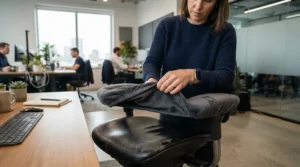
Day one. Test-fit before you commit. Slide the pad on, sit at your desk and check that your elbows rest at roughly a right angle without your shoulders lifting. If they lift, remove foam layers (ARMazing, Betteron) or pick a thinner model like Western Comfort.
Strap fitting. For strapped designs like Mind Reader, Foamula and Western Comfort, thread the strap under the armrest and pull it snug but not tight. Over-tightening deforms the foam and pushes it off-centre.
Sleeve fitting. For Aloudy, hook the far end first, then stretch across. Smooth out wrinkles so the zip sits underneath.
First 30 days. Common mistakes are leaving pads slightly crooked, ignoring creeping slippage and forgetting to adjust monitor height after raising your arms. If your forearms now sit higher, check that your keyboard and mouse still sit at a comfortable level.
Cleaning. Spot-clean covers with a damp cloth. For removable covers, follow the label. Let foam air-dry fully, away from direct heat, which can degrade polyurethane.
For a structured check, the HSE’s display screen equipment workstation checklist walks you through chair, desk and screen set-up in one pass.
Real-World Scenarios: Matching Pads to Real Buyers
Scenario 1: The home-working accountant. Nine hours a day, hard plastic armrests, a room that gets warm by 3 pm. Budget around £30. The Everlasting Comfort pads are the logical first look for the cooling gel. If elbows still hang low, a thicker pad like Foamula might be a fallback.
Scenario 2: The student with a gaming chair. Four to six hours of gaming and coursework daily, on odd-shaped armrests, tight budget. Strap-fit pads like Mind Reader wrap around awkward shapes better than sleeves.
Scenario 3: The ergonomics-conscious contractor. Works from a shared desk, adjusts the chair constantly, wants longevity. Betteron or ARMazing suit, because their removable layers let you re-tune height whenever the desk changes.
Scenario 4: The tight-desk commuter. Hot-desking at an office with fixed-height desks. Western Comfort‘s slimmer foam avoids bumping the desk edge.
In each case, the right choice depends on three variables: armrest shape, desk clearance and how long you sit. Get those right and nearly any decent pad will do the job.
Problem → Solution Guide: Fixing the Usual Complaints
Problem: the pads slide around. Solution: switch from sleeve to strap, or add a non-slip liner. Check that the surface under the pad is dry and clean.
Problem: my shoulders are tense. Solution: your armrests are probably now too high. Remove a foam layer, drop the chair’s arm height or choose a thinner pad.
Problem: forearms feel sweaty. Solution: move to gel-topped foam such as Everlasting Comfort or a breathable cover. Avoid faux leather in warm rooms.
Problem: the foam has gone flat. Solution: press-test it. If dents persist, replace the pads. Budget foam commonly wears faster than the warranty-backed alternatives.
Problem: the cover is grubby. Solution: choose a removable or machine-washable cover like Mind Reader or Aloudy, and clean monthly.
Safety, Regulations and Ergonomic Compliance
In the UK, employers have duties under the Health and Safety (Display Screen Equipment) Regulations 1992 to manage the risks of screen-based work. HSE guidance says armrests shouldn’t prevent you getting close enough to the desk, and that chair set-up should support a comfortable working posture.
If you’re employed and using a work-issued chair, speak to your DSE assessor or line manager before modifying equipment. Some employers prefer approved accessories, and some will supply armrest pads for free.
One more safety note: memory foam, like other polyurethane products, can be combustible. Buy from reputable sellers, check for appropriate product markings (UKCA or CE where applicable) and keep foam away from open flames. If you have persistent pain, tingling or numbness in your arms, see a GP or physiotherapist rather than relying on accessories.
FAQ: Memory Foam Armrest Pads for Office Chair
❓ Do memory foam armrest pads for office chair setups raise my arm height?
❓ How do I measure my armrest before buying?
❓ Are slow recovery foam armrest pads better than standard foam?
❓ Can I use these pads on a gaming chair or wheelchair?
❓ How long do memory foam armrest pads last?
Conclusion: Your Elbows Deserve Better Than Bare Plastic
Choosing memory foam armrest pads for office chair comfort comes down to fit, thickness and honest foam. Aloudy is the safest all-rounder for standard chairs. Everlasting Comfort is the one to try if heat bothers you. Foamula gives the most height on a budget, while Betteron and ARMazing reward those who like adjustable, long-lasting set-ups. Mind Reader and Western Comfort suit strap-fit and tight-clearance needs respectively.
Remember what the research showed. None of these listings publish a foam density figure, several lack independent reviews and every cooling or durability claim deserves a pinch of salt. That’s why measuring your armrest, respecting your desk height and keeping the returns window handy are worth more than any adjective on the box.
Do that, and viscoelastic foam can quietly turn a grim chair into a much kinder one, with all-day sitting comfort you notice only when it’s missing.
✨ Ready to Upgrade Your Chair?
🛋️ Click any highlighted product name above to check current pricing and availability on Amazon UK. Your forearms have put up with enough. Give them something soft!
Recommended for You
- Armrest Covers For Office Chair: 7 Best Budget Picks UK (2026)
- Armrest Pads For Elbow Pain: 7 Best Picks To Soothe Sore Arms (2026)
- Memory Foam Armrest Pads Vs Gel Armrest Pads: 7 Best Picks (2026)
Disclaimer: This article contains affiliate links. As an Amazon Associate, I earn from qualifying purchases. If you purchase products through these links, we may earn a small commission at no additional cost to you.
✨ Found this helpful? Share it with your friends! 💬🤗
