

In This Article
What are armrest pads for elbow pain? They are strap-on or slip-on memory foam cushions that wrap around the hard plastic (or worn-out padding) of a chair arm, spreading pressure across your forearm and elbow. They won’t cure an injury, but they can stop a bad armrest from making one worse.
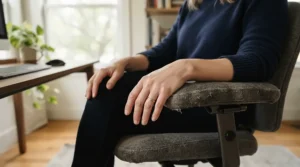
Here’s the thing about elbows: they’re built for bending, not for bearing weight. Yet millions of us spend eight hours a day parking them on rock-hard plastic ledges, shifting about, going numb, and wondering why the outside of the arm throbs by Thursday. The culprit is often the humble armrest. Hard edges concentrate pressure on a tiny patch of skin and bone, and the tissue underneath (nerves, a small fluid-filled sac called the bursa, tendon attachments) gets squashed for hours.
Good armrest pads for elbow pain fix the pressure problem. They don’t fix the posture problem, and that distinction matters, so we’ll keep coming back to it. The NHS explains that tennis elbow is mainly an overuse issue involving the forearm muscles, which means a cushion alone is rarely the whole answer.
This guide compares seven real, widely available options, from budget to premium. It also covers how foam density, thickness and fit change the experience, and how to build an ergonomic desk setup around them. Product prices are shown as ranges only, because they shift constantly. Check current price and availability on amazon.co.uk before you buy.
Quick Comparison: Armrest Pads for Elbow Pain at a Glance
Short on time? This table puts the seven picks side by side. Price ranges are indicative only and based on research at the time of writing, so prices may vary by seller, pack size and colour.
| Product | Standout Feature | Indicative Price Range | Best For |
|---|---|---|---|
| Foamula Office Chair Armrest Pads | Wipe-clean faux leather, non-slip base | Under £25 | Budget buyers and messy desks |
| Aloudy Ergonomic Memory Foam Armrest Pads | 1.5-inch plush cushioning, washable | Roughly £15-£30 | All-round daily office use |
| BEAUTRIP Ergonomic Armrest Pads | Cooling gel top, arc-shaped profile | Roughly £15-£30 | Hot sleepers and warm offices |
| Everlasting Comfort Arm Pads | OEKO-TEX certified foam with gel layer | Roughly £15-£30 | Sensitive skin, wheelchair users |
| Ergo360 Chair Armrest Pad Covers | Removable ½-inch foam inserts | Roughly £15-£25 | People who want to tune firmness |
| Arozzi Memory Foam Armrest Pads | Gaming-chair-friendly, two colours | Roughly £20-£35 | Gamers and streamers |
| Betteron Chair Arm Pads | Double-layer foam, long warranty | Mid-£30s to low-£40s | Heavy daily users, DSE-assessed desks |
The table shows the trade-off clearly. Foamula and Ergo360 keep costs low, while Betteron charges more for a specialist-supplier pedigree and a longer warranty. If you run hot, BEAUTRIP and Everlasting Comfort are the two to look at first because both use a cooling gel layer.
💬 Just one click — help others make better buying decisions too!😊
Top 7 Armrest Pads for Elbow Pain: Expert Analysis
A quick note on method. These write-ups draw on published specifications and the themes that appear repeatedly in real buyer reviews. I haven’t tested these products personally, so you won’t find invented anecdotes here. Where reviews couldn’t be verified, I say so.
1. Foamula Office Chair Armrest Pads — best wipe-clean budget pick
The standout here is the waterproof, stain-resistant faux leather cover, which is unusual at this price. Most budget foam pads use fabric that gets grubby fast.
The listing describes a high-resilience memory foam core with a non-slip fabric base and extra-long Velcro straps. Dimensions are roughly 30 × 8 cm with a generous profile, which is bigger than many standard cushions. In practice, a longer pad means your whole forearm rests on foam rather than just the elbow tip, and that’s the point if you’re trying to offload pressure.
Based on the spec sheet, these suit anyone sharing a desk (hot-desking, family study spaces) because a wipe-down beats a wash cycle. Faux leather does trap heat, so warm-weather workers may prefer a breathable cover.
I couldn’t verify a meaningful set of independent UK buyer reviews for this exact listing, so treat it as a value pick on specification rather than proven longevity.
Pros:
- ✅ Waterproof cover wipes clean in seconds
- ✅ Non-slip base keeps pads from creeping
- ✅ Longer pad supports the whole forearm
Cons:
- ❌ Faux leather can feel warm in summer
- ❌ Limited verifiable review history
Price range: under £25, so low-risk value, but check current price. Verdict: a sensible first purchase if you want to test whether pads help at all.

2. Aloudy Ergonomic Memory Foam Armrest Pads — best all-rounder for daily desk work
The Aloudy pads stand out for their thick, plush 1.5-inch cushioning in a washable design. Listings describe them as fitting armrests around 6 to 10.5 inches long, which covers most standard office and gaming chairs.
Thickness is the headline spec. A 1.5-inch pad lifts your arm noticeably, and that cuts both ways: it cushions hard plastic brilliantly, but it also raises your elbow height. Check that your shoulders don’t hitch upward afterwards.
Reviewers consistently report that the pads eased elbow ache after long desk days. One theme is that they protect the original armrest too, with a reviewer describing cracked chair arms they’d previously struggled with. Another common note is that they raise armrest height, so a desk or chair adjustment may be needed. A few mention that digging an elbow in sharply can bottom out the foam.
Analytically, this is the pad for a typical nine-to-five where comfort and durability matter more than gimmicks.
Pros:
- ✅ Deep 1.5-inch foam cushions hard plastic arms
- ✅ Machine-washable cover for easy upkeep
- ✅ Protects the original armrest from wear
Cons:
- ❌ Adds noticeable armrest height
- ❌ Foam can bottom out under sharp pressure
Price range: roughly £15-£30, so good value for the thickness. Check current price.
3. BEAUTRIP Ergonomic Armrest Pads — best for cooling gel comfort
What sets the BEAUTRIP pads apart is the cooling gel layer on top of a 100% memory foam core, designed to absorb heat, plus an arc-shaped profile that cradles the forearm and wrist.
Why does heat matter? Warm foam makes you shift and fidget, and constant micro-movement is exactly what a pressure-relief pad is meant to calm. One listing describes a breathable, detachable mesh cover with adjustable straps for arms roughly 3-6 inches wide, so measure your chair before buying.
Reviewers frequently describe the pads as comfortable and easy to install. Common praise includes that the foam doesn’t go flat quickly, even after months of use, and that they suit both office and gaming chairs. The recurring complaint is height: several describe them as quite tall.
On the spec comparison, BEAUTRIP is a strong choice if your office runs warm or you tend to get sweaty forearms against foam.
Pros:
- ✅ Cooling gel top reduces heat build-up
- ✅ Curved shape cradles forearm and wrist
- ✅ Detachable, breathable cover is easy to clean
Cons:
- ❌ Quite tall, so desk height may need adjusting
- ❌ Narrow strap range limits wider armrests
Price range: roughly £15-£30. A mid-range pick with a genuinely useful extra feature.
4. Everlasting Comfort Office Chair and Wheelchair Arm Pads — best for sensitive skin and wheelchairs
The Everlasting Comfort pads advertise OEKO-TEX certified memory foam with a cooling gel layer. That certification is a textile-safety standard, which matters if you have reactive skin or you spend all day with bare forearms on the cover.
Listed dimensions are about 9.5 × 3 × 1.5 inches (roughly 24 × 7.5 × 3.8 cm), secured with double-sided fasteners and a non-slip finish. The compact size suits narrower armrests, wheelchairs and travel seating, though large forearms may overhang.
Reviewers often say the foam feels sturdier than plain budget foam, with elbows sinking less and rebounding quicker. Some doubled up two pairs for extra depth. One practical warning surfaced repeatedly: the Velcro can snag and wear clothing, so sleeves matter.
For anyone who needs reliable, gentle padding rather than a fashion statement, this is a considered choice. It’s particularly well matched to shared mobility seating.
Pros:
- ✅ OEKO-TEX certified foam suits sensitive skin
- ✅ Gel layer and firmer foam rebound well
- ✅ Works on wheelchairs and office chairs
Cons:
- ❌ Velcro can catch on clothing
- ❌ Compact size may not cover wide forearms
Price range: roughly £15-£30. Check current price; good value for the materials.
5. Ergo360 Chair Armrest Pad Covers — best for adjustable firmness
The clever bit with Ergo360 is the optional ½-inch foam inserts: you choose whether to run memory foam alone or layered with extra foam beneath.
That flexibility solves the biggest memory-foam complaint, which is sinking straight through to the hard arm. One reviewer said they only found comfort after adding the inserts, because otherwise their elbow bottomed out. Another reviewer who mentioned tennis elbow troubles said the pads were a major comfort upgrade on a racing-style chair. Strong elastic that doesn’t shift in normal use gets regular praise.
The weakness is lateral loading. A reviewer noted that propping their head on a hand pushed the elbow down through the foam and left a small dip. That tells you something useful: pads are for resting, not for sustained leaning.
If you like tinkering, this suits you. Start with the inserts in, then remove them if the pad feels too tall.
Pros:
- ✅ Removable inserts let you tune thickness
- ✅ Strong elastic keeps pads in place
- ✅ Fits most standard-sized armrests
Cons:
- ❌ Foam can dip under concentrated leaning
- ❌ Fiddly to reassemble after washing
Price range: roughly £15-£25. A tweakable budget option.
6. Arozzi Memory Foam Armrest Pads — best for gaming chairs
Arozzi is a name gamers know, and these pads (AZ-MFPAD-BK in black, AZ-MFPAD-GY in grey) are marketed as premium memory foam with a gaming-chair aesthetic.
I could verify that the product exists in two colours and is described as premium memory foam, but detailed thickness figures and a reliable body of buyer reviews weren’t available in the sources I could check. That’s worth stating plainly rather than guessing.
What the brand context suggests is a design intended for the broad, often moulded armrests found on gaming chairs. If you stream or game for long sessions, that fit matters more than raw thickness, because a pad that slides around is worse than none.
My advice: confirm the fit against your specific chair, read the latest reviews on amazon.co.uk, and use the returns window if the shape disappoints.
Pros:
- ✅ Designed with gaming chair shapes in mind
- ✅ Available in black or grey
- ✅ Established brand with UK presence
Cons:
- ❌ Fewer verifiable spec details available
- ❌ Pricier than generic foam pads
Price range: roughly £20-£35. Fair value if the fit is right.
7. Betteron Chair Arm Pads — best for heavy daily users
The Betteron pair is the specialist option, sold through ergonomic suppliers such as Posturite (check amazon.co.uk availability, as stock varies). It’s the only pick here with a double layer of foam: viscoelastic memory foam plus a removable standard foam layer.
The cover is soft Lycra with stretchy edges, designed to pull over arms measuring 150-280 mm long. That stretch fit looks cleaner than strap-on designs and doesn’t snag sleeves. The supplier listing also quotes an 8-year warranty, which is unusually confident for foam.
The ergonomic argument is practical: if your chair arms can’t be lowered or raised to match your desk, a pad can add a small amount of height. That is specific, honest advice rather than marketing waffle.
I couldn’t verify a large pool of independent review data, so the case rests on construction quality and warranty rather than crowd approval.
Pros:
- ✅ Double-layer foam balances softness and support
- ✅ Stretch Lycra cover won’t snag clothes
- ✅ Long warranty signals build confidence
Cons:
- ❌ Highest price of the seven
- ❌ Limited independent review data
Price range: mid-£30s to low-£40s. Worth it for heavy daily use.
Head-to-Head: Thickness, Cooling and Fit Compared
Specs only matter when you can translate them into how a pad feels at 3pm on a Tuesday. This table pulls the key points together from listings and recurring review themes.
| Product | Size / Thickness (per listings) | Cooling / Cover | Fastening | Recurring Review Theme | Best For |
|---|---|---|---|---|---|
| Foamula | About 30 × 8 cm, thick profile | Waterproof faux leather | Long Velcro, non-slip base | Not enough verified data | Budget, shared desks |
| Aloudy | 1.5 in thick, arms ~6-10.5 in | Washable fabric | Straps | Eased ache, adds height | Everyday desk work |
| BEAUTRIP | Arc profile, arms ~3-6 in wide | Cooling gel, mesh cover | Adjustable Velcro | Doesn’t flatten, quite tall | Warm offices |
| Everlasting Comfort | 9.5 × 3 × 1.5 in | Cooling gel, OEKO-TEX | Double-sided fasteners | Sturdy foam, Velcro snags | Sensitive skin, wheelchairs |
| Ergo360 | Optional ½ in inserts | Fabric cover | Elastic | Add inserts or it bottoms out | Tinkerers |
| Arozzi | Not verified | Not verified | Not verified | Limited data | Gaming chairs |
| Betteron | Fits arms 150-280 mm | Lycra cover | Stretch edges | Limited data | Heavy daily use |
The pattern is clear. Aloudy, BEAUTRIP and Everlasting Comfort have the strongest documented spec-plus-review story, while Betteron is the long-term-value outlier. For mixed workloads where you share a chair, Ergo360 gives you the most control, and Foamula wins on easy cleaning.
How to Choose Armrest Pads for Elbow Pain
Follow these six steps and you’ll avoid most regrets.
- Measure your armrest first. Length and width decide whether straps reach or pads overhang. A pad rated for 3-6 inch arms will wobble on a wide gaming-chair arm.
- Decide how much height you can afford. Every centimetre of foam lifts your elbow. If your shoulders already hunch, choose thinner foam or an adjustable one like Ergo360.
- Match foam to your weight and habits. Light pressure suits soft foam, while heavy leaning needs a denser or double-layer option such as Betteron.
- Check cover practicality. Wipe-clean faux leather (Foamula) beats fabric in shared spaces, while breathable mesh (BEAUTRIP) suits warm rooms.
- Prioritise fastening. Strong straps or stretch edges prevent the nightly “where did my pad go?” ritual, and non-slip bases help.
- Read the latest reviews. Look for patterns about fit and longevity rather than single glowing comments, and use the return window if the pad doesn’t suit your chair.
Armrest Pads for Tennis Elbow: What They Can and Can’t Do
Let’s be straight about armrest pads for tennis elbow. Tennis elbow (lateral elbow tendinopathy) is pain from the tendons on the outside of the elbow, and most cases have nothing to do with tennis. It comes from repeated gripping, wrist movement and forearm overuse.
A pad doesn’t treat that. What it can do is remove one aggravator: hard edges pressing into an already irritated forearm. It can also help you rest the arm in a neutral, supported position between bouts of typing and mousing.
Clinical leaflets from NHS trusts say much the same: most cases settle on their own over time, and physiotherapy exercises help if symptoms persist. They also note that evidence for braces and supports as stand-alone treatment is limited. For exercises and trusted guidance on elbow pain, the Chartered Society of Physiotherapy’s elbow pain page is a sensible next stop.
Practical tip: when shopping for armrest pads for tennis elbow, favour a longer pad that supports the forearm rather than only the elbow tip, and pair it with a lighter mouse grip and regular breaks. If pain persists or worsens, see your GP or a physio rather than relying on cushions.
Pressure Relief Armrest Cushions: Why Foam Density Matters
Not every foam is equal, and “memory foam” on a listing can mean anything from dense, slow-recovery material to something closer to a sofa cushion. Pressure relief armrest cushions work by distributing load over a larger area. If the foam is too soft, your elbow bottoms out and you’re back to resting on plastic.
Three things govern real-world performance:
Density. Denser foam resists compression, so it keeps its shape for longer. Reviewers of cheaper pads frequently mention flattening, which is why firmer or double-layer designs like Betteron and Everlasting Comfort attract praise for rebound.
Thickness. Around 1.5 inches (as with Aloudy and Everlasting Comfort) is a common sweet spot. Thicker feels luxurious but raises your arm height, which can defeat the ergonomic purpose.
Surface. A gel layer, as on BEAUTRIP, adds cooling. A slightly firmer top surface also spreads pressure more evenly across the forearm.
One concrete warning from user feedback: leaning your head on your hand drives the elbow through even decent foam. Pressure relief armrest cushions are for supported resting, not for propping up your whole upper body. If you find yourself leaning heavily, the fix is usually screen position or chair height, not a thicker pad.
Ergonomic Armrest Support: Getting the Height Right
Good ergonomic armrest support does one job: it holds your forearms so your shoulders can relax. The shoulders should drop, the elbows should sit roughly at a right angle, and the forearms should rest lightly without pushing up or out.
Here’s where pads can backfire. Add 4 cm of foam to an armrest that’s already too high and your shoulders will creep up toward your ears. That tension travels straight down to the elbow and forearm. UK workplace guidance based on HSE advice makes a related point: armrests shouldn’t stop you getting close enough to the desk, and if they do, lower adjustable ones or remove them.
So treat pads as a fine-tuning tool. If your armrests are adjustable, lower them by the thickness of the pad before you fit it. If they’re fixed and too low, a pad can add a small, useful lift, which is exactly the use case the Betteron supplier describes for its pair.
A quick test: sit with your shoulders relaxed and your upper arms by your sides. Your forearms should meet the pad without you lifting or reaching. If you’re shrugging, the pad is too tall or the armrest too high.
Elbow Bursitis and Armrest Pads: Protecting the Point
Elbow bursitis (olecranon bursitis) is inflammation of the small fluid-filled sac that sits between the bony tip of your elbow and the skin. It’s classically caused by repeated pressure, such as leaning on hard surfaces for long periods, or by a knock to the elbow.
NHS patient information is blunt about the sensible response: avoid leaning on the elbow where possible, keep the joint moving gently, and use a cushion or elbow pad if leaning is unavoidable. Many cases settle without treatment, though it can take a while.
That’s where armrest pads earn their keep. A soft pad reduces the concentrated point pressure that irritates the bursa. Look for pads with a wider surface (such as the larger Foamula profile) so load spreads beyond the very tip of the elbow.
Two cautions. First, pads are a comfort measure, not a treatment. Second, if the elbow turns red, hot, swollen and painful, or you develop a fever, that can signal an infected bursa and needs prompt medical attention. Don’t wait it out with a cushion.
Repetitive Strain Injury and Your Desk: The Bigger Picture
Repetitive strain injury (RSI) is a catch-all term for pain in muscles, tendons and nerves caused by repeated movement or overuse. The NHS page on repetitive strain injury notes it commonly affects the shoulder, elbow, forearm, wrist and hand, and that most people can manage symptoms and recover without further treatment.
What does that mean for armrests? Pads address one contributing factor, which is contact stress from hard surfaces. They do nothing for the repetitive movements themselves. Typing, mousing and gripping are the main drivers, and those need task changes, breaks and workstation adjustments.
Public health guidance consistently recommends smaller, more frequent breaks rather than one long pause. If you work at a computer all day, check that your seat, keyboard, mouse and screen are positioned to cause the least strain.
Think of pads as the cherry on the cake, not the cake. The base layers are posture, movement variety and a sensible workload. If symptoms persist, NHS community MSK services often accept self-referral, and a pharmacist can also advise.
Ergonomic Desk Setup: A Step-by-Step Practical Guide
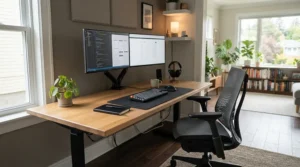
Pads work best inside a well-arranged workspace. Here is a practical ergonomic desk setup sequence to run through in about fifteen minutes.
Step 1: Set seat height first. Sit so your feet are flat and your forearms can rest roughly level with the desk. Everything else follows from this.
Step 2: Check armrest clearance. Slide the chair under the desk. If the arms clash with the desk edge, lower them or fit slimmer pads.
Step 3: Fit your pads. Strap them on snugly. Test by gently pushing a forearm side to side. A pad that slides will annoy you within an hour.
Step 4: Position keyboard and mouse. Keep them close enough that your elbows stay near your sides, not reaching forward.
Step 5: Set the screen. Roughly arm’s length away, with the top at or just below eye level, so your neck doesn’t jut forward.
Step 6: Build a 30-day habit. In the first month, watch for common mistakes: adding too much foam, propping your head on your hand, and sitting for hours without a break. Set a reminder to stand and stretch every 30-45 minutes.
Maintenance schedule: wash or wipe covers monthly, check straps and foam rebound every few months, and replace pads when they stay compressed.
For employers and home workers wanting the formal framework, the HSE’s guidance on working with display screen equipment (L26) sets out the legal duties and practical checklists.

Real-World Scenarios: Matching Pads to People
Let’s translate all of this into three profiles.
Scenario 1: The home worker with a sore forearm. Say you work from the kitchen table on a basic chair, around eight hours a day, with a dull ache after lunch. A comfortable, mid-priced pick like Aloudy gives thick cushioning for general office work. Keep the budget modest and reassess after two weeks.
Scenario 2: The warm-office worker. Suppose you sit near a radiator in a stuffy open-plan office and your forearms get clammy. BEAUTRIP with its cooling gel and mesh cover addresses the actual problem, and the arc shape cradles the wrist during mouse work.
Scenario 3: The hot-desker or shared-chair user. Picture a clinic or co-working space where multiple people use the same chair. Foamula‘s wipe-clean cover and non-slip base make it practical, and the low price means swapping is painless.
A bonus scenario: heavy daily user on an assessed workstation. If your employer has done a DSE assessment and the chair arms are fixed and slightly low, Betteron with its double-layer foam and long warranty offers a longer-term solution. Anyone using a wheelchair or needing gentle materials might look at Everlasting Comfort, and gamers on bucket-style chairs at Arozzi.
The principle is the same throughout: match the pad to your actual constraint (heat, cleaning, height, fit), not to a generic “best” label.
Problem → Solution Guide: Fixing Common Armrest Pad Annoyances
Even good pads throw up irritations. Here’s how to fix the common ones.
Problem: The pad keeps sliding. Solution: tighten the strap, choose a non-slip base like Foamula‘s, or pick stretch-fit Betteron. Wipe dust off the armrest before fitting.
Problem: My shoulder aches after adding pads. Solution: you’ve raised the arm too much. Lower adjustable armrests or switch to thinner foam. Ergo360‘s removable inserts let you reduce height.
Problem: My elbow sinks through the foam. Solution: add an insert (Ergo360), double up thin pairs as some Everlasting Comfort reviewers did, or move to a double-layer design. Also stop leaning your head on your hand.
Problem: Velcro snags my clothes. Solution: cover or tuck the strap ends, or pick stretch-edge Betteron. Reviewers of Everlasting Comfort specifically flagged this.
Problem: The pads make me too hot. Solution: switch to a cooling gel option like BEAUTRIP and use the mesh cover.
Problem: My chair arms are too wide or too narrow. Solution: measure first. BEAUTRIP lists a narrower range than Aloudy, so check compatibility before ordering.
Armrest Pads vs Alternatives: Which Fix Is Right?
Pads aren’t the only answer. Here’s how they compare with other ways of dealing with hard armrests.
| Option | Pressure Relief | Adds Height | Cost | Best For |
|---|---|---|---|---|
| Strap-on foam pads | Good | Yes (1-4 cm) | Low | Aloudy, Foamula for most desk workers |
| Premium double-layer pads | Very good | Small | Medium | Betteron for heavy daily use |
| Replace chair with soft, adjustable arms | Excellent | Adjustable | High | Long-term, budget-flexible buyers |
| Towel or DIY wrap | Fair | Yes | Near zero | Short-term trials |
| Remove armrests entirely | None (no support) | No | Free | Those needing desk clearance |
The comparison shows foam pads sit in a sweet spot for cost and convenience. If your chair is fundamentally wrong (wrong height range, no adjustability), no pad will fully fix it, and replacement makes sense. For testing whether padding helps at all, Foamula and Ergo360 are low-risk entry points.
Long-Term Cost and Maintenance of Armrest Pads
Foam wears out. That isn’t a defect, it’s physics. The question is how much you pay per day of comfort.
Here’s a hypothetical illustration: a £20 pair that lasts about 18 months of working days (roughly 390 days) works out at around 5p per working day. A premium pair in the £40 range with a long warranty, like Betteron, only wins on cost if it genuinely lasts much longer, so judge it on durability rather than sticker price.
Maintenance is simple. Wash removable covers as directed (Aloudy and BEAUTRIP are described as washable with detachable covers), and wipe faux leather such as Foamula‘s regularly. Let foam air-dry fully before refitting, and never tumble-dry foam inserts.
Watch for signs of fatigue: foam that stays flattened, covers that stretch, or straps that lose grip. Reviewers of budget pads often note compression over time, so inspect pads every few months.
One last cost consideration: pads can protect expensive chairs. Reviewers of Aloudy noted they preserved the original armrests from cracking, which is a genuine saving if the chair is costly.
Common Mistakes When Buying Armrest Pads for Elbow Pain
A few repeat offenders crop up whenever people buy pads.
Buying on thickness alone. Thicker isn’t always better. Extra height can create shoulder tension that makes forearm and elbow symptoms worse.
Ignoring measurements. A strap range of 3-6 inches won’t wrap a wide gaming-chair arm. Measure first.
Expecting a medical cure. Pads reduce contact pressure, but conditions such as tennis elbow and RSI involve overuse. Treat the pad as support, not therapy.
Forgetting the rest of the desk. If the keyboard is too far away or the screen too low, you’ll lean and reach regardless of foam.
Skipping returns checks. Fit on odd armrest shapes is the biggest source of disappointment. Check the returns policy before ordering.
Believing every glowing review. Look for patterns (fit, rebound, snagging) rather than a single enthusiastic comment, and be wary of listings with no verifiable history.
Leaning your head on your hand. Even good foam gives way, as one Ergo360 reviewer discovered. Fix the cause, which is usually screen height.
✨ Don’t Miss These Exclusive Deals!
🔍 Take your desk comfort to the next level with these carefully selected armrest pads. Click on any highlighted product name to check current pricing and availability on amazon.co.uk. A small change to your seating could make long working days feel noticeably kinder to your elbows!

FAQ
❓ How thick should armrest pads for elbow pain be?
❓ Will memory foam armrest pads fit my office chair?
❓ Can pressure relief armrest cushions make my desk setup worse?
❓ Are armrest pads washable?
❓ How long do memory foam armrest pads last before going flat?
Conclusion
Sore elbows at a desk are rarely a mystery. Hard armrests concentrate pressure on bone, tendon and bursa, and eight hours later you feel it. The right armrest pads for elbow pain spread that load, protect your chair, and make long days more bearable, though they work best alongside good posture, regular breaks and a sensible workstation.
If you want one all-rounder, Aloudy offers thick, washable cushioning. If heat is your issue, BEAUTRIP and Everlasting Comfort bring gel layers to the table. Foamula is the easy-clean budget route, Ergo360 lets you tune thickness, Arozzi is worth a look for gaming chairs, and Betteron is the specialist option for heavy daily users. Whichever you choose, measure your armrests, mind your arm height, and check current price and availability on amazon.co.uk.
Pads are not a treatment. If pain, swelling or numbness persists, speak to your GP, pharmacist or a physiotherapist.
Recommended for You
- Memory Foam Armrest Pads Vs Gel Armrest Pads: 7 Best Picks (2026)
- Office Chair Armrest Pads: 7 Best Picks For Sore Elbows (2026)
- Locking Office Chair Castors: 7 Best Picks That Stay Put (2026)
Disclaimer: This article contains affiliate links. As an Amazon Associate, I earn from qualifying purchases. If you purchase products through these links, we may earn a small commission at no additional cost to you.
✨ Found this helpful? Share it with your friends! 💬🤗
