
In This Article
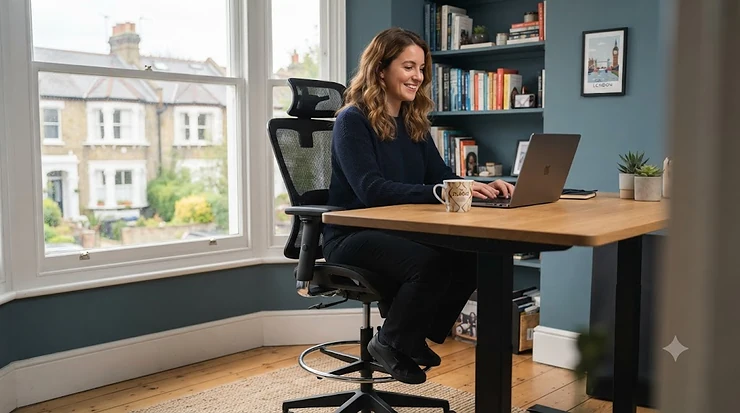
If you’ve ever perched on a “standard” office chair with your knees somewhere near your ears, you already know the problem with most desk furniture: it’s built for an average that doesn’t include you. Extra tall desk chairs exist precisely to fix that mismatch — taller backrests, longer seat-height ranges, and gas cylinders that actually lift high enough to matter.
Here’s the 40-second version: extra tall desk chairs are office seating engineered with an extended seat-height range (typically 20–29 inches from the floor), a taller backrest that supports the shoulder blades rather than stopping mid-spine, and reinforced components rated for larger frames — designed for users roughly 6’0″ and above who find standard chairs leave their knees too high or their upper back unsupported.
The stakes here are bigger than comfort alone. Poor chair fit forces compensatory slouching, and UK employers are legally required to provide training on good posture when using display screen equipment, which tells you how seriously occupational health bodies take this. A chair that’s two or three inches too short doesn’t just feel wrong for an afternoon — it quietly reshapes how you sit for eight hours a day, five days a week.
This guide skips the marketing fluff and gets into what actually separates a genuinely tall-friendly chair from a regular chair with a taller-sounding name. We’ve pulled together seven real, currently available models spanning budget drafting stools to premium ergonomic chairs, compared their seat-height ranges and backrest dimensions side by side, and worked through the practical stuff — how extra tall desk chairs pair with standing desks, what an “extra-tall gas cylinder” actually means for your knees, and where drafting-style chairs beat conventional ones. Whether you’re 6’1″ and mildly annoyed or 6’6″ and genuinely struggling to find anything that fits, there’s a realistic path through the options below.
Quick Comparison Table: Extra Tall Desk Chairs at a Glance
| Chair | Seat Height Range | Best For | Price Range |
|---|---|---|---|
| Herman Miller Aeron (Size C) | 16.9″–21.75″ | Premium all-day ergonomics | £1,300–£1,600 range |
| Steelcase Leap Plus | 17″–21″ (extended frame) | Heaviest-duty premium build | £1,000–£1,300 range |
| Secretlab Titan Evo XL | 19.7″–23.2″ | Wide frames, tall backrest | £500–£650 range |
| Autonomous ErgoChair Ultra 2 | 17.7″–21.7″ | Adjustable seat depth on a budget | £350–£450 range |
| SIHOO M18 | 18.5″–22″ | Best value big & tall | under £200 |
| BestOffice Drafting Chair | 20.7″–28.5″ | Standing desk pairing | under £150 |
| DUMOS Drafting Chair | 22″–32″ | Counter-height + drafting tables | £150–£200 range |
Look at that spread and a pattern jumps out immediately: the drafting-style chairs at the bottom don’t just compete with the premium ergonomic chairs on height — they blow past them, because they’re solving a completely different problem (counter-height desks, not standard 29-inch desks). Meanwhile, the three “office chair” options in the middle cluster within a few inches of each other, which tells you the real differentiator between them isn’t raw height at all — it’s backrest support, seat depth adjustability, and build quality at that height. Budget shoppers should note that price doesn’t track neatly with maximum height here; the cheapest chair on this list has the tallest range of the bunch.
💬 Just one click — help others make better buying decisions too!😊
Top 7 Extra Tall Desk Chairs: Expert Analysis
1. Herman Miller Aeron (Size C) — the ergonomic benchmark for very tall frames
The Aeron’s Size C isn’t a cosmetic upsize of the standard model — it’s a genuinely different frame, and that distinction matters enormously if you’re comparing it against chairs that just stretch the same parts taller. The 8Z Pellicle mesh distributes pressure across seven zones rather than relying on foam padding, which stays supportive over a full workday instead of compressing flat by 3pm the way cheaper foam does. PostureFit SX gives independent support to both the lumbar curve and the sacrum, a detail that matters more for taller spines because the lower back sits further from a “standard” backrest’s sweet spot.
Who should care: professionals doing genuine 8-hour desk days who value long-term spinal support over short-term price. Based on the spec comparison, the Aeron C’s frame is built for users up to roughly 6’6″ and around 300 lbs, putting it near the top of what any mesh ergonomic chair offers without moving into bespoke territory. Reviewers consistently note that the breathability is unmatched in this category — genuinely useful if your home office runs warm — though several also mention the seat pan feels firmer than expected for the first few weeks before it “breaks in” psychologically, if not physically.
Pros:
- ✅ Independently sized frame, not just a taller backrest bolt-on
- ✅ 12-year warranty reflects genuine long-term confidence
- ✅ Breathable mesh stays cool during long sessions
Cons:
- ❌ Firm seat pan takes real adjustment time
- ❌ Premium price puts it out of reach for casual users
At around £1,300–£1,600, the Herman Miller Aeron (Size C) sits at the top of this list price-wise, and the value case only really holds up if you’re sitting in it most of the working week — for occasional use, it’s genuinely hard to justify.
2. Steelcase Leap Plus — the extended-range workhorse for heavier, taller users
Where the Aeron leans on mesh, the Leap Plus leans on mechanical adjustability, and that’s the honest way to frame the difference — it’s not “better,” it’s a different philosophy for tall-frame support. The LiveBack technology mimics the spine’s natural curve as you recline, shifting support dynamically rather than locking you into one fixed lumbar position. What most buyers overlook about this model is the seat depth adjustment via the Natural Glide System, which slides the whole seat pan forward or back rather than just the backrest — genuinely useful for taller users whose thigh length doesn’t match their torso length.
The extended frame variant is rated up to roughly 400 lbs, and Forbes’ 2026 big-and-tall roundup specifically flags the extended-range Steelcase models as one of only a handful engineered for users over 6’3″ or 350 lbs, alongside the Titan Evo XL. On paper this means the Leap Plus is over-engineered relative to a typical 6’1″ user’s needs, but that headroom is exactly the point if your frame sits at the upper end of “tall.”
Pros:
- ✅ Seat depth glides independently of backrest angle
- ✅ Extended-range frame rated for genuinely heavy use
- ✅ 12-year warranty matches Herman Miller’s confidence level
Cons:
- ❌ Adjustment levers have a learning curve at first
- ❌ Bulkier footprint than mesh-back competitors
Expect to pay in the £1,000–£1,300 range for the extended frame, and check current pricing carefully — Steelcase’s standard and extended-range Leap models are easy to confuse when browsing.
3. Secretlab Titan Evo XL — the widest seat and tallest backrest in this lineup
The Titan Evo XL started life as a gaming chair and that heritage shows in the best possible way here: a 19.3-inch seat base and a backrest genuinely taller than most office chairs bother building, because gaming chair design never assumed everyone sits at “average” height. Reviewers and testers highlight the magnetic memory-foam head pillow and 4D armrests as standout features, and honestly, the cold-cure foam holds its shape noticeably longer under sustained pressure than the softer foam used in cheaper big-and-tall chairs.
Here’s what the spec sheet won’t tell you outright: this is the chair for people who are tall and broad, not just tall. If your issue is purely leg length with an otherwise average build, the extra width is dead weight you’re paying for. But for genuinely large frames, the combination of wide seat and tall backrest solves two fit problems that most single-purpose ergonomic chairs only solve one of. The leatherette-style PU option trades breathability for durability, so factor your room temperature into that decision.
Pros:
- ✅ Widest seat base of any chair in this comparison
- ✅ Tall backrest built for above-average torso length
- ✅ Cold-cure foam resists long-term compression
Cons:
- ❌ PU leatherette runs warmer than mesh alternatives
- ❌ Overkill width if your build is slim
Priced around £500–£650, the Secretlab Titan Evo XL undercuts the two premium ergonomic picks above by a wide margin while matching or beating their raw dimensions — a genuinely strong value argument for wide-and-tall buyers specifically.
4. Autonomous ErgoChair Ultra 2 — adjustable seat depth without the premium price tag
This is the chair that makes the case for mid-range mesh done properly. Rather than a fixed foam seat, the Ultra 2 uses a flexing TPE backrest that moves with your spine, and — this is the detail that actually matters for tall users — an adjustable seat depth that slides back several inches, giving meaningfully more thigh support than the fixed-depth seats found on most chairs at this price. Reviewers have specifically praised the seat as unusually spacious for the category, and airflow through the mesh backrest holds up well across long sessions.
Based on the spec comparison against the Aeron and Leap Plus above, the Ultra 2 gives up some long-term durability and warranty depth in exchange for roughly a third of the price — a genuinely reasonable trade for anyone not sitting eight hours a day, every day, for a decade. Rated to 320 lbs, it comfortably covers most tall users without stepping into big-and-tall territory specifically, which keeps the design lighter and less bulky than the Titan Evo XL.
Pros:
- ✅ Seat depth adjusts independently for longer thighs
- ✅ Strong mesh airflow across full workdays
- ✅ Roughly a third of the premium chairs’ price
Cons:
- ❌ Warranty and long-term durability trail the premium tier
- ❌ Lumbar support is less precise than dial-adjustable rivals
At £350–£450, the Autonomous ErgoChair Ultra 2 is arguably the strongest all-round value pick here for anyone who’s tall but not specifically broad-framed.
5. SIHOO M18 — the budget entry point for big and tall buyers
If your budget realistically caps out under £200, the M18 is where the genuine trade-offs start rather than where they hide. It’s explicitly designed for users over roughly 6’2″ and up to 330 lbs, which puts its stated capacity ahead of several pricier chairs on this list — a good reminder that weight rating and price don’t always move together. The high backrest and wide seat address the two most common tall-user complaints directly rather than as an afterthought.
What most buyers overlook about budget big-and-tall chairs generally, and the M18 specifically, is that the adjustability list looks similar to premium chairs on paper (lumbar, headrest, armrests) but each adjustment has a narrower range and coarser increments. Reviewers consistently note it’s genuinely comfortable for typical desk work but note the mesh and foam quality don’t match the mid-range and premium picks above under sustained daily pressure over years rather than months.
Pros:
- ✅ 330 lb capacity beats several pricier competitors
- ✅ High backrest specifically sized for tall spines
- ✅ Genuinely accessible price point under £200
Cons:
- ❌ Coarser adjustment increments than premium rivals
- ❌ Foam and mesh durability untested over multi-year use
At under £200, the SIHOO M18 is the clear starting point for anyone who needs tall-specific dimensions but can’t yet justify a mid-range or premium spend.
6. BestOffice Drafting Chair for Standing Desk — the extra-tall gas cylinder specialist
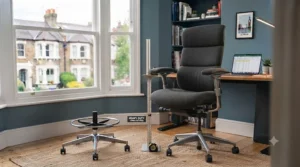
This is a genuinely different category from the six chairs above it, and it’s worth being upfront about that: it’s a drafting-style chair, not a conventional office chair, built around an extra-tall gas cylinder with a hydraulic seat-height range stretching from roughly 20.7 to 28.5 inches off the ground. That range exists specifically to match counter-height surfaces and standing desks raised to their mid-point — a standard chair’s cylinder simply doesn’t extend that far, full stop.
Here’s the honest analysis: at this price, you’re not getting Herman Miller-grade materials, and the 250 lb capacity confirms it’s built lighter-duty than the big-and-tall specialists above. What you are getting is a heavy-duty metal base rated to handle the leverage of that longer cylinder safely, an adjustable foot ring (essential once your seat height climbs past 24 inches and your feet stop reaching the floor), and flip-up arms that tuck away when you need to pull in close to a drafting table or elevated desk surface.
Pros:
- ✅ Genuinely reaches counter and standing-desk heights
- ✅ Adjustable foot ring compensates for the extra height
- ✅ Flip-up arms suit close-in desk or drafting work
Cons:
- ❌ 250 lb capacity trails the big-and-tall specialists
- ❌ Materials noticeably more basic than mid-range picks
Priced under £150, the BestOffice Drafting Chair for Standing Desk earns its spot here on pure functional range rather than luxury — nothing else on this list reaches that seat height for anywhere near the price.
7. DUMOS Drafting Chair with Flip-up Arms — the tallest range built for counter-height desks
Closing out the list is another drafting-style pick, and it’s here because the difference between it and #6 genuinely matters for a specific type of buyer. The DUMOS pushes seat height even further — up into the low 30-inch range at full extension — which is overkill for a standard 29-inch desk but exactly right for genuine counter-height and drafting-table setups, or for standing desks kept permanently at a higher working position rather than adjusted throughout the day.
The mid-back mesh construction and 360-degree swivel casters make it more comfortable for actual desk work than a pure drafting stool, while flip-up arms keep the option open for close-in tasks. Based on the spec comparison with #6, the DUMOS trades a slightly narrower weight capacity for a taller maximum reach — the right call if your desk setup is the limiting factor, the wrong call if raw stability and capacity matter more to you.
Pros:
- ✅ Tallest maximum seat height of any chair here
- ✅ Mesh mid-back adds comfort over pure stools
- ✅ 360° casters suit an active, standing-adjacent workspace
Cons:
- ❌ Overkill height for standard 29-inch desks
- ❌ Narrower weight capacity than heavier-duty picks
At £150–£200, the DUMOS Drafting Chair with Flip-up Arms is the specialist’s choice — buy it because your desk genuinely sits high, not just because you’re tall.
Practical Usage Guide: Setting Up Your Extra Tall Desk Chair
Getting an extra tall desk chair home is only half the job — the first 30 days of setup determine whether you actually get the benefit you paid for. Start with the gas cylinder at roughly the midpoint of its range, then sit down and check the classic reference point: your knees should sit at (or very slightly below) hip height with feet flat on the floor. If your feet dangle even with the cylinder at minimum height, you likely need a footrest rather than a shorter chair — a common mistake buyers make is assuming height alone solves the fit.
Next, dial in the backrest before touching armrests. On extra tall chairs, the temptation is to set the backrest as high as it goes immediately; instead, raise it until the lumbar bulge sits in the small of your back, then check where the top edge lands — it should support your shoulder blades, not stop mid-back. As a general rule, position yourself high enough that you don’t need to shrug your shoulders to reach the keyboard comfortably.
A quick maintenance schedule genuinely extends chair life: wipe mesh or fabric monthly, check caster wheels for hair and dust buildup every few weeks (this quietly ruins rolling resistance over time), and re-torque any visible base bolts after the first month of regular use, since flat-pack assembly hardware settles in. Gas cylinders on genuinely heavy-duty chairs rarely need attention, but if you notice slow height drift, that’s your early warning sign rather than something to ignore for another year.
Real-World Scenarios: Who Actually Needs an Extra Tall Desk Chair
The 6’4″ software developer working from home. Ten-hour coding days, a standard 29-inch desk, and a history of lower back tightness by Thursday afternoon. For this profile, the Herman Miller Aeron (Size C) or Steelcase Leap Plus makes the most sense — daily, sustained use justifies the premium spend, and the independently sized frame (not a stretched standard chair) actually matters at this frequency.
The budget-conscious student pairing a chair with a standing desk. Working from a small flat, desk raised to a mid-standing height for half the day, sitting for the other half, spending under £200 total on seating. The BestOffice Drafting Chair for Standing Desk fits this exactly — the extra-tall gas cylinder reaches the raised desk height, and the price leaves room in the budget for the desk itself.
The broad-framed remote worker who’s also over 6’2″. Not just tall — genuinely needs width as well as height, and has tried standard “tall” chairs that fit length-wise but pinch at the hips. The Secretlab Titan Evo XL or SIHOO M18 solves both dimensions at once, where a purely height-focused chair would leave the width problem unsolved.
Pairing an Extra Tall Office Chair With a Standing Desk
This is where a lot of buyers get tripped up, because “tall chair” and “chair that works with a standing desk” are related but not identical requirements. A standing desk raised to its sit-stand midpoint often sits several inches above a standard fixed desk — which means a chair that’s perfectly tall enough for a normal desk can still feel too short once the desk itself gets raised. This is precisely the gap drafting-style chairs are built to close, with cylinders extending 6–10 inches beyond what a typical ergonomic office chair offers.
The practical fix isn’t always a taller chair, though — sometimes it’s a footrest. UK occupational health guidance notes that individual needs should take priority over generic minimum standards, particularly for anyone requiring a purpose-built workstation — a useful principle even outside a formal workplace: the “right” seat height is the one that gets your specific knees to 90 degrees, not a number on a spec sheet. If you’re raising your desk to alternate between sitting and standing throughout the day, a chair with a genuinely wide height-adjustment range (like the drafting-style picks above) avoids needing two separate chairs — one gas cylinder extension does the job of adapting the seat to both your sitting height and your desk’s raised position.
One practical tip that Amazon listings rarely mention: measure your desk’s actual raised working height with a tape measure before ordering, not just your own height. Two people of identical height can need different chair ranges depending entirely on how high they set their desk.
How to Choose an Extra Tall Desk Chair
Picking the right one comes down to seven decision points, roughly in priority order:
- Measure your actual seated knee height first. Sit on any existing chair, note where your knee sits relative to your hip, and use that — not your total height — as your starting reference.
- Check the seat height range, not just the maximum. A chair that goes up to 24 inches but starts at 19 inches is more useful than one ranging 22–29 inches if your desk sits at standard height.
- Confirm backrest height against your torso, not your overall height. Two people of the same height can have very different torso-to-leg ratios.
- Match weight capacity with margin, not exactly. Buying a chair rated at your exact weight is buying a chair built to fail within a couple of years.
- Decide if you need width as well as height. These are separate problems; don’t assume a “tall” chair automatically fits a broad frame.
- Factor in your desk type. Standard 29-inch desks need different range than standing desks or drafting tables.
- Check the cylinder class. Class 4 gas cylinders handle the leverage of extended height ranges safely; lower-rated cylinders on very tall settings are a genuine safety consideration, not just a durability one.
Under UK workplace law, a work chair must be stable, allow easy freedom of movement and a comfortable position, with height-adjustable seating and a backrest adjustable in both height and tilt — a useful baseline checklist even for home buyers, drawn from the Health and Safety (Display Screen Equipment) Regulations 1992.
Extra Tall Drafting Office Chairs vs Standard Extra Tall Chairs
These two categories get lumped together constantly, and the confusion costs buyers real money when they order the wrong type. A standard extra tall office chair — think the Aeron, Leap Plus, or Ultra 2 above — extends its range mostly through a taller backrest and a moderately extended cylinder, typically topping out somewhere around 21–22 inches. A drafting-style chair takes a fundamentally different approach: it starts where standard chairs end, with cylinders built to reach 26, 28, even 32 inches, specifically because it’s designed to pair with counter-height surfaces rather than a standard 29-inch desk.
The trade-off runs in both directions. Drafting chairs almost universally sacrifice backrest sophistication — you won’t find PostureFit-style lumbar mapping or seat-depth glide systems on a sub-£200 drafting chair — in exchange for that extended reach. They also lean on foot rings rather than assuming your feet reach the floor, which is a feature standard office chairs don’t need and drafting chairs can’t function well without once you’re seated at height. If your desk is fixed at standard height and your only issue is torso and leg length, a standard extra tall chair like the Ultra 2 or M18 will out-comfort a drafting chair every time. If your desk is raised, elevated, or you’re working at an actual drafting table, the equation flips entirely — no amount of ergonomic sophistication in a standard chair compensates for a cylinder that simply doesn’t reach.
Extra-Tall Gas Cylinders Explained: The Spec Nobody Explains Properly
“Extra-tall gas cylinder” gets thrown around in product titles constantly, but it’s rarely explained, and that’s a genuine gap given how much it affects both comfort and safety. A gas cylinder is a sealed pneumatic piston — pressurised nitrogen inside a metal tube — that lets you adjust seat height smoothly by shifting your weight while releasing a lever, rather than needing a hand crank. The mechanism itself is standard across nearly all office seating; what changes on a “tall” or drafting chair is the stroke length — how far the piston can extend — and the cylinder’s load class.
This is the detail that actually matters: cylinders are rated in safety classes, typically Class 1 through Class 4, with Class 4 rated for roughly 1,000 lbs of static load and built with thicker steel walls to handle the extra leverage that comes with an extended stroke. A short, standard-class cylinder pushed to its absolute maximum extension is under considerably more mechanical stress than the same cylinder at mid-range — which is precisely why genuine extra-tall chairs specify Class 4 hardware rather than just a longer version of a lower-rated part. When you’re comparing drafting-style chairs specifically, checking for an explicit Class 4 rating (rather than just “extra tall” in the marketing copy) is the single best proxy for whether the extended height range is actually engineered for daily use or just technically possible.

Common Mistakes When Buying an Extra Tall Desk Chair
The most frequent error is buying on overall chair height alone rather than seat height range — a chair can look imposing in product photos while offering barely more usable adjustment than a standard model. Close behind is ignoring backrest width in the pursuit of backrest height; a tall, narrow backrest can still leave shoulders unsupported on a broader frame, which is exactly the gap chairs like the Titan Evo XL are built to close.
Buyers also frequently skip checking the weight capacity margin, assuming a chair rated near their exact weight is fine — it isn’t, structurally, over years of daily compressive load. And a subtler mistake: ordering a drafting-style chair for a standard desk because it’s marketed as “extra tall,” without realising the minimum seat height might sit well above what a normal 29-inch desk needs, leaving you perched too high with no way to bring the chair down far enough.
Long-Term Cost & Maintenance of Extra Tall Office Chairs
Total cost of ownership rarely tracks the sticker price cleanly. A £1,300 Aeron with a 12-year warranty and genuinely durable mesh construction can work out cheaper per year of use than replacing a £150 budget chair every 18–24 months as foam compresses and mechanisms loosen — the maths favours premium chairs specifically for daily, years-long use. For occasional or transitional use (a student flat, a temporary home office setup), that logic reverses; a £150 drafting chair used for two years costs less overall than financing a fraction of a premium chair’s price.
Maintenance costs stay low across the board if you’re proactive: caster replacement runs a modest sum and extends chair life meaningfully, gas cylinder replacements are available as standalone parts for most drafting-style chairs specifically because manufacturers expect that component to be the first to wear on extended-height models, and mesh cleaning requires nothing beyond routine care. The real long-term cost driver isn’t the chair itself — it’s whether the weight and usage pattern match what you bought, because an under-rated chair pushed past its intended capacity fails years earlier than its warranty period suggests.
Safety, Standards & Regulations for Tall Office Seating in the UK
For anyone buying seating for a home office used for employed work, UK regulation is more relevant than most buyers realise. The UK’s Display Screen Equipment Regulations 1992, amended in 2002, implement the EU’s VDU Directive and remain in force despite Brexit, setting the legal standard for DSE use in British workplaces. Employers have a genuine legal duty here, not just a suggestion — and that duty extends to remote and hybrid staff, not solely people working from a traditional office.
Beyond the legal framework, the practical guidance matters just as much for anyone buying for themselves. Good seating advice for back pain sufferers centres on maintaining the spine’s natural curve, since poor posture in sitting can aggravate back and neck pain over time. For a full walkthrough of correct setup, the NHS trust guide to seating and ergonomics is a genuinely useful independent reference alongside the specifications covered in this guide. On the manufacturing side, look for BIFMA certification (the North American furniture safety standard many reputable chairs still meet even when sold in the UK) as a reasonable proxy for structural safety testing, particularly on drafting-style chairs where the extended cylinder puts more mechanical stress on the base.
Frequently Asked Questions
❓ What height desk chair is best for a 6'3' person?
❓ Can extra tall desk chairs work with a standard 29-inch desk?
❓ What is a Class 4 gas cylinder and do I need one?
❓ Are drafting chairs comfortable for regular desk work, not just standing desks?
❓ How much should I budget for a genuinely tall-friendly office chair?
Conclusion
Extra tall desk chairs aren’t a niche product category anymore — they’re a genuine fix for a mismatch that standard furniture design has left unsolved for a huge share of desk workers. What separates a chair that actually works from one that just claims to is specific and checkable: a real seat height range (not just a tall-looking backrest), a cylinder rated for the stress of extended extension, and a backrest sized to your actual torso rather than your overall height.
Across the seven chairs covered here, the right pick genuinely depends on your specific situation rather than any single “best” answer. Daily, years-long use at a standard desk points toward the Herman Miller Aeron or Steelcase Leap Plus. A broad-and-tall frame points toward the Titan Evo XL or SIHOO M18. A standing desk or counter-height setup points squarely at the BestOffice or DUMOS drafting chairs, where the extra-tall gas cylinder is the entire point rather than a bonus feature. Whichever direction fits, the framework in this guide — measure your actual knee height, check the real adjustment range, confirm the cylinder class, and match capacity with genuine margin — travels with you regardless of which specific chair you eventually choose.
✨ Ready to Find Your Perfect Fit?
🔍 Compare current prices and availability on the models above before they change. A properly fitted chair pays for itself in comfort within the first week — click through to check today’s pricing on your top pick!
Recommended for You
- Office Chair for Over 6ft: 7 Best Tall-Person Picks (2026)
- 7 Best Tall Office Chairs UK 2026: Mesh vs Executive Tested
- 7 Best Office Chairs for Tall People UK: 2026
Disclaimer: This article contains affiliate links. As an Amazon Associate, I earn from qualifying purchases. If you purchase products through these links, we may earn a small commission at no additional cost to you.
✨ Found this helpful? Share it with your friends! 💬🤗
