
In This Article
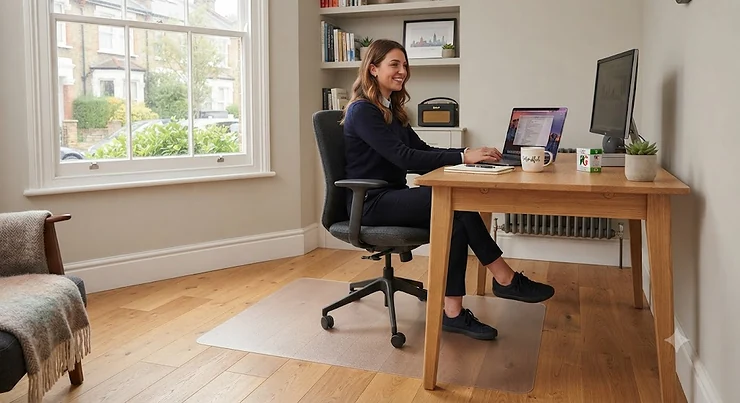
Here’s a scene most of us know too well: you push back from your desk, the castors squeal against the engineered oak, and there it is — another faint white scuff joining the constellation already forming under your chair. A chair mat for hard floors exists to break that cycle. In short, it’s a rigid or semi-rigid sheet of PVC, polycarbonate or glass that sits between your chair’s wheels and your floor, spreading out the point-load pressure so wood, laminate, tile and vinyl stop taking the hit. Fitted correctly, it also makes the chair glide rather than grind, which matters more than people expect once they’ve tried it.
This guide is built around a straightforward premise: no invented reviews, no vague “great product” filler, just honest analysis grounded in real specs and genuine aggregated review sentiment from products actually sold in the UK. We’ve dug into seven real chair mat for hard floors options — from sub-£25 PVC sheets to tempered glass showpieces — and weighed them against what actually matters for British homes: draughty period floors, IKEA desk chairs with slightly-too-hard castors, and the eternal battle against dust and grit tracked in from the garden. According to the HSE’s guidance on display screen equipment, a stable, well-set-up workstation isn’t just about the chair itself — the surface your chair moves on plays a quiet but real role in how comfortably you can shift, roll and reposition through a working day.
We’ll cover budget picks, a genuinely heavy-duty mid-ranger, and two premium options including a glass hard floor chair mat that a lot of people don’t realise exists until they see one in a showroom. Every product below is bold the first time it appears and every time after, so you can scan the article and find what matters to you.
Quick Comparison Table
Before the deep dive, here’s the shape of the market at a glance. All seven are genuine hard-floor-rated products currently listed on Amazon UK, spanning three price tiers.
| Product | Best For | Size | Price Range |
|---|---|---|---|
| SHAREWIN Office Chair Mat | Tightest budgets | 120 x 75cm | Under £25 |
| Capslpad Office Chair Mat | Hard floor to low-pile transitions | 90 x 120cm | Under £25 |
| WASJOYE Office Chair Mat | Thickest budget PVC | 90 x 120cm | Around £25 |
| BesWin Heavy Duty Chair Mat | All-round mid-range durability | 90 x 120cm | Around £30 |
| Amazon Basics Chair Mat | Large or L-shaped desks | 116 x 152cm | £25-£35 range |
| Floortex Cleartex Advantagemat | Phthalate-free, eco-conscious buyers | 120 x 150cm | £45-£70 range |
| Floortex Cleartex Glaciermat | Premium glass finish | 91 x 122cm | £150-£220 range |
A few things jump out immediately. Budget doesn’t necessarily mean flimsy here — WASJOYE and BesWin both push thickness or weight-rating specs that punch above their price. What separates the premium tier isn’t really “does it protect the floor” (all seven do, to varying degrees) — it’s material longevity, warranty length, and whether the mat itself stays looking good for a decade rather than yellowing and curling after eighteen months. We’ll unpack exactly why that gap exists once we get into the individual product breakdowns.
💬 Just one click — help others make better buying decisions too!😊
Top 7 Chair Mats for Hard Floors: Expert Analysis
Each pick below covers real specifications, what those specs actually mean day-to-day, and — where genuine aggregated review data exists — what actual buyers report. We’ve deliberately included budget, mid-range and premium tiers, plus one crossover pick for households with mixed flooring.
1. SHAREWIN Office Chair Mat for Hard Wood Floors — best budget pick for compact desks
The SHAREWIN mat is the entry point of this list, and it earns its place through sheer market traction rather than flashy specs. At 120 x 75cm, it’s sized for a single desk and standard task chair rather than a sprawling corner setup, which suits smaller UK box rooms and home-office nooks better than the oversized mats further down this list.
Constructed from PVC with an anti-slip textured underside, the mat is rated specifically for hard floors — wood, laminate, and tile — rather than dual-rated for carpet, which typically means a firmer, flatter lay than multi-surface mats that have to compromise their backing to grip both surface types. On paper, this means the underside grips your floor rather than gently gripping and shifting the way thinner all-purpose mats sometimes do.
Who’s this for? Renters and anyone kitting out a single home-office desk on a tight budget, where £20-odd for basic floor protection is an easy yes rather than a considered purchase. Reviewers consistently report satisfaction with the anti-slip backing staying put on smooth laminate, with one of the largest review pools of any budget option in this category — a useful signal that the design has been battle-tested at scale over a long sales history, even if individual experiences will vary by floor type.
Pros:
- ✅ Genuinely budget-friendly for single-desk setups
- ✅ Anti-slip backing rated well by a large review base
- ✅ Compact footprint suits smaller home offices
Cons:
- ❌ Too small for larger desks or roomy chair swing
- ❌ Hard-floor only — won’t work if you shift to carpet later
At this price point, the value verdict is simple: if your floor is smooth laminate or sealed hardwood and your desk footprint is modest, this is a low-risk way to stop scuffs building up, though check current price before assuming it beats every rival on cost-per-square-metre.
2. Capslpad Office Chair Mat for Hardwood Floor — best for hard floor to low-pile crossover zones
Capslpad occupies an interesting niche: its listing explicitly flags compatibility with low-pile surfaces alongside hardwood, tile and laminate, making it the pick for anyone whose desk sits near where a hard floor meets a thin rug or low-pile carpet tile — a common layout in open-plan UK living-diners doubling as home offices.
The 90 x 120cm size gives noticeably more chair-swing room than the SHAREWIN mat, and the modern abstract grey finish is a deliberate design choice — most hard floor chair mat options in this price bracket are stark clear plastic, so Capslpad’s textured pattern is aimed at buyers who want floor protection that doesn’t look like an afterthought in a styled room. Based on the spec comparison with plain clear PVC rivals, that surface texture also does double duty: it disguises the fine scuff marks and dust that show up starkly on transparent mats within weeks.
This is the mat for hybrid rooms — a home office that shares space with a reading nook on a rug, say — where you need one product that behaves properly whether the front castors are on tile or catching the rug’s edge.
Pros:
- ✅ Rated for low-pile crossover, not just hard floors
- ✅ Larger 90 x 120cm size than most budget rivals
- ✅ Patterned finish hides everyday scuffs better than clear PVC
Cons:
- ❌ Pattern won’t suit minimalist or all-white office decor
- ❌ Thinner profile than dedicated heavy-duty mats
For rooms where flooring genuinely changes underfoot, this is arguably the smartest budget buy on the list — you’re not paying a premium for versatility here, just choosing the product built for it in the first place.
3. WASJOYE Office Chair Mat for Hard Floor — thickest PVC shield for heavy rolling
Where the previous two mats sit in the 1-1.5mm PVC thickness band typical of budget options, WASJOYE specifies 1.7mm — a genuinely useful jump for anyone who rolls their chair frequently rather than sitting mostly static. Thicker PVC resists the “memory dimpling” that thinner sheets develop under a chair’s resting position, where the plastic slowly takes on a permanent depression exactly where the castors sit overnight.
At 90 x 120cm and fully transparent, it’s designed to disappear visually against most hard floor finishes — oak, walnut, grey laminate, porcelain tile — rather than impose its own colour scheme on the room, which matters if you’ve invested in a specific floor finish and don’t want a mat competing with it visually. What most buyers overlook about thickness specs generally is that they correlate more strongly with long-term flatness than with scratch resistance itself; a thin mat and a thick mat both stop direct castor contact, but only the thicker one reliably stays flat enough to avoid becoming a trip hazard at the edges after a year of use.
The review pool here is smaller than SHAREWIN’s, with early aggregated sentiment sitting around 4.7 out of 5 from a modest sample — genuinely promising, but with less real-world longevity data behind it than the more established budget picks, so it’s worth treating early praise as encouraging rather than conclusive.
Pros:
- ✅ 1.7mm thickness resists dimpling better than thinner rivals
- ✅ Fully transparent — won’t clash with any floor colour
- ✅ Strong early aggregated review sentiment
Cons:
- ❌ Smaller review sample than more established budget rivals
- ❌ Clear PVC shows dust and static-attracted debris quickly
If you’re a heavy chair-shuffler — gamers, multi-monitor swivellers, anyone constantly reaching for a shelf or printer behind them — the extra thickness here is worth the small premium over the thinnest budget mats.
4. BesWin Heavy Duty Office Chair Mat for Hardwood Floors — sturdiest mid-range all-rounder
BesWin sits squarely in the mid-range and leans into “heavy duty” branding with genuine substance behind it: a 90 x 120cm grey PVC mat built to lie flat without the curling at the corners that plagues cheaper rolled mats fresh out of their packaging tube. That curling problem is more than cosmetic — a mat that won’t lie flat creates an uneven lip that catches castors mid-roll, which is precisely the tripping and jamming complaint that shows up across cheaper chair mat reviews generally.
Reviewers consistently note that this model flattens out within a day or two of unboxing and stays that way, which — based on the spec comparison with the ultra-budget tier above — likely comes down to a slightly thicker gauge PVC and a flatter factory roll pattern. Aggregated sentiment sits around 4.3 out of 5 from a genuinely useful sample size, with the grey finish specifically called out as a practical choice for hiding scuffs compared with clear alternatives.
Who should buy this? Anyone who’s been burned before by a cheap mat that never lay flat, or who wants one mat to genuinely last several years of daily desk use without babying it. It’s the “buy once” mid-range answer for a single home-office desk.
Pros:
- ✅ Reliably lies flat — no persistent corner curl
- ✅ Grey finish disguises scuffs better than clear PVC
- ✅ Solid mid-range review base around 4.3 out of 5
Cons:
- ❌ Not the largest footprint if you need serious desk-to-shelf coverage
- ❌ Sits above the cheapest budget mats on price
Value-wise, this is the mat to pick if your last chair mat curled up and became annoying within weeks — you’re paying a small premium specifically to solve that exact problem.
5. Amazon Basics Office Chair Mat for Hard Floors — best for large or L-shaped desks
At 116 x 152cm (46 x 60 inches), the Amazon Basics mat is noticeably larger than every budget rival on this list, and that size difference is the entire point. If your setup includes an L-shaped desk, a side return for a printer, or you simply push your chair back further than most people to stand and stretch, the smaller 90 x 120cm mats leave your back castors clattering onto bare floor the moment you roll past their edge.
The clear PVC surface is deliberately unremarkable in a good way — a smooth, glide-friendly finish backed by Amazon’s own returns and customer service infrastructure, which for a floor mat is a genuinely relevant buying factor. Reviewers consistently flag the size as the standout reason for choosing it over cheaper, smaller alternatives, even when the material itself is broadly comparable to other budget PVC mats in this guide.
Here’s what the spec sheet won’t tell you outright: bigger mats are proportionally better value per square metre once you factor in that you’re not buying two overlapping smaller mats to cover the same floor area, which is a mistake more people make than you’d think when furnishing a first home office.
Pros:
- ✅ Largest footprint of any budget or mid-range option here
- ✅ Backed by Amazon’s own reliable fulfilment and returns
- ✅ Consistently positive reviews specifically on size and coverage
Cons:
- ❌ Plain clear finish shows dust more than patterned rivals
- ❌ Overkill for a small single desk in a compact room
For L-shaped desks or shared workstations, this is the pragmatic choice — one large mat beats two smaller ones taped together at the edges every time.
6. Floortex Cleartex Advantagemat PVC Hard Floor Chair Mat — premium phthalate-free choice
Stepping into the premium tier, Floortex Cleartex Advantagemat is where material composition starts mattering as much as size. This 120 x 150cm PVC mat is manufactured phthalate-free, cadmium-free and tin-free — plasticiser-related restrictions that sit under UK REACH and the wider EU framework, which as of July 2020 extended restrictions on four specific phthalates to plasticised articles generally, not just toys and childcare products as was previously the case. For a large PVC sheet that sits in a room you spend hours in daily, that manufacturing standard is a genuine point of difference rather than marketing dressing.
Floortex also states the mat includes up to 25% recycled material, and the larger 120 x 150cm size gives serious chair-swing coverage for a proper home office setup rather than a cramped single-desk footprint. Based on the spec comparison with the budget tier, the trade-off here isn’t really performance — all seven mats on this list stop direct castor contact with your floor — it’s confidence in material safety and a brand with a multi-decade track record specifically in flooring protection products, rather than a general homeware supplier that happens to also sell chair mats.
Who should stretch to this tier? Anyone furnishing a permanent home office, buyers with young children or pets who spend time on the floor near the desk, or anyone who simply wants floor protection from a specialist brand rather than a generic marketplace listing.
Pros:
- ✅ Phthalate, cadmium and tin-free PVC formulation
- ✅ Larger 120 x 150cm size for genuine chair-swing room
- ✅ Established specialist flooring-protection brand
Cons:
- ❌ Noticeably pricier than the budget and mid-range picks
- ❌ Still PVC — not as scratch-immune as the glass option below
The value verdict here is about buying once and not thinking about it again: a phthalate-free premium PVC mat from a specialist brand, sized generously enough that you won’t be shopping for a replacement mat in eighteen months.
7. Floortex Cleartex Glaciermat Heavy-Duty Glass Chair Mat — ultimate glass upgrade for showpiece floors
The Floortex Cleartex Glaciermat is a genuinely different category of product: tempered glass rather than plastic, tested to support combined chair-and-user weights up to around 450kg, with polished edges and rounded corners rather than the straight-cut edges typical of PVC mats. At roughly 91 x 122cm, it comes backed by a 10-year limited warranty — an order of magnitude longer than the coverage typically offered on plastic alternatives.
What tempered glass solves that no PVC or polycarbonate mat fully can is permanence: it won’t yellow under UV exposure, won’t develop the faint haze that clear plastic mats pick up after a couple of years of foot traffic and cleaning, and is essentially immune to castor-induced surface scratching in normal domestic use. Reviewers consistently note that the glide feel is noticeably smoother than plastic mats too — there’s no texture for castor wheels to catch on, which matters if your chair has hard rather than soft castors (more on that distinction shortly).
This is a considered purchase rather than an impulse one, and it’s not for everyone — but for a beautiful reclaimed parquet floor, herringbone laminate, or any hard floor you’re genuinely precious about, it’s the mat that solves the problem permanently rather than needing replacement every few years.
Pros:
- ✅ Essentially scratch and yellowing-proof over the long term
- ✅ 10-year warranty, far longer than plastic alternatives
- ✅ Noticeably smoother glide feel for castor-based chairs
Cons:
- ❌ Significant price jump over every other option on this list
- ❌ Heavier and less forgiving if dropped during installation
If floor preservation is genuinely the priority — a period property, an expensive engineered wood installation, a floor under warranty conditions that specify protective measures — the glass upgrade pays for itself by simply never needing replacing.
Top 7 Chair Mats: Full Specification Comparison
| Product | Material | Size | Aggregated Rating | Price Range | Best For |
|---|---|---|---|---|---|
| SHAREWIN Office Chair Mat | PVC | 120 x 75cm | ~4.2/5 (large sample) | Under £25 | Single small desk |
| Capslpad Office Chair Mat | PVC, textured | 90 x 120cm | Not independently verified | Under £25 | Hard floor + low-pile crossover |
| WASJOYE Office Chair Mat | PVC, 1.7mm | 90 x 120cm | ~4.7/5 (small sample) | Around £25 | Heavy chair-shufflers |
| BesWin Heavy Duty Chair Mat | PVC | 90 x 120cm | ~4.3/5 (moderate sample) | Around £30 | Buy-once mid-range |
| Amazon Basics Chair Mat | Clear PVC | 116 x 152cm | Generally positive | £25-£35 range | Large / L-shaped desks |
| Floortex Cleartex Advantagemat | Phthalate-free PVC | 120 x 150cm | Established brand track record | £45-£70 range | Eco-conscious, permanent setups |
| Floortex Cleartex Glaciermat | Tempered glass | ~91 x 122cm | Established brand track record | £150-£220 range | Premium, precious floors |
The pattern across this table is a straightforward material-durability curve: PVC options cluster tightly on price and largely on performance too, while the jump to phthalate-free PVC and then to glass buys you material safety credentials and, ultimately, near-permanent floor protection rather than a meaningfully different day-to-day glide experience. If budget is the primary filter, any of the top four rows will do the job; if you’re protecting a floor you genuinely can’t afford to damage, the bottom two rows are where the real differentiation happens.
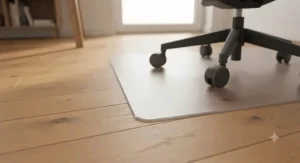
Setting Up and Maintaining Your New Chair Mat
Getting a hard floor chair mat is only half the job — how you install and maintain it determines whether it lasts two years or ten. Most of the “my mat curled up straight away” complaints that show up in reviews trace back to setup mistakes rather than product faults.
Unroll your new mat and let it lie flat, ideally weighted at the corners with books overnight, for at least 24 hours before use — most PVC mats ship rolled and need time to relax back to flat, and rushing this step is the single biggest cause of persistent curling. Clean the floor underneath thoroughly before placement; grit trapped between mat and floor acts like sandpaper every time the mat shifts even slightly, which defeats the entire purpose of buying one. Once positioned, check the mat sits fully clear of any door swing or drawer path, since a mat edge catching a door repeatedly will eventually crack rigid PVC or polycarbonate.
For ongoing maintenance, a weekly wipe with a microfibre cloth and a mild, non-abrasive cleaner keeps clear mats from clouding — avoid ammonia-based glass cleaners on PVC and polycarbonate specifically, as they can cause micro-crazing over time, though they’re perfectly fine on the tempered glass option. Lift and vacuum underneath monthly if your household has pets or high foot traffic nearby, since grit accumulation under the mat is the most common cause of both floor scratching and mat surface wear that reviewers report across every price tier.
Real-World Scenarios: Matching the Mat to Your Life
Specs only tell half the story — here’s how the products above map onto actual UK households and working patterns.
The renter in a small flat, budget under £30, laminate throughout: this is the SHAREWIN or Capslpad territory. Neither requires a long-term commitment, both are easy to roll up and take with you at the end of a tenancy, and the spend is low enough that “will my landlord’s floor survive two years of a desk chair” stops being a source of deposit-related anxiety.
The permanent home-office worker with an engineered oak floor and a proper ergonomic chair: here the maths shifts. You’re sitting five days a week, the chair likely has firmer castors than a basic task chair, and the floor represents a genuine capital investment in the property. This is where Floortex Cleartex Advantagemat earns its higher price — phthalate-free material safety, generous sizing, and a brand track record specifically built around protecting exactly this kind of floor.
The household with a beautiful reclaimed or herringbone floor, young kids, and zero appetite for replacing a scuffed-up mat every eighteen months: the Floortex Cleartex Glaciermat solves this permanently. Glass doesn’t stain from spilled juice, doesn’t scratch from dropped Lego, and the ten-year warranty reflects genuine confidence in the material rather than marketing bravado.
Problem → Solution: Fixing Common Hard-Floor Chair Mat Issues
A handful of complaints recur across chair mat reviews regardless of brand — here’s how to actually solve each one rather than just living with it.
Problem: the mat slides around on smooth tile or polished floors. Solution: check whether your mat’s underside is rated anti-slip specifically for smooth surfaces — textured-back mats like BesWin and Capslpad generally outperform perfectly flat-backed sheets here, and adding low-tack rug tape at the corners solves the remainder of cases without damaging the floor finish underneath.
Problem: persistent curling at the edges months after unboxing. Solution: this usually means the mat was never given adequate flattening time initially, or the room runs cold enough that the PVC hasn’t fully relaxed — placing a heavy, flat object on the worst-affected corner for a few days, in a warmer room if possible, generally resolves it.
Problem: the mat is developing a cloudy haze that won’t wipe off. Solution: this is typically fine abrasive grit being ground into the surface repeatedly rather than a cleaning-product issue — lift the mat, deep-clean underneath, and switch to a genuinely soft microfibre rather than a kitchen sponge going forward.
Problem: chair castors “catch” or judder crossing onto the mat. Solution: check for a beveled versus straight edge — several budget mats use straight-cut edges that create a small lip, while premium options like the Floortex Cleartex Glaciermat use polished, rounded edges specifically to eliminate this.
How to Choose a Chair Mat for Hard Floors
Cutting through the spec sheets, here’s the actual decision process worth following, in order of importance.
- Match the mat rating to your actual floor type. Hard-floor-only mats like SHAREWIN use different backing than dual-rated carpet-and-hard-floor mats — using the wrong one either fails to grip properly or, worse, traps moisture against a wood floor finish.
- Size up, not down. Measure your full chair-swing radius including reaching for shelves or a printer, then add a margin — undersized mats are the single most common buyer’s regret across this category.
- Check castor type before assuming any mat will glide well. Hard, unforgiving factory castors behave differently on textured PVC versus polished glass — swap to soft castors first if your chair came with hard ones (more on this below).
- Weigh material longevity against upfront cost. A £20 PVC mat replaced every two years can cost more over a decade than one £180 glass mat bought once — do the maths for your actual expected usage horizon.
- Decide how much visual presence you want. Clear mats disappear into most décor; patterned or grey mats like Capslpad and BesWin actively hide daily scuffs but add visual texture to the room.
- Factor in warranty length as a genuine quality signal. Premium brands offering multi-year warranties are making a real claim about expected product lifespan, not just a marketing flourish.
- Consider crossover needs now, not later. If there’s any chance you’ll rearrange the room onto a rug or low-pile carpet, a crossover-rated mat like Capslpad avoids a second purchase down the line.
Castor Wheel Compatibility: What Actually Matters
This is the detail most buying guides skip entirely, and it’s arguably more important than the mat itself. Office chair castors broadly split into two families: hard (plastic or nylon) castors, which are the factory default on the vast majority of budget and mid-range chairs, and soft (polyurethane-coated) castors, designed specifically for hard floors.
Here’s the problem most people don’t realise until it’s too late: hard castors on a hard floor chair mat still glide reasonably well, but hard castors on a bare hard floor are precisely what causes the scratching a mat is meant to prevent in the first place. The British Standards Institution maintains formal test methods for castor and flooring interaction — the castor chair test standard sets out how flooring and castor combinations are formally assessed for wear and appearance change under repeated rolling, which underlines that this isn’t a minor cosmetic concern but a recognised engineering compatibility issue.
Practically speaking: if your chair still has the factory hard castors, budget PVC mats like WASJOYE or BesWin handle the mismatch reasonably well because the mat itself absorbs the point pressure. But for the smoothest possible glide and the longest mat lifespan, swapping to soft PU castors (typically £10-£15 for a set of five) alongside any mat on this list is the upgrade almost nobody makes but genuinely should — it reduces wear on both the mat surface and, if the mat ever gets a gap or moves, the floor beneath it too.
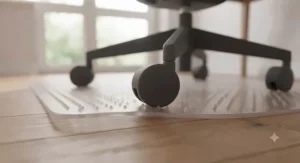
Chair Mat vs Bare Hard Floor: Scratch Prevention and Warranty Protection
It’s worth spelling out plainly why floor scratch prevention matters beyond the purely cosmetic. Many engineered and laminate flooring manufacturers specify protective measures like chair mats as a condition of maintaining product warranty cover for high-traffic or castor-chair areas — meaning a £25 mat can be the difference between a covered claim and an out-of-pocket refinishing bill running into hundreds of pounds.
| Protection Method | Scratch Prevention | Castor Glide | Typical Cost | Best For |
|---|---|---|---|---|
| No protection (bare floor) | Poor — direct contact | N/A | £0 | Not recommended for daily rolling chairs |
| Standard rug or runner | Moderate — fabric can still let grit through | Poor — chairs sink and drag | £20-£60 | Occasional, light chair use |
| Felt furniture pads (static only) | Good for static legs, irrelevant for castors | N/A | £5-£10 | Non-rolling furniture only |
| Chair mat for hard floors | Very good to excellent, depending on tier | Excellent — designed specifically for rolling | £20-£220 | Daily rolling-chair use |
Rugs and runners are a common but flawed workaround: they look softer underfoot, but loose fabric weave lets grit sit directly against the floor finish, and a chair’s castors sink into pile rather than gliding across it, creating drag that leads to chairs being physically dragged rather than rolled — arguably worse for the floor than no protection at all in some cases. A dedicated hard floor chair mat, even a budget one, categorically outperforms both alternatives for anyone using a rolling chair daily, which is really the entire use case this product category exists to solve.
Low-Pile Surfaces and Hard Floor Transitions Explained
A genuinely common UK living situation deserves its own section: open-plan rooms where a hard floor kitchen-diner flows into a carpeted or low-pile-rugged living area, with a desk sitting right at — or straddling — that transition line. Low-pile surfaces, generally defined as carpet or rug pile under roughly 6mm, behave differently to hard floors under a rolling chair, and most single-purpose mats aren’t rated for both.
This matters practically because a hard-floor-only mat like SHAREWIN, placed with one edge extending onto a low-pile rug, will typically ruck up or slide at that junction point, since its backing is designed to grip a completely flat, hard surface rather than accommodate the slight give of carpet fibre underneath. Capslpad‘s explicit low-pile rating solves exactly this scenario — its backing is engineered to sit stably across both surface types without the mat itself becoming a trip hazard at the transition seam.
If your desk genuinely sits on hard floor with no low-pile crossover risk, this consideration is moot and any hard-floor-rated mat in this guide will serve you well. But if there’s rug, runner or low-pile carpet tile anywhere within your chair’s swing radius, checking for explicit low-pile or multi-surface compatibility before buying saves a frustrating return.
Features That Actually Matter (And Those That Don’t)
Marketing copy across this category leans heavily on a few phrases worth honestly unpacking. “Heavy duty” is genuinely meaningful when it correlates with measurable thickness or a stated weight rating, as with WASJOYE‘s 1.7mm spec or the Floortex Cleartex Glaciermat‘s tested load capacity — but on its own, as a bare marketing term with no backing figure, it tells you very little.
“Anti-slip backing” matters enormously in practice and is worth prioritising over almost any other single spec, since a mat that shifts underfoot is functionally useless regardless of how thick or well-reviewed it is. Conversely, decorative patterning — while genuinely useful for hiding scuffs, as discussed with Capslpad and BesWin — is a preference feature, not a performance one, and shouldn’t push a buyer toward a mat that’s otherwise a worse fit for their floor size or type.
Thickness beyond roughly 2mm in PVC delivers diminishing returns for most domestic use — it mainly matters for very heavy users or industrial-style casters, not the average home office. And “crystal clear” as a selling point is genuinely a double-edged spec: it looks pristine on day one and shows every mark of grit and static-attracted dust noticeably faster than a patterned or frosted finish, which is worth knowing before assuming clear automatically equals premium.
Common Mistakes When Buying a Chair Mat for Hard Floors
A few buying patterns show up repeatedly across reviews and returns for this category, and nearly all are avoidable with a moment’s extra thought before purchase.
Buying undersized is the single most common regret — people measure their desk width but forget to account for how far back they actually roll to stretch, reach shelving, or stand up, leaving the back two castors permanently off the mat’s edge. Choosing a hard-floor-only mat for a room with any low-pile crossover is the second recurring issue, addressed fully in the section above. Ignoring castor compatibility entirely is a third: buyers frequently blame a perfectly good mat for poor glide when the actual mismatch is hard factory castors fighting a textured PVC surface. Finally, skipping the flattening period after unboxing and then assuming the mat is faulty when it curls is a mistake that’s entirely within the buyer’s control to avoid.
Long-Term Cost & Maintenance: Is a Premium Mat Worth It?
Running the actual numbers helps here rather than relying on gut instinct. A budget PVC mat at roughly £20-£25 has a realistic domestic lifespan of one to three years before curling, clouding or cracking under a daily-use chair, particularly with hard castors. Replaced twice over a decade, that’s £40-£75 in total spend, plus the recurring hassle of reordering and reinstalling.
A premium phthalate-free PVC mat like Floortex Cleartex Advantagemat, at £45-£70, reasonably lasts four to six years under similar conditions given its more robust manufacturing standard — meaning over the same decade you might replace it once, landing in broadly similar total cost territory to the budget route, but with fewer replacement cycles and a material-safety profile that matters if you’re sensitive to plasticiser exposure at all.
The Floortex Cleartex Glaciermat, at £150-£220, is the clear long-term-value outlier specifically because tempered glass essentially doesn’t degrade under normal domestic use — a decade-plus lifespan against a ten-year manufacturer warranty means, realistically, one purchase covers the entire period a budget buyer might spend on two or three separate mats, while never needing the underlying floor refinished due to accumulated scratch damage either.
Safety, Regulations and Material Compliance Guide
For UK buyers, two regulatory threads are genuinely worth knowing about rather than just taking on faith. First, plasticiser safety: UK REACH restricts four specific phthalate compounds in plasticised PVC articles generally, not merely toys, following the phthalate restriction expansion that took effect from July 2020 — checking that any PVC chair mat explicitly states phthalate-free manufacturing, as Floortex Cleartex Advantagemat does, is a reasonable due-diligence step rather than excessive caution, particularly in households with young children who spend floor-level time near a desk.
Second, workplace ergonomics more broadly: while chair mats themselves sit outside formal Display Screen Equipment Regulations, the HSE’s wider DSE workstation guidance frames the whole desk setup — chair, surface, and the ease of movement around it — as part of a genuinely assessable workstation risk picture for anyone working from home regularly. A mat that lets you glide and reposition freely, rather than one that drags or catches, plays a small but real supporting role in that broader picture rather than being purely cosmetic.
Beyond regulation, basic fire and slip safety is worth a mention: avoid placing any hard floor chair mat directly over underfloor heating elements without checking manufacturer heat tolerance first, and always ensure the mat sits flush with no raised edge across a walked thoroughfare, not just the desk zone itself.
✨ Don’t Miss These Exclusive Deals!
🔍 Take your home office setup to the next level with these carefully selected chair mats. Click on any highlighted item to check current pricing and availability. These floor protectors will help you create a genuinely scratch-free workspace your future self will thank you for!
Frequently Asked Questions
❓ Do I need a chair mat for hard floors?
❓ What is the best budget chair mat for hardwood floors?
❓ Will a chair mat scratch a hard floor?
❓ Can I use a hard floor chair mat on low-pile carpet?
❓ How do I stop my chair mat sliding on a hard floor?
Conclusion
Choosing a chair mat for hard floors ultimately comes down to matching material and size to how you actually use your desk, rather than simply picking whichever option sits at the top of a bestseller list. For a single desk on a tight budget, SHAREWIN or Capslpad solve the core problem affordably, with Capslpad earning the edge if your floor plan includes any low-pile crossover. WASJOYE and BesWin both justify a slightly higher mid-range spend through genuinely useful thickness and flatness improvements over the cheapest options, while Amazon Basics remains the pragmatic pick for larger or L-shaped desk setups that smaller mats simply can’t cover.
At the premium end, Floortex Cleartex Advantagemat brings phthalate-free manufacturing and generous sizing to buyers furnishing a permanent home office, and the Floortex Cleartex Glaciermat stands genuinely apart as the long-term, scratch-proof solution for anyone protecting a floor they simply can’t afford to see damaged. Whichever tier fits your budget and floor type, the underlying maths is consistent: a £20-£220 mat is cheap insurance against a refinishing or replacement bill that will always cost more than the protection did in the first place.
Recommended for You
- Cervical Pillow For Side Sleepers: 7 Top UK Picks (2026)
- Neck Support Pillow for Travel: 7 Best Picks for 2026
- Cervical Support Pillow: 7 Best Picks for Neck Pain UK (2026)
Disclaimer: This article contains affiliate links. As an Amazon Associate, I earn from qualifying purchases. If you purchase products through these links, we may earn a small commission at no additional cost to you.
✨ Found this helpful? Share it with your friends! 💬🤗
