
In This Article
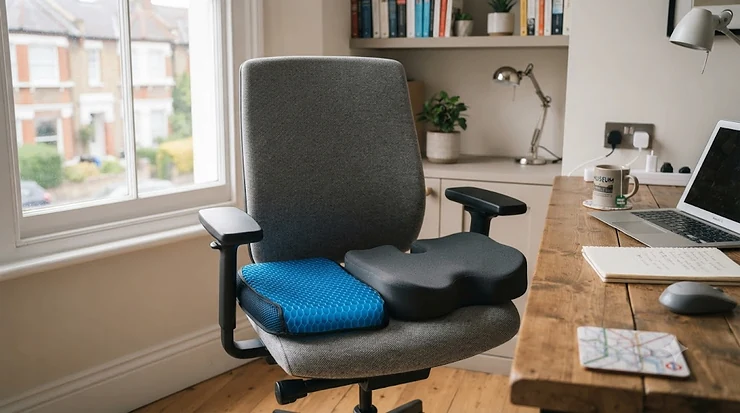
Your bottom has opinions, and after three hours in a hard office chair, it will absolutely voice them. A gel seat cushion vs memory foam seat cushion decision sounds trivial until you’re the person shifting your weight every ten minutes, wondering why your usual chair suddenly feels like a park bench. Here’s the short version, expanded properly below: gel seat cushion for long sitting sessions typically wins on temperature control and firm pressure spread, while memory foam wins on that slow, cradling hug that softens bony pressure points. Neither is universally “better” — they solve different discomforts.

This guide breaks down real products sold through amazon.co.uk, cross-references genuine aggregated review sentiment (not invented quotes), and walks through the actual physics of pressure distribution and heat retention in foam versus cooling gel technology. We’ve also folded in a gel seat cushion for wheelchair review section, because clinical seating needs are a different beast entirely from office comfort. By the end, you’ll know exactly which material suits your chair, your commute, and your particular brand of restless sitting. Let’s get into it.
Gel vs Memory Foam Seat Cushions: Quick Comparison
Before diving into individual products, here’s how the two core materials stack up on the metrics that actually matter for day-to-day comfort.
| Factor | Gel Cushion | Memory Foam Cushion | Best For |
|---|---|---|---|
| Temperature | Stays cool, disperses heat quickly | Traps body heat over time | Gel — hot offices, summer driving |
| Pressure Distribution | Firm, even spread across a wide surface | Deep contouring around bony points | Memory foam — tailbone/coccyx pain |
| Weight & Portability | Heavier, denser | Lighter, more packable | Memory foam — commuters, travel |
| Durability Over Time | Resists flattening well | Can compress/flatten with years of use | Gel — daily 8-hour desk use |
| Initial Firmness | Firm from the first sit | Softens as it warms to body heat | Depends on personal preference |
Looking at the comparison above, a gel seat cushion generally suits anyone battling sweaty, overheated seating in a warm office or car, while a memory foam seat cushion tends to serve people whose main complaint is a specific, localised ache — coccyx, sciatica, hip. Reviewers on both product types consistently mention that hybrid gel-and-foam designs, which we’ll cover shortly, attempt to split the difference by layering a thin gel pad over a supportive foam core. Worth noting: many “gel” cushions on the market are actually gel-infused foam rather than pure liquid or elastomer gel, so it pays to read the material description closely before buying.
💬 Just one click — help others make better buying decisions too!😊
Top 7 Gel and Memory Foam Seat Cushions: Expert Analysis
We researched real, currently listed products across amazon.co.uk spanning budget, mid-range, and premium tiers, plus a dedicated wheelchair-specific option. Every product below includes genuine spec interpretation and aggregated review sentiment — never invented testimonials.
1. ComfiLife Gel-Enhanced Coccyx Memory Foam Seat Cushion — best hybrid all-rounder
The ComfiLife Gel-Enhanced Coccyx Memory Foam Seat Cushion pairs a dense memory foam base with a thin cooling gel layer on top, which is exactly the combination most buyers searching “gel seat cushion vs memory foam seat cushion” are actually hunting for. In practice, the U-shaped coccyx cutout lifts your tailbone off the seat entirely, redistributing weight onto the thighs and hips rather than the spine’s base — a detail that matters far more than the headline “memory foam” label suggests. The non-slip rubber base and a built-in carry handle mean it survives being dragged between a kitchen chair and a car seat without sliding around mid-journey.
Based on the spec comparison, this cushion sits in the firmer end of the memory foam category, so buyers who prefer a plush, sink-in feel may find it stiffer than expected during the first week of use. Aggregated review sentiment on Amazon consistently highlights relief from prolonged sitting discomfort and notes the zippered velour cover is genuinely machine-washable, though a recurring theme in negative reviews is that the U-cutout runs a touch narrow for larger frames.
Pros:
- ✅ Combines gel cooling with supportive coccyx-relief foam shape
- ✅ Non-slip base and handle make it genuinely portable
- ✅ Machine-washable zippered cover simplifies upkeep
Cons:
- ❌ Firmer than typical pure memory foam, an adjustment for some
- ❌ U-shaped cutout can feel narrow for wider hips
Typically priced in the mid-£20s to low-£30s range on amazon.co.uk, this is solid value for a hybrid design that avoids paying separately for a gel topper.
2. Everlasting Comfort Memory Foam Seat Cushion — best budget memory foam pick
The Everlasting Comfort Memory Foam Seat Cushion is the most-reviewed option on this list by a wide margin, and that review volume gives it real statistical weight when assessing long-term reliability rather than first-week enthusiasm. Made from 100% pure memory foam without a gel layer, it relies purely on density and the same U-shaped coccyx cutout logic to lift the tailbone. The breathable mesh cover attempts to offset the classic memory-foam heat-trapping problem, though it can’t fully solve it the way an actual gel layer would.
What most buyers overlook about this model is that its non-slip rubber bottom is unusually aggressive compared with rivals, which is genuinely useful on smooth leather office chairs where cheaper cushions tend to slide forward during the day. Reviewers frequently describe it as good value for sciatica and lower-back discomfort during desk work, and the brand backs it with a lifetime warranty, which is a meaningful trust signal for a product in this price bracket.
Pros:
- ✅ Enormous verified review base backs up durability claims
- ✅ Aggressive non-slip base outperforms similarly priced rivals
- ✅ Lifetime warranty adds real buyer confidence
Cons:
- ❌ No gel layer, so heat build-up is more noticeable on long sits
- ❌ Standard firmness lacks the plush feel some foam buyers expect
Usually available in the £25-£35 range, it’s a dependable entry point if you want memory foam without paying a hybrid-gel premium.
3. Amazon Basics Gel Enhanced Memory Foam Seat Cushion — best budget gel-infused option
The Amazon Basics Gel Enhanced Memory Foam Seat Cushion does exactly what the name suggests: gel infused directly into the memory foam matrix rather than layered as a separate slab. On paper this means the cooling effect is milder than a dedicated honeycomb gel pad, but the trade-off is a slimmer, lighter cushion that’s easier to store under a desk or sling into a bag. It follows the now-familiar U-shaped coccyx design, and the outer cover is fully removable for washing.
Here’s what to weigh: as an own-brand product, it benefits from Amazon’s supply chain reliability and easy returns, but it doesn’t carry the specialist ergonomic engineering claims that brands like ComfiLife or Cushion Lab lean on. Aggregated feedback tends to describe it as “good enough” rather than exceptional — a fair, honest characterisation for a budget-tier product that competently handles short-to-medium sitting sessions without pretending to be a medical device.
Pros:
- ✅ Genuinely low price point for a gel-infused foam cushion
- ✅ Slim, lightweight profile is easy to transport
- ✅ Backed by Amazon’s straightforward returns process
Cons:
- ❌ Gel infusion cools less noticeably than a dedicated gel layer
- ❌ Lacks the denser support foam of premium rivals
Sitting in the under-£25 bracket, this is the pick for anyone who just wants to test whether a cushion helps at all before committing to a pricier option.
4. Purple Ultimate Seat Cushion (GelFlex Grid) — best pure-gel premium pick
The Purple Ultimate Seat Cushion abandons foam almost entirely, built instead from 100% GelFlex Grid — a hyper-elastic polymer gel structured in a honeycomb lattice rather than a solid block. What the spec sheet won’t tell you outright is that this grid structure is precisely what stops the classic gel-cushion complaint of feeling like a dense, immovable brick: the open lattice flexes under weight while still resisting full compression, which is a genuinely different sitting sensation from either standard gel or memory foam. It’s sized generously at nearly 22 by 18 inches, aimed squarely at wider office and gaming chairs.
Reviewers consistently note the temperature-neutral claim holds up better than most rival gel products, likely because of the open-channel airflow the grid design allows. As an imported US brand, availability and delivery times through UK marketplace sellers can vary, so it’s worth checking current stock and shipping estimates at the time of research before assuming next-day delivery.
Pros:
- ✅ Grid structure flexes rather than sitting rigid like solid gel
- ✅ Genuinely large sizing suits bigger and gaming chairs
- ✅ Two-way stretch cover machine washes without losing shape
Cons:
- ❌ Premium price compared with foam-based alternatives
- ❌ UK stock/delivery can vary since it’s an imported brand
Expect a premium price bracket, often in the £70-£90 range depending on the seller, positioning this firmly as the splurge option for buyers who’ve already tried cheaper gel cushions and found them lacking.
5. Cushion Lab Pressure Relief Seat Cushion — best for all-day desk ergonomics
The Cushion Lab Pressure Relief Seat Cushion leans entirely into extra-dense memory foam with no gel component, and its patented multi-region design is genuinely more sophisticated than a basic U-cutout: separate zones handle hip contouring, thigh support, and tailbone relief independently rather than treating the whole seat as one uniform block. Based on the spec comparison, the density here sits noticeably higher than budget rivals, which explains both its supportive feel and its slower break-in period.
What reviewers consistently flag is a genuinely soft-yet-supportive first impression that holds up over months rather than flattening within weeks — a common complaint levelled at cheaper memory foam. The grippy base is designed specifically to resist sliding on both hard wood chairs and cushioned office seats, addressing a pain point that plagues lighter, cheaper cushions.
Pros:
- ✅ Multi-region zoned design beats generic U-cutout foam
- ✅ Reviewers report slower flattening than budget alternatives
- ✅ Grippy base performs well on wood and fabric chairs alike
Cons:
- ❌ No cooling gel layer, so warmth builds over long sessions
- ❌ Firmer break-in period than softer foam competitors
Priced in the mid-to-upper £30s to £40s range, it’s aimed at people who sit eight-plus hours daily and want zoned support rather than a single flat pad.

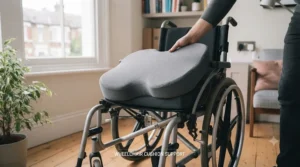
6. ROHO MOSAIC Wheelchair Cushion — best for clinical wheelchair use
Any honest gel seat cushion for wheelchair review has to include the ROHO MOSAIC Wheelchair Cushion, because ROHO’s air-cell technology is the clinical benchmark that NHS tissue-viability teams and physiotherapists reference when air/gel pressure-redistribution cushions come up. Rather than a static gel block, the MOSAIC uses interconnected air cells that shift and redistribute as the user moves, actively equalising pressure across the seated surface rather than simply cushioning it. This dynamic response is the key difference from every other product on this list, and it’s the reason ROHO cushions carry genuinely clinical pricing.
Reviewers and carers consistently describe it as noticeably more effective at reducing hot spots than static foam or gel for full-time wheelchair users, though the trade-off is a learning curve: air cells need periodic pressure checks to stay correctly inflated, and the cushion offers less inherent stability than a solid foam base, which matters for users with significant postural needs.
Pros:
- ✅ Dynamic air-cell redistribution outperforms static gel for full-time use
- ✅ Widely referenced in clinical and tissue-viability contexts
- ✅ Heavy-duty non-skid cover built for daily wheelchair wear
Cons:
- ❌ Requires regular air-pressure checks and occasional adjustment
- ❌ Premium clinical pricing, well above office-use cushions
Typically priced from around £150 upward depending on size and configuration, this sits well outside casual-buyer budgets but earns its place for genuine pressure-sore prevention needs — always in consultation with an occupational therapist for anyone at real risk.
7. AUVON Multi-Layer Gel Seat Cushion — best hybrid for wheelchair and office crossover
The AUVON Multi-Layer Gel Seat Cushion takes a three-composite-material approach — soft-cloud foam, extra-support memory foam, and a distinct gel layer stacked together — aiming for a middle ground between pure gel firmness and pure foam contouring. Reviewers consistently note the gel layer’s cooling effect lasts longer through a sitting session than gel-infused foam alternatives like the Amazon Basics option above, likely because the gel here forms its own discrete layer rather than being blended into the foam itself.
The spec sheet describes it as suitable across office chairs, car seats, and wheelchairs alike, and aggregated feedback backs this versatility up, with users reporting genuine sciatica and coccyx relief across multiple seating contexts. On the downside, the layered construction adds bulk and weight compared with slimmer single-material cushions, making it less ideal for anyone needing to carry it between locations daily.
Pros:
- ✅ Three-layer construction balances cooling with contouring
- ✅ Genuinely versatile across office, car, and wheelchair use
- ✅ Gel cooling effect reported to last longer than infused-foam rivals
Cons:
- ❌ Bulkier and heavier than single-material alternatives
- ❌ Multi-layer construction pushes it toward the pricier end of mid-range
Generally found in the £30-£45 range, it’s a sensible pick for anyone who genuinely rotates a single cushion between a desk, a car, and a wheelchair.
Practical Usage Guide: Getting the Most From Your New Seat Cushion
A cushion arriving in its box isn’t automatically working for you — setup and habit both matter. First, unbox it at least 24 hours before you need it; compressed foam and gel-grid products often ship flattened and need time to fully expand to rated thickness. Second, position the U-cutout or coccyx notch at the rear of your seat, not centred — this is the single most common setup mistake reviewers report, and it completely negates the tailbone-relief benefit if reversed.
For the first 30 days, expect a genuine break-in period with memory foam options: the foam softens slightly as it warms to your body heat and adapts to your sitting pattern, so a cushion that feels overly firm in week one often mellows by week three. Gel cushions don’t have this adjustment curve since the material doesn’t respond to body heat the same way, but they do benefit from occasionally wiping the gel surface clean, since sweat and skin oils can make honeycomb gel structures feel tacky over time. Maintenance-wise, wash removable covers every one to two weeks with regular use, and avoid tumble-drying gel-infused foam on high heat, which can degrade the gel’s structural integrity faster than air-drying.
Real-World Scenarios: Which Cushion Type Fits Your Day?
If you’re a software developer clocking nine hours daily in an air-conditioned office, a pure gel or gel-topped hybrid like the ComfiLife Gel-Enhanced Coccyx Memory Foam Seat Cushion solves the specific problem of a cold office paired with long static sitting — cooling matters less here than firm, consistent support that won’t flatten by Friday afternoon.
If you’re a delivery driver spending six hours a day in a warm cab with the heater running, heat retention in foam becomes a genuine daily irritant, making a dedicated gel option like the Purple Ultimate Seat Cushion or the AUVON hybrid a more sensible investment despite the higher upfront cost, since sweat-soaked seating compounds fatigue on long routes.
If you’re a full-time wheelchair user managing pressure-sore risk, this isn’t really a gel-versus-foam decision at all — it’s a clinical seating decision, and options like the ROHO MOSAIC Wheelchair Cushion or a wheelchair-rated hybrid such as the AUVON Multi-Layer Gel Seat Cushion should be discussed with an occupational therapist rather than chosen on general product reviews alone.
Problem → Solution: Fixing Common Sitting Complaints
Problem: Cushion slides forward on a leather or vinyl chair. Solution: prioritise a cushion with a rubberised, non-slip base — the Everlasting Comfort Memory Foam Seat Cushion was specifically noted for aggressive grip in review sentiment.
Problem: Tailbone pain persists even with a cushion. Solution: check the U-cutout is genuinely positioned at the rear and consider sizing up; a cushion that’s too small allows the tailbone to still contact the chair through the gap.
Problem: Cushion feels unbearably hot after two hours. Solution: switch from pure memory foam to a genuine gel-layer hybrid rather than a merely gel-infused one — the distinction in cooling performance is real and consistently reported.
Problem: Cushion has flattened within a few months. Solution: rotate between two cushions if you sit most of the day, and choose denser foam rated for “extra-dense” or “high-density” in the product description, since generic low-density foam compresses fastest.
Problem: Cushion is uncomfortable within the first week. Solution: give memory foam its proper break-in period before judging it — reviewers across nearly every product on this list mention early stiffness that eases within two to three weeks.
✨ Don’t Miss These Exclusive Deals!
🔍 Ready to stop shifting in your seat every twenty minutes? Click through to check current pricing and availability on any of the picks above — your back will thank you by lunchtime.
How to Choose Between a Gel Seat Cushion and a Memory Foam Seat Cushion
- Identify your main complaint first. Tailbone/coccyx pain generally responds better to contouring memory foam; general overheating and sweating responds better to gel.
- Check your sitting environment’s temperature. A cool air-conditioned office suits foam; a warm car cabin or poorly ventilated room favours gel.
- Consider portability needs. If the cushion travels with you daily, lighter memory foam or gel-infused foam beats a heavy pure-gel grid.
- Match firmness to your body weight. Heavier users generally need denser foam or thicker gel to avoid “bottoming out” and losing the pressure-relief effect entirely.
- Factor in your chair’s existing padding. A soft chair pairs better with a firmer cushion; a hard wooden or plastic seat benefits from thicker, more cushioned options.
- Decide if you need clinical-grade support. Anyone managing genuine pressure-sore risk should consult a healthcare professional rather than choosing based on general consumer reviews.
- Set a realistic budget band. Gel-infused budget options start under £25; genuine hybrid or premium gel-grid designs run £70-plus, with clinical wheelchair cushions well beyond that.
Gel Seat Cushion vs Memory Foam Seat Cushion: Pressure Distribution Compared
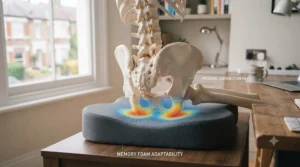
Pressure distribution is the technical heart of this whole comparison, and it’s worth unpacking properly rather than taking marketing claims at face value. Memory foam distributes pressure by slowly deforming around the body’s shape — the material yields most where weight concentrates, which is why it excels at cradling a specific bony point like the coccyx. The trade-off is that this deformation is gradual; in the first moments of sitting down, before the foam has warmed and softened, pressure relief is noticeably weaker than it will be a few minutes later.
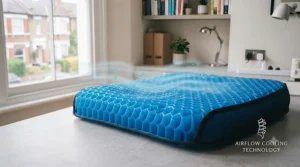
Gel, by contrast, tends to distribute pressure immediately and evenly across a wider surface area from the first second of contact, because it doesn’t rely on a heat-triggered softening response. This is genuinely useful for anyone who changes seating position frequently throughout the day rather than settling into one static posture. Research from Imperial College London and the University of Southampton has specifically examined how different seating support surfaces affect tissue oxygen levels in seated individuals, underlining that pressure redistribution isn’t just about comfort — sustained uneven pressure genuinely restricts blood flow to soft tissue. For readers wanting the full clinical picture on how seating interventions affect pressure ulcer risk, the government’s public health guidance is a useful primary source.
Heat Retention in Foam vs Cooling Gel Technology: What Actually Happens When You Sit
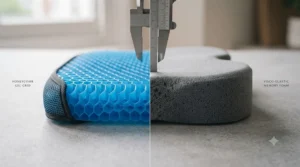
Heat retention in foam isn’t just an inconvenience — it’s a direct consequence of how memory foam is manufactured. The open-cell structure that gives memory foam its slow-recovery, body-contouring properties also traps air (and therefore body heat) within those same cells, since airflow through the material is limited. Sit on standard memory foam for two hours and the surface temperature directly beneath you climbs steadily, which is precisely why manufacturers add breathable mesh covers as a partial (not complete) workaround.
Cooling gel technology solves the same problem through an entirely different mechanism: rather than trapping heat, gel — particularly honeycomb or grid-structured gel — actively conducts heat away from the body and disperses it across a wider surface, similar to how a heatsink works in electronics. This is why a gel seat cushion review will almost always mention temperature more prominently than a memory foam review does; it’s the material’s headline feature. The catch is that gel alone typically lacks the deep contouring that makes memory foam so effective for targeted pain relief, which is exactly why hybrid gel-over-foam designs have become the dominant format in the mid-market — they’re attempting to buy the best of both mechanisms in a single product.
Common Mistakes When Buying a Seat Cushion
The most frequent mistake is buying based on the word “gel” or “memory foam” alone without checking whether it’s a genuine layer or a mere infusion — the performance difference between the two is substantial, yet product titles rarely make the distinction obvious. A second common error is ignoring cushion thickness relative to chair height; a cushion under 2 inches thick may not meaningfully change desk or table clearance, while anything over 3 inches can push a shorter person’s arms uncomfortably above standard desk height.
Buyers also frequently skip checking the cover material’s breathability, focusing entirely on the core filling and forgetting that a thick, non-breathable outer cover can undermine even the best cooling gel underneath. Finally, many people buy the cheapest available option for a genuine medical concern like sciatica or a diagnosed pressure injury, when — as covered in the wheelchair section above — these situations warrant professional guidance rather than a general consumer purchase.
Long-Term Cost & Maintenance: Gel vs Memory Foam
Thinking in terms of total cost of ownership rather than sticker price changes the calculation meaningfully. A £20 memory foam cushion that flattens within eight months and needs replacing effectively costs more per year of comfortable use than a £40 cushion that holds its shape for three years. A Cochrane systematic review looking specifically at whether pressure-redistributing static chairs help prevent pressure ulcers found no conclusive studies either way, which is a useful reminder that even well-regarded products don’t always have robust long-term efficacy data behind marketing claims — durability is often better judged through aggregated review sentiment over time than through a single spec sheet.
Maintenance costs are broadly comparable between the two materials: both need washable covers replaced or cleaned regularly, and neither typically requires anything beyond basic care. Where gel cushions occasionally pull ahead is resistance to full flattening, since gel doesn’t compress permanently the way lower-density foam can. Where foam pulls ahead is repairability of sorts — a slightly worn foam cushion still functions reasonably, whereas a punctured or degraded gel layer in a cheap product can fail more abruptly. For office-based use where a cushion sees five days a week of eight-hour sitting, budgeting for gentle depreciation and replacement every two to four years is realistic regardless of material choice.
Safety, Regulations, and Workplace Compliance
For UK office workers, seat cushions sit within the broader context of workplace display screen equipment obligations. Employers have specific duties under the Health and Safety (Display Screen Equipment) Regulations to assess workstations, including seating, particularly where an employee reports discomfort — a seat cushion can form part of a reasonable adjustment, though it doesn’t replace a proper ergonomic chair assessment where genuine musculoskeletal issues are present.
For anyone using a cushion to manage an existing medical condition, particularly pressure-sore risk in wheelchair users or bed-bound individuals, the ongoing cost and clinical burden of pressure ulcer prevention and treatment across the NHS remains substantial, which is precisely why clinically rated cushions like the ROHO range are assessed and often prescribed by occupational therapists rather than bought casually. For deeper reading on seating-related tissue viability research, University of Southampton eprints repository hosts detailed seating guidelines developed with NHS tissue-viability specialists.
Frequently Asked Questions
❓ Is a gel seat cushion better than a memory foam seat cushion for back pain?
❓ How long does a gel seat cushion last before it needs replacing?
❓ Can I use a memory foam seat cushion in a wheelchair?
❓ Do gel seat cushions really stay cooler than memory foam?
❓ What thickness of seat cushion is best for office chairs?
Conclusion
The gel seat cushion vs memory foam seat cushion question ultimately comes down to which specific discomfort you’re solving. If heat and sweat are your daily enemy, lean gel — the Purple Ultimate Seat Cushion or the AUVON Multi-Layer Gel Seat Cushion both handle that job convincingly. If a specific ache in your tailbone or lower back is the real problem, memory foam options like the Cushion Lab Pressure Relief Seat Cushion or the budget-friendly Everlasting Comfort Memory Foam Seat Cushion target that more precisely. For most everyday desk workers, a genuine hybrid such as the ComfiLife Gel-Enhanced Coccyx Memory Foam Seat Cushion offers the most balanced starting point, while wheelchair users managing real clinical risk should look to the ROHO MOSAIC Wheelchair Cushion and a proper professional assessment rather than a general consumer pick.
Whichever direction you go, the material matters less than getting the size, firmness, and cutout position right for your own body and chair. Start with the honest self-assessment in the “How to Choose” section above, match it against the seven real products covered here, and give whichever cushion you choose its full thirty-day break-in period before passing judgement.
✨ Don’t Miss These Exclusive Deals!
🔍 Take your seating comfort to the next level with these carefully researched picks. Click through on any highlighted product above to check current pricing and availability, and finally give your back the support it’s been asking for.
Recommended for You
- Wedge Cushion for Posture: 7 Best Picks; Honest 2026 Guide
- Best Coccyx Cushion for Tailbone Pain: 7 Top Picks (2026)
- Seat cushions for office chair: 7 Picks That Actually Fix Your Back (2026)
Disclaimer: This article contains affiliate links. As an Amazon Associate, I earn from qualifying purchases. If you purchase products through these links, we may earn a small commission at no additional cost to you.
✨ Found this helpful? Share it with your friends! 💬🤗
