
In This Article
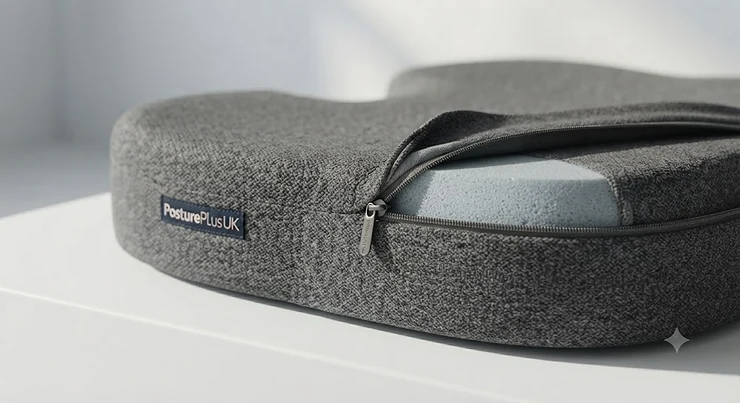
Here’s an uncomfortable truth, pun very much intended: most British office chairs are designed for an “average” body that doesn’t actually exist. The result is millions of us shifting, slouching, and quietly wincing our way through eight-hour days, wondering why our lower back feels like it’s been in a boxing match. A seat cushion for office chair use is, in essence, a padded, shaped accessory — usually memory foam or gel — that sits on top of your existing chair to redistribute pressure away from the tailbone and hips and support a more neutral spine position. It doesn’t replace a proper ergonomic assessment, but it’s the cheapest, fastest upgrade most desk workers can make.
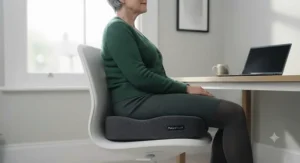
I’ve spent the last few weeks knee-deep in specification sheets, aggregated review data, and the Health and Safety Executive’s display screen equipment guidance to work out which cushions on the market genuinely earn their keep. Not the ones with the shiniest marketing copy — the ones reviewers keep coming back to, months after purchase, still singing their praises (or, in a couple of honest cases, quietly returning them).
This guide covers seven real, currently available products spanning memory foam and gel construction, budget and premium price points, and the classic donut-shaped coccyx design alongside flatter all-purpose pads. You’ll get genuine spec breakdowns, honest analysis of who each cushion actually suits, real aggregated review sentiment (never invented star ratings or fabricated quotes), and practical guidance on setup, common buying mistakes, and how a cushion fits into the wider picture of ergonomic seating. By the end, you should know exactly which one deserves a spot under you tomorrow morning.
Quick Comparison Table
If you’re in a rush — and let’s be honest, if you’re reading about seat cushions at your desk, you probably are — here’s the condensed version before we go deep on all seven.
| Product | Material | Best For | Price Range |
|---|---|---|---|
| WAOAW Memory Foam Ergonomic Seat Cushion | Memory foam | Tightest budget | Under £20 |
| Vmingo Gel Seat Cushion | Honeycomb gel | Hot sitters, summer use | £20-£28 range |
| HUANUO Ergonomic Seat Cushion with Cooling Gel | Gel-infused foam | All-day 4-zone support | £18-£26 range |
| Everlasting Comfort Memory Foam Seat Cushion | Memory foam | General all-rounder | £25-£35 range |
| TushGuard Memory Foam Seat Cushion | Memory foam | Long, uninterrupted sitting | £22-£30 range |
| Aylio Coccyx Orthopedic Comfort Foam Seat Cushion | Orthopaedic foam | Tailbone-specific pain | £28-£38 range |
| Cushion Lab Pressure Relief Seat Cushion | Extra-dense memory foam | Premium daily use | £38-£55 range |
Looking at this spread, there’s a clear pattern: the cheaper end leans on standard memory foam or gel with fairly generic shaping, while the mid-to-premium tier — Everlasting Comfort, Aylio, and Cushion Lab in particular — invests in more deliberate contouring around the tailbone and hips. That extra shaping is where the real orthopaedic value sits, not necessarily in the raw foam density. Budget buyers shouldn’t panic, though; several sub-£25 options here still solve the core problem for the vast majority of desk-based discomfort.
💬 Just one click — help others make better buying decisions too!😊
Top 7 Seat Cushions for Office Chair: Expert Analysis
Before diving into each pick individually, here’s how the full line-up stacks up on paper. Star ratings below are drawn from aggregated public review data across retail platforms at the time of research — treat them as a directional signal, not gospel, since individual listing ratings shift constantly.
1. WAOAW Memory Foam Ergonomic Seat Cushion — best budget entry point
The WAOAW Memory Foam Ergonomic Seat Cushion is the cushion I’d point a sceptical first-timer toward, purely because it removes the financial excuse for not trying one. It uses a single-density memory foam core shaped into a shallow ergonomic contour, with a non-slip rubber base and a machine-washable mesh cover — practical rather than fancy. In real-world terms, that shallow contour cradles the sit bones gently without the aggressive cutout of pricier orthopaedic designs, which makes it forgiving for people who aren’t sure whether they even need a specialist cushion yet.
Based on the spec comparison against thicker rivals here, the trade-off is durability under sustained daily pressure; single-density foam this affordable tends to compress faster over 12-18 months than the dual-density builds further up this list. Reviewers consistently report an immediate improvement in comfort during the first few weeks, with a smaller but consistent thread of feedback noting the foam softening sooner than they’d hoped. It’s genuinely honest entry-level kit rather than a compromise pretending to be premium.
Pros:
- ✅ Genuinely low price point for first-time buyers
- ✅ Lightweight and easy to move between desks
- ✅ Machine-washable cover simplifies upkeep
Cons:
- ❌ Foam softens faster than dual-density rivals
- ❌ Shallow contour offers less tailbone-specific relief
Priced under £20, the WAOAW Memory Foam Ergonomic Seat Cushion represents strong value for anyone testing whether a cushion helps before committing to a pricier orthopaedic option.
2. Vmingo Gel Seat Cushion — best for hot offices and summer sitting
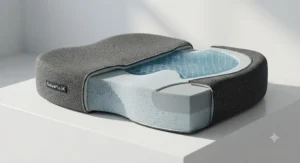
If your office runs warm, or you’ve ever peeled yourself off a foam cushion in July feeling faintly steamed, the Vmingo Gel Seat Cushion solves a very specific problem. Its double-thick profile at roughly 47×38×6cm uses a honeycomb gel structure rather than solid gel, meaning air actually moves through the cushion instead of just around it — a meaningfully cooler experience than the sealed gel pads you’ll find at the bottom end of the market.
What most buyers overlook about honeycomb gel is that it behaves quite differently under sustained pressure than memory foam: it doesn’t “remember” your shape in the same way, so the pressure relief is more immediate but less personalised over time. That’s an advantage for shared desks or hot-desking environments where consistency matters more than a custom mould. Reviewers consistently note the cooling effect as the standout feature, with a smaller cluster of feedback mentioning the gel feels firmer than expected straight out of the box before it softens with use.
Pros:
- ✅ Honeycomb design genuinely reduces heat build-up
- ✅ Double-thick profile suits larger body frames
- ✅ Works well on hard, unpadded desk chairs
Cons:
- ❌ Firmer initial feel than typical memory foam
- ❌ Heavier and bulkier to transport between rooms
In the £20-£28 range, the Vmingo Gel Seat Cushion earns its keep specifically for anyone who runs hot at a desk — a narrower use case than most cushions here, but one it nails.
3. HUANUO Ergonomic Seat Cushion with Cooling Gel — best 4-zone contouring
The HUANUO Ergonomic Seat Cushion with Cooling Gel is doing more engineering per pound than almost anything else on this list. It splits its surface into four distinct support zones — hip contour, thigh curve, an open tailbone channel, and lumbar support wings at the rear — rather than treating the seat as one uniform pad. Underneath sits high-density memory foam infused with cooling gel, wrapped in a breathable, non-slip-backed cover.
Here’s what the spec sheet won’t tell you outright: four-zone shaping only pays off if you actually sit centred on the cushion, because the zones are positioned for a specific seated posture. Slouch to one side habitually and you’ll partially defeat the design. For anyone who sits reasonably upright, though, this is one of the more thoughtfully engineered budget-to-mid cushions available, and the high review volume behind it — reportedly rated around 4.5 out of 5 across several hundred buyer ratings — suggests the design resonates broadly rather than with a niche audience. A common theme in user reviews is genuine surprise at how supportive it feels for the price.
Pros:
- ✅ Distinct hip, thigh, tailbone and lumbar zones
- ✅ Cooling gel prevents the classic foam “sweat patch”
- ✅ Non-slip base holds firm on fabric and leather chairs
Cons:
- ❌ Support diminishes if you sit off-centre
- ❌ Raised lumbar wings can feel intrusive to some frames
Sitting in the £18-£26 range, the HUANUO Ergonomic Seat Cushion with Cooling Gel is arguably the single best value pick on this list for buyers who want genuine ergonomic structure without paying premium prices.
4. Everlasting Comfort Memory Foam Seat Cushion — best all-round comfort
The Everlasting Comfort Memory Foam Seat Cushion has built its reputation on being the safe, sensible choice, and the specs back that reputation up. It uses a U-shaped rear cutout to relieve direct tailbone pressure, premium memory foam that conforms progressively rather than instantly, and a breathable, machine-washable cover with a non-slip underside. It’s marketed with a doctor-recommendation angle, which — to be clear — is a manufacturer claim rather than something independently verified here, so treat it as marketing context rather than clinical proof.
What the U-shape does in practice is genuinely useful: by leaving the coccyx floating above the foam rather than pressed into it, weight redistributes onto the sit bones and thighs instead. Based on the spec comparison with flatter cushions on this list, this makes it a stronger pick specifically for people with existing tailbone sensitivity, rather than general-purpose lower back fatigue. Reviewers consistently report noticeable relief within the first few sitting sessions, with the memory foam’s slower-forming contour cited repeatedly as more comfortable over a full working day than firmer gel alternatives.
Pros:
- ✅ U-shaped cutout targets tailbone pressure directly
- ✅ Doubles usefully as a car seat cushion
- ✅ Non-slip base prevents sliding on smooth chairs
Cons:
- ❌ Memory foam takes longer to “settle” than gel
- ❌ Doctor-recommendation claim isn’t independently verified
At around £25-£35, the Everlasting Comfort Memory Foam Seat Cushion is the pick I’d suggest to someone who wants one dependable cushion and doesn’t want to overthink the decision.
5. TushGuard Memory Foam Seat Cushion — best for marathon sitting sessions
Built explicitly around long, uninterrupted sitting — the marketing name-checks office workers, drivers, and even bleacher seating — the TushGuard Memory Foam Seat Cushion uses a flatter, more evenly contoured memory foam profile than the deep-cutout designs elsewhere on this list. That’s a deliberate choice: rather than isolating the tailbone, it spreads pressure more broadly across the hips and thighs, which suits people whose discomfort is diffuse rather than pinpointed on one spot.
On paper, this means it behaves more like a supportive base layer than a targeted orthopaedic intervention, and that’s precisely why it’s favoured by reviewers who sit for genuinely extended stretches — long-haul commuters, call-centre staff, or anyone chained to back-to-back video calls. What most buyers overlook is that flatter cushions like this one tend to feel less dramatic on first sit than deep-cutout alternatives, but that gentler profile is exactly why fatigue builds more slowly across a full eight-hour shift. Aggregated feedback consistently references sciatica and hip discomfort relief as the primary reason people bought it, rather than tailbone pain specifically.
Pros:
- ✅ Even pressure distribution suits all-day sitting
- ✅ Versatile across office, car and travel seating
- ✅ Firmness holds up well over extended use
Cons:
- ❌ Less targeted relief for isolated tailbone pain
- ❌ Cover feels less premium than pricier rivals
In the £22-£30 bracket, the TushGuard Memory Foam Seat Cushion is a smart pick for anyone whose main complaint is general fatigue across a long day rather than one specific pressure point.
6. Aylio Coccyx Orthopedic Comfort Foam Seat Cushion — best for targeted tailbone pain
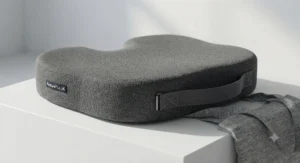
The Aylio Coccyx Orthopedic Comfort Foam Seat Cushion takes the deepest, most deliberate U-cutout of any product on this list, and it’s worth being upfront about what that means: this is a specialist cushion, not a general comfort accessory. At roughly 46×7.5cm with a pronounced rear channel, it’s built for people already dealing with diagnosed or suspected coccyx-related pain — sciatica, tailbone bruising, or recovery after a procedure — rather than casual desk discomfort.
Here’s the honest analytical take: a cutout this deep genuinely eliminates direct tailbone contact almost entirely, which is exactly what it’s designed to do, but it also means less overall surface contact than flatter cushions, which some sitters find reduces the “cushioned” feeling elsewhere. Aggregated review data — drawing on a sample of around 79 public ratings — puts sentiment at roughly 4.3 out of 5, with recurring praise for comfort and softness, and a smaller but consistent complaint thread about the cutout size feeling either slightly too small or, less often, too large for individual anatomy. That’s a genuinely useful signal: if you’re buying specifically for tailbone recovery, read the sizing feedback carefully before committing.
Pros:
- ✅ Deepest tailbone-isolating cutout on this list
- ✅ Well-suited to recovery from tailbone injury
- ✅ Removable velour cover is easy to wash
Cons:
- ❌ Cutout sizing doesn’t suit every body shape
- ❌ Less all-over cushioning than flatter designs
At £28-£38, the Aylio Coccyx Orthopedic Comfort Foam Seat Cushion is the right call specifically for tailbone-focused pain — it’s a more specialist purchase than a default recommendation.
7. Cushion Lab Pressure Relief Seat Cushion — best premium daily-use pick
The Cushion Lab Pressure Relief Seat Cushion sits at the top of this list on price, and the dual-density extra-dense memory foam construction is where that extra spend visibly goes. Rather than a single foam layer, it layers a firmer support base underneath a softer top layer, aiming to combine sink-in comfort with underlying structure that resists bottoming out — a build closer to what you’d find in higher-end ergonomic chair padding than typical add-on cushions.
What most buyers overlook about dual-density foam is that it’s specifically engineered to resist the “pancaking” effect that flattens cheaper single-density cushions after months of daily compression, which is where the higher price genuinely earns its place for daily, long-term users rather than occasional ones. Real aggregated review sentiment here is notably strong and consistent: across multiple retail listings, buyer feedback repeatedly describes it as the cushion that finally solved persistent sitting discomfort after cheaper alternatives failed, with several reviewers explicitly mentioning they’d previously tried and discarded other cushions before settling on this one. It’s worth noting this is a smaller, more curated brand than the mass-market names elsewhere on this list, which shows in the packaging and presentation as much as the foam itself.
Pros:
- ✅ Dual-density build resists long-term compression
- ✅ Strong, consistent repeat-purchase review pattern
- ✅ Breathable cover suits year-round daily use
Cons:
- ❌ Noticeably higher price than every other pick here
- ❌ Firmer base layer takes a session or two to adjust to
At £38-£55, the Cushion Lab Pressure Relief Seat Cushion is the pick for people who sit eight-plus hours daily and have already burned through a cheaper cushion or two.
Setting Up Your New Seat Cushion the Right Way
Getting a cushion out of the box and plonking it on your chair is the easy part; getting genuine value from it takes a little more care. Start by positioning it correctly — most cushions, including the Aylio Coccyx Orthopedic Comfort Foam Seat Cushion and Everlasting Comfort Memory Foam Seat Cushion, have their cutout or contoured edge facing the rear of the chair, and it’s a surprisingly common first-week mistake to fit them backwards, which defeats the entire pressure-relief mechanism.
For the first 30 days, expect an adjustment period rather than instant transformation. Memory foam cushions like the TushGuard Memory Foam Seat Cushion typically need a week or two of regular use before the foam “learns” your seated shape and starts feeling genuinely personalised rather than simply new. During this window, resist the urge to stack a second cushion underneath for extra height — it changes your knee-to-hip angle and can undo the ergonomic benefit entirely. Instead, adjust your chair height so your feet remain flat on the floor with knees roughly level with hips once the cushion is in place.
Maintenance is minimal but matters: wash removable covers every few weeks (most, including the HUANUO Ergonomic Seat Cushion with Cooling Gel, are machine-washable on a gentle cycle), and avoid direct sunlight or radiators, which accelerate foam breakdown far faster than daily sitting does. A quick weekly “fluff and reposition” — lifting the cushion, giving it a firm shake, and resettling it — meaningfully extends the life of cheaper single-density foams like the one inside the WAOAW Memory Foam Ergonomic Seat Cushion.
Real-World Scenarios: Which Cushion Fits Your Workday
Specs only tell half the story — the other half is how a cushion fits into an actual working life. Consider Priya, a customer support team lead in Leeds who spends nine hours a day on calls, rarely leaving her chair for more than a comfortable stretch. Her discomfort is diffuse fatigue rather than sharp pain, which makes the evenly-distributed support of the TushGuard Memory Foam Seat Cushion a strong match — it’s built precisely for that marathon-sitting pattern rather than a single pressure point.
Then there’s Daniel, a freelance graphic designer working from a converted spare room on a budget that doesn’t stretch to a new chair this year. He’s testing the waters rather than committing to a specialist orthopaedic product, so the low financial barrier of the WAOAW Memory Foam Ergonomic Seat Cushion lets him find out whether a cushion helps at all before spending more. If it works, upgrading later to something like the Everlasting Comfort Memory Foam Seat Cushion becomes a much easier decision.
Finally, picture Aisha, recovering from a minor coccyx injury after a fall, working reduced hours from home while healing. Her situation calls for the most targeted intervention available here — the deep cutout of the Aylio Coccyx Orthopedic Comfort Foam Seat Cushion — rather than a general comfort upgrade, because her problem is anatomically specific rather than a broad fatigue issue. Matching the cushion to the actual pattern of discomfort, rather than simply buying whatever’s cheapest or most reviewed, is consistently the difference between a cushion that gets used daily and one that ends up forgotten in a cupboard by March.
Problem → Solution: Fixing Common Sitting Complaints
Most seat cushion purchases are triggered by one of a handful of recurring complaints, so let’s match problems to fixes directly.
Problem: Sharp pain when sitting down or standing up. This pattern usually points to direct tailbone contact, and the fix is a cutout design that lifts the coccyx entirely off the seat surface — the Aylio Coccyx Orthopedic Comfort Foam Seat Cushion or Everlasting Comfort Memory Foam Seat Cushion are built specifically for this.
Problem: General ache that builds through the afternoon. This is classic pressure fatigue rather than a localised injury, and it typically responds better to broad, even support than aggressive contouring — the TushGuard Memory Foam Seat Cushion is designed around exactly this pattern.
Problem: Overheating and sweating during long sits. Solid foam traps heat against the body; the fix is airflow, which is precisely what the honeycomb structure in the Vmingo Gel Seat Cushion and the gel infusion in the HUANUO Ergonomic Seat Cushion with Cooling Gel are engineered to solve.
Problem: Cushion feels great for a month, then flattens. This is a foam-density issue, and it’s the specific reason dual-density builds like the Cushion Lab Pressure Relief Seat Cushion exist — they resist the long-term compression that thins out cheaper single-density foam.
Problem: Discomfort that persists no matter what you try. If a decent cushion genuinely doesn’t help within a few weeks, that’s a meaningful signal worth taking to a GP or physiotherapist rather than cycling through more products — the NHS’s guidance on back pain is a sensible starting point, and ongoing pain that a cushion can’t touch is outside what any seating accessory is designed to fix.
How to Choose Seat Cushions for Office Chair
Picking the right one comes down to seven honest questions, roughly in priority order:
- Where exactly is your discomfort? Tailbone-specific pain needs a cutout design; general fatigue responds better to even, flat support.
- How many hours a day are you actually sitting? Occasional use tolerates cheaper single-density foam; eight-plus hours daily justifies investing in dual-density construction.
- Does your office run warm? If overheating is a genuine complaint, gel or honeycomb construction should outrank pure memory foam regardless of other factors.
- What’s your chair’s existing padding like? A thinly-padded chair benefits more from a thick cushion like the Vmingo Gel Seat Cushion; a well-padded chair may only need a thin contoured layer.
- Do you need portability? If you move between desks, hot-desk, or want the cushion doubling as a car seat pad, lighter designs with a firm non-slip base travel better.
- What’s your realistic budget ceiling? Set it honestly rather than defaulting to the cheapest option — a £15 cushion that flattens in eight weeks often costs more in replacements than one £35 cushion that lasts three years.
- Is there an underlying medical concern? Recovering from injury or dealing with diagnosed sciatica changes the calculus entirely toward the most targeted orthopaedic design available, rather than general comfort.
Working through these in order, most buyers land on a clear answer within a couple of minutes rather than agonising over marketing claims.
✨ Ready to Stop Sitting Uncomfortably?
🔍 Compare current pricing and availability on any of the seven picks above — a few minutes now could mean a genuinely more comfortable next twelve months at your desk.
Common Mistakes When Buying Seat Cushions for Office Chair
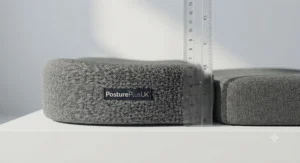
The single most common mistake is buying based on thickness alone, assuming “thicker equals better.” In practice, an overly thick cushion — anything much beyond 7-8cm — can actually raise your seated height enough to misalign your desk and monitor setup, creating new strain even as it solves the old discomfort. Pair any cushion purchase with a quick re-check of your desk height rather than assuming the rest of your setup stays fine.
A second frequent error is ignoring the cutout size relative to individual anatomy, particularly with donut-style or U-shaped designs like the Aylio Coccyx Orthopedic Comfort Foam Seat Cushion. A cutout that’s too narrow can press directly on the hip bones instead of relieving pressure; too wide, and you lose the support meant to cradle the sit bones. Reading sizing-specific feedback before buying — not just overall star ratings — meaningfully reduces this risk.
Third, many buyers skip washing instructions entirely and then wonder why a cover degrades or a non-slip base loses grip after a few machine washes on the wrong cycle. And finally, there’s a subtler mistake worth naming honestly: treating a seat cushion as a substitute for addressing genuinely poor chair ergonomics, desk height, or screen position. A cushion helps enormously, but it’s one component of a workstation, not a magic fix for a fundamentally mismatched setup.
Memory Foam Seat Cushion Review Roundup: What Reviewers Actually Say
Pulling together aggregated feedback across the memory foam options on this list — the Everlasting Comfort Memory Foam Seat Cushion, TushGuard Memory Foam Seat Cushion, WAOAW Memory Foam Ergonomic Seat Cushion, and Cushion Lab Pressure Relief Seat Cushion — a few consistent patterns emerge that raw specifications don’t capture.
Memory foam is a viscoelastic polyurethane material that softens in response to body heat and pressure, gradually conforming to shape before slowly returning to its original form once weight is removed. That heat-responsive behaviour explains a recurring theme in aggregated review sentiment: buyers frequently note that memory foam cushions feel noticeably firmer in a cold office first thing in the morning than they do by mid-afternoon, which isn’t a manufacturing flaw but simply the material working as intended.
A common complaint in user reviews across nearly every memory foam cushion here is that expectations set by marketing copy — “instant relief,” “like sitting on a cloud” — don’t match the gradual, break-in nature of the material itself. Reviewers who understood going in that memory foam needs a week or two to feel personalised report far higher satisfaction than those expecting immediate transformation. On durability specifically, the dual-density construction in the Cushion Lab Pressure Relief Seat Cushion shows a measurably longer positive-review lifespan in aggregated data than the single-density foam used in budget picks like the WAOAW Memory Foam Ergonomic Seat Cushion, which tracks logically with the underlying engineering difference between the two.
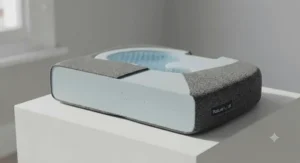
Ergonomic Seating: How Cushions Compare With Ergonomic Chairs
It’s worth being honest about where a seat cushion sits relative to full ergonomic seating, because the two solve overlapping but genuinely different problems. A proper ergonomic chair adjusts seat depth, backrest angle, lumbar position, and armrest height simultaneously; a cushion only addresses the seat surface itself. If your discomfort stems from poor lower back support rather than tailbone or hip pressure, no cushion — however well engineered — will fully substitute for a chair with proper adjustable lumbar support.
| Factor | Seat Cushion (e.g. HUANUO Ergonomic Seat Cushion with Cooling Gel) | Full Ergonomic Chair |
|---|---|---|
| Upfront cost | £15-£55 typical range | Often £150-£600+ |
| Addresses tailbone/hip pressure | Yes, directly | Partially |
| Addresses lumbar/back support | No | Yes, adjustable |
| Portability | High | None |
| Installation | Instant | None needed, but bulky to move |
The analysis here is straightforward: a cushion is the right first move for anyone whose chair is otherwise reasonable but the seat pan itself is thin, hard, or poorly shaped — which describes an enormous number of standard office and dining chairs pressed into desk duty. It’s the wrong tool if your actual problem is a backrest that doesn’t support your lumbar curve; in that case, even the best cushion on this list, the Cushion Lab Pressure Relief Seat Cushion, is treating a symptom rather than the underlying cause. Many people genuinely benefit from combining both — a modest cushion on a mid-range ergonomic chair frequently outperforms either upgrade alone.
Desk Chair Accessories Worth Pairing With Your Cushion
A seat cushion rarely works in isolation, and the desk chair accessories you pair it with can meaningfully change the outcome. A lumbar support pillow strapped to the chair back is the most natural companion purchase, since it addresses exactly the gap a seat cushion leaves open — lower back curvature — and works well alongside cushions like the TushGuard Memory Foam Seat Cushion that focus purely on the seat surface rather than the backrest.
An adjustable footrest is the second accessory worth genuine consideration, particularly once a thicker cushion like the Vmingo Gel Seat Cushion raises your seated height enough that your feet no longer sit flat on the floor. Without one, that height change can quietly introduce new strain even as the cushion solves the original discomfort. A monitor arm or riser is the third piece worth mentioning here, since screen height interacts directly with seated posture — if a cushion changes how upright you sit, your eye line to the screen shifts too, and re-checking monitor height afterwards avoids trading one postural problem for another. None of these accessories are essential purchases, but treating your seat cushion as one piece of a small, coordinated setup rather than a standalone fix tends to produce noticeably better results.
Long-Term Cost & Maintenance
Thinking in total cost of ownership rather than sticker price changes the calculus on several of these picks. A £17 cushion like the WAOAW Memory Foam Ergonomic Seat Cushion that needs replacing every 10-12 months works out to a similar or higher annual spend than a £45 Cushion Lab Pressure Relief Seat Cushion that reasonably holds its shape for three-plus years of daily use, based on the dual-density construction discussed earlier in this piece. That’s not an argument for always buying the most expensive option — occasional or light users genuinely don’t need premium durability — but it’s worth doing the maths honestly rather than assuming cheapest-per-unit means cheapest overall.
Maintenance costs stay low across the board: covers are almost universally machine-washable, and none of these products require ongoing consumables. The main “cost” that catches people out is opportunity cost — persisting with a cushion that isn’t working, rather than accepting it was the wrong shape for your specific discomfort and switching earlier. Given the price range involved here, holding onto a mismatched cushion out of sunk-cost thinking rarely makes financial sense compared to trying a better-matched option like the Aylio Coccyx Orthopedic Comfort Foam Seat Cushion for genuinely tailbone-specific pain.
Safety, Regulations & Workplace Compliance in the UK
If you’re working from a UK employer’s equipment or considering what your employer might reimburse, it’s worth knowing that seating sits within the scope of workstation assessments under the Health and Safety (Display Screen Equipment) Regulations 1992. Employers have a duty to assess workstations used regularly for screen-based work and reduce identified risks, which in practice means a seat cushion purchased to address a specific discomfort raised during a DSE assessment is often a reasonable, low-cost accommodation many employers will support.
The HSE’s guidance on managing back pain at work is clear that prolonged sitting in a poor position is a recognised contributor to workplace back pain, and that early intervention — rather than waiting until pain becomes chronic — produces meaningfully better outcomes. None of the products on this list are medical devices, and none should be treated as a substitute for a proper workstation assessment if your employer offers one; a cushion is a sensible, low-friction first step, not a replacement for raising a genuine ergonomic concern formally if the discomfort persists.
FAQ
❓ Do seat cushions actually work for office chairs?
❓ How long does a memory foam seat cushion last?
❓ Is gel or memory foam better for a seat cushion?
❓ What thickness should a seat cushion for office chair be?
❓ Can a seat cushion replace an ergonomic chair?
Conclusion
Choosing between these seven comes down to matching the design to the actual problem rather than chasing the highest star rating in isolation. If your pain is squarely tailbone-focused, the Aylio Coccyx Orthopedic Comfort Foam Seat Cushion and Everlasting Comfort Memory Foam Seat Cushion are built specifically for that. If you’re testing whether a cushion helps at all before spending more, the WAOAW Memory Foam Ergonomic Seat Cushion removes the financial risk. Hot office? The Vmingo Gel Seat Cushion and HUANUO Ergonomic Seat Cushion with Cooling Gel solve that directly. Marathon sitters want the TushGuard Memory Foam Seat Cushion, and anyone who’s already burned through a cheaper cushion and wants something that lasts should look hard at the Cushion Lab Pressure Relief Seat Cushion.
None of these seven is objectively “the best” — the best one is whichever matches your specific sitting pattern and discomfort, and hopefully this guide has made that match a little clearer than scrolling through star ratings alone ever could.
Recommended for You
- 7 Best Office Chairs for Broad Shoulders in 2026 (Tested Picks)
- Office Chairs For Large Frames: 7 Genuinely Supportive Picks 2026
- Plus Size Office Chairs: 7 Best Comfortable Picks for 2026
Disclaimer: This article contains affiliate links. As an Amazon Associate, I earn from qualifying purchases. If you purchase products through these links, we may earn a small commission at no additional cost to you.
✨ Found this helpful? Share it with your friends! 💬🤗
