
In This Article
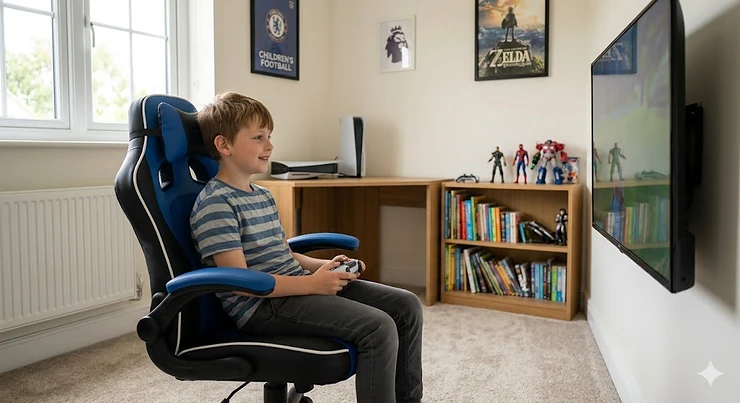
Right, let’s address the elephant in the room. When your eight-year-old asks for a gaming chair for kids, your first instinct might be to roll your eyes and suggest the perfectly adequate dining chair they’ve been using since Reception. I understand — I had the same reaction.
But here’s what changed my mind: children’s spines are still developing, and those marathon Minecraft sessions (which, let’s be honest, aren’t going anywhere) can do real damage when they’re hunched over in furniture designed for adults. According to research from the Better Health Channel, poor posture during childhood can lead to chronic back issues that persist well into adulthood. Rather sobering when you consider that UK children now spend an average of 4-6 hours daily on screens, a significant portion of that time gaming.
The UK market for children’s gaming chair options has exploded in 2026, but quality varies wildly. Some are simply scaled-down adult chairs with cartoon colours slapped on. Others are genuinely engineered for growing bodies, with proper lumbar support, adjustable features that “grow” with your child, and safety certifications that meet British Standards. The difference matters — not just for comfort during those Fortnite sessions, but for your child’s long-term spinal health and posture development.
What most parents overlook about gaming chairs for children is this: unlike adult gaming chairs where you’re optimising for performance, with kids you’re investing in developmental support. Their skeletal structure is still forming, their attention to posture is virtually non-existent, and they’ll happily sit in the same crossed-leg position for three hours straight if you let them. A proper junior gaming chair UK actually corrects these habits passively through design, rather than relying on a ten-year-old to remember to “sit up straight.”
Quick Comparison: Top Gaming Chairs for Kids at a Glance
| Model | Type | Age Range | Key Feature | Price Range (GBP) | Best For |
|---|---|---|---|---|---|
| X Rocker Agility JR | PC Gaming Chair | 6-14 years | 3D adjustable armrests | £100-£130 | PC gamers who need desk chair |
| X Rocker Shift Luxe JR | Floor Rocker | 5-12 years | Built-in 2.1 audio system | £80-£110 | Console gamers, small bedrooms |
| GTPLAYER Fabric Chair | PC Gaming Chair | 8-16 years | Breathable fabric, footrest | £110-£140 | Long gaming sessions |
| X Rocker Agility RGB | PC Gaming Chair | 6-14 years | App-controlled LED lighting | £130-£160 | Streamers, RGB enthusiasts |
| Bigzzia Gaming Chair | PC Gaming Chair | 8-15 years | Budget ergonomic design | £55-£70 | Budget-conscious families |
| Racingreat Gaming Chair | PC Gaming Chair | 8-14 years | Essential ergonomics | £45-£60 | Tight budgets, occasional use |
| X Rocker Floor Rocker | Floor Rocker | 4-10 years | Foldable, space-saving | £50-£80 | Younger children, limited space |
💬 Just one click — help others make better buying decisions too! 😊
Top 7 Gaming Chair for Kids: Expert Analysis
1. X Rocker Agility JR Gaming Chair
The X Rocker Agility JR represents what happens when you take a proper eSports tournament chair and scale it down without cutting corners. This isn’t a toy chair with racing stripes — it’s engineered specifically for bodies between 125-155 cm tall, which covers most UK children from about age six through early teens.
What sets this apart from budget children’s gaming chair options is the 3D adjustable armrests. These move forward, backward, side-to-side, and up-and-down, which sounds excessive until you realise that children’s arm lengths vary wildly as they grow. The armrests turn inward for a controller-friendly grip when your child is playing FIFA on Xbox, then swing outward for relaxed YouTube watching. The backrest reclines up to 120 degrees — useful for those post-raid wind-down sessions when they’re not quite ready to move to bed but need to decompress.
The gas lift mechanism adjusts seat height smoothly, and here’s the clever bit: the removable neck and lumbar cushions mean the chair provides proper support whether your child is 4’2″ or pushing 5’1″. British buyers consistently praise the assembly process, with most reporting 25-30 minute setup times using the included Allen key and clear instructions.
Customer feedback from UK Amazon.co.uk reviewers highlights the chair’s durability through growth spurts. One verified purchaser noted their son used it from age 7 to 11 before outgrowing it, which represents excellent value. The faux leather wipes clean easily — rather important when you’re dealing with the inevitable crisp crumbs and juice spills.
Pros:
✅ Properly sized for junior bodies, not just a scaled adult chair
✅ 3D armrests accommodate growth and different gaming styles
✅ Recline function supports varied activities (gaming, homework, streaming)
Cons:
❌ Premium price point compared to basic options
❌ Faux leather can feel warm during summer months
Around £100-£130 depending on colour choice, this represents solid mid-range value. You’re paying for engineering rather than gimmicks, and for parents serious about supporting healthy posture during screen time, it’s money well spent.
2. X Rocker Shift Luxe JR 2.1 Stereo Gaming Chair
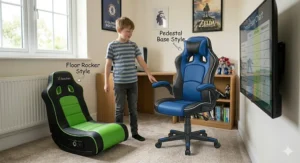
The X Rocker Shift Luxe JR takes a completely different approach to the gaming chair for 10 year old market by focusing on console gamers who play in bedrooms or lounges rather than at desks. This floor rocker chair eliminates wheels and height adjustment entirely, sitting directly on the floor with a supportive rocking motion.
The standout feature is the built-in 2.1 audio system with proper subwoofer. Your child connects it directly to PlayStation, Xbox, or Nintendo Switch, and suddenly they’re experiencing games with directional audio that cheaper headphones simply can’t match. The speaker quality exceeds what you’d expect at this price point — dialogue in games like Spider-Man comes through crisp and clear, while explosions have actual bass presence. For UK homes where neighbours object to loud gaming at night, this provides immersive sound without disturbing the family downstairs.
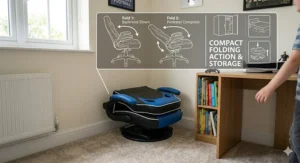
What parent reviewers appreciate: the flip-up seat reveals hidden storage for controllers, game cases, and headphones. In smaller British bedrooms where every cubic metre counts, this dual-purpose design prevents the usual scattered controller chaos. The faux leather and breathable mesh combination means your child doesn’t stick to the seat during July heatwaves, whilst the whole thing folds flat for storage when grandparents visit and the bedroom needs to look presentable.
UK Amazon.co.uk customers report the audio connections work seamlessly with major consoles. One parent noted their daughter uses it daily for Splatoon 3 sessions, and after six months the stitching and audio components remain solid. Assembly takes about 15 minutes and requires no tools — it unfolds and you’re done.
Pros:
✅ Immersive 2.1 audio eliminates need for separate speakers
✅ Hidden storage tackles bedroom clutter problem
✅ Folds completely flat for storage in small UK homes
Cons:
❌ No wheels or desk compatibility limits versatility
❌ Audio cables may require adapters for older devices
At £80-£110, this occupies the sweet spot for console-focused families. You’re essentially getting a gaming chair and sound system in one purchase, which justifies the price when you consider that decent gaming speakers alone typically cost £40-60.
3. GTPLAYER Fabric Gaming Chair
The GTPLAYER Fabric Gaming Chair addresses the single biggest complaint about budget gaming chairs: that clammy, stuck-to-the-seat feeling you get after hour three of any extended session. This model ditches PU leather entirely in favour of breathable fabric construction, and anyone who’s gamed through a British summer in a poorly ventilated bedroom will immediately understand why that matters.
The retractable footrest is the feature that separates this from basic office chairs. Your child pulls it out during particularly intense gaming sessions or when they’re watching streams, elevating their legs to reduce pressure on the back of thighs and improve circulation. It’s not just comfort — proper leg positioning actually reduces fatigue during those marathon weekend sessions. The massage function in the lumbar pillow works via USB power, providing gentle vibration that helps prevent the lower back stiffness that plagues growing spines.
What makes this particularly good value for UK buyers: Amazon.co.uk stocks it with Prime delivery, and with over 13,000 reviews averaging 4.4 stars, it has proven reliability across diverse body types and use cases. The fabric comes in seven colour options, so your child can match their setup aesthetic without you paying a premium for “special editions.” The chair reclines to 155 degrees, and the Class 4 gas lift supports weights up to 150 kg — well beyond what any child needs, but it means the chair handles rough treatment without deflating over time.
British customers specifically praise the armrest height adjustment range, which accommodates children from about 8 years through mid-teens. One verified reviewer noted their 14-year-old uses it for both gaming and GCSE revision, and the ergonomic support has eliminated the neck pain they previously experienced during study sessions.
Pros:
✅ Breathable fabric prevents overheating during long sessions
✅ Retractable footrest improves circulation and reduces fatigue
✅ Proven reliability with 13,000+ UK customer reviews
Cons:
❌ Fabric shows stains more readily than wipe-clean PU leather
✅ Assembly takes 35-40 minutes (longer than simpler models)
Priced around £110-£140, this represents the best overall value in the mid-range category. You’re getting premium features — footrest, massage lumbar, breathable construction — at a price point that won’t require a family meeting to justify.
4. X Rocker Agility Compact RGB Gaming Chair
The X Rocker Agility Compact RGB takes the excellent foundation of the standard Agility JR and adds Neo Motion Sync LED technology, which sounds gimmicky until you realise that for children who stream on Twitch or create YouTube gaming content, RGB lighting has genuine practical value for visual branding.
The companion app controls over 200 colour patterns and combinations. Your child can sync the chair’s lighting to their team colours, match their keyboard and mouse setup, or create custom sequences that react to music and game audio. For the growing number of UK children taking content creation seriously — and yes, some 12-year-olds are earning actual pocket money from YouTube channels — this provides professional-looking production value without requiring expensive studio lighting.
Beyond the LEDs, you’re getting the same ergonomic excellence as the standard Agility JR: 3D adjustable armrests, reclining backrest to 120 degrees, removable neck and lumbar cushions, and proper sizing for growing bodies. The faux leather material wipes clean quickly, and the chair assembles in about 25 minutes using the included tools and clear instructions.
What UK parents should know: the RGB system runs via USB power, so your child needs to connect it to their PC or a USB wall adapter. The LEDs draw minimal power (roughly £2-3 annually if left on 24/7, though most users toggle them off when not streaming), and the app works reliably on both iOS and Android devices. One Amazon.co.uk reviewer noted their son uses the colour-changing feature as a visual timer — green for homework time, blue for gaming time — which inadvertently helped with time management.
Pros:
✅ App-controlled RGB adds production value for young streamers
✅ Same ergonomic excellence as standard Agility JR
✅ Over 200 lighting patterns provide creative flexibility
Cons:
❌ Premium price for a feature some children won’t utilise
❌ Requires USB connection for RGB functionality
At £130-£160, this costs about £30-40 more than the non-RGB Agility JR. If your child has no interest in streaming or content creation, save your money. If they do, the professional appearance this provides makes it worthwhile.
5. Bigzzia Gaming Chair
The Bigzzia Gaming Chair proves you don’t need to spend triple digits for proper ergonomic support, though you do make specific compromises to hit that £55-70 price point. This budget option delivers surprisingly solid foam density (52 kg/m³, better than some £100 competitors) and includes the essential health-supporting features: height adjustment, reclining backrest, lumbar cushion, and headrest.
The PU leather construction means easy cleaning — your child spills Ribena, you wipe it off, job done. The 360-degree swivel and smooth-rolling casters work reliably on both carpet and hard floors, and the chair assembles in roughly 20 minutes with clear instructions. What you’re not getting: adjustable armrests (they’re fixed height), breathable mesh panels, or premium stitching that’ll last a decade.
Here’s the trade-off British buyers should understand: the fixed armrests mean this works brilliantly for children within a narrow height range (roughly 4’6″ to 5’2″), but kids significantly shorter or taller will find the arm positioning awkward. The thinner PU leather shows minor creasing after heavy use, and during summer sessions of three hours or longer, heat buildup becomes noticeable compared to fabric alternatives.
UK Amazon.co.uk reviewers consistently note the chair exceeds expectations for the price paid. One parent mentioned buying it as a “trial” gaming chair to see if their son would actually use it properly, then being pleasantly surprised when it remained comfortable through daily use for 18 months. For families unsure whether a dedicated gaming chair for kids makes sense, this provides an affordable entry point.
Pros:
✅ Exceptional value — ergonomic essentials at budget pricing
✅ Easy-clean PU leather handles spills and grime
✅ Solid foam density rivals pricier competitors
Cons:
❌ Fixed armrests won’t suit all heights comfortably
❌ Thinner materials show wear faster than premium options
Around £55-70, this represents the best value in the budget category. You’re not getting frills, but you are getting the core postural support that prevents the hunched-over-laptop position that sends children to physiotherapists.
6. Racingreat Ergonomic Gaming Chair
The Racingreat Ergonomic Gaming Chair occupies the absolute entry level of the adjustable kids gaming chairs market at £45-60, and manages to deliver the bare minimum ergonomic necessities without feeling like a complete compromise. This is what you buy when budget is the primary concern, but you still want your child’s spine to receive some basic support.
The adjustable lumbar support is the standout feature at this price point — many £50 chairs offer a fixed cushion or nothing at all, whilst Racingreat includes a pillow you can position up or down to match your child’s lower back curve. The PU leather is basic but functional, the gas lift adjusts height across a reasonable range, and the chair reclines about 135 degrees. Assembly takes 25-30 minutes and requires only the included Allen key.
What you’re compromising on: build quality that’ll survive years of daily abuse. This is engineered for lighter weight and occasional use, not a 14-year-old who games six hours daily. The casters are functional rather than smooth, the armrests lack padding, and the overall construction feels less substantial than mid-range alternatives. UK customers report the chair performs adequately for 12-18 months of moderate use before showing significant wear.
Where this makes sense: as a first gaming chair for younger children (8-10 years) who’ll outgrow it anyway before it wears out. For families on strict budgets where £100+ simply isn’t feasible. Or as a secondary chair for a child’s friend to use during gaming sleepovers. One Amazon.co.uk reviewer noted they bought it for their son’s 9th birthday expecting to replace it in a year, which set appropriate expectations and resulted in satisfaction when it lasted 14 months.
Pros:
✅ Lowest price point whilst maintaining basic ergonomics
✅ Adjustable lumbar support uncommon at this price
✅ Adequate for younger children who’ll outgrow it anyway
Cons:
❌ Build quality suited for occasional use, not daily marathons
❌ Minimal padding on armrests and seat
At £45-60, this delivers exactly what the price promises: basic ergonomic support on a tight budget. Don’t expect it to last through your child’s entire gaming career, but for families where every pound matters, it’s vastly better than hunching over a kitchen chair.
7. X Rocker Floor Rocker Gaming Chair
The X Rocker Floor Rocker range offers multiple models designed for younger gamers (typically 4-10 years) who play consoles from the bedroom or living room floor. These eliminate wheels, height adjustment, and desk compatibility entirely, focusing instead on comfortable low-level seating that folds flat for storage — rather crucial in British homes where spare room is measured in centimetres rather than metres.
Different models within the range offer varied features. Basic versions provide padded seating and ergonomic back support with a gentle rocking motion. Mid-tier options add built-in speakers for audio connectivity with PlayStation or Xbox. Premium variants include Bluetooth connectivity and subwoofers for proper immersive sound. All models fold completely flat — slide them under a bed or behind a door when not in use, perfect for shared bedrooms or multipurpose spaces.
What makes floor rockers particularly suitable for UK families: they sidestep the “will this damage the carpet” concern that wheeled chairs create, whilst providing better postural support than bean bags or sitting directly on the floor. The low centre of gravity means no tipping risk with enthusiastic movement, and the wipeable materials handle the inevitable spills better than fabric sofas.
UK customers on Amazon.co.uk particularly value the foldability for smaller homes. One reviewer noted they unfold it when their two children want to play Mario Kart together, then pack both chairs away in under 30 seconds when the session ends. The audio-enabled models typically require a simple 3.5mm connection to the controller or console, working seamlessly with major gaming systems.
Pros:
✅ Folds completely flat — perfect for small UK homes
✅ No tipping risk with low centre of gravity
✅ Many models include immersive audio systems
Cons:
❌ Age range limited (typically 4-10 years)
❌ No desk compatibility for homework or PC gaming
Prices range from £50-£80 depending on audio features, representing excellent value for younger children. By the time they outgrow these (usually around age 10-11), they’ll need a proper desk chair anyway for secondary school homework and potential PC gaming.
How to Set Up Your Child’s Gaming Chair for Maximum Comfort
Most parents skip this section and wonder why their £120 chair didn’t magically fix their child’s posture. Here’s what actually matters for proper setup in British homes, where room layouts often dictate compromises that aren’t necessary in larger spaces.
Seat Height Adjustment
Your child’s feet should rest flat on the floor with knees bent at roughly 90 degrees. In practice, this means lowering the chair more than you’d expect — children’s legs are shorter than their torsos compared to adult proportions. If their feet dangle or they’re on tiptoes, lower the seat. If their knees are higher than their hips, raise it slightly. The gas lift adjustment on most gaming chair for 10 year old models makes this quick, so reassess every 3-4 months as they grow.
For UK homes with carpeted bedrooms (common in older properties), chairs sink slightly into pile carpet. You might need to raise the seat 1-2 cm higher than you would on hard flooring to achieve the same leg position. Use a firm carpet protector mat if the chair sinks excessively — this also protects against wheel damage to carpets, which landlords take quite seriously.
Armrest Positioning
If the chair has adjustable armrests (models like the X Rocker Agility JR), set them so your child’s elbows rest comfortably at 90 degrees when their hands are on the controller or keyboard. Their shoulders shouldn’t hunch up or slump down. For younger children with shorter arms, you might lower armrests more than seems logical to adults — trust the 90-degree elbow rule rather than what “looks right.”
Fixed armrests (budget models like Bigzzia or Racingreat) either work for your child’s current height or they don’t. If the armrests force awkward shoulder positions, your child is better off removing them entirely rather than developing compensatory posture habits that’ll require physiotherapy to undo.
Lumbar Support
The lumbar cushion should sit in the small of the back, roughly at waist height. Most children’s gaming chair options include removable pillows — slide it up or down until it fills the natural curve of your child’s lower back without pushing their spine forward. During growth spurts (typically ages 10-14), reassess positioning every few months as torso length changes.
For chairs with built-in lumbar support (some GTPLAYER models), adjust the knob or lever until you feel gentle pressure against the lower back without forcing the torso forward. If your child can’t sit back naturally against the backrest, the support is too prominent — reduce it.
Maintenance in British Climate
Humid British weather creates mould concerns that buyers in drier climates don’t face. Once monthly, inspect the underside of seat cushions for moisture accumulation, particularly during autumn and winter when bedroom heating creates condensation. Faux leather wipes clean easily, but fabric models like the GTPLAYER require occasional fabric freshener spray and thorough airing.
For homes with persistent damp issues (common in older British properties), consider running a small dehumidifier in gaming spaces. Moisture trapped in foam cushions breaks down materials faster and creates that musty smell that seems to plague teenage bedrooms regardless of cleaning efforts.
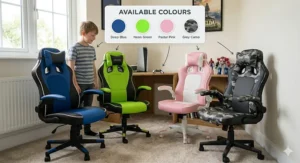
Gaming Chair vs Traditional Desk Chair: What UK Parents Should Know
The marketing pitch says gaming chairs provide superior ergonomics that justify the premium price over basic office chairs. The reality is more nuanced, particularly for UK buyers navigating limited space and tighter budgets than American counterparts.
Ergonomic Differences
Proper children’s gaming chair models include features specifically absent from budget office chairs: adjustable lumbar support positioned for shorter torsos, seat depths scaled for shorter legs, and armrests that accommodate narrower shoulders. A £60 basic office chair from Argos provides a seat and backrest. A £60 youth ergonomic seating option like the Racingreat includes targeted postural support for developing spines.
However, premium office chairs (£200+) from brands like Herman Miller or Steelcase offer superior adjustment ranges and longer-lasting materials than gaming chairs at the same price point. If your budget stretches to £250+, investigate proper ergonomic office chairs before assuming gaming chairs represent the pinnacle of seated support.
Space Considerations
British bedrooms average 2.5 x 3 metres in modern builds, smaller in older properties. A full-size gaming chair for kids with extended footrest can occupy 1.2 metres depth when reclined, which in a 2.5-metre bedroom leaves precious little space for, well, anything else. Floor rockers like the X Rocker range fold to 15 cm thickness and slide under beds — vastly more practical for shared bedrooms or smaller spaces.
Traditional office chairs on wheels tend to migrate around rooms unless you implement religious discipline about returning them to desks. Gaming chairs with wider bases and larger casters stay put better on carpet, which matters when you’re navigating a dark bedroom at 2 AM to check on strange noises.
Durability and Value
Quality gaming chairs outlast budget office chairs because they’re engineered for the punishment gamers inflict: rapid movements, weight shifting, leaning back dramatically after victories. A £100 junior gaming chair UK typically survives 3-4 years of daily use. A £100 basic office chair from a high street retailer shows significant wear after 18-24 months of similar treatment.
However, the absolute cheapest gaming chairs (£40-50 range) offer no durability advantage over basic office chairs at the same price point. You’re paying for racing-style aesthetics, not engineering. If budget forces you below £60, a simple office chair with decent lumbar support represents equal value.
Age-Appropriate Gaming Chairs: Matching Chair to Child
Ages 4-7: Entry-Level Floor Rockers
Children this young lack the attention span for extended gaming sessions, but they benefit enormously from proper posture support during the screen time they do get. Floor rockers like the X Rocker range work brilliantly because they’re low to the ground (reducing fall risk), provide back support superior to sitting on floors or sofas, and fold away when playtime ends.
Avoid wheeled gaming chairs for this age group. The mobility creates tipping hazards, and children this young haven’t developed the postural awareness to use adjustable features correctly. They’ll set the chair to maximum recline because it’s fun, then game in positions that horrify physiotherapists.
Ages 8-11: Compact Gaming Chairs with Basic Adjustment
This is the sweet spot for introductory adjustable kids gaming chairs like the Racingreat or Bigzzia models. Children are old enough to understand “adjust the height so your feet touch the floor” and actually comply. They’re gaming for longer sessions (1-2 hours), making proper support worthwhile. But they’re still growing rapidly, so investing £200+ in a chair they’ll outgrow in 24 months makes little economic sense.
Look for models with height adjustment, reclining backs, and basic lumbar support. Skip advanced features like 3D armrests or RGB lighting — these add cost without providing developmental benefit. Your money is better spent on the essential ergonomic features.
Ages 12-16: Full-Featured Gaming Chairs
By secondary school, gaming patterns have typically stabilised. Your child knows whether they’re primarily a PC or console gamer, whether they stream or just play casually, and what features they’ll actually utilise. This is when investing in quality junior gaming chair UK options like the X Rocker Agility JR or GTPLAYER makes sense.
These ages also see extended gaming sessions (3-5 hours on weekends isn’t uncommon), making proper ergonomic support crucial for preventing the chronic back pain that NHS physiotherapists increasingly see in teenage patients. Features like retractable footrests and breathable fabric construction transition from “nice to have” to “actually prevents discomfort” during these longer sessions.
Weight considerations matter here too. A 15-year-old might exceed the weight limits of chairs designed for younger children. Verify maximum weight capacity before purchasing — most gaming chair for kids models support 100-120 kg, but cheaper options sometimes max out at 80 kg, which larger teenagers might approach or exceed.
Common Mistakes Parents Make When Buying Gaming Chairs in the UK
Assuming Cheaper Equals Adequate
The £35 gaming chair you saw on sale at a budget retailer will absolutely function as a seat. It will not provide proper lumbar support, it will develop wobbles within three months, and the padding will compress to almost nothing after six months of daily use. This isn’t being snobby about price points — it’s physics. Proper foam density and support structures cost money to manufacture, and corners get cut viciously below £50.
If budget constrains you to under £60, the Racingreat at £45-60 represents the absolute minimum viable option. Below that price point, you’re better off with a basic office chair from Ikea rather than a gaming chair that’ll fail quickly and teach your child that ergonomic furniture doesn’t work.
Ignoring UKCA/CE Marking for Children’s Furniture
British safety standards for children’s furniture exist for sensible reasons — they prevent tip-overs, ensure materials aren’t toxic, and verify structural integrity won’t fail catastrophically. Some cheaper imports bypass these certifications entirely. Check for UKCA marking (or CE marking until 2027 under current regulations) before purchasing children’s gaming chair options, particularly from unfamiliar brands on marketplaces.
The General Product Safety Regulations 2005 requires consumer products to meet safety standards. Whilst gaming chairs aren’t typically classified as toys, those marketed specifically for children should comply with relevant furniture safety standards. Reputable brands like X Rocker include certification details in product listings; if you can’t find safety information, that’s a red flag worth heeding.
Buying for Current Height Rather Than Growth
Children grow approximately 5-6 cm annually during primary school years, accelerating to 8-10 cm annually during growth spurts around ages 11-14. A chair that fits perfectly today will be uncomfortably small in 18 months if it lacks adjustment range. Look for models with wide height adjustment ranges and adjustable components that “grow” with your child — the X Rocker Agility JR serves children from roughly age 6 through 14 for precisely this reason.
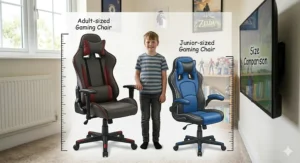
Conversely, buying a full-size adult gaming chair for a 10-year-old creates immediate ergonomic problems. Their feet won’t reach the floor even at minimum height, the seat depth will be too long (forcing them to sit forward and defeating the back support), and the armrests will be too wide for their shoulders. The “they’ll grow into it” logic doesn’t apply to ergonomic furniture where correct sizing matters for postural health.
Overlooking UK Home Space Constraints
American gaming chair reviews often test products in bedrooms that would qualify as master bedrooms in British homes. That chair with the fully extended footrest and 170-degree recline might work brilliantly in a 4 x 5 metre bedroom. In a typical 2.5 x 3 metre British bedroom with existing furniture, it’ll dominate the space and make the room feel cramped and cluttered.
Measure your child’s gaming space before buying. Factor in that chairs need clearance behind them to recline without hitting walls or furniture. Consider whether the room layout permits a wheeled chair to roll freely, or whether floor-fixed seating makes more sense. X Rocker’s foldable floor rockers exist specifically because British homes often can’t accommodate permanent large furniture in children’s bedrooms.
Ignoring Material Suitability for British Climate
PU leather gaming chairs feel luxurious and wipe clean beautifully, but during July heatwaves in bedrooms without air conditioning (which is to say, most British bedrooms), they become sweaty and uncomfortable. Children stick to the surface after extended sessions, and the lack of breathability means their backs end up damp. Fabric alternatives like the GTPLAYER breathable mesh design prevent this entirely, though they’re slightly harder to clean when spills occur.
Conversely, fabric chairs in damp British winter conditions can develop that characteristic musty smell if bedrooms aren’t well-ventilated. Match material choice to your home’s specific conditions — if your child’s bedroom runs warm year-round, fabric makes sense. If it tends toward damp and cool, PU leather’s easy-clean and moisture-resistant properties provide practical advantages.
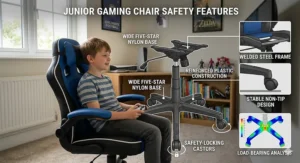
Child-Safe Gaming Furniture: UK Safety Standards Explained
British safety regulations for children’s furniture prioritise preventing injuries through design standards that American products sometimes don’t meet. When purchasing gaming chair for 10 year old options or any child-safe gaming furniture, understanding these standards helps you identify truly safe products versus those with superficial safety marketing.
Tip-Over Prevention
BS EN 17191 (Children’s Furniture – Seating for Children) replaced older standards in 2021 and sets specific stability requirements for children’s seating. Chairs must withstand tilting forces without tipping — essentially, your child can lean back or to the side without the chair toppling over. Quality gaming chairs achieve this through wider wheelbases, lower centres of gravity, and weight distribution that accommodates enthusiastic movement.
Floor rocker models like X Rocker’s range excel here because their low profile makes tipping physically impossible. Elevated gaming chairs with wheels need careful evaluation — cheaper models sometimes use narrow five-star bases that pass adult furniture standards but become unstable when 10-year-olds lean back dramatically after Fortnite victories.
Material Safety and Chemical Restrictions
UK REACH regulations restrict hazardous substances in consumer products, but enforcement varies. Reputable brands like X Rocker and GTPLAYER comply with substance restrictions and provide material safety documentation. Unknown brands importing directly from factories might use flame retardants, plasticisers, or dyes that exceed British safety limits.
Check product listings for compliance statements. UKCA marking indicates conformity with UK regulations. If a children’s gaming chair listing lacks any safety certification information and costs significantly less than competitors, investigate further before purchasing. Your child spends hours in direct contact with the materials — ensuring they’re non-toxic matters.
Fire Safety Requirements
The Furniture and Furnishings (Fire) (Safety) Regulations 1988, amended in 2025, sets strict fire safety standards for upholstered furniture sold in the UK. Gaming chairs must include fire-resistant materials and permanent labels confirming compliance. This regulation prevented approximately 54 deaths annually when introduced, according to government analysis — it’s not bureaucratic nonsense, it’s proven lifesaving legislation.
Look for permanent labels (usually underneath the seat) confirming fire safety compliance. Reputable UK retailers won’t stock non-compliant furniture, but marketplace sellers sometimes bypass these requirements. If purchasing from Amazon.co.uk, verify the seller is established and UK-based rather than shipping directly from overseas warehouses that might not adhere to British safety standards.
Weight Limits and Age Recommendations
Manufacturers provide maximum weight capacities for structural reasons — exceed them and joints weaken, gas lifts fail, and safety margins disappear. Most gaming chair for kids options support 100-120 kg, adequate for any child. Some budget models max out at 80-90 kg, which larger teenagers might approach.
Age recommendations on children’s furniture aren’t arbitrary — they reflect developmental factors like a child’s ability to use adjustment features correctly and their postural awareness. A chair marketed for ages 8+ assumes the user can understand “adjust height so feet touch floor,” whilst 4-7 year products assume adult supervision and simpler designs.
What Features Actually Matter (And Which Are Marketing Gimmicks)
The gaming chair industry loves adding features that sound impressive but provide minimal real-world benefit, particularly in the youth ergonomic seating category where parents unfamiliar with gaming are easier to upsell. Here’s how to separate genuine ergonomic value from marketing fluff.
Essential Features Worth Paying For
Adjustable seat height is non-negotiable. Children grow rapidly, and proper ergonomics require feet-flat-on-floor positioning that changes every few months. Gas lift mechanisms cost manufacturers roughly £5-8; if a chair lacks this feature to hit a lower price point, it’s a false economy.
Lumbar support, either through removable cushions or adjustable built-in mechanisms, prevents the lower back pain that NHS physiotherapists increasingly see in teenage patients. This doesn’t need to be fancy — a simple removable pillow you can position correctly provides 90% of the benefit of expensive adjustable systems.
Recline function isn’t about luxury; it’s about varied positioning. Children shift between intense forward-leaning gameplay and relaxed content-watching. A backrest that reclines 120-135 degrees accommodates both postures without forcing them to choose between comfort and screen visibility.
Breathable materials (fabric or mesh) prevent the sweaty-back situation that makes longer gaming sessions genuinely uncomfortable. This matters more in British homes without air conditioning, where summer bedroom temperatures can reach 25-28°C during heatwaves.
Features That Add Value in Specific Situations
RGB lighting (X Rocker Agility RGB) provides genuine value for children streaming or creating content, where visual setup cohesion matters for viewer experience and channel branding. For children who just play games, it’s £30-40 extra for something they’ll use enthusiastically for two weeks before ignoring.
Built-in audio (X Rocker Shift Luxe JR, floor rockers with speakers) eliminates the need for separate speakers or headphones, creating genuinely immersive console gaming experiences. But it’s only valuable if your child primarily games on consoles in bedroom or living room settings. PC gamers at desks typically use headphones and won’t utilise the audio system.
Retractable footrests (GTPLAYER models) improve comfort during extended sessions by elevating legs and reducing pressure on the back of thighs. This transitions from “nice luxury” to “actually prevents discomfort” when gaming sessions regularly exceed 3 hours. For casual gamers playing 1-hour sessions, the feature adds cost without practical benefit.
3D adjustable armrests (X Rocker Agility JR) accommodate different gaming styles (controller inward grip vs keyboard outward position) and grow with children’s changing arm lengths. This matters for children using the chair daily for 3-4 years. For younger children who’ll outgrow the entire chair in 18 months, fixed armrests work adequately.
Marketing Gimmicks to Ignore
“Professional eSports Design” means nothing unless accompanied by specific ergonomic certifications. Actual professional gaming chairs cost £300-600 and provide industrial-grade components. Budget gaming chairs using this terminology have simply copied the visual aesthetic of racing seats.
“4D Armrests” sounds impressive until you realise it just means up/down, forward/back, inward/outward movement — the exact same adjustment range marketed as “3D” by competitors, with manufacturers counting different directions separately to inflate the number.
Massage functions with multiple vibration points rarely provide therapeutic benefit. The simple vibrating lumbar pillow in some GTPLAYER models offers gentle stimulation that can prevent stiffness. Elaborate multi-point massage systems add cost and complexity whilst providing minimal advantage over the basic version.
Excessive recline angles (170-180 degrees) sound luxurious but create awkward positioning where your child can barely see the screen. Recline ranges of 120-155 degrees provide practical versatility; anything beyond that is marketing rather than functionality.
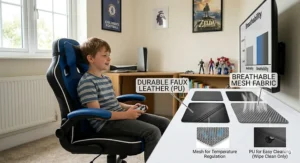
Gaming Chair Maintenance for British Homes
Maintaining gaming chairs in British homes requires addressing climate factors that American or Australian buyers don’t face — persistent damp, limited space forcing chairs into awkward positions, and the general wear patterns created by daily use in smaller bedrooms.
Weekly Cleaning for Faux Leather Models
PU leather chairs (X Rocker Agility JR, Bigzzia, Racingreat) wipe clean with slightly damp microfibre cloths. Avoid harsh chemical cleaners that degrade the surface coating — warm water with tiny amounts of washing-up liquid works perfectly for gaming-related grime: crisp crumbs, hand oils, the mysterious sticky residues that materialise near teenage boys.
For persistent marks, white spirit on cotton wool removes most stains without damaging PU leather. Test on inconspicuous areas first — some budget PU leather coatings react badly to solvents. Once monthly, apply leather conditioner (£4-6 from supermarkets) to prevent the material becoming brittle and cracking, particularly in centrally heated homes where air is quite dry.
Fabric Chair Care in Damp British Climate
Breathable fabric models (GTPLAYER) require different maintenance approaches. Vacuum the seat and backrest weekly using upholstery attachments to remove dust, crumbs, and the general detritus of daily use. This prevents particles embedding in fabric weave where they become impossible to remove.
Once monthly during autumn and winter, when British homes experience persistent damp, thoroughly air the cushions. Remove them from the chair frame and position near radiators or in well-ventilated areas for 4-6 hours. This prevents moisture accumulation in foam layers, which causes that musty smell and eventually degrades materials.
For spills, blot immediately with absorbent cloths — rubbing spreads stains into fabric. Most fabric chairs tolerate spot cleaning with upholstery foam cleaners (£3-4 from supermarkets). Test on inconspicuous areas first, as some dyes aren’t colourfast to cleaning chemicals. For serious stains, remove the fabric cover if possible and hand wash according to manufacturer instructions.
Mechanical Maintenance
Gas lift mechanisms require no maintenance but occasionally fail (typically after 3-4 years of daily use). When this happens, replace the entire gas lift — kits cost £15-25 on Amazon.co.uk and installation takes 15 minutes with basic tools. Don’t attempt to repair failed gas lifts; they operate under pressure and improper handling creates safety risks.
Caster wheels accumulate hair, threads, and general floor debris that impairs rolling. Once monthly, flip the chair and remove each wheel (most pull straight out or require small clips released). Extract accumulated material with tweezers, wipe the wheel axles clean, and reinsert. This simple maintenance prevents the frustrating situation where one wheel refuses to roll properly, causing the chair to veer sideways.
Check bolts and screws quarterly, particularly on budget models where vibration during enthusiastic gaming can loosen connections over time. Keep the Allen key or screwdriver that came with assembly instructions in your tools drawer and spend five minutes tightening any loose components. This prevents minor looseness from progressing to structural failure.
Storage in Small British Homes
If your child’s gaming chair needs temporary storage (room redecoration, extended holiday, accommodating visiting relatives), British homes rarely offer dedicated storage spaces like American basements or garages. Foldable floor rockers solve this completely — fold flat and slide under beds or behind wardrobes.
For full-size gaming chairs, disassembly to reduce height works better than trying to store assembled chairs in lofts or sheds. Most models separate into base and seat/back components in 10-15 minutes. Store components in bin bags to prevent dust accumulation, and label clearly so reassembly isn’t a frustrating puzzle when your child wants their chair back.
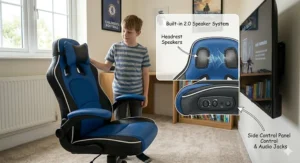
Frequently Asked Questions
❓ Do gaming chairs actually improve posture for children?
❓ Can my 8-year-old use an adult gaming chair?
❓ Are gaming chairs with speakers worth the extra cost in UK homes?
❓ How long should a gaming chair for kids last?
❓ What safety certifications should I look for on children's gaming chairs sold in the UK?
Conclusion: Choosing the Right Gaming Chair for Your UK Child
Right, let’s cut through the marketing noise and focus on what actually matters when you’re standing in the bedroom with a tape measure, trying to decide whether a gaming chair for kids represents a sensible investment or just another piece of plastic tat your child will abandon in three months.
The evidence for proper ergonomic seating during childhood isn’t ambiguous. NHS physiotherapists report increasing numbers of teenage patients with chronic back pain directly attributable to years of poor posture during screen time. The NHS website notes that developing good postural habits in childhood prevents issues that become progressively harder to correct in adulthood. A quality children’s gaming chair won’t magically fix everything — your child still needs regular breaks, varied activities, and occasional reminders to sit properly — but it makes healthy positioning the path of least resistance rather than requiring constant conscious effort.
For most UK families, the X Rocker Agility JR at £100-130 or the GTPLAYER Fabric model at £110-140 represents the sweet spot between engineering that actually supports growing spines and pricing that doesn’t require a family meeting to justify. These aren’t the cheapest options, but they’re the ones you’ll still be using three years from now rather than replacing annually when budget models fail. If you absolutely must stay under £60, the Racingreat at £45-60 delivers basic ergonomic necessities without pretending to be something it isn’t.
Console gamers in smaller British homes should seriously consider floor rockers (X Rocker range, £50-110) that fold completely flat for storage. The space-saving aspect matters enormously in 2.5 x 3 metre bedrooms where permanent large furniture creates that oppressive cramped feeling that makes rooms unpleasant to occupy. The built-in audio on mid-tier models eliminates separate speaker costs whilst providing genuinely immersive gaming experiences.
Whatever you choose, measure your child’s gaming space before purchasing, verify UKCA/CE marking for safety compliance, and set realistic expectations about longevity. A £130 chair serving daily use from age 8 to 11 costs roughly 12p per day — less than a Freddo bar, and with considerably better impact on your child’s long-term spinal health. That’s not extravagance; that’s sensible preventive healthcare delivered through furniture rather than medical appointments.
Recommended for You
- Best Gaming Chair Under £500 UK 2026 – 7 Expert Picks
- Best Racing Gaming Chairs UK 2026: 7 F1-Style Seats Tested
- Best Gaming Chair for Short Person UK 2026 – Top 7 Picks
Disclaimer: This article contains affiliate links. As an Amazon Associate, I earn from qualifying purchases. If you purchase products through these links, we may earn a small commission at no additional cost to you.
✨ Found this helpful? Share it with your mates! 💬🤗
