
In This Article
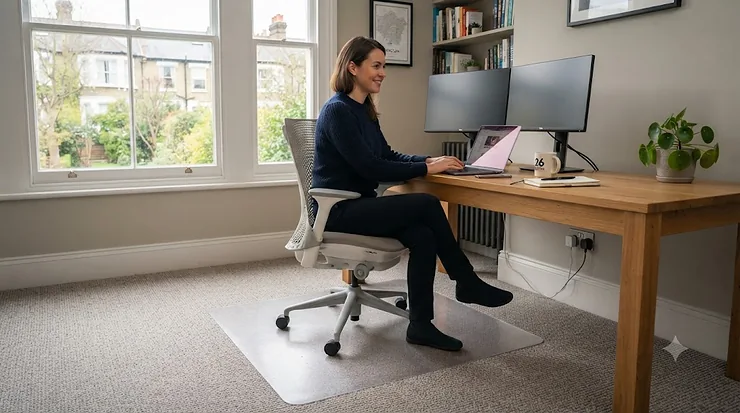
Every desk chair is a small, wheeled bulldozer. Push off, spin round, roll back to the printer, repeat forty times a day, and those five castors grind one patch of carpet into a shiny, flattened racetrack. The underlay beneath starts to crumble, and the wear that follows is exactly what landlords and flooring warranties love to complain about. A chair mat for carpet is the unglamorous fix. Choose badly, though, and you simply swap a worn patch for a sheet of plastic that wanders across the room like a bored cat.

Hybrid working has turned this from a stop-gap into a permanent home-office problem: more of us now sit at desks on carpets that were never designed for wheeled traffic. Employers have reasons to care too. The HSE’s display screen equipment workstation checklist treats furniture, the chair included, as one of six risk areas, and a chair that skids or sinks into its floor is a genuine ergonomic nuisance, not just a cosmetic one.
This guide compares seven real options sold on amazon.co.uk, built around three questions most listings gloss over: how the spiked backing behaves, whether high-pile carpet compatibility is genuine, and how much chair rolling resistance you will feel. One honest note up front: everything below comes from spec comparison and aggregated review sentiment, not from personal testing.
What Is a Chair Mat for Carpet?
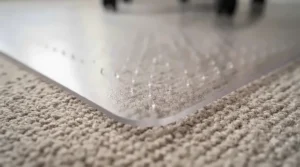
A chair mat for carpet is a rigid or semi-rigid plastic sheet placed under a wheeled desk chair to shield carpet fibres and underlay from castor wear. Its underside carries studs, cleats or spikes that grip the pile so the mat stays put, while the smooth top lets the chair roll freely. You will also see it sold as a carpet chair mat; the meaning is identical.
The crucial detail is the underside. Smooth-backed mats are built for hard floors and will skate across carpet, whereas gripper-backed versions are designed for pile. Buy the wrong one and no amount of clever positioning will rescue you.
Quick Comparison Table: 7 Chair Mats for Carpet at a Glance
| Product | Material | Carpet Pile Suited To | Size (cm) | Price Range | Best For |
|---|---|---|---|---|---|
| Floortex Ultimat | Polycarbonate | Over 12 mm (incl. underlay) | 119 x 89 up to 116 x 150 | Around £60-£125 | Deep, plush carpets |
| Marvelux Deep Pile | Polycarbonate | Up to 18 mm (incl. underlay) | 90 x 120 | From around £60 | Thick carpet on a mid-premium budget |
| Marvelux Medium Pile | Polycarbonate | Low to medium, up to 12 mm | 90 x 120 and larger | £30-£60 range | Best all-rounder |
| SHAREWIN | Flexible plastic, with lip | Low to medium | 120 x 90 | Roughly £20-£35 | Big-value lipped coverage |
| BesWin | PVC, about 2.2 mm | Low pile | 90 x 120, 75 x 120 | £24-£34 range | Budget carpet protection |
| Kuyal | PVC, about 2 mm | Low to no pile | 90 x 120 | £25-£35 range | Budget, BPA-free buyers |
| Trintion | PVC, about 2 mm, pointed | Low to medium | 75 x 120 up to 120 x 150 | From around £25 | Maximum grip on a budget |
Looking at the comparison above, the Marvelux Medium Pile delivers the most balanced mix of rigidity, sensible pricing and size choice for typical carpets, while the Floortex Ultimat and Marvelux Deep Pile only earn their higher prices if your pile is genuinely thick. Budget buyers should note that BesWin, Kuyal and Trintion trade rigidity for a lower price, which matters most on softer carpet where castors can press into a flexible sheet. Prices are ranges at the time of research and may vary, so check the current price before buying.
💬 Just one click — help others make better buying decisions too!😊
Top 7 Chair Mats for Carpet: Expert Analysis
Each pick below is judged on what its specifications mean in practice and on the aggregated sentiment in real buyer reviews. Ratings quoted are approximate figures from listings at the time of research and shift by size and variant.
1. Floortex Ultimat — built for deep, plush carpets
If your carpet feels closer to a lawn than a floor, this is the mat designed for you. The Floortex Ultimat deep-pile version is polycarbonate, roughly 3 mm thick, with a gripper back rated for carpets over 12 mm including underlay. That thickness is the whole story: a rigid 3 mm sheet spreads castor load across a wide footprint, so wheels ride on top instead of dimpling in, which is the practical heart of high-pile carpet compatibility. Sizes run from about 119 x 89 cm to 116 x 150 cm, and one retailer’s spec sheet lists a 115 kg weight rating, so heavier users should double-check.
Based on the spec comparison, it suits anyone turning a plush spare-room carpet into a permanent workspace. The 40-year limited warranty is reassuring, though warranties are only as good as their small print. Reviewer sentiment is more mixed than the price implies: the 120 x 150 cm deep-pile listing on Amazon UK sat near 3.6 stars from roughly 1,000 ratings, and one shopper on a retailer listing noted slight creep on thick carpet, wishing for deeper studs.
Pros:
- ✅ Rigid polycarbonate that resists dipping under castors
- ✅ Genuine rating for carpets over 12 mm
- ✅ Long limited warranty and several large sizes
Cons:
- ❌ Highest price on this list
- ❌ Mixed star ratings and reports of slight creep
Expect roughly £60-£125 depending on size; check the current price. Verdict: expensive, but the sensible choice when your pile is truly thick.
2. Marvelux Deep Pile — rated for carpets up to 18 mm
Most chair mats give up at 12 mm; this one keeps going. The Marvelux Deep Pile polycarbonate mat is rated for carpets up to 18 mm including underlay, with a studded underside and a lightly embossed top surface. That embossing is a small, clever trade-off: it gives castors a touch more control than a glass-smooth finish, at the cost of a marginally less slippery glide. The brand describes it as suitable over underfloor heating and resistant to bowing around wheels, though those are manufacturer claims rather than independent test results.
On paper, this is the more forgiving fit for owners of luxury carpet who sit between the ordinary 12 mm ceiling and the very deepest shags, and the 90 x 120 cm size suits a standard desk and chair without much roaming. Its listing average of about 4.6 stars rests on only a few dozen ratings, so treat that as promising rather than proven. Reviewers of the wider Marvelux range generally praise rigidity, though the brand itself admits stay-put grip varies with carpet weave.
Pros:
- ✅ Rated up to 18 mm including underlay
- ✅ Embossed surface adds castor control
- ✅ Polycarbonate stays flat rather than curling
Cons:
- ❌ Small review pool so far
- ❌ Only one main size at 90 x 120 cm
Priced from around £60. Verdict: worth paying for when standard mats are simply too thin for your carpet.
3. Marvelux Medium Pile — the best all-rounder for typical carpets
For most homes, this is where the search should start. The Marvelux Medium Pile is polycarbonate with a studded underside, made for low, standard and medium pile up to 12 mm including underlay, sold in 90 x 120 cm and larger sizes. Rigidity is the headline feature: because a stiff sheet does not flex under a castor, chair rolling resistance stays low and the mat does not develop the shallow dents that soft plastic can pick up. The listing also notes that the degree of stay-put grip depends on carpet weave, which is refreshingly honest.
Aggregated sentiment is strong: the Amazon UK listing carried around 4.2 stars from more than 2,000 ratings and an Amazon’s Choice badge at the time of research, and one UK review roundup credits it with arriving flat and outlasting several PVC rivals. That is the sort of consistency that makes it an easy recommendation for daily home-working.
Pros:
- ✅ Rigid polycarbonate with low rolling drag
- ✅ Large review base and several sizes
- ✅ Suitable for underfloor heating, per the brand
Cons:
- ❌ Not suitable for carpets above 12 mm
- ❌ Grip varies with carpet weave
Expect roughly £30-£60 depending on size. Verdict: the best value-for-durability balance in this roundup.
4. SHAREWIN — generous lipped coverage for the price
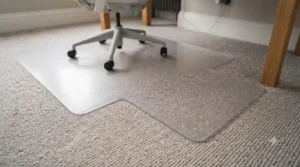
The SHAREWIN carpet version comes in a 120 x 90 cm lipped format aimed at low to medium pile, with a lip that extends beyond the main rectangle to shelter carpet near the desk. A lip is more useful than it sounds: it stops the chair from rolling off the mat when you slide in and out, which is where most carpet wear actually happens. Its listing is one of the most-reviewed in the category, at about 4.2 stars from over 12,000 ratings, although that figure blends several variants, including a hard-floor one.
Reviewers report that chairs glide smoothly and the mat protects the carpet, but feedback on stability is mixed, with some saying it offers little grip. The recurring grumble is unrolling: several describe a two-person job and a day or more before it relaxes. That is typical of flexible plastic shipped in a tight roll, so plan to weigh it down, and check the pile compatibility before ordering.
Pros:
- ✅ Lip protects the high-wear entry point
- ✅ Very large base of buyer reviews
- ✅ Wallet-friendly for the coverage
Cons:
- ❌ Slow to flatten after unrolling
- ❌ Mixed reports on grip
Roughly £20-£35; check the current price. Verdict: solid value if you can wait a couple of days for it to settle.
5. BesWin — the bestselling budget favourite
The BesWin 90 x 120 cm mat is about 2.2 mm of PVC with a studded underside, aimed squarely at low pile carpet. It sits near the top of Amazon UK’s carpet chair mat bestseller list, at around 4.1 stars from more than 5,000 ratings. In practice, 2.2 mm is fine for a home office used a few days a week on firm carpet, but the flexibility that makes PVC cheap also means castors can press into it on softer surfaces.
Reviewer sentiment is consistent: buyers like the thickness and say the grippers stop the mat walking, while others say it takes effort to flatten, and one complained that the studs felt quite sharp during laying. A UK review site suggests replacing it after two to three years under heavier use, which is reasonable for the price.
Pros:
- ✅ Popular, well-reviewed budget option
- ✅ Grippers help stop the mat creeping
- ✅ Two sizes for smaller desks
Cons:
- ❌ Stiff and slow to flatten
- ❌ Studs can be sharp when handling
Around £24-£34; check the current price. Verdict: great for low pile and light-to-moderate use, less so for plush carpet.
6. Kuyal — BPA-free budget protection
The Kuyal 90 x 120 cm carpet mat is about 2 mm of studded PVC, described as BPA-free and intended for low and no-pile carpet, with a lipped version also available. Its studs are the selling point: one UK reviewer noted the many small studs underneath keep it steady even on deep carpet, though the listing itself restricts it to low pile, so that anecdote should be taken as a bonus rather than a guarantee. The lipped variant scores around 4.2 stars from a few hundred ratings.
The pattern in reviews will sound familiar: sturdy and good quality, but difficult to unroll and flatten. One buyer called it very substantial, while another rated it one star for refusing to lie flat. The moral is to buy it if you are patient, since the material is not the issue but the packaging is.
Pros:
- ✅ Sturdy for the price
- ✅ BPA-free, per the listing
- ✅ Lipped version available
Cons:
- ❌ Notoriously difficult to flatten
- ❌ Restricted to low or no pile
Around £25-£35. Verdict: a fair budget pick for firm, thin carpet and patient owners.
7. Trintion — pointed grip for the creep-averse
The Trintion mat is the most aggressive example of spiked backing here: a pointed, T-shaped pattern on the underside, 2 mm PVC, sold in sizes from 75 x 120 cm to 120 x 150 cm for low, standard and medium pile. Pointed grips do bite harder, so if a smooth mat has ever crept across your floor, this design directly addresses that. The trade-off, as the next sections explain, is care when laying it and a firmer stance on softer carpet.
Reviews are the most divided on the list, at roughly 3.9 stars from around 800 ratings. Buyers praise carpet protection and staying power, yet some say the wheels still sink in a bit on softer carpet, several found it hard to unroll, and a few reported cracking. Value opinions are split, too.
Pros:
- ✅ Pointed backing bites into carpet strongly
- ✅ Sizes up to 120 x 150 cm
- ✅ Protects carpet from castor wear
Cons:
- ❌ Wheels can sink in on soft carpet
- ❌ Some reports of cracking and stiffness
From around £25; check the current price. Verdict: worth considering when grip matters most, but not for plush pile.
✨ Don’t Miss These Exclusive Deals!
🔍 Take your workspace to the next level with these hand-picked mats. Click any highlighted product name to check current pricing and availability, and give your carpet the protection it deserves. Your castors will never know what hit them!
How to Lay and Flatten a Chair Mat for Carpet: A Practical Guide
Amazon listings show a pristine mat; they rarely show the wrestling match. PVC mats especially ship tightly rolled, and the reviews above are full of people struggling to flatten them.
Day one, in five steps:
- Clear the area and hoover the carpet, since grit trapped underneath will act like sandpaper.
- Unroll the mat studs-down in a warm room, ideally with a second pair of hands.
- Weigh the corners with heavy books or bricks (one buyer reported needing eight bricks) and leave it for a few days.
- Roll the chair over it daily; foot traffic and castors help it relax.
- Check the edges for ripples, because a rippled edge is a trip hazard as well as an eyesore.
Polycarbonate mats generally arrive flatter, so this routine matters most for PVC.
Maintenance schedule:
- Monthly: wipe the surface with warm soapy water; no harsh chemicals are needed.
- Every three months: lift the mat and hoover the carpet beneath to stop compression marks setting.
- Yearly: rotate the mat 180 degrees to even out wear.
Common mistakes in the first 30 days: dragging the mat instead of lifting it (which can pull carpet fibres and dull the studs), placing it studs-up, and forgetting to move the chair off it before hoovering.
One overlooked benefit is movement. An easy-gliding chair makes it simpler to shift position, and NHS trust guidance on seating and ergonomics advises breaking up long spells of sitting by standing and walking around. A mat that stops your chair fighting the carpet makes those small breaks slightly less of a chore.
Real-World Scenarios: Which Chair Mat for Carpet Fits Your Home?
Specs are abstract until they meet a real room. Here are three typical profiles, matched to picks with reasoning.
The Renter in a Box Room
A tenant works from home three days a week on a thin, low-pile carpet with a deposit to protect. A budget of £25-£35 makes the BesWin or Kuyal the logical choice: thin carpet means castors barely sink, so the flexibility of PVC is not a problem. Budget an afternoon of weighting the corners, and choose a lipped variant if the chair habitually leaves the mat.
The Plush-Carpet Remote Worker
A full-time home worker sits eight hours a day on a thick bedroom carpet with generous underlay. Here the wrong material fails within months, so it is worth spending £60-£125. Measure carpet and underlay first: if the total exceeds 12 mm, the Floortex Ultimat is the safer fit, while a total up to 18 mm points to the Marvelux Deep Pile. Rigidity keeps chair rolling resistance manageable across a full working day.
The Family Office and Gaming Desk
A shared study with a heavier gaming chair and a teenager who spins constantly needs durability and size. The Marvelux Medium Pile in a larger size offers rigidity at a moderate £30-£60, while the SHAREWIN works if budget is tighter and the carpet is firm. For a heavy chair, check any weight rating first, and steer clear of the softest PVC on plush pile.
Spiked Backing Explained: Grip, Damage and What to Watch For
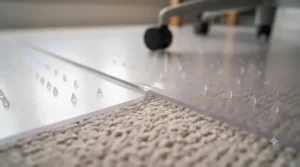
Spiked backing is the feature that decides whether your mat stays put. Underneath, manufacturers use studs (short, rounded nodules), cleats (moulded ridges) or pointed spikes (the sharper option, as on the Trintion). Each grips carpet by pressing into the pile, and each trades grip against gentleness.
Sharper is not automatically better. The Marvelux Medium Pile and Marvelux Deep Pile listings argue that longer or sharper grippers can damage carpet and underlay over time, but remember that this comes from a brand selling shorter studs. Meanwhile, one BesWin reviewer found the nodules quite sharp when laying, which suggests the risk is mainly in handling. At least one UK specialist markets a multi-directional cleat design with a claimed improvement in slide resistance of up to 20 per cent over standard claw backs, but treat that as marketing until independently verified.
Practical rules for any spiked backing:
- Lift the mat into place rather than dragging it.
- Avoid loop-pile carpets with pointed grips, since in principle spikes could snag loops.
- Make sure studs face down; the smooth side takes the castors.
- If a mat still creeps after a week, try a larger size, as a bigger footprint holds better.
Grip performance also depends on the carpet weave, which is why listings such as the Marvelux Medium Pile caveat their claims. The best backing is the one matched to your carpet, not simply the sharpest.
High-Pile Carpet Compatibility: Measure Before You Buy
High-pile carpet compatibility is where most purchases go wrong. Listings quote a carpet thickness limit, typically 12 mm or 18 mm, and that figure usually includes the underlay, so measuring pile alone will mislead you. Fold back a corner, measure carpet plus underlay with a ruler, and round up if in doubt.
Why does it matter? In principle, studs are engineered for a given pile depth. On deeper pile, a mat may float on the fibre tips so the studs never find purchase, and a thin flexible sheet lets castors sink and lift its edges. Rigid polycarbonate resists that, which is why the premium options concentrate on deep-pile ranges.
| Carpet Depth (incl. underlay) | What to Look For | Best Pick From This List | Best For |
|---|---|---|---|
| Low or no pile (under about 6 mm) | Studded PVC is adequate | Kuyal, BesWin | Renters, light use |
| Low to medium (up to 12 mm) | Rigid or lipped, studded back | Marvelux Medium Pile, SHAREWIN, Trintion | Everyday home offices |
| Deep (12 mm and over) | Thick polycarbonate, deep-pile rating | Floortex Ultimat | Plush spare rooms |
| Deep (up to 18 mm) | Deep-pile polycarbonate with studs | Marvelux Deep Pile | Luxury carpet, all-day use |
Reading the table above, the smartest move is to match the rating to your measurement rather than buying the biggest number. Overspecifying a deep-pile mat for thin carpet wastes money, while underspecifying for plush carpet is what leads to the sinking, creeping and dented results reviewers complain about. When your total sits near a boundary, choose the higher rating.
Chair Rolling Resistance: Why Some Mats Feel Like Wading Through Treacle
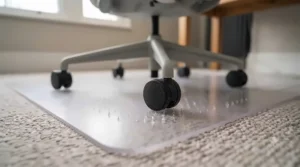
Chair rolling resistance is the drag you feel when pushing off. In physics terms, rolling resistance is the force opposing a wheel as it rolls, and it comes mainly from energy lost as the wheel and the surface deform without fully springing back. Put simply, if either the castor or the floor squashes, you pay for it in effort.
On plush carpet, a castor sinks in and pushes a small bow wave of fibre ahead of it. A rigid mat removes that deformation from the equation, which is why polycarbonate options such as the Marvelux Medium Pile and Floortex Ultimat usually feel easier than 2 mm PVC. Reviewers of the Trintion note that wheels still sink in a bit on softer carpet, which is exactly this effect.
Three factors change how sluggish a mat feels:
- Thickness and rigidity: stiffer sheets deform less under load.
- Surface texture: the lightly embossed finish on the Marvelux Deep Pile trades a little glide for control.
- Castor type: softer treads deform more, so on a rigid mat, hard castors generally roll more freely, though they can skid on very smooth surfaces.
Before blaming the mat, check that castors are free of hair and dust, and confirm the mat is fully flat, as ripples add drag. Lower chair rolling resistance is more than a comfort perk; it means less effort every time you move.
Chair Mat vs the Alternatives
Some people skip the mat, lay a rug or reach for a smooth hard-floor mat and hope for the best. Here is how the options stack up.
| Option | Carpet Protection | Rolling Ease | Cost Profile | Best For |
|---|---|---|---|---|
| Chair mat for carpet (polycarbonate) | Excellent | Very good | Higher upfront, long life | Daily home-working |
| Chair mat for carpet (PVC) | Good | Fair on soft carpet | Low upfront, shorter life | Light use, tight budgets |
| Bare carpet | Poor over time | Poor on plush pile | Free now, costly later | Occasional sitting only |
| Rug over carpet | Fair | Poor, bunches under castors | Moderate | Decoration, not chairs |
| Smooth hard-floor mat on carpet | Poor, often creeps | Good but unstable | Similar to a proper mat | Hard floors only |
The conclusion is clear: a properly matched chair mat for carpet beats the alternatives on protection and stability, while PVC versions are the sensible compromise for lighter use. A smooth-backed hard-floor mat is the false economy of the group, because it lacks the grip that keeps it in place. Tempered glass is another route, though it sits at the premium end and is outside this roundup.
Long-Term Cost and Maintenance: What a Chair Mat for Carpet Really Costs
Buying a cheaper mat can be the pricier decision. A UK review site suggests replacing a PVC mat like the BesWin after two to three years under heavier use. Using illustrative round numbers, a mat costing about £30 and lasting two and a half years works out near £12 a year, whereas a polycarbonate mat around £90 lasting ten years is nearer £9 a year. Warranties such as the 40 years attached to the Floortex Ultimat point the same way, though they are limited and only useful if you keep the paperwork.
Those figures are illustrative, but the principle holds: for occasional use, PVC is fine; for daily use, rigidity pays. Repairing or replacing worn carpet and underlay, meanwhile, can quickly cost more than any mat on this list, and a worn patch may cause disputes with landlords.
Keep costs down with simple habits: wipe monthly, lift and hoover quarterly, rotate yearly, and lay the mat carefully the first time. Check listings for any warranty terms before you buy, keep your order confirmation, and remember that prices vary, so compare before committing.
FAQ
❓ How much should a decent chair mat for carpet cost in the UK?
❓ Do I need a lip on a carpet chair mat?
❓ Can I use a chair mat for carpet over underfloor heating?
❓ Why does my chair mat for carpet keep creeping?
❓ Is polycarbonate better than PVC for a carpet chair mat?
Conclusion
The best chair mat for carpet is the one matched to your pile depth, your daily hours and your patience for unrolling. For most homes, the Marvelux Medium Pile offers the best balance of rigidity, review depth and sensible pricing. If your carpet is genuinely thick, the Floortex Ultimat or the Marvelux Deep Pile are the safer bets, depending on whether your carpet and underlay total more or less than 18 mm. Budget buyers on thin carpet will be well served by the BesWin or Kuyal, and the SHAREWIN adds useful lipped coverage. Anyone battling a creeping mat might consider the Trintion, while accepting its softer-carpet limitations.
Remember the three questions from the start: check the spiked backing, verify high-pile carpet compatibility against a real measurement, and think about chair rolling resistance rather than just protection. Get those right and the mat disappears into the background, which is exactly what good floor protection should do.
✨ Ready to give your carpet a fighting chance?
🛒 Click any highlighted product name to check current pricing and availability, then choose the mat that fits your floor, your desk and your budget. Your carpet (and your deposit) will thank you! 🙌
Recommended for You
- Chair Mat For Hard Floors: 7 Best Picks to Stop Scratches (2026)
- Cervical Pillow For Side Sleepers: 7 Top UK Picks (2026)
- Neck Support Pillow for Travel: 7 Best Picks for 2026
Disclaimer: This article contains affiliate links. As an Amazon Associate, I earn from qualifying purchases. If you purchase products through these links, we may earn a small commission at no additional cost to you.
✨ Found this helpful? Share it with your friends! 💬🤗
