
In This Article
Here’s an uncomfortable truth: your office chair is probably doing more damage than your commute, your mattress, and your questionable posture habits combined. If you’re living with chronic back pain — the kind that greets you before your morning coffee and follows you to bed — there’s a reasonable chance that the chair you’re spending eight or more hours in every day is actively making things worse.
An office chair for chronic back pain isn’t just a piece of furniture you park yourself on between meetings. It’s a therapeutic tool. And in the UK, where lower back pain costs the NHS an estimated £1.3 billion a year and affects roughly one in six adults at any given time, the stakes are higher than most people realise.
The right chair does three things that a standard desk chair simply doesn’t: it maintains the natural S-curve of your spine, redistributes pressure away from the discs and nerve roots causing your pain, and allows you to shift position naturally throughout the day without collapsing into a physiotherapy-requiring slump by 3pm.
What is an office chair for chronic back pain? In short, it’s a fully adjustable ergonomic chair engineered with dynamic lumbar support, adjustable seat depth, and high-quality materials capable of withstanding eight-plus hours of daily use — specifically designed to reduce pressure on the discs, sacrum, and sciatic nerve.
In this guide, you’ll find the 7 best options currently available on Amazon.co.uk, spanning from well-considered budget picks to genuine clinical-grade investments. Prices are in GBP. Products are UK-verified. Opinions are honest. Let’s begin.
Quick Comparison: 7 Best Office Chairs for Chronic Back Pain (UK)
| Chair | Price Range | Lumbar Type | Best For | Amazon.co.uk |
|---|---|---|---|---|
| SIHOO M18 | Under £150 | Adjustable fixed | Budget-conscious buyers, occasional use | ✅ Available |
| SIHOO M57 | £150–£200 | Dual-adjustable | Daily use, value seekers | ✅ Available |
| Boulies EP200 | £190–£280 | Adjustable + depth | Versatile all-day users | ✅ Available |
| FlexiSpot C7 | £250–£350 | Self-adaptive dynamic | Mid-range chronic pain sufferers | ✅ Available |
| SIHOO Doro C300 | £270–£340 | Spine-adaptive dynamic | Long-hour sitters, mixed postures | ✅ Available |
| Steelcase Leap V2 | £700–£1,000 | LiveBack adaptive | Serious chronic pain investment | ✅ Available (incl. refurb) |
| Herman Miller Aeron | £1,200–£1,500+ | 8Z Pellicle zoned | Premium therapeutic seating | ✅ Available |
The table above tells a story worth unpacking. Notice that the price gap between the mid-range tier (FlexiSpot C7, Doro C300) and the premium tier (Steelcase Leap, Aeron) is enormous — we’re talking a factor of four or five. For most UK buyers managing chronic pain, the mid-range options do the heavy lifting at a fraction of the cost. That said, if your condition is clinically diagnosed, the Steelcase Leap V2 or Aeron may legitimately pay for themselves in avoided physiotherapy appointments.
💬 Just one click — help others make better buying decisions too! 😊
✨ Don’t Miss These Exclusive Deals!
🔍 Take your comfort and back health to the next level with these carefully selected ergonomic chairs. Click on any highlighted product name to check current pricing and availability on Amazon.co.uk. Your spine will thank you for it!
Top 7 Office Chairs for Chronic Back Pain: Expert Analysis
1. SIHOO M18 Ergonomic Office Chair — Best Budget Pick for Chronic Back Pain
Don’t let the accessible price put you off. The SIHOO M18 is what you get when a company decides to focus on function rather than flashy marketing — and it mostly works. The M18 features a plush foam-cushioned seat (a deliberate departure from full-mesh designs that can feel punishing on sensitive hips and tailbones), a breathable mesh backrest, a height-adjustable lumbar support, and a tilt mechanism that locks at multiple positions.
In practice, the cushioned seat is the M18’s trump card for chronic pain sufferers. Where full-mesh chairs distribute your weight across a taut surface, the M18’s foam seat reduces coccyx and sciatic pressure quite meaningfully — something people with degenerative disc disease or sacroiliac joint dysfunction will immediately notice. The lumbar support adjusts vertically, which is fine at this price, though it won’t chase your spine as you shift position throughout the day. The 2D armrests are serviceable; they go up and down, and that’s your lot.
UK buyers with compact home offices in terraced houses or flats will appreciate the M18’s relatively modest footprint. It doesn’t sprawl. Assembly is rated as straightforward by most UK reviewers — generally 20–30 minutes.
Pros:
✅ Foam seat reduces coccyx and sacral pressure
✅ Breathable mesh back prevents overheating during long sessions
✅ Excellent value at under £150
Cons:
❌ 2D armrests lack lateral adjustment — not ideal for shoulder pain
❌ Lumbar support is fixed in depth — doesn’t adapt as you shift
Price range: Under £150 | Verdict: A sensible entry-point. The SIHOO M18 is best for home workers who sit for moderate hours and need meaningful lumbar support without committing to a three-figure spend. Prime-eligible for fast delivery.
2. SIHOO M57 Ergonomic Mesh Office Chair — Best Value Chair for Chronic Back Pain UK
If the SIHOO M18 is a solid start, the SIHOO M57 is where things get genuinely interesting. This is arguably the best-value office chair for chronic back pain on Amazon.co.uk right now, and the evidence is hard to argue with: it consistently tops “best of” roundups at Expert Reviews and TechRadar, and for good reason.
The M57 is a full-mesh design — both seat and back — which might give disc pain sufferers pause. In reality, the split backrest conforms to the natural S-shape of the spine rather well, cushioning the vertebrae without the rigidity of foam. The dual-adjustable lumbar support moves both vertically and horizontally, meaning you can actually dial in the depth to match your specific spinal curve, not just a generic approximation of it. The 3D armrests adjust forward/backward, left/right, and up/down — this alone is a serious differentiator at this price point.
The headrest tilts and adjusts in height, the recline goes to 126°, and the waterfall-edged seat is thoughtfully designed to reduce thigh pressure. For chair for all-day sitting back pain, the M57’s cooling mesh construction is also genuinely useful in warm weather — and while British summers are never guaranteed, working from a converted bedroom in July can get stuffy.
UK reviewers consistently note this chair’s quality-to-cost ratio is exceptional. Assembly takes around 30 minutes and the instructions are clear enough.
Pros:
✅ Dual-adjustable lumbar (height + depth) — genuinely rare under £200
✅ 3D armrests reduce shoulder and neck tension
✅ Full-mesh construction keeps you cool during long sessions
Cons:
❌ Full mesh seat isn’t for everyone — those with hip pain may prefer foam
❌ No seat depth adjustment at this price tier
Price range: £150–£200 | Verdict: Outstanding. The SIHOO M57 represents the sweet spot for UK buyers who want serious ergonomic support without taking out a second mortgage.
3. Boulies EP200 Ergonomic Office Chair — Best Mid-Range All-Rounder
The Boulies EP200 is a name that doesn’t always appear in the mainstream back-pain conversation, which is rather a shame — because it’s a genuinely capable chair that sits in a sweet spot between the SIHOO range and the FlexiSpot C7.
What makes the EP200 notable for chronic pain sufferers is the combination of seat depth adjustment and well-calibrated adjustable lumbar support. Seat depth adjustment is critically underappreciated in the back pain world. Too shallow and your thighs are unsupported, tilting your pelvis and creating lower back tension. Too deep and you’re cutting off circulation behind the knee. The EP200 lets you find the right balance — useful whether you’re 5’3″ or 6’1″. The 3D armrests are comfortable and the headrest is wide and properly supportive, not the token nodule that some manufacturers call a headrest.
TechRadar rated the EP200 highly as a daily driver that remained consistently supportive well over eight hours a day — which is precisely the kind of endorsement that matters when you’re choosing a chair for chronic pain, rather than occasional use. UK availability is solid, with Prime delivery.
Pros:
✅ Seat depth adjustment — genuinely critical for pelvic alignment
✅ Wide headrest supports neck in multiple positions
✅ Reliable all-day support confirmed in long-term testing
Cons:
❌ Lumbar support is adjustable but not fully self-adaptive
❌ Can feel firm during initial break-in period
Price range: £190–£280 | Verdict: If you’re torn between the SIHOO M57 and the FlexiSpot C7, the Boulies EP200 is a thoughtful middle path — particularly for taller UK buyers who need that seat depth control.
4. FlexiSpot C7 Ergonomic Office Chair — Best for Adaptive Lumbar Support
This is the one that genuinely surprised ergonomic reviewers when it landed. The FlexiSpot C7’s standout feature is its self-adaptive dynamic lumbar system — a spring-loaded mechanism that physically chases your lower back as you shift between positions. Lean forward to type and it pushes out to meet you. Recline to think and it relaxes. You don’t touch a single knob. Gravity does the work.
For sufferers of disc degeneration seating issues — particularly those with degenerative disc disease or facet joint pain — this matters enormously. Static lumbar supports, however well-placed, lose contact with your spine the moment you shift. The C7’s system maintains that contact through the workday, which is the ergonomic equivalent of having a quiet but attentive physiotherapist permanently at your back.
The C7 also features seat depth adjustment (critical, as noted above), a wide headrest, and 4D armrests that are substantially more flexible than the 2D or 3D options on cheaper chairs. UK customers with chronic sciatica report meaningful reduction in daily stiffness after switching to the C7. The mesh breathes well. Build quality is solid — FlexiSpot backs it with a multi-year warranty.
One honest caveat: the lumbar support is aggressive. If your chronic pain is muscular rather than disc-related, or if you’re accustomed to softer chairs, the C7’s lumbar push can take a week or two to get used to.
Pros:
✅ Self-adaptive lumbar — maintains contact as you shift positions naturally
✅ Seat depth adjustment accommodates different heights
✅ 4D armrests offer the most refined arm positioning in this price range
Cons:
❌ Lumbar support may feel intense initially for some pain types
❌ Pricier than SIHOO alternatives — a meaningful jump in spend
Price range: £250–£350 | Verdict: The FlexiSpot C7 is the gold standard for mid-range office chairs for chronic pain sufferers. Well worth every pound.
5. SIHOO Doro C300 Ergonomic Office Chair — Best for Mixed-Posture Long-Hour Sitting
The Doro C300 occupies a fascinating niche in the office chair for chronic pain sufferers market. It’s designed specifically for people who don’t sit still — coders, writers, analysts who move between typing hunched forward, leaning back to think, and occasionally contorting themselves in ways that would alarm a physiotherapist.
The C300’s spine-inspired backrest uses a self-adaptive lumbar cushion that moves with the user rather than against them — SIHOO describes it as designed to “track the body in all positions.” What does that mean in practice? It means whether you’re sitting bolt upright for a video call or reclined at 45° pondering a difficult deadline, the lumbar support retains meaningful contact with your lower back. For persistent pain management, this dynamic quality is far more valuable than a rigid foam pad that only works in one position.
Seat height, headrest, and 3D armrests are all properly adjustable. The mesh is notably breathable. UK reviewers rate assembly as manageable — typically 25–35 minutes. One consistent piece of UK customer feedback: the C300’s padding is softer than the M57, making it a more comfortable starting point for those transitioning from a padded chair.
Pros:
✅ Self-adaptive lumbar designed for mixed postures and frequent movement
✅ Softer feel than the M57 — gentler transition for first-time ergonomic users
✅ Excellent all-day comfort confirmed across multiple UK reviews
Cons:
❌ No seat depth adjustment — less suitable for very tall users
❌ Slightly higher price than the M57 for a modest feature upgrade
Price range: £270–£340 | Verdict: A refined, capable chair that earns its price for chronic pain sufferers who rarely stay in one position. If you’re also a light gamer after hours, the C300 doubles up beautifully.
6. Steelcase Leap V2 Ergonomic Office Chair — Best Premium Chair for Serious Chronic Back Pain
At this price level, you stop buying chairs and start buying engineering. The Steelcase Leap V2 has a special reputation in the chronic back pain world, and it’s earned. The LiveBack technology — a flexible backrest that continuously recalibrates to the shape and movement of your spine — is a different category of support to anything in the mid-range. Not better adjusted; architecturally different.
The Leap V2 also features natural glide, which allows the seat to move forward as you recline, keeping your hips at a stable angle and preventing the disc-compressing slump that cheaper chairs encourage. The lower back firmness and upper back force controls let you tune the support to your specific pathology — a feature that’s particularly useful for UK buyers managing clinically diagnosed conditions like degenerative disc disease or spondylolisthesis. Both your physiotherapist and your spine will notice the difference.
Steelcase backs the Leap V2 with a 12-year warranty — outstanding, and a realistic reflection of the chair’s build quality. Available on Amazon.co.uk in both new and refurbished condition; the refurbished options in “very good” condition offer excellent value in the £700–£800 range and are worth serious consideration.
Pros:
✅ LiveBack technology continuously adapts to spinal movement
✅ Natural glide mechanism prevents disc-compressing posture collapse
✅ 12-year warranty reflects exceptional build quality
Cons:
❌ Significant investment — not for every budget
❌ Bulkier than mid-range options; less suited to compact UK home offices
Price range: £700–£1,000+ (new); refurbished options from around £400 | Verdict: If chronic pain has become a clinical and financial burden — costing you in NHS appointments, private physio, or lost productivity — the Steelcase Leap V2 is a legitimate medical investment that pays for itself.
7. Herman Miller Aeron Ergonomic Office Chair — Best Premium Long-Term Investment
The Herman Miller Aeron is the chair that ergonomists reference the way architects reference the Eiffel Tower — partly to acknowledge its genuine excellence, partly because it’s become the benchmark against which everything else is measured. Designed with input from over 30 physicians, biomechanics PhDs, and ergonomic specialists, the Aeron is the most thoroughly researched office chair in existence.
The 8Z Pellicle mesh — Herman Miller’s proprietary material — varies in tension across eight zones of the seat and back. Tighter at the edges for lateral support; more yielding where your body makes sustained contact. The result is exceptional pressure distribution across the entire back, which matters considerably for disc degeneration seating and long-hour support. Three UK size options (A, B, C based on height and weight) ensure a genuine fit rather than a one-size-fits-most compromise.
PostureFit SL — the Aeron’s dual-pad lumbar and sacral support system — targets both the lower lumbar and the sacrum simultaneously, which separates it from virtually every other chair on this list. For people with complex chronic pain involving multiple spinal regions, this dual targeting is meaningful.
Herman Miller offers a 12-year warranty on the Aeron, and UK availability on Amazon.co.uk is consistent. This is an indulgence only if you’re sitting for fewer than four hours a day. For serious long-hour support, it’s arguably the most cost-effective chair per decade of use.
Pros:
✅ 8Z Pellicle zoned mesh delivers superior pressure distribution
✅ PostureFit SL supports both lumbar and sacrum simultaneously
✅ 12-year warranty; proven longevity over decades of use
Cons:
❌ Eye-watering upfront cost — not accessible without financial planning
❌ Takes 1–2 weeks of adjustment for the body to fully adapt
Price range: £1,200–£1,500+ | Verdict: The Aeron is the pinnacle. Whether it’s worth the cost depends entirely on your pain severity, your hours at the desk, and how much you’ve already spent on treatment. For many, the maths eventually works in its favour.
Setting Up Your Chair for Maximum Back Pain Relief: A Practical Guide
Buying the right chair is only half the battle. The other half — the half most people skip entirely — is setting the chair up correctly. A £1,500 Herman Miller Aeron badly adjusted will make you ache; a £175 SIHOO M57 properly configured can be genuinely therapeutic. The difference is almost always technique.
Step 1: Start with seat height. Sit down and plant your feet flat on the floor. Your knees should form a 90–100° angle. If your feet are dangling or your knees are higher than your hips, you’re creating pelvic tilt and the associated disc compression.
Step 2: Adjust seat depth. You should have roughly a fist’s width between the back of your knees and the front of the seat. Too little and you’re unsupported; too much and you’re cutting off circulation — which worsens sciatic symptoms.
Step 3: Configure the lumbar support before touching anything else. Position it so it presses gently into the natural curve of your lower back — the concave bit just above the belt line. On self-adaptive chairs like the FlexiSpot C7 and Doro C300, this is largely automatic; on the SIHOO M57, set the depth so it makes contact without pushing.
Step 4: Set your armrests. Your elbows should rest at desk height with your shoulders relaxed — not hunched up around your ears. On 3D or 4D armrests, sweep them slightly inward to support the full forearm, which reduces the shoulder tension that often compounds lower back pain.
Step 5: Use the recline — properly. Chronic pain experts consistently recommend slight recline (100–110°) rather than the ninety-degree “exam posture” we’ve all been taught. A mild recline reduces disc pressure by roughly 25% compared to sitting bolt upright. Use the tilt tension to set it so you can move naturally without flopping backwards.
A note for UK home workers: Many of us work from compact spaces — converted box rooms, kitchen tables, spare bedrooms. If your desk height is non-negotiable, prioritise chair height above all else and consider a footrest (widely available on Amazon.co.uk under £20) to compensate.
Real UK Buyer Profiles: Which Chair Is Actually Right for You?
Profile 1: The Remote Worker in a Bristol Terrace — Sophie, 34, works in digital marketing and spends 9 hours daily at her desk managing chronic lower back ache that started during lockdown. Budget: under £250. Home office: converted second bedroom, limited space.
For Sophie, the SIHOO M57 is the clear call. The dual-adjustable lumbar can be set precisely to her lumbar curve, the cooling mesh is helpful during the warmer months (even in Bristol), and at under £200 it doesn’t require a financial conversation. The M57’s relatively modest footprint also suits her compact setup.
Profile 2: The Senior Developer in Manchester — James, 47, has been diagnosed with degenerative disc disease. He codes eight-plus hours daily and notices pain flares every afternoon. Budget: £300–£500. Home office: dedicated study in a semi-detached.
James needs the FlexiSpot C7. The self-adaptive lumbar is precisely suited to disc degeneration seating — it maintains contact through the constant micro-shifts of a developer’s working posture without requiring manual adjustment mid-task. The seat depth adjustment matters at his height (183 cm). He should budget time for a one-to-two week adaptation period.
Profile 3: The Finance Professional in Edinburgh — Alison, 52, manages ongoing sciatica alongside sacroiliac joint dysfunction and can afford to invest properly. Budget: £700+. Office: home study plus three days per week in a City Centre office.
Alison’s profile calls for the Steelcase Leap V2. The natural glide system is specifically well-suited to sciatic presentations, and the lower back firmness control can be tuned to her specific pain profile. The 12-year warranty means she won’t be having this conversation again anytime soon. A refurbished Leap V2 in very good condition from Amazon.co.uk brings the cost into a more manageable range.
How to Choose an Office Chair for Chronic Back Pain in the UK
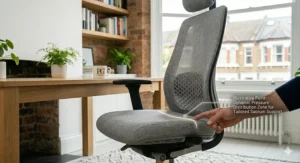
- Match the lumbar type to your condition. Static lumbar supports work for mild generalised pain. Adaptive dynamic systems (FlexiSpot C7, Doro C300) are necessary for disc pain or sciatica. Premium biomechanical systems (Steelcase Leap, Aeron) are justified for complex or severe chronic presentations.
- Prioritise seat depth adjustment if you’re over 180 cm. Tall UK buyers are disproportionately harmed by shallow seat pans. The Boulies EP200 and FlexiSpot C7 both offer this adjustment; most budget chairs don’t.
- Think about the mesh vs. foam question honestly. Full-mesh chairs (M57, C300, Leap, Aeron) are breathable and comfortable for most people, but those with tailbone pain, hip pain, or post-surgical sensitivity may find a padded seat (M18) significantly more comfortable.
- Budget for the long game. A £100 chair replaced every eighteen months costs more over five years than a £300 chair that lasts a decade. Factor warranty length into your true cost of ownership.
- Don’t ignore armrest quality. Neck and shoulder pain frequently compound chronic back pain. 3D or 4D armrests that allow lateral and forward adjustment eliminate the shoulder elevation that tight workspaces in British homes often create.
- Consider your home office footprint. UK homes are smaller than their American counterparts on average. The SIHOO range is notably compact; the Steelcase Leap V2 and Aeron are larger chairs. Measure before you order — Amazon.co.uk’s 30-day return policy under the Consumer Contracts Regulations means you’re covered if it doesn’t fit.
Common Mistakes When Buying an Office Chair for Chronic Back Pain
Buying on aesthetics alone. A chair that photographs well in your Instagram-perfect home office is not a chair that’s managing your chronic pain. A beige minimalist occasional chair may look tasteful; it will not protect your L4-L5 disc.
Ignoring the adjustment range. Many budget chairs technically have lumbar support. Most of it adjusts to a height range of about 4 cm. For anyone under 5’5″ or over 6’0″, this makes the adjustment functionally useless. Check the specifications carefully — and read UK reviews from people of similar height.
Mistaking firmness for support. A rock-hard lumbar pad is not the same as proper lumbar support. The foam in many budget chairs compresses within months, at which point you’re sitting against plastic. Mesh systems with tension adjustment (or self-adaptive mechanisms) age more gracefully.
Overlooking the Amazon.co.uk return policy. UK buyers have 30 days to return an online purchase under the Consumer Contracts Regulations 2013 — a stronger protection than in many other markets. Use it. If a chair is causing discomfort at two weeks, don’t talk yourself into persisting. Return it and try the next option on this list.
Buying based on a friend’s recommendation without accounting for body type. The chair that transformed your colleague’s working life may be entirely wrong for your height, weight, or specific pain presentation. Use the profiles above as a starting point, but trust your own body.
Ergonomic Chair vs Standard Office Chair: Is the Upgrade Worth It?
| Feature | Standard Office Chair | Ergonomic Chair for Chronic Pain |
|---|---|---|
| Lumbar support | Fixed foam pad (or none) | Adjustable / self-adaptive |
| Seat depth | Fixed | Adjustable (mid-range and above) |
| Armrests | 1D (height only) | 3D or 4D on quality models |
| Tilt mechanism | Basic recline | Multi-position tilt with tension control |
| Build quality | 1–3 year lifespan (typical) | 5–12+ year lifespan |
| Back pain outcomes | Worsens over time | Measurably reduces daily pain with correct setup |
| UK price range | £40–£150 | £150–£1,500+ |
| Best for | Occasional, short use | Daily use, chronic pain management |
The comparison table makes the answer clear — but it’s worth spelling out for the sceptics. Research published via NHS musculoskeletal guidance consistently supports ergonomic seating as a frontline intervention for persistent pain management. The British Society for Rheumatology notes that prolonged poor seating posture is a modifiable risk factor for worsening back conditions.
A standard office chair under £100 has, at best, a static foam lumbar pad and height adjustment. An ergonomic chair in the £150–£350 range has adjustable lumbar support, proper armrest control, and tilt mechanics that allow natural movement throughout the day. That gap is clinically meaningful for disc degeneration seating and long-hour support. The upgrade is almost always worth it.
Long-Term Cost & Maintenance in the UK
The hidden economics of office chairs are rarely discussed honestly. Here they are.
A £100 chair typically lasts 18–24 months before the foam compresses, the gas lift loses height retention, and the lumbar mechanism becomes ineffective. Over five years, that’s two to three replacement chairs — a total outlay of £200–£300, without the ergonomic benefits.
A mid-range chair in the £200–£350 range (SIHOO M57, FlexiSpot C7, Doro C300) is typically built to last five to seven years under daily use. The cost-per-year works out to roughly £30–£70 — meaningfully less than even a single NHS physiotherapy referral waiting period’s worth of private treatment.
The premium tier (Steelcase Leap V2 at £700–£1,000, Aeron at £1,200–£1,500) comes with 12-year warranties and build quality to match. At £70–£125 per year over the warranty period, these chairs are not extravagant — they’re simply amortised over a longer timeline. Parts and service are available in the UK, which matters for post-Brexit warranty support on European-manufactured products.
Maintenance tips for UK conditions:
- 🔧 Tighten all bolts at six months — vibration from castors on mixed UK flooring loosens fittings faster than you’d expect
- 🧴 Clean mesh backrests with a damp cloth and mild detergent every two to three months — dust and skin particles degrade the tension over time
- 🛞 Replace castors after three to four years — hardwood-safe castors are available on Amazon.co.uk for under £10 and make a noticeable difference to rolling ease and floor protection
UK Workplace Regulations & Back Pain: What Every Home Worker Should Know
The Health and Safety Executive (HSE) requires UK employers to assess the workstation setup of employees who regularly use display screen equipment — a category that includes the vast majority of modern office workers, including those working from home. If your employer has asked you to work from home without assessing your workstation, you are entitled to request a DSE (Display Screen Equipment) assessment.
This matters for chronic back pain sufferers for one practical reason: a qualifying DSE assessment may entitle you to employer-funded ergonomic equipment, including an office chair for chronic back pain. This is a legal obligation, not a perk. If your employer dismisses the request, the HSE guidance at the link above is clear on your rights.
For self-employed UK workers, the good news is that ergonomic office equipment purchased wholly and exclusively for work use may qualify as an allowable expense against self-assessment tax — worth confirming with your accountant, but potentially reducing the net cost of a Steelcase or Aeron by 20–40% depending on your tax position.
Frequently Asked Questions
❓ What is the best office chair for chronic back pain in the UK in 2026?
❓ Are ergonomic office chairs covered by NHS or employer schemes in the UK?
❓ What features should I look for in an office chair for degenerative disc disease?
❓ How long does an ergonomic office chair last under daily UK home-working conditions?
❓ Can I return an ergonomic chair bought on Amazon.co.uk if it worsens my back pain?
Conclusion: Your Back Deserves Better Than the Chair It’s Currently Sitting In
Chronic back pain is relentless in a way that’s hard to convey to anyone who hasn’t experienced it. It follows you from desk to sofa to bed and back again. But it isn’t inevitable. The right office chair for chronic back pain doesn’t cure anything — let’s be sensible about that — but it removes one of the most consistent, daily contributors to your pain from the equation. And that, over weeks and months, is genuinely life-changing.
The SIHOO M57 is where most UK buyers should start: thoroughly capable, properly adjustable, and available at a price that doesn’t sting. If your pain is more complex or your hours are longer, the FlexiSpot C7 or SIHOO Doro C300 step things up meaningfully. And if you’re ready to commit properly, the Steelcase Leap V2 is simply the best chair most humans will ever sit in.
Whatever you choose: set it up correctly, follow the five-step guide above, and give your body a week to adapt. The results are worth the effort.
✨ Ready to Invest in Your Back Health?
🔍 Click on any highlighted chair name in this guide to check the current price and availability on Amazon.co.uk. Free delivery on eligible orders over £25 — Prime members get next-day delivery on most models. Your spine will notice the difference sooner than you think.
Recommended for You
- Best Office Chair for Upper Back Pain: 7 UK Expert Picks (2026)
- Best Office Chair for Lower Back Pain UK 2026: 7 Expert Picks
- Best Office Chairs for Back Pain UK 2026: 7 Expert Picks
Disclaimer: This article contains affiliate links. As an Amazon Associate, I earn from qualifying purchases. If you purchase products through these links, we may earn a small commission at no additional cost to you. All prices are approximate GBP ranges only — please check Amazon.co.uk for current pricing. The information in this article is for educational purposes only and does not constitute medical advice. Always consult a qualified healthcare professional regarding chronic back pain or musculoskeletal conditions.
✨ Found this helpful? Share it with your mates! 💬🤗
