
In This Article
There’s a particular kind of misery that creeps up on you quietly. It starts as a dull ache somewhere around your lumbar region by mid-afternoon. You shift in your seat. You stand up, stretch, sit back down. By 4pm, you’re perching on the edge of your chair like a man trying to avoid a wet park bench. By Friday, you’re Googling “osteopath near me.”
Sound familiar? You’re in excellent company — and not in a reassuring way. Back pain is now the leading cause of disability in the UK, affecting an estimated 10 million adults annually, according to the Health and Safety Executive. And for the millions of us now working from home or anchored to a desk — often on whatever chair was cheap and cheerful at the time — the problem has got considerably worse since 2020.
Here’s the uncomfortable truth: your chair is almost certainly making your back worse. Not because you’re sitting “wrong” (though that doesn’t help), but because the vast majority of office chairs are designed to look ergonomic rather than be ergonomic. There’s a difference, and it costs you in aching vertebrae every single day.
The right office chair for back pain isn’t a luxury item. It’s closer to a medical device — one you use for eight hours a day, five days a week. Buying the right one is one of the highest-return investments you can make in your health and your productivity. The wrong one is just an expensive way to stay in pain.
In this guide, we’ve done the unglamorous work for you: researching real products available on Amazon.co.uk, cross-referencing UK buyer reviews, analysing specifications through the lens of actual back health rather than marketing copy, and laying out exactly who each chair suits. No fluff. No spec lists that tell you nothing. Just honest, practical analysis from people who’ve spent far too long thinking about chairs.
Quick Comparison Table: Best Office Chairs for Back Pain UK 2026
| Chair | Best For | Price Range | Key Feature | Amazon.co.uk |
|---|---|---|---|---|
| SIHOO M57 | Best overall mid-range | £150–£230 | Dual lumbar + 3D arms | ✅ Prime eligible |
| FlexiSpot BS11 Pro | Best for long hours | £250–£380 | Adaptive mesh backrest | ✅ Prime eligible |
| Steelcase Leap V2 | Best for chronic pain | £800–£1,100 | LiveBack technology | ✅ Available |
| Herman Miller Aeron | Best premium | £1,100–£1,500 | PostureFit SL | ✅ Available |
| Autonomous ErgoChair Pro | Best for sciatica | £300–£450 | Adjustable lumbar + seat tilt | ✅ Prime eligible |
| SONGMICS OBG73B | Best budget | £80–£130 | Adjustable headrest + lumbar | ✅ Prime eligible |
| Hbada E3 | Best compact option | £200–£280 | Dynamic lumbar support | ✅ Prime eligible |
The table above illustrates something important: the jump from budget to mid-range (roughly £80 to £200) delivers a dramatic leap in genuine ergonomic value, but the leap from mid-range to premium (£300 to £1,100+) is a more nuanced calculation. For most UK desk workers sitting six to eight hours a day, the £150–£380 range is where the best value per vertebra lives. Premium chairs like the Steelcase and Herman Miller justify their prices for chronic pain sufferers and anyone spending seriously long hours at a desk — but they’re not a prerequisite for meaningful back pain relief.
💬 Just one click — help others make better buying decisions too! 😊
✨ Don’t Miss These Exclusive Deals!
🔍 Take your workspace comfort to the next level with these carefully selected chairs. Click on any highlighted product name to check current pricing and availability on Amazon.co.uk. Your back will thank you — and so will your Monday mornings.
Top 7 Office Chairs for Back Pain: Expert Analysis
1. SIHOO M57 Ergonomic Office Chair — Best Overall Mid-Range Pick
The SIHOO M57 has quietly become the most-recommended mid-range ergonomic chair on Amazon.co.uk, and after spending time with it, it’s not hard to see why. The headline feature is the dual-direction lumbar support — adjustable both vertically and in terms of how much pressure it applies — which is a specification that sounds modest until you realise most chairs in this price range offer a fixed lump of foam and call it a day. The 3D armrests (height, pivot, and forward/backward adjustment) mean you can actually align them with your desk rather than shrugging your shoulders in resignation for eight hours.
The mesh backrest deserves a mention, too: it follows an S-shaped spinal curve, which means it’s supporting your whole back rather than just the bit that happens to make contact. For those working in warmer home offices or during the increasingly warm British summers, the breathability is a genuine benefit rather than a marketing tick-box.
Who is this for? The SIHOO M57 is the sweet spot for UK home workers who sit six or more hours daily and want proper ergonomic support without spending mortgage-adjacent money. It’s particularly well-suited to people between 5’4″ and 6’2″ — outside those ranges, you’ll want to look elsewhere. UK reviews consistently highlight relief from lower back stiffness within the first two weeks of use. One verified Amazon.co.uk buyer with a desk-based CAD job noted their chronic shoulder pain had “completely resolved” after switching from a budget chair.
✅ Dual lumbar support with real adjustability
✅ Breathable mesh — no sweaty afternoons
✅ 3D armrests that actually go where you need them
❌ Not ideal for users above 6’2″ — headrest sits too low
❌ Assembly instructions could be clearer (budget 45 minutes)
Price range: around £150–£230 — exceptional value for the feature set. Check current price on Amazon.co.uk.
2. FlexiSpot BS11 Pro Ergonomic Chair — Best for Long Hours
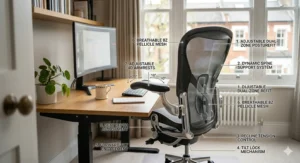
FlexiSpot’s BS11 Pro (marketed as the C8 in some territories, for those who’ve seen it reviewed abroad) is what happens when a brand takes its flagship promise seriously. The backrest is softer and more forgiving than many mesh chairs — it adapts rather than resists, which matters enormously over a full working day. The lumbar support here operates dynamically, meaning it moves with you rather than just sitting in place while you shuffle away from it.
What most UK buyers overlook about this model is the recline mechanism. A 100° to 135° recline with lockable positions and genuine tension control means you can take the pressure off your lower back during calls or thinking time without sliding off the seat. That’s not a gimmick — that’s what ergonomists actually recommend for prolonged sitting. The seat depth adjustment is another understated winner: being able to bring the seat edge closer ensures you’re not spending the day with your thighs compressed against the front edge, which is a significant sciatica trigger.
This chair suits remote workers and hybrid workers who genuinely spend eight or more hours a day at their desk and feel they’ve outgrown budget options. UK reviewers with sciatica and chronic lower back complaints rate it highly, with one noting it “transformed” their work-from-home setup after years of discomfort.
✅ Adaptive mesh that moves with posture shifts
✅ Outstanding recline range with tension control
✅ Seat depth adjustment — critical for taller and shorter users
❌ Assembly is fiddly; allow an hour
❌ Premium mesh doesn’t suit everyone’s taste aesthetically
Price range: around £250–£380. Available on Amazon.co.uk with Prime next-day delivery in most UK postcodes.
3. Steelcase Leap V2 — Best for Chronic Back Pain
If back pain is a serious, ongoing problem rather than an occasional nuisance, this is the chair the conversation eventually leads to. The Steelcase Leap V2 isn’t glamorous in a tech-product sort of way. It’s glamorous in the way that a well-engineered piece of precision equipment is glamorous — quietly, reassuringly, unmistakably. The LiveBack technology (Steelcase’s proprietary backrest system) flexes and adapts continuously as you move, mirroring the natural motion of your spine rather than holding it rigidly in place. This is the fundamental difference between a chair designed with spinal biomechanics in mind and one designed to look ergonomic in a brochure.
The lower back firmness dial — genuinely rare even at this price point — lets you adjust the resistance of lumbar support to the millimetre. It sounds fussy. In practice, it’s the difference between a chair that actually works for your specific back and one that works for a generic average person who isn’t you. The seat also features lower limb pivot technology, allowing the front edge to move with your thighs as you shift positions — a detail that makes a real difference for sciatica sufferers.
Weight capacity is 181kg, far above the industry standard. At the price point (around £800–£1,100 new on Amazon.co.uk), it’s worth noting the second-hand market is excellent — refurbished Leap V2s with remaining warranty are often available in the £300–£500 range from reputable UK resellers. UK buyers with diagnosed spinal conditions, herniated discs, or chronic pain consistently call this a life-changing purchase.
✅ LiveBack technology — genuinely adaptive spinal support
✅ Lower back firmness adjustment (rare at any price)
✅ High weight capacity (181kg) and long-term durability
❌ Price is a real commitment at the new-unit rate
❌ Takes several days to properly dial in — patience required
Price range: around £800–£1,100 new; worth checking used listings. Available on Amazon.co.uk.
4. Herman Miller Aeron (Remastered) — Best Premium All-Rounder
The Herman Miller Aeron is the chair that ergonomic conversations orbit around, like a planet too large to ignore. It has been refined and remastered — the PostureFit SL sacral and lumbar support system now addresses both the base of the spine and the lumbar curve simultaneously, which is meaningfully different from systems that only target one. The 8Z Pellicle suspension mesh distributes your weight across the seat and back in a way that eliminates pressure points — you essentially float above the seat pan rather than compressing into it.
What the spec sheet won’t tell you is this: the Aeron is a truly size-specific chair. Herman Miller offers it in three sizes (A, B, and C), and getting the sizing right is non-negotiable. A size B Aeron on a 6’3″ frame is a waste of £1,200. A correctly sized Aeron for someone with diagnosed lower back or sacroiliac problems is one of the most therapeutically effective pieces of office furniture you can buy.
For UK buyers working in demanding roles — architects, designers, developers, anyone doing truly long hours — the Aeron’s durability (12-year warranty, typically outlasting three or four budget chairs) makes the cost/benefit calculation more favourable than the sticker price suggests. UK customer feedback emphasises the quality of the Amazon.co.uk purchase experience, with Prime delivery and straightforward returns providing the reassurance the price demands.
✅ PostureFit SL — addresses sacrum and lumbar simultaneously
✅ Three size options for genuinely personalised fit
✅ 12-year warranty; this is the last chair you’ll buy for a decade
❌ Size selection is critical — easy to order the wrong one
❌ Price is eye-watering; not for the faint of wallet
Price range: around £1,100–£1,500. Available on Amazon.co.uk; Prime eligible.
5. Autonomous ErgoChair Pro — Best for Sciatica
Sciatica deserves its own category. The sciatic nerve runs from the lower back through the hips and buttocks and down each leg, and the wrong chair applies continuous pressure to exactly the wrong places. The Autonomous ErgoChair Pro addresses this more directly than most chairs at its price point by combining a waterfall seat edge (which reduces compression on the back of the thighs), significant seat tilt adjustment, and a genuinely usable lumbar support system. The seat depth adjustment is particularly valuable for sciatica management — being able to properly support the thighs without creating pressure points behind the knees is not a detail to overlook.
The recline range (85° to 128°) with separate seat tilt makes it possible to find the decompressed sitting position that sciatica sufferers often describe as the only comfortable option. The frame supports up to 136kg and the height range accommodates users from roughly 5’0″ to 6’2″. UK buyers living with sciatica report that properly calibrating this chair (a process that takes a few days of experimentation) delivers consistent, meaningful pain reduction during working hours.
It’s worth noting that the ErgoChair Pro ships to UK buyers from Amazon.co.uk warehouses, meaning you get the benefit of UK consumer protections and Amazon’s returns policy — important for a chair at this price point where fit matters enormously.
✅ Waterfall seat edge — essential for sciatica management
✅ Wide recline + seat tilt combination for pressure relief
✅ UK warehouse stock; covered by Consumer Rights Act 2015
❌ Assembly is complex — follow the video rather than the manual
❌ The armrest build quality is the weakest element of an otherwise strong package
Price range: around £300–£450. Available on Amazon.co.uk with Prime delivery.
6. SONGMICS OBG73B Ergonomic Office Chair — Best Budget Pick
Let’s be honest: not everyone can or should spend £300 on a chair. The SONGMICS OBG73B exists for precisely this reality, and it does a more creditable job of it than the price suggests. The mesh backrest with built-in lumbar support and the adjustable headrest give you the structural basics without the structural price. Seat height adjustment, 90°–110° recline, and flip-up armrests round out a feature set that would have seemed mid-range five years ago.
What most buyers overlook about this model is what not to expect: the lumbar support is non-adjustable, the armrests don’t pivot, and the mesh quality won’t hold up to the same abuse as a FlexiSpot or SIHOO. This is a chair for people who sit four to six hours daily and want a meaningful upgrade from a kitchen chair or a knackered old leather executive chair — not a substitute for a proper ergonomic investment for full-time remote workers.
For students, part-time home workers, or anyone furnishing a second workspace or a home study, the SONGMICS OBG73B represents a sensible, honest purchase. UK reviews are consistently positive at its price tier, with buyers particularly praising the straightforward assembly (typically 25–30 minutes) and the step-change improvement over supermarket-bought desk chairs.
✅ Decent lumbar and headrest for the price
✅ Quick, easy assembly — no PhD required
✅ Flip-up armrests are genuinely useful in tight spaces
❌ Lumbar support is fixed — limited customisation
❌ Not designed for eight-hour days; padding compresses over time
Price range: around £80–£130. Available on Amazon.co.uk; typically Prime eligible with next-day delivery.
7. Hbada E3 Ergonomic Office Chair — Best Compact Option
Here’s the one most people won’t have heard of, and that’s a shame. The Hbada E3 is a genuinely clever chair for UK buyers dealing with the perpetual British problem of not quite enough space. The footprint is compact enough for smaller home offices — the sort of converted spare bedroom or desk-in-the-corner arrangement that is the reality for millions of us — without compromising on the ergonomic essentials.
The dynamic lumbar support adjusts with your movements (a feature more commonly found above the £300 mark), and the backrest angle and height are both independently adjustable. The mesh construction is well-ventilated, and the tilt mechanism is smooth and properly tensioned rather than the binary on/off toggle you find on cheaper alternatives. It accommodates users up to 125kg and the height range suits most British adults.
For home workers in smaller properties — flats, terraced houses, that particular type of creative home office that occupies what was briefly a dining room — the E3 offers a well-considered balance of ergonomics and spatial efficiency. UK buyers in particular rate the chair’s tidy aesthetic, which matters when your office chair doubles as part of your living space’s decor.
✅ Compact footprint for smaller UK home offices
✅ Dynamic lumbar — punches above its price point
✅ Clean design that works in living spaces as well as offices
❌ Not for users above 125kg or taller than 6’2″
❌ Armrests are height-adjustable only — no pivot or depth adjustment
Price range: around £200–£280. Available on Amazon.co.uk with Prime delivery.
How to Set Up Your New Chair Correctly: A Practical UK Guide
Buying the right chair is only half the equation. The number of people who spend £200 on an ergonomic chair and then sit in it incorrectly — negating most of the benefit — would be genuinely alarming if it weren’t so predictable. Here’s what the assembly manual won’t tell you.
Start with seat height. Your feet should be flat on the floor (or a footrest if you’re shorter), with your thighs parallel or very slightly angled downward. Your knees should be at roughly 90°. If you’re adjusting around your desk height rather than your body, you’ve got it backwards — your chair height should be set for your body, and your desk height adjusted to match.
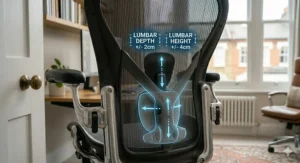
Set the lumbar support before you do anything else. The lumbar curve of your spine sits roughly at the level of your belt. Your lumbar support should be pressing gently into this curve — not into your mid-back, not into your tailbone. If your chair has vertical adjustment on the lumbar (the SIHOO M57 and FlexiSpot BS11 Pro both do), take the five minutes to get this right. It’s the single adjustment that makes the most difference to lower back pain.
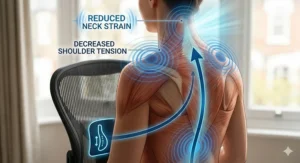
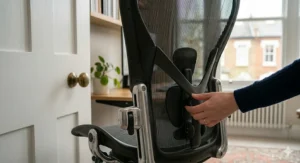
Armrests: the most overlooked adjustment. Your shoulders should be relaxed — not hunched, not reaching. The armrests should support your forearms lightly when your hands are at keyboard level. Too high and you’ll hunch your shoulders; too low and you’ll let your arms drag, pulling on your lower back. If your armrests are getting in the way of your desk, raise the desk or lower the armrests — don’t just ignore them.
The 20-minute rule. No chair, however good, eliminates the need to move. The NHS and leading ergonomists recommend breaking up seated time every 20–30 minutes with at least a brief stand or short walk. Even excellent lumbar support doesn’t compensate for static posture over four hours. Set a timer if you have to. Your discs will thank you.
UK-specific note: Many UK home offices have radiators that create warm spots in winter and cold spots in summer (the British climate being what it is). Sitting directly in front of a radiator or in a cold draught can worsen muscle tension and back discomfort independently of your chair. Chair placement matters more than people realise.
Real UK Buyer Profiles: Matching the Right Chair to Your Situation
Understanding which chair suits you isn’t just a matter of budget. It’s about how you work, where you work, and what your back specifically needs. Here are three profiles we see repeatedly in UK buyer research:
Profile 1 — The London Commuter-Turned-Remote Worker. You used to commute to a proper office with decent chairs, and now you’re working from your flat in Hackney on whatever you grabbed from IKEA in 2020. You sit seven to eight hours a day, your lower back aches by Thursday, and you have roughly 4 square metres of workspace. Budget: £200–£350. Best match: FlexiSpot BS11 Pro or Hbada E3. The BS11 Pro’s adaptive support will address the chronic ache directly; the E3 is the better call if space is genuinely limited.
Profile 2 — The Suburban Home Worker with Sciatica. You work from a home in Birmingham, Leeds, or Bristol — probably in a converted dining room or spare bedroom. You have more space, a proper desk, and a diagnosed sciatica condition that makes mornings miserable and afternoons worse. Budget: £300–£500. Best match: Autonomous ErgoChair Pro or FlexiSpot BS11 Pro. The waterfall seat edge and seat tilt adjustability of the ErgoChair Pro are specifically designed for the kind of nerve pressure management sciatica requires.
Profile 3 — The Power User with Chronic Back Problems. You’re a developer, designer, or analyst working 10+ hours daily. You’ve seen a physio. You’ve been told to invest in your chair. You’re ready to spend properly. Budget: £700+. Best match: Steelcase Leap V2 or Herman Miller Aeron. Both are genuinely therapeutic-grade chairs. The Leap V2 wins on lumbar adjustability and adaptive backrest; the Aeron wins on overall pressure distribution and build longevity. Get the sizing right on the Aeron — it’s non-negotiable.
How to Choose an Office Chair for Back Pain in the UK: 7 Key Criteria
There’s a lot of noise about office chair features. Here’s what actually matters when back pain is the primary concern, stripped of the marketing hyperbole:
- Lumbar support adjustability. The ability to adjust both the height and depth (pressure) of lumbar support is the single most important feature. Fixed lumbar positions fit some people perfectly and others not at all — adjustability means the chair works for your spine, not a hypothetical average.
- Seat depth adjustment. Critical and frequently overlooked. The seat should support your thigh comfortably without pressing into the back of your knee. An adjustable seat pan accommodates the enormous variation in human leg length that a fixed seat cannot.
- Recline with tension control. Locking a chair in a fully upright position puts maximum pressure on your lumbar discs. A proper recline (100°–110°) with adjustable tension — not a binary tilt lock — allows you to genuinely decompress during the working day.
- Armrest quality. 4D armrests (height, width, depth, and pivot) are the gold standard. At minimum, height adjustability is non-negotiable. Armrests that sit too high are a primary driver of upper back and shoulder pain that many people mistakenly attribute to their chairs not being ergonomic enough.
- Seat material and breathability. Mesh seats maintain far better temperature regulation than foam or faux leather — not irrelevant in an increasingly warm UK climate. Foam compresses over time; a good mesh maintains its support profile considerably longer.
- Build quality and weight capacity. Check the weight rating explicitly — many budget chairs are rated to 100–110kg and have plastic bases that fatigue under daily use. The best chairs use aluminium or reinforced nylon for the base and have five-point stability rather than four.
- Trial period and returns. Under the Consumer Contracts Regulations, UK buyers have a 14-day cooling-off period for online purchases. Amazon.co.uk’s return policy is typically even more generous. For a chair at this price, knowing you can return it is more valuable than it might seem — fit is personal, and even the best-reviewed chair might not work for your specific anatomy.
Common Mistakes UK Buyers Make When Choosing an Office Chair for Back Pain
Buying based on looks. The ergonomic chair market is littered with chairs that look the part — high mesh backs, contoured shapes, chunky lumbar bumps — but deliver nothing meaningful in adjustability or support. A chair that looks like it came from a NASA control room but has a fixed lumbar and non-adjustable armrests is not an ergonomic chair. It’s a prop.
Conflating “mesh” with “good.” Mesh is generally better for breathability and often for long-term support, but mesh quality varies enormously. The mesh on a £60 budget chair and the mesh on a FlexiSpot BS11 Pro are essentially different materials performing different functions.
Ignoring seat depth. This is consistently the most overlooked adjustment in ergonomics, and the most commonly the cause of sciatica flare-ups. Most buyers focus entirely on the back of the chair. The seat pan matters as much, or more.
Buying for the office they wish they had. A £1,200 Herman Miller Aeron is an outstanding investment for someone sitting 9 hours a day. It’s a questionable one for someone working part-time in a casual home setup. Match the chair to your actual situation, not your aspirational workspace.
Not accounting for UK home office realities. British homes — terraced houses, Victorian conversions, flats without lifts — present genuine challenges for large chair delivery and assembly. Check the flat-pack dimensions before ordering a chair that won’t fit through your front door or up your staircase. Assembly time matters, too: a chair requiring two hours to assemble is a significant reality in a small flat with limited space.
Office Chair vs Ergonomic Accessories: What the Spec Sheet Won’t Tell You
Sometimes the question isn’t which chair to buy — it’s whether a chair upgrade alone will solve the problem. Here’s an honest assessment:
| Solution | Best For | GBP Cost Range | Limitation |
|---|---|---|---|
| Ergonomic chair upgrade | All-day desk workers | £150–£1,500 | Needs proper setup |
| Lumbar support cushion | Occasional workers, travel | £20–£60 | Doesn’t fix a bad chair |
| Footrest | Shorter users, fixed desks | £25–£80 | Addresses symptoms only |
| Sit-stand desk converter | Posture variety | £80–£300 | Requires desk space |
| Full standing desk | Power users | £300–£800+ | Expensive; not for everyone |
The honest analysis: for anyone sitting six or more hours daily, a proper ergonomic chair upgrade delivers significantly more value than accessories layered on top of a bad chair. A lumbar cushion in a fundamentally poor chair is like fitting premium tyres to a car with broken suspension — it helps a little, but you’re still driving a broken car. Accessories excel as complements to a good chair, not substitutes for one. For occasional workers or those managing a tight budget short-term, a decent lumbar cushion (around £20–£40 on Amazon.co.uk) is a worthwhile stopgap.
The price comparison above also illustrates why many UK workers eventually graduate to a sit-stand desk in addition to a proper ergonomic chair. Movement variety is the single most evidence-backed intervention for desk-based back pain — and alternating between sitting and standing throughout the day reduces the burden on even the best chair.
Long-Term Value & Maintenance: Getting the Most Out of Your Investment
An ergonomic chair is only a good investment if it lasts. Here’s what UK buyers need to know about longevity and total cost of ownership:
How long should a good chair last? Budget chairs (under £130) typically begin showing wear after 2–3 years of daily use. Mid-range chairs (£150–£400) should comfortably last 5–7 years. Premium chairs — Steelcase and Herman Miller specifically — are routinely used for 10–15 years and still hold their value on the second-hand market.
Basic maintenance matters. The single most common failure point on any office chair is the gas cylinder. If your chair starts sinking during the day, a replacement cylinder (typically £15–£30 on Amazon.co.uk and compatible across most chairs) will fix it within 20 minutes. Don’t replace the whole chair — replace the part.
Mesh maintenance. Vacuum mesh backrests monthly to prevent dust and allergen accumulation. A damp cloth handles most surface cleaning; avoid harsh detergents that can degrade mesh fibres over time. In the UK’s damp climate, avoid leaving mesh chairs near open windows in rain — moisture in the mesh can lead to mildew in the padding beneath.
Armrest pads. These wear faster than any other component. Replacements are available for most major brands (SIHOO, FlexiSpot, and Herman Miller all sell spares) and cost £10–£30. Replacing worn armrest pads dramatically extends chair life and maintains the ergonomic support they provide.
The total cost of ownership calculation. A £180 SIHOO M57 lasting 6 years costs about £30 per year. A £1,200 Herman Miller Aeron lasting 12 years costs £100 per year. The premium chair costs more in absolute terms but less per year — and if it genuinely reduces your back pain, the NHS appointments you don’t need to book reduce the real cost further.
Frequently Asked Questions
❓ What is the best office chair for back pain in the UK?
❓ Can an office chair really help with sciatica?
❓ How much should I spend on an ergonomic chair for back pain in the UK?
❓ Are office chairs on Amazon.co.uk covered by a warranty in the UK?
❓ How do I know if my office chair is causing my back pain?
Conclusion
Your back is doing something remarkable right now: it’s holding you upright against gravity, absorbing the forces of every movement, managing the compression load of sitting, and doing all of this without your conscious involvement. The least you can do is give it a chair that helps rather than hinders.
The honest takeaway from this guide is relatively simple. For most UK home workers, a mid-range ergonomic chair in the £150–£350 range — properly adjusted and correctly set up — will make a meaningful, measurable difference to daily back pain. You don’t need to spend £1,200 unless your situation genuinely warrants it. You do need to spend more than £60 on a chair you’re using for eight hours a day if back pain is a real concern.
The NHS guidance on back pain consistently emphasises that prolonged static sitting — in any chair — is a significant risk factor, and that regular movement breaks are essential alongside any ergonomic investment. A brilliant chair and a timer on your phone to stand up every 25 minutes is a combination that will do more for your back than any single product alone.
Buy the right chair for your budget and your actual situation. Set it up properly. And for goodness’ sake, stand up occasionally.
✨ Ready to Give Your Back the Support It Deserves?
🔍 Click on any highlighted product above to check current pricing and availability on Amazon.co.uk. Whether you’re after a budget-friendly starting point or a premium investment in your long-term health, there’s an option in this list for every situation and every spine.
Recommended for You
- Best Office Chair Under £200 UK: 7 Ergonomic Picks for 2026
- Guest Room Desk Chair: 7 Best UK Picks for 2026
- Best Office Chair for Living Room: 7 Stylish UK Picks (2026)
Disclaimer: This article contains affiliate links. As an Amazon Associate, I earn from qualifying purchases. If you purchase products through these links, we may earn a small commission at no additional cost to you. All medical references are for informational purposes only and do not constitute medical advice — consult a qualified healthcare professional regarding any specific back or spinal condition.
✨ Found this helpful? Share it with your mates! 💬🤗
