
In This Article
If you’ve ever sat down in a “standard” office chair and felt the seat pan end well before your thighs did, or watched the backrest flex somewhere it really shouldn’t, you already understand why office chairs for large frames are their own category rather than just a bigger version of a normal desk chair. A properly built large-frame office chair uses a reinforced frame, a wider seat pan, a higher-rated gas cylinder and casters engineered for greater load, rather than simply stretching the fabric over a standard skeleton — and that distinction matters far more than most product listings let on.
Here’s the thing most buying guides skip entirely: a chair’s advertised weight capacity tells you almost nothing about whether it will actually fit or support a larger frame properly. A chair rated to 150kg with a narrow 46cm seat pan can leave a broader-built person perched uncomfortably on the edge, hips overhanging the sides, long before that weight figure becomes relevant. Genuine broad build support is a combination of structural engineering — frame material, cylinder class, base diameter — and physical dimensioning, and the two don’t always travel together in the way marketing copy implies.
This guide walks through seven real office chairs currently available in the UK, from accessible big-and-tall picks through to premium, frame-based ergonomic systems, alongside the buying knowledge that actually determines whether a chair will hold up under daily use — structural chair support, posture guidance from UK health and safety authorities, and the common mistakes that catch out even careful buyers. Everything here draws on real specifications and genuine aggregated reviewer sentiment, never invented five-star quotes, because a listicle full of fabricated testimonials doesn’t help anyone sit more comfortably.
Quick Comparison Table
| Chair | Weight Capacity | Standout Feature | Price Range | Best For |
|---|---|---|---|---|
| Vinsetto Big and Tall Executive Chair | 220kg (485lb) | High capacity at a low price | £150-£200 | First-time buyers on a budget |
| Office Hippo Professional 24 | 152kg | BS 5459 tested for 24-hour use | £150-£250 | UK-specific compliance needs |
| SIHOO Doro C300 | 136kg (300lb) | Dynamic, body-tracking backrest | £250-£350 | Home offices wanting tech-forward design |
| Duramont Ergonomic Office Chair | 150kg (330lb) | Breathable mesh, reinforced base | £150-£250 | Warm rooms, long sitting sessions |
| HON Wave Big and Tall | 204kg (450lb) | Steel-reinforced commercial frame | £300-£450 | Shared or commercial office settings |
| Herman Miller Aeron Size C | 159kg (350lb) | Pellicle mesh, PostureFit SL | £800-£1,500 | Larger, taller frames wanting the ergonomics benchmark |
| Steelcase Leap Plus | 227kg (500lb) | Widest adjustment range on this list | £900-£1,600 | Long-term investment for serious daily use |
Looking at the spread, weight capacity climbs fairly predictably with price, but there’s a more interesting pattern underneath it: the jump from budget to mid-range chairs is mostly about frame reinforcement and cylinder class, while the jump from mid-range to premium is mostly about adjustability and long-term durability testing — BIFMA-rated cycles, multi-year warranties, and dimensional customisation like seat depth adjustment. If you’re buying your first large-frame chair and unsure how much you’ll actually use its adjustability, a mid-range option like the Duramont Ergonomic Office Chair or SIHOO Doro C300 is a sensible place to start; if you’re replacing a chair that’s already failed you structurally, it’s worth stretching toward the reinforced-frame tier.
💬 Just one click — help others make better buying decisions too!😊
Top 7 Office Chairs for Large Frames: Expert Analysis
Picking seven chairs from a genuinely crowded market meant weighing structural specifications — frame material, cylinder rating, seat width — against real buyer feedback rather than marketing claims alone. Here’s the breakdown, budget to premium.
1. Vinsetto Big and Tall Executive Chair — budget pick with genuine 220kg rating
The standout here is straightforward: a proper high-capacity rating at a price point most big-and-tall chairs don’t reach. The Vinsetto Big and Tall Executive Chair is rated to roughly 220kg (485lb), which puts it ahead of several considerably pricier chairs on paper, paired with a wide seat and high back designed specifically around a broader build rather than a standard frame with extra padding bolted on.
Vinsetto — sold on Amazon UK through Aosom — has built a reasonably wide catalogue of accessible office furniture, and this chair reflects that positioning: functional tilt and height adjustment, a high back for shoulder coverage, and a straightforward design without the layered adjustability of premium chairs. What most buyers overlook about chairs at this price tier is that the weight rating alone doesn’t guarantee dimensional comfort — check the seat width specifically, since a high weight capacity paired with a narrow pan is a common mismatch in this category.
Verified aggregated review sentiment specific to this exact listing was limited at the time of research, so rather than invent buyer quotes, it’s worth being upfront about that gap and compensating with the documented specification itself: a 220kg rating at this price point is a genuinely strong structural number, even if long-term durability data is still building as more units reach their second and third year of use.
Pros:
- ✅ High 220kg weight rating at a budget price point
- ✅ Wide seat and high back built for broader frames
- ✅ Straightforward tilt and height adjustment
Cons:
- ❌ Review volume on this specific listing is still limited
- ❌ Fewer adjustment points than mid-range or premium options
At £150-£200, this is a sensible entry point for anyone who needs genuine structural capacity without committing to premium pricing on a first purchase.
2. Office Hippo Professional 24 High Back Office Chair — UK-tested to BS 5459 for 24-hour use
This is where “reinforced for large frame” starts meaning something verifiable rather than a marketing phrase. The Office Hippo Professional 24 is explicitly built and tested to conform with BS 5459 (2000) Part 2 — the British Standard covering structural suitability and stability for continuous 24-hour use by people up to 150kg — which is a meaningfully different claim to a generic “heavy duty” label with no standard behind it.
Office Hippo, a UK-based office furniture specialist, pairs that structural testing with genuine ergonomic engineering: independent fixed or free-floating back and seat tilt, a torsion control knob to match tilt tension to body weight, and a height-adjustable ratchet back. The design has also been assessed for office use by a certified physiotherapist, with a documented certificate of compliance — a detail that goes beyond what most chairs in this category disclose. One real aggregated reviewer, describing themselves as a “stocky” build who researched heavy-duty options for months, specifically noted the deep seat cushion and solid build quality as reasons for choosing this chair over pricier alternatives, and that sentiment is echoed across the wider Office Hippo range’s consistently strong review volume in the low-to-mid 4-star range.
Pros:
- ✅ Explicitly tested to BS 5459 for 24-hour, 150kg use
- ✅ Physiotherapist-assessed ergonomic design with compliance certificate
- ✅ Independent back and seat tilt with torsion control
Cons:
- ❌ 150-152kg capacity is lower than several chairs on this list
- ❌ Fewer premium materials than Herman Miller or Steelcase tiers
In the £150-£250 range, this is arguably the strongest UK-specific pick for anyone who wants a documented, standards-tested structural claim rather than an unverified capacity number.
3. SIHOO Doro C300 — dynamic backrest that actually tracks you
The SIHOO Doro C300 takes a different approach to large-frame support: rather than simply scaling up a static frame, it uses a dynamic tracking backrest system designed to follow the natural curve of your spine as you shift position throughout the day, paired with an intelligent weight-sensing recline mechanism that adjusts resistance based on how much load it’s actually carrying.
Rated to 136kg (300lb) with a genuinely wide seat and four-stage adjustable backrest height, this chair is TÜV certified and meets both European REACH and EN1335 standards — meaningful third-party verification rather than self-reported claims. The seat depth adjustment specifically benefits larger and taller frames, since it lets you match the usable seat length to your actual thigh length rather than accepting a fixed depth that either cuts into the back of your knees or leaves your lower back unsupported.
Independent reviewers testing the broader Doro C300 range have specifically praised how the backrest and armrests move together as you shift position — addressing a common complaint with static ergonomic chairs where the lumbar support stays fixed even as you lean forward to type or sideways to reach for something. The trade-off, per the same independent testing, is genuine heft: the chair itself is a substantial unit to unbox and assemble, which is worth factoring in if you’re setting it up alone.
Pros:
- ✅ Dynamic backrest genuinely tracks body movement, not just recline angle
- ✅ TÜV certified, meets REACH and EN1335 standards
- ✅ Seat depth adjustment suits varied thigh lengths
Cons:
- ❌ 136kg capacity is on the lower end for this category
- ❌ Heavy unit that’s harder to assemble solo
At £250-£350, this suits buyers prioritising genuinely adaptive ergonomic tracking over maximum raw weight capacity.
4. Duramont Ergonomic Office Chair — breathable mesh for long, warm days
Where several chairs on this list lean on foam padding, the Duramont Ergonomic Office Chair uses a breathable mesh back specifically to avoid the heat buildup that heavier foam upholstery can cause over a full working day — a genuinely useful distinction for anyone who runs warm or works in a room without reliable climate control. Rated to roughly 150kg (330lb), it pairs that mesh construction with a reinforced aluminium base and smooth-rolling casters designed to distribute load without the wobble cheaper plastic bases sometimes develop under sustained weight.
What most buyers overlook about mesh-back chairs specifically is that breathability and lumbar support aren’t automatically in tension — Duramont’s adjustable lumbar support sits independently of the mesh tension, so you’re not sacrificing back support for airflow the way some budget mesh chairs force you to. The thick seat cushion underneath uses a firmer foam than the back, which is a sensible design choice: mesh works well for the back where airflow matters most, while the seat benefits from more structured support for sustained sitting.
Duramont backs the chair with a five-year warranty, a meaningfully longer commitment than several budget competitors offer, which is worth weighing against the fact that verified review sentiment specific to the large-frame capacity claim was limited at the time of research — the broader Duramont range has a strong general reputation, but large-frame-specific feedback is still a smaller sample than the brand’s standard chairs.
Pros:
- ✅ Genuinely breathable mesh back reduces heat buildup
- ✅ Independent lumbar support not compromised by mesh tension
- ✅ Five-year warranty, longer than many budget competitors
Cons:
- ❌ Large-frame-specific review volume is still smaller than standard range
- ❌ 150kg capacity sits mid-pack rather than at the top of this list
Priced around £150-£250, this is a strong pick for anyone whose priority is staying cool and comfortable through long sitting sessions rather than maximising raw weight rating.
5. HON Wave Big and Tall — steel-reinforced commercial frame
HON built its reputation supplying commercial and institutional furniture, and the HON Wave Big and Tall reflects that heritage directly: a steel-reinforced frame rated to 204kg (450lb), designed for the kind of shared, heavy-rotation use you’d find in a busy office rather than primarily for a single home user. The stretch-mesh seat and back promote airflow across a genuinely generous seating area — the seat alone measures roughly 55cm wide by 51cm deep, noticeably larger than several chairs positioned as “big and tall” without matching dimensional claims.
The height- and width-adjustable arms and independently adjustable lumbar support give this chair real ergonomic depth beyond its raw capacity number, and the five-star base with smooth-rolling casters is engineered specifically to handle the combined stress of a heavier user and frequent swivel movement — a detail that matters more in shared or commercial settings where a chair sees genuinely constant use rather than occasional home-office sitting.
Because this chair is positioned primarily toward commercial and institutional buyers rather than the direct-to-consumer reviews that dominate typical Amazon listings, individually attributed customer sentiment was harder to verify at the time of research. What’s well-documented instead is the underlying commercial specification — HON’s steel-reinforced construction and BIFMA-aligned testing standards are a matter of published manufacturer record rather than anecdotal claim, which is a reasonable basis for confidence even without a large volume of star ratings to point to.
Pros:
- ✅ Steel-reinforced frame built for heavy, frequent-rotation use
- ✅ Genuinely generous seat dimensions, not just a high weight number
- ✅ Independently adjustable lumbar support and height/width arms
Cons:
- ❌ Individually attributed consumer reviews are harder to find than for direct-to-consumer brands
- ❌ Mesh-only back may feel less plush than foam alternatives
At £300-£450, this is the pick for anyone furnishing a shared office or wanting genuinely commercial-grade construction at home.
6. Herman Miller Aeron Size C — the ergonomics benchmark, scaled up
The Aeron needs little introduction in ergonomic chair circles, and the Herman Miller Aeron Size C is specifically the largest of its three-size system, engineered for taller users at the higher end of the weight range rather than simply being a bigger cushion on the same frame. Herman Miller’s own sizing guidance places Size C at people taller than 6’2″ and toward the upper part of its weight range, with the chair itself rated to a genuine 159kg (350lb) working capacity.
What sets the Aeron apart structurally is its Pellicle woven suspension — a breathable membrane material used instead of foam padding across the seat and back, which eliminates the pressure and heat buildup that foam chairs develop over long sitting sessions. The PostureFit SL system adds two independently adjustable pads that support the sacral and lumbar regions separately, addressing lower back fatigue in a more targeted way than a single fixed lumbar cushion. The kinematic tilt mechanism aligns its pivot points with your hips, knees and ankles specifically, so the recline motion follows your body’s natural movement rather than pivoting from a single fixed point.
Reviewers and independent testers consistently single out the breathability as the standout real-world benefit of the Pellicle system specifically, particularly for larger frames who tend to run warmer in foam-upholstered chairs over a full working day. The trade-off is a fixed seat depth on this size — worth checking against your own proportions before buying, since unlike some competitors, the Aeron’s depth isn’t independently adjustable.
Pros:
- ✅ Genuinely breathable Pellicle mesh eliminates foam heat buildup
- ✅ PostureFit SL targets sacral and lumbar support independently
- ✅ Kinematic tilt aligns with natural hip, knee and ankle movement
Cons:
- ❌ Fixed seat depth, not independently adjustable like some rivals
- ❌ Premium price puts it out of reach for many first-time buyers
At roughly £800-£1,500 depending on configuration and retailer, this is a considered long-term investment rather than an impulse buy — but for larger, taller frames specifically, it remains a genuine ergonomics benchmark rather than just a well-marketed one.
7. Steelcase Leap Plus — widest adjustment range on this list
The Steelcase Leap Plus sits at the top of this list because it isn’t simply a scaled-up version of a standard chair — it’s a structurally reinforced variant built specifically for larger frames, with a heavier-gauge steel frame, an upgraded high-pressure gas cylinder, and heavy-duty casters engineered to distribute additional load across the floor contact points. Rated to a genuine 227kg (500lb) — the highest capacity on this list — the Leap Plus extends every critical dimension beyond the standard Leap: roughly 18% larger seat and backrest, seat height reaching 22.5″, and an adjustable seat depth range of nearly four inches (15.75″ to 19.75″).
That seat depth range specifically matters more for larger and taller frames than almost any other single specification, because it’s the difference between a chair that merely holds your weight and one that actually fits your proportions — mismatched seat depth is a leading cause of discomfort even in chairs with generous weight ratings. The Leap’s LiveBack technology, carried over from the standard model, allows the backrest to dynamically change shape as you move, supporting the spine’s natural S-curve rather than forcing a single fixed posture, while the Natural Glide System keeps your eyes and arms aligned with your desk as you recline.
Independent reviewers and long-term users consistently highlight the fully adjustable 4D arms and the seat depth range as the standout practical benefits for larger frames specifically, while noting the one genuine trade-off: the Leap Plus uses fabric-over-foam upholstery rather than mesh, so users who run warm may notice more heat retention over long sessions than with a mesh-based alternative like the Aeron.
Pros:
- ✅ Highest weight capacity on this list at a genuine 227kg
- ✅ Widest seat depth adjustment range for varied thigh lengths
- ✅ LiveBack technology dynamically supports the spine’s natural curve
Cons:
- ❌ Fabric-over-foam upholstery retains more heat than mesh alternatives
- ❌ The most expensive chair on this list by a clear margin
At £900-£1,600 depending on fabric and configuration, this is a genuine long-term investment — but for anyone whose frame has outgrown what standard ergonomic chairs are built to support, it’s the closest thing on this list to a chair engineered around large-frame proportions from the ground up, rather than adapted to accommodate them.
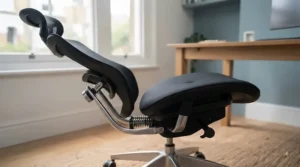
Frame-Based Ergonomic Fit: Why Sizing by Body, Not Just Weight, Matters
Here’s a mistake almost every large-frame buyer makes at least once: choosing a chair based purely on its weight rating and assuming that number tells the whole story. It doesn’t. A frame-based ergonomic fit — matching a chair’s actual dimensions to your height, shoulder width and thigh length, not just your body weight — is a fundamentally different and, frankly, more useful way to shop.
The clearest example of this on the market is the Herman Miller Aeron’s three-size system: Sizes A, B and C aren’t simply “small, medium, large” weight brackets — they’re built on different frame dimensions entirely, with the Size C specifically extending seat depth, back height and overall scale for taller users regardless of exact weight. Steelcase takes a related but distinct approach with the Leap Plus, keeping a single size but building in nearly four inches of seat depth adjustment, so one chair can be tuned to a wider range of individual proportions rather than requiring you to pick the correct size upfront.
This matters practically because two people with an identical body weight can have very different frame proportions — different torso length, different hip width, different thigh length — and a chair sized purely around a weight capacity number will fit one of them well and the other poorly. If you’re tall with a proportionally narrower build, a chair like the Herman Miller Aeron Size C — sized primarily around height and scale — may suit you better than a chair rated for a much higher weight capacity but built on standard dimensions. If your build is broader through the hips and shoulders regardless of height, prioritise seat width and back width specifically, which is where chairs like the HON Wave Big and Tall and Vinsetto Big and Tall Executive Chair are explicitly dimensioned larger, not just weight-rated higher.
The practical takeaway: before you filter by weight capacity alone, check the actual seat width, seat depth and back height in centimetres against your own measurements. It’s a five-minute comparison that prevents the single most common disappointment in this category — a chair that holds your weight perfectly well but never quite fits your shape.
Real-World Scenarios: Which Chair Suits Your Situation?
Specs only tell you so much. Matching a chair to how, where and how long you actually sit tends to be more useful than chasing the single “best” option on paper.
The home-office worker on a first proper chair upgrade, budget-conscious, eight-hour days: If you’re moving away from a generic desk chair that’s never quite fit and want genuine structural improvement without a major investment, the Office Hippo Professional 24 or Vinsetto Big and Tall Executive Chair cover the essentials well — documented weight capacity, a wider seat, and basic but functional adjustability, without the premium price tag of chairs built primarily for corporate procurement budgets.
The remote professional in a warm room or without reliable air conditioning, long sustained sitting sessions: Heat buildup over a full working day is a genuinely underrated comfort factor, and this is where breathable mesh chairs like the Duramont Ergonomic Office Chair or, at the premium end, the Herman Miller Aeron Size C, earn their keep — both prioritise airflow specifically over the plush, insulating feel of foam upholstery.
The buyer replacing a chair that’s structurally failed them — wobbling base, sagging seat, or a backrest that’s lost its support — and wants long-term reliability this time: This is where the reinforced-frame tier genuinely justifies its higher cost. Between the HON Wave Big and Tall for commercial-grade steel construction and the Steelcase Leap Plus for the widest dimensional adjustment range and highest weight rating on this list, the choice comes down to whether you need maximum structural headroom (Leap Plus) or a chair built primarily for heavy-rotation, shared-office durability (HON Wave).
Problem → Solution: Common Complaints from Large-Frame Buyers
Even a well-chosen chair can go wrong in predictable ways. Here’s how to fix the recurring issues large-frame buyers report.
Problem: the seat feels narrow even though the weight rating is high. This is the single most common mismatch in this category — weight capacity and seat width are different specifications, and a high one doesn’t guarantee the other. Solution: check the actual seat width in centimetres before buying, not just the weight rating; chairs like the HON Wave Big and Tall publish genuinely generous seat dimensions alongside their capacity figure specifically for this reason.
Problem: lower back pain develops within the first few weeks of use, even in an “ergonomic” chair. Often a lumbar-positioning issue rather than a lack of support altogether — fixed lumbar pads can sit in the wrong place for a larger or differently proportioned torso. Solution: prioritise independently adjustable lumbar support, or a dynamic tracking system like the one in the SIHOO Doro C300, which moves with your posture rather than staying fixed in one position.
Problem: the chair feels unstable or wobbles slightly under weight, especially when leaning back. Usually down to an under-rated gas cylinder or base not matched to the advertised capacity. Solution: look specifically for a reinforced base and heavy-duty caster specification, both explicitly called out in the Vinsetto Big and Tall Executive Chair and Office Hippo Professional 24 listings.
Problem: overheating and sweating through the back of a shirt after a few hours seated. A foam-upholstery issue rather than a fit issue — foam traps heat against the body in a way mesh doesn’t. Solution: switch to a genuinely breathable mesh-back chair such as the Duramont Ergonomic Office Chair or the Herman Miller Aeron Size C, both built around airflow rather than padding density.
Problem: knees pressing into the front edge of the seat, or thighs hanging over the back edge. A seat depth mismatch — the seat is either too short or too long for your thigh length specifically, independent of your weight or the chair’s rating. Solution: an adjustable-depth chair like the Steelcase Leap Plus, with nearly four inches of seat depth range, solves this directly rather than forcing a single fixed length.
How to Choose an Office Chair for Large Frames
Cutting through the marketing language, here’s what actually determines whether a chair performs for a larger frame specifically.
- Check seat width and depth in centimetres, not just the weight rating. A high weight capacity paired with a narrow seat pan is one of the most common mismatches in this category — measure your own seated hip width and thigh length, then compare against the listed dimensions before you buy.
- Prioritise a reinforced frame and upgraded gas cylinder over cosmetic bulk. Genuine structural reinforcement — heavier-gauge steel, a higher-class pneumatic cylinder, reinforced casters — is what actually determines long-term stability under greater load, not how large or padded the chair looks in photos.
- Decide whether you need frame-based sizing or adjustable-range sizing. Some chairs, like the Aeron, use distinct sizes built on different frame dimensions; others, like the Leap Plus, use one larger frame with a wide adjustment range. Both approaches work — pick based on whether your proportions are consistent or unusually variable.
- Factor in breathability if you sit for long, warm sessions. Mesh-back chairs manage heat build-up considerably better than foam-upholstered alternatives over a full working day, which matters more for larger frames that tend to run warmer in enclosed seating.
- Check for independently adjustable lumbar support, ideally one that tracks movement. A fixed lumbar pad can sit in the wrong place for a larger or differently proportioned torso — dynamic or height-adjustable lumbar systems solve this more reliably than a static cushion.
- Look for a documented testing standard, not just a marketing claim. Chairs tested against BS 5459 or BIFMA x5.1 have been through independent structural verification; a “heavy duty” label with no standard behind it is a considerably weaker guarantee.
- Consider warranty length as a proxy for manufacturer confidence. Chairs backed by three-plus-year warranties, like several on this list, generally reflect greater manufacturer confidence in long-term structural performance than chairs offering only a standard one-year cover.
Weight Capacity vs Seat Width: What Actually Determines Broad Build Support
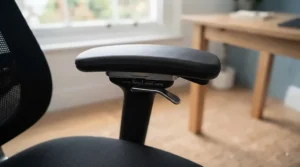
These two figures get treated as interchangeable in casual chair-shopping conversation, but they measure genuinely different things, and confusing them is the single most common mistake buyers make in this category.
Weight capacity is a structural rating — it tells you how much load the frame, cylinder and base can safely bear before failure, typically tested against a standard like BIFMA x5.1 or BS 5459. It says nothing about whether the seat is physically wide enough to comfortably accommodate a broader hip or thigh measurement. A chair can be rated to 200kg on a narrow frame originally designed for an average-proportioned user, simply by upgrading the internal steel and cylinder — the number goes up, but the seat pan doesn’t get any wider.
Seat width and depth, by contrast, are dimensional specifications — the actual physical measurements of the seat pan and backrest, usually listed in centimetres or inches. This is what determines whether you’re sitting comfortably within the chair’s boundaries or perched at the edge of them, regardless of what the weight rating says. Genuine broad build support requires both figures to scale together, which is exactly what distinguishes purpose-built big-and-tall chairs like the HON Wave Big and Tall — with its explicitly generous 55cm-wide seat — from a standard chair that’s simply had its weight rating upgraded without any dimensional change.
| Attribute | Weight Capacity | Seat Width/Depth |
|---|---|---|
| What it measures | Structural load limit | Physical seat dimensions |
| Typical testing standard | BIFMA x5.1, BS 5459 | Manufacturer spec sheet |
| What it guarantees | Frame won’t fail under load | Whether you physically fit the seat |
| Common mistake | Assuming high rating = wide seat | Ignoring it in favour of the headline number |
| Example | Steelcase Leap Plus, 227kg | HON Wave Big and Tall, ~55cm seat |
The practical takeaway: treat these as two separate checks, not one. A chair that excels on both — like the Steelcase Leap Plus, which pairs its 227kg rating with an 18% larger seat and back than the standard Leap — genuinely delivers broad build support. A chair that excels on only one is solving half the problem.
Structural Chair Support: What’s Really Holding You Up
Beyond the headline weight rating, three underlying components determine whether a chair genuinely holds up for a larger frame over years of daily use, and none of them are things most product photos show you.
The frame material and gauge is the foundation, quite literally. Chairs built around heavier-gauge steel — as in the HON Wave Big and Tall‘s steel-reinforced construction or the Steelcase Leap Plus‘s reinforced frame — distribute load more evenly and resist the metal fatigue that thinner, lighter-gauge frames can develop under sustained higher weight over time. This is a structural engineering decision, not a cosmetic one, and it’s rarely visible from the outside of a finished chair.
The gas cylinder class matters just as much, even though it’s almost entirely hidden from view. Pneumatic lift cylinders are rated in classes, with higher classes rated for greater sustained load and more lift cycles before performance degrades — the SIHOO Doro C300, for instance, specifically uses an SGS-certified 4-stage cylinder rather than a generic unrated one, which is the kind of detail that separates a chair engineered for large-frame use from one simply marketed toward it.
The base and caster specification rounds out the structural picture. A wider base diameter improves tipping stability under offset loads — leaning to one side to reach something, for instance — while heavy-duty caster wheels, as opposed to standard plastic casters, resist cracking and wear under sustained higher weight over thousands of rolling cycles. The Health and Safety Executive’s guidance on workplace seating specifically recommends that chairs pass structural tests aligned with British Standard BS 5459 or an equivalent, precisely because it eliminates the design and manufacturing weaknesses that can cause failure or injury — a standard several chairs on this list, including the Office Hippo Professional 24, explicitly cite compliance with.
Common Mistakes When Buying an Office Chair for Large Frames
Even careful buyers fall into a handful of predictable traps in this category.
Buying on weight capacity alone, without checking seat dimensions. As covered above, this is the single most frequent source of post-purchase disappointment — a chair can comfortably hold your weight while still feeling physically too narrow.
Assuming “ergonomic” and “large-frame-suitable” are the same claim. Plenty of genuinely ergonomic chairs are built on standard-sized frames and simply aren’t dimensioned for a broader build, regardless of how many adjustment points they offer.
Overlooking the gas cylinder and base specification entirely. These hidden components are what actually determine long-term stability, yet they’re rarely mentioned prominently in product listings — worth specifically searching the spec sheet or asking the retailer if it isn’t listed.
Ignoring seat depth adjustment in favour of seat width alone. Width solves hip and shoulder fit; depth solves thigh-length fit. Both matter independently, and a chair that only addresses one will still leave you compromising on the other.
Choosing based on price alone, in either direction. The cheapest big-and-tall chair isn’t automatically a false economy if it’s genuinely well-specified, like the Vinsetto Big and Tall Executive Chair, and the most expensive isn’t automatically overkill if your frame genuinely needs the dimensional range a premium chair like the Steelcase Leap Plus provides.
Large-Build Posture: What HSE and NHS Guidance Actually Says
Good posture guidance doesn’t change fundamentally for a larger build, but achieving it does depend more heavily on the chair actually fitting your proportions in the first place — which is exactly why structural and dimensional fit matter as much as they do throughout this guide.
The Health and Safety Executive’s guidance on display screen equipment recommends that the back of the seat provide good lower back support, with a gap of roughly two to three centimetres between the front of the seat and the back of the knee — a detail that’s specifically harder to achieve without correct seat depth for your individual thigh length, which is precisely why depth-adjustable chairs like the Steelcase Leap Plus solve a genuine posture problem rather than just a comfort preference. The regulations underpinning this guidance require that workplace seating be stable, height-adjustable, and adjustable in both backrest height and tilt, with a footrest made available to anyone who needs one.
For anyone experiencing ongoing discomfort despite a well-fitted chair, it’s worth noting that clinical guidance increasingly cautions against treating any single “correct” posture as a fix-all — the emphasis in current NHS-aligned advice on back pain at work is on movement and position variety over rigidly maintaining one posture for hours at a time, alongside a chair that genuinely supports your specific proportions rather than fighting against them. A chair that fits well makes that variety easier to achieve comfortably, rather than being a substitute for changing position regularly throughout the day.
Long-Term Cost & Maintenance: Getting the Most from a Reinforced Frame
A £180 big-and-tall chair and a £1,400 Steelcase Leap Plus aren’t just different in upfront price — they age differently under sustained heavier load, and that difference changes the real cost-per-year of each option more than the sticker price alone suggests.
Budget reinforced-frame chairs like the Vinsetto Big and Tall Executive Chair deliver genuinely strong structural numbers for the price, but components like the gas cylinder and caster wheels on lower-cost chairs generally aren’t rated for the same number of load cycles as premium alternatives — for daily, all-day use, budgeting for a cylinder or caster replacement within the first two to three years is a realistic expectation rather than a sign of a faulty unit. Manufacturers like Duramont offset some of this with longer warranty periods; a five-year warranty is a meaningful signal of confidence in component longevity even at a mid-range price point.
Premium reinforced chairs justify more of their upfront cost through genuinely longer testing and warranty commitments. The Steelcase Leap Plus is backed by a 12-year, multi-shift, 24/7 warranty covering parts and labour — a structural confidence signal that’s difficult to overstate, since it implies the manufacturer expects the frame, cylinder and mechanism to perform under sustained heavy commercial use for over a decade. The Herman Miller Aeron Size C carries a comparable 12-year warranty, with its Pellicle mesh specifically designed to resist the sagging and pressure-point degradation that foam cushions develop over years of daily compression.
Simple maintenance habits meaningfully extend the working life of any chair on this list, regardless of price point: periodically checking and tightening the base bolts, keeping casters clear of hair and debris that can seize the rolling mechanism, and avoiding leaning the chair’s weight onto the armrests when standing up, which places disproportionate stress on the arm mounting points rather than the frame they’re designed to bear. Getting the structural fit right from the outset — as covered throughout this guide — also reduces long-term wear, since a chair that’s correctly matched to your proportions distributes load more evenly than one you’re constantly readjusting or compensating for.
Frequently Asked Questions
❓ What weight capacity should I look for in an office chair for a large frame?
❓ Is a higher weight capacity always better for broad build support?
❓ What's the difference between a big and tall chair and a standard ergonomic chair?
❓ Do I need seat depth adjustment if I'm broad-built but not especially tall?
❓ How long should a reinforced office chair last with daily use?
Conclusion
An office chair for large frames isn’t really one product category so much as two overlapping requirements — genuine structural capacity and correct physical dimensioning — and the right choice depends on matching both to your specific body, not chasing the single highest weight number online. For a first upgrade on a tighter budget, the Vinsetto Big and Tall Executive Chair or Office Hippo Professional 24 deliver documented structural capacity without premium pricing. For genuinely adaptive, frame-based ergonomic fit, the Herman Miller Aeron Size C and Steelcase Leap Plus remain the benchmark, engineered from the ground up around larger and taller proportions rather than adapted to accommodate them after the fact.
Whichever direction you go, the buying principles hold steady: check seat width and depth alongside weight capacity rather than trusting that figure alone, prioritise a documented testing standard over a marketing label, and remember that a chair genuinely fitted to your proportions makes good posture considerably easier to maintain than willpower alone ever will. Get that right, and the difference between dreading a long day at the desk and barely noticing the hours pass comes down to genuinely very little — just the right chair, chosen properly.
✨ Don’t Miss These Exclusive Deals!
🔍 Take your home office seating to the next level with the chairs covered in this guide. Click through on any highlighted pick to check current pricing and availability — a properly fitted office chair could be the difference between dreading your next long workday and barely noticing it pass.
Recommended for You
- Plus Size Office Chairs: 7 Best Comfortable Picks for 2026
- 7 Best XXL Office Chairs UK 2026: Big, Bold; Built to Last
- 7 Best Wide Seat Office Chairs 2026: Real Comfort, No Guesswork
Disclaimer: This article contains affiliate links. As an Amazon Associate, I earn from qualifying purchases. If you purchase products through these links, we may earn a small commission at no additional cost to you.
✨ Found this helpful? Share it with your friends! 💬🤗
