
In This Article
Here’s a scene you might recognise: you sit down at 9am, shoulders already creeping past the top of the backrest, knees jammed under a desk that was clearly built with someone six inches shorter in mind. By lunchtime your lower back is doing all the work your chair should be doing. That’s not bad luck — that’s basic anthropometry. Standard chairs are built around an “average” torso and leg length that simply doesn’t exist for a huge chunk of the population.
Tall office chairs are seating designed with taller torsos, longer thigh bones, and higher shoulder lines in mind — typically offering a seat height range starting above 50cm, a deeper seat pan, and a backrest tall enough to reach the shoulder blades rather than stopping at mid-spine. That’s the short definition. The longer answer is that “tall” isn’t one single spec — it’s a combination of leg length, torso length, and arm reach, and the seven chairs below tackle those variables in genuinely different ways.
We’ve spent time cross-referencing manufacturer specification sheets, aggregated customer feedback, and independent testing data to put together this guide — not a rewritten spec sheet, but an honest look at what actually changes when you sit in these chairs for eight hours a day. According to Health and Safety Executive’s guidance on working with display screen equipment, ill-fitting seating is a recognised contributor to musculoskeletal strain at work — which is exactly why getting this purchase right matters more than most people assume. Whether you’re 6’1″ and mesh-obsessed or 6’4″ and after something with genuine executive presence, there’s a chair below built with your frame in mind. Let’s get into it.
Quick Comparison Table
| Chair | Type | Fits Heights | Price Range | Best For |
|---|---|---|---|---|
| SIHOO Doro C300 Pro V2 | Mesh | 150-190cm | £430-£510 | Best overall tall mesh chair |
| Steelcase Gesture | Foam/upholstered | 150-190cm (best 183-193cm) | £900-£1,200 | Premium multi-device users |
| Hbada E3 Ultra | Mesh, Big & Tall | 150-196cm | £280-£380 | Users needing a footrest included |
| Hbada E3 Air 2026 | Mesh | 155-195cm | £160-£260 | Best headrest adjustability on a budget |
| COLAMY Executive | PU leather executive | up to 191cm | £100-£180 | Cheapest genuine executive option |
| SIHOO Doro C300 | Mesh | 152-190cm | £260-£340 | Best value tall-back mesh |
| naspaluro High Back Executive | PU leather executive | up to approx. 188cm | £80-£150 | Budget executive with headrest |
Look closely and a pattern jumps out: there’s a real ceiling around 190-196cm across almost every chair here, and price climbs fast once a brand adds genuine adjustability rather than just size. The Steelcase Gesture sits in its own bracket entirely — you’re paying for a warranty and a mechanism, not just extra foam. Meanwhile the Hbada E3 Ultra is the only chair on this list that throws in a footrest as standard, which matters if you’re the type who alternates between sitting upright and half-reclined during long calls.
💬 Just one click — help others make better buying decisions too!😊
Top 7 Tall Office Chairs: Expert Analysis
1. SIHOO Doro C300 Pro V2 — best overall tall mesh office chair
The SIHOO Doro C300 Pro V2 is what happens when a brand takes its most popular chair and stops treating “tall” as an afterthought. Sihoo’s own sizing guide states the chair is built to comfortably support users between 150cm and 190cm — and unlike a lot of mesh chairs in this bracket, that claim is backed by a genuinely adjustable frame rather than just a taller backrest panel.
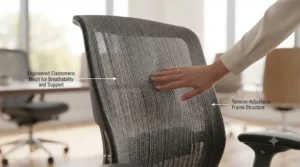
The standout feature here is the DynaCore full-body support system, which pairs a dual-spring, dual-track suspension with a weight-sensing recline mechanism that recalibrates itself automatically between 40kg and 100kg of user weight. In practice, that means you’re not fighting a tension knob every time you lean back — the chair reads your weight and adjusts resistance accordingly. Add a 4cm seat depth adjustment and a triangular mesh backrest that flexes laterally as you twist, and you get a chair that tracks your movement rather than just containing it.
Based on the spec comparison against rivals in this price bracket, the seat depth adjustment is what genuinely separates the SIHOO Doro C300 Pro V2 from cheaper mesh chairs — most sub-£300 options fix the seat pan at one length, which leaves anyone with long femurs either sliding forward or losing knee clearance. This one is built for taller users who want a mesh chair that adapts to leg length as precisely as it adapts to weight. Reviewers consistently report that the “waterfall” front edge of the seat noticeably reduces thigh pressure during long sitting sessions, and the 8D armrest system draws consistent praise for staying stable during typing rather than drifting out of position.
Pros:
- ✅ Weight-sensing recline removes manual tension adjustment
- ✅ 4cm seat depth adjustment suits long femurs
- ✅ Triangular mesh backrest flexes with lateral movement
Cons:
- ❌ Premium mesh tension takes a session or two to adjust to
- ❌ No footrest included at this price tier
Expect to pay somewhere in the £430-£510 range at the time of research, which puts it firmly above budget mesh but comfortably below executive-branded seating — a fair trade for the adjustability on offer.
2. Steelcase Gesture — best for tall multi-device users
If there’s one chair on this list that’s earned its reputation the hard way, it’s the Steelcase Gesture. Steelcase built it after studying more than 2,000 working postures across six continents, specifically to handle the way people now shift between keyboards, tablets, and phones throughout the day — and for tall users in the 183-193cm range, it remains one of the more consistently recommended options on the market.
The seat height climbs to roughly 53cm and the seat depth extends out to around 48cm, while the 61cm backrest gives most torsos up to about 193cm proper shoulder-blade coverage. What most buyers overlook about the Gesture is that its signature feature isn’t the size at all — it’s the 360-degree armrest system, engineered to mimic the full range of motion of a human arm rather than the usual up-down-swivel combination. LiveBack technology means the backrest itself flexes and reshapes as you move, so lumbar support adjusts passively instead of requiring constant fiddling.
Here’s what the spec sheet won’t tell you, but independent long-term reviewers note: back height on the Gesture isn’t independently adjustable, because the backrest and seat are mechanically linked to preserve that flexing motion. For most users up to roughly 193cm this is a non-issue, but anyone taller than that, or with an unusually long torso relative to their leg length, should look at the taller-backed Steelcase Leap Plus instead. Aggregated customer sentiment is overwhelmingly positive on build quality and the 12-year warranty, with the most common complaint being that the seat padding feels thinner than expected for the price.
Pros:
- ✅ 360-degree armrests track natural arm movement
- ✅ LiveBack flexes automatically with posture changes
- ✅ Rated for continuous 24-hour use with 12-year warranty
Cons:
- ❌ Backrest height isn’t independently adjustable
- ❌ Among the priciest chairs in this entire guide
At around £900-£1,200 depending on upholstery and headrest options, the Steelcase Gesture is a serious investment — but for anyone spending 40+ hours a week at a desk, the cost-per-year math over a 12-year warranty period tends to work out better than replacing a £200 chair every 18 months.
3. Hbada E3 Ultra — best big and tall chair with included footrest
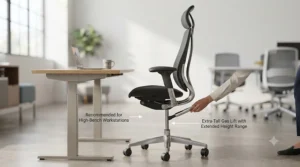
The Hbada E3 Ultra is the one chair on this list explicitly marketed as “big and tall,” and it shows in the details that most competitors treat as optional extras. It’s rated for users between roughly 150cm and 196cm — the widest range on this list — and ships with a footrest as standard, which is a genuinely rare inclusion at this price point.
Under the CloudMesh seat sits an aluminium alloy frame paired with an Auto-Balance Mechanism, and the extended height range pushes the overall chair height up to around 139cm at full extension. The 3-zone elastic lumbar system adjusts for height, depth, and a 40-degree side-wing rotation, while the 4D headrest offers 70-degree dual rotation plus up-down and forward-backward travel. On paper this means the chair is trying to solve for both leg length and torso length simultaneously, rather than assuming one fixes the other.
Reviewers consistently flag the assembly instructions as a weak point — several mention that Hbada’s manual relies almost entirely on diagrams with minimal written explanation, which can slow first-time setup considerably. That said, once assembled, aggregated feedback is strongly positive on the lumbar adjustment once dialled in correctly, with several buyers specifically praising customer support for walking them through the calibration process. For anyone over 6’2″ who’s been told repeatedly that “this chair fits most people,” the E3 Ultra is refreshingly upfront about who it’s actually built for.
Pros:
- ✅ Footrest included as standard, unlike most rivals
- ✅ Widest advertised height range on this list (150-196cm)
- ✅ 720-degree omni-armrests with full pad rotation
Cons:
- ❌ Assembly instructions rely too heavily on diagrams
- ❌ Lumbar mechanism needs careful calibration to feel right
Typically found in the £280-£380 range, it undercuts the Pro V2 while still targeting genuinely tall frames — a sensible middle path if a footrest is on your must-have list.
4. Hbada E3 Air 2026 Edition — best headrest adjustability on a budget
If headrest adjustability is your main priority — and given the secondary focus of this guide, it’s worth calling out specifically — the Hbada E3 Air 2026 Edition punches well above its price bracket. The 4D bi-axial headrest rotates through 70 degrees on both the frame and the cushion independently, and slides 4cm vertically plus 7cm forward-to-back, which lets you dial in cervical support with a precision that budget chairs rarely offer.
The chair itself is rated for users between 155cm and 195cm, with an 8.5cm seat height adjustment range and a 5cm seat depth slide. The backrest lifts through a nine-position mechanism offering roughly 7cm of vertical travel, addressing the classic tall-user complaint of a backrest that “just stops” mid-shoulder-blade. Based on the spec comparison with the older third-generation E3 Air, this 2026 edition specifically upgraded headrest tracking and softened the CloudMesh seat material, based on Hbada’s own product documentation.
What most buyers overlook about headrest-focused chairs like this one is that the benefit isn’t really about “resting your head” — it’s about relieving the trapezius muscles during long calls or reading sessions, where the neck tends to creep forward without support. Reviewers consistently report that the mesh fits snugly through the hips and shoulders without pinching, and several specifically call out how the headrest holds position without drifting during a normal working day — a common failure point on cheaper adjustable headrests.
Pros:
- ✅ Independent dual-axis headrest rotation for precise neck support
- ✅ Nine-position backrest lift adds real shoulder-blade coverage
- ✅ CloudMesh seat stays breathable over long sessions
Cons:
- ❌ Recline tension isn’t independently adjustable
- ❌ Armrest padding is thinner than the E3 Ultra’s
Prices typically sit in the £160-£260 range depending on colourway and ongoing promotions, making this the strongest headrest-adjustability pick for anyone who doesn’t want to stretch into premium mesh pricing.
5. COLAMY Executive Office Chair — cheapest genuine tall executive chair
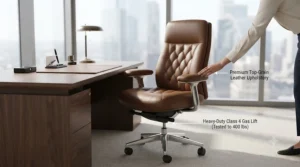
For anyone who wants the classic high-back leather look rather than mesh, the COLAMY Executive Office Chair is the most accessible entry point into tall executive seating on Amazon.co.uk, typically available in the £100-£180 range. It’s rated to accommodate users up to roughly 191cm and 136kg, with a maximum seat height around 52cm and a backrest measuring approximately 60cm.
Here’s the honest trade-off: that 60cm backrest is genuinely adequate for users under about 188cm, but noticeably shorter than the premium alternatives further up this list — so anyone at the very top of the “tall” bracket may find their shoulder blades sitting slightly above the padded zone. The seat depth is fixed at 47cm with no adjustment mechanism, which works fine for average leg lengths but can feel cramped for users over roughly 193cm with longer-than-average femurs.
What most buyers overlook about executive-style chairs at this price is that PU leather, not genuine leather, is doing the visual heavy lifting here — and reviewers are broadly honest about that trade-off in aggregated feedback, generally rating the look and initial comfort well while flagging that the padding compresses faster than pricier alternatives after a year or more of daily use. For anyone who wants the boardroom aesthetic without the boardroom price tag, and whose height sits comfortably under 6’2″, this remains a sound pick.
Pros:
- ✅ Genuine executive look at a budget-friendly price
- ✅ Rated for users up to 136kg — solid weight capacity
- ✅ Widely available with fast UK delivery
Cons:
- ❌ Fixed seat depth won’t suit very long femurs
- ❌ Backrest height is shorter than premium alternatives
At under £180 in most listings, it’s hard to argue with the value here — provided you’re honest with yourself about where you actually sit on the height spectrum.
6. SIHOO Doro C300 — best value tall-back mesh support
Think of the SIHOO Doro C300 as the more affordable sibling to the Pro V2 above — same brand DNA, same commitment to tall-back mesh support, but with some of the smart-sensing tech dialled back to hit a friendlier price point. UK listings put it typically around £260-£340, and it’s built to comfortably fit users from roughly 152cm up to 190cm and beyond, according to Sihoo’s own FAQ documentation.
The 6D armrests adjust for height, depth, width, and angle, and — critically for taller users — move in sync with the chair’s recline, so your arms stay supported whether you’re upright and typing or leaned back mid-thought. The independent headrest adjusts 4.5cm vertically and 6.5cm horizontally with 20 degrees of rotation, while the backrest itself offers 6cm of height adjustment through a triangular mesh frame designed to flex laterally as your torso twists.
Based on the spec comparison against the Pro V2, what you’re giving up here is the automatic weight-sensing recline and the seat depth adjustment — this is a fixed seat depth chair, so it suits average-to-long leg lengths rather than the full spectrum. The spec sheet won’t tell you this, but user reports suggest the headrest, while adjustable, sits slightly lower than ideal for users over roughly 193cm — a limitation echoed in independent reviewer notes on taller-user comfort. Still, for the price, the certification story is strong: it passes EU REACH and EN1335 standards, giving it a genuine safety and quality baseline that budget chairs sometimes skip.
Pros:
- ✅ 6D armrests move in sync with recline angle
- ✅ EN1335 and REACH certified for safety compliance
- ✅ Strong value relative to the Pro V2’s feature set
Cons:
- ❌ Fixed seat depth, unlike the Pro V2’s adjustable version
- ❌ Headrest sits slightly low for users well over 6’3″
For buyers who want genuine tall-back mesh support without stretching to premium pricing, this remains one of the more sensible middle-ground picks on the market right now.
7. naspaluro High Back Executive Chair — budget executive with adjustable headrest
Rounding out the list is the naspaluro High Back Executive Chair, a genuinely budget-friendly option that still ticks the “tall office chair with headrest” box many buyers are searching for. It’s worth being transparent here: naspaluro doesn’t publish the same detailed independent-lab measurements that brands like Steelcase or Sihoo do, so we can’t verify an exact seat-height range with full confidence — what we can confirm from the product listing and aggregated buyer feedback is a high-back PU leather executive design with a flip-up armrest and an adjustable headrest and lumbar cushion.
That flip-up armrest detail matters more than it sounds. For taller users who like to pull their chair right under the desk, fixed armrests are often the single biggest obstacle — they hit the desk lip before the seat gets close enough. Being able to fold the arms up entirely solves that problem outright, and it’s a feature genuinely missing from several pricier chairs on this list.
Honest analytical take: this is a chair for buyers who’ve decided their budget ceiling is firm and are looking for the best possible combination of executive looks, an adjustable headrest, and flip-up arms within that constraint — rather than for anyone chasing lab-verified ergonomic precision. Aggregated review sentiment tends to praise the initial comfort and styling, with the more common criticism centring on long-term cushion durability after 12+ months of daily use, a pattern that’s fairly typical across this entire budget executive category rather than unique to this one model.
Pros:
- ✅ Flip-up armrests solve the desk-clearance problem
- ✅ Adjustable headrest and lumbar cushion included
- ✅ One of the most affordable executive-style options available
Cons:
- ❌ Independent lab measurements aren’t published
- ❌ Cushion durability reviews are mixed beyond year one
Typically priced from around £80-£150, it’s a reasonable entry point provided expectations are set around “budget executive” rather than “premium ergonomic.”
Top 7 Products: Specs & Value Snapshot
| Chair | Seat Height Range | Weight Capacity | Headrest | Price Range |
|---|---|---|---|---|
| SIHOO Doro C300 Pro V2 | Adjustable, fits 150-190cm | ~150kg | Adaptive, part of DynaCore | £430-£510 |
| Steelcase Gesture | ~40-53cm | ~160kg | Optional add-on | £900-£1,200 |
| Hbada E3 Ultra | Extended, fits 150-196cm | Not independently verified | 4D dual-axis | £280-£380 |
| Hbada E3 Air 2026 | 8.5cm adjustment range | Not independently verified | 4D bi-axial | £160-£260 |
| COLAMY Executive | Up to ~52cm | 136kg | Fixed high-back | £100-£180 |
| SIHOO Doro C300 | Fits 152-190cm+ | ~150kg | Adjustable, 4.5cm/6.5cm | £260-£340 |
| naspaluro Executive | Not independently verified | Not independently verified | Adjustable | £80-£150 |
Looking at the numbers side by side, the pattern is clear: chairs that publish precise, independently verifiable seat-height and weight figures — the two SIHOO models, the Gesture, the COLAMY — also tend to be the ones with stronger aggregated review consistency, simply because buyers know what they’re getting before it arrives. The budget executive picks trade that certainty for a lower price tag, which is a fair swap as long as you go in with realistic expectations.
Benefits vs Standard Office Chairs
| Factor | Standard Office Chair | Tall Office Chair |
|---|---|---|
| Seat height range | Typically 42-52cm | Typically 48-58cm |
| Backrest height | 45-55cm | 55-65cm+ |
| Seat depth | Fixed, ~44-46cm | Often adjustable, 46-50cm+ |
| Best For | Users 5’4″-5’11” | Users 6’0″ and above |
The gap in backrest height is the one that catches most buyers off guard — a standard chair’s backrest simply ends before it reaches a taller user’s shoulder blades, forcing the upper back to go unsupported for hours at a time. Seat depth is the quieter issue: even a chair with a generous backrest can leave long-legged users perched too far forward if the seat pan itself doesn’t stretch to match. Put together, these two gaps explain why so many tall office workers report chronic lower-back and shoulder tension despite technically owning an “ergonomic” chair.
Setting Up Your Tall Office Chair for Maximum Comfort
Getting a tall office chair home is only half the job — the real payoff comes from setup, and this is the part most Amazon listings never walk you through. Start with seat height before anything else: sit down, plant both feet flat on the floor, and aim for a 90-100 degree angle at the knee. If your thighs slope downward toward your knees, the chair is too high; if they slope upward, it’s too low.
Next, set seat depth if your chair allows it — you want roughly two to three fingers’ width of gap between the back of your knee and the front edge of the seat. Too little gap creates pressure behind the knee that restricts circulation over long sessions; too much leaves your lower back unsupported. Once seat height and depth are dialled in, move to the backrest and lumbar support, positioning the lumbar bulge to sit in the small curve just above your belt line, not higher up your spine.
A common mistake in the first 30 days is over-adjusting the recline tension immediately. Give the chair’s default tension a few days before tweaking it — most weight-sensing mechanisms like the one on the SIHOO Doro C300 Pro V2 need a short calibration period to feel natural. Finally, set armrest height so your shoulders stay relaxed and elbows sit close to your body at roughly 90 degrees; armrests set too high are one of the most common causes of shoulder tension in taller users, since it forces the shoulder to hike upward for hours at a time.
Which Tall Office Chair Fits Your Situation?
Picture three different desks. First: a software developer, 6’3″, working from a spare bedroom, switching constantly between a laptop, a second monitor, and a phone propped on a stand. For that setup, the 360-degree armrest system on the Steelcase Gesture genuinely earns its keep — it’s built for exactly this kind of multi-device juggling, and the long-term warranty suits someone treating the home office as a permanent fixture rather than a temporary setup.
Second: a university student, 6’1″, renting a flat with limited budget and a desk that gets used for gaming as much as studying. Here, the Hbada E3 Air 2026 Edition makes far more sense — the headrest adjustability handles long gaming sessions just as well as work calls, and the price point doesn’t demand a five-year commitment to justify itself.
Third: a small business owner, 6’4″, working from a home office that doubles as a space for client video calls. Executive styling matters here for how the background looks on camera as much as comfort does, which points toward the COLAMY Executive or, for anyone who also wants a genuinely adjustable headrest visible on camera, stepping up to the SIHOO Doro C300. Matching the chair to the actual working pattern — not just the height number — tends to produce far better long-term satisfaction than chasing the single “best” chair on a spec sheet.
How to Choose a Tall Office Chair
Picking the right chair comes down to seven checkpoints, and working through them in order tends to save the most regret later:
- Measure your actual seat height need. Sit in your current chair at a comfortable typing position and measure floor-to-hip. This single number narrows the field faster than any marketing claim.
- Check the backrest height, not just “tall” branding. A backrest under 58cm rarely covers shoulder blades for anyone over 6’1″.
- Prioritise seat depth adjustment if you have long legs. Fixed-depth seats like the COLAMY or naspaluro suit average femur lengths only.
- Decide between mesh and executive upholstery early. Mesh breathes better for long sessions; executive leather-look chairs suit client-facing spaces.
- Confirm the weight capacity matches your body weight with margin. A chair rated right at your weight will wear out its gas lift faster than one with 20-30kg of headroom.
- Read aggregated review themes, not star ratings alone. A 4.3-star chair with consistent headrest complaints tells you more than a 4.6-star average with no detail.
- Factor in assembly and warranty length together. A tricky assembly with a strong warranty (like the Gesture) is a very different trade-off to an easy build with a one-year warranty.
Tall Mesh Office Chair vs Tall Executive Office Chair
This is the debate that trips up more buyers than any other spec on this list, and it deserves more than a table can offer. A tall mesh office chair — think the SIHOO Doro C300 Pro V2 or Hbada E3 Air 2026 — breathes noticeably better across an 8-hour day, particularly in homes without air conditioning during summer months. Mesh also tends to age more gracefully; PU leather on chairs like the COLAMY Executive or naspaluro can crack or peel after two to three years of daily use, while quality mesh typically just needs an occasional clean.
A tall executive office chair earns its keep in a different way: appearance and perceived authority. If your desk is visible on client video calls, or you’re the kind of person who simply prefers the boardroom aesthetic, the padded, upholstered look of an executive chair reads as more “finished” on camera than mesh does. There’s also a comfort argument in colder climates — mesh can feel noticeably cooler to sit on during winter months, whereas padded executive seating retains a bit more warmth.
What most buyers overlook about this decision is that it isn’t really mesh-versus-leather at all — it’s breathability-versus-aesthetics, and the honest answer depends entirely on how visible and how hot your workspace tends to get. Reviewers consistently note that mesh chair complaints cluster around initial firmness (which usually eases within a few weeks of regular use), while executive chair complaints cluster around long-term cushion compression — two very different trade-offs worth weighing against your own priorities rather than picking whichever looks nicer in a product photo.
Headrest Adjustability: Why It Matters More Than the Marketing Suggests
Headrest adjustability is one of those specs that gets buried in bullet-point lists, sandwiched between “breathable mesh” and “360-degree swivel,” when in reality it’s one of the features most likely to determine whether a tall office chair actually solves your discomfort. The reasoning is simple anatomy: taller users generally have a proportionally longer neck and higher shoulder line, which means a fixed or poorly positioned headrest either presses awkwardly into the upper back or sits so far above the head it does nothing at all.
The best-performing chairs here — the Hbada E3 Air 2026 Edition and Hbada E3 Ultra — both offer independent dual-axis adjustment, meaning the headrest tilts and slides on two separate planes rather than one fixed hinge. That distinction matters enormously during video calls and reading-heavy tasks, where the neck naturally creeps forward and a properly positioned headrest gives it somewhere to rest without forcing an unnatural backward lean.
Reviewers consistently report that a well-adjusted headrest reduces the “creeping forward” posture that builds up trapezius tension over a working day — something a lumbar cushion alone can’t fix, since it addresses the lower spine rather than the neck. If headrest adjustability tops your priority list, both Hbada options and the SIHOO Doro C300 line outperform the fixed executive-style headrests on the COLAMY and naspaluro chairs, which move but within a noticeably narrower range.
Common Mistakes When Buying a Tall Office Chair
Even experienced buyers fall into a handful of predictable traps. Chief among them: relying on a brand’s “up to 6’5″ fit” claim without checking whether that figure refers to overall height or specifically to backrest coverage — the two aren’t the same, and marketing copy often blurs the distinction deliberately. A second common mistake is ignoring seat depth entirely, focusing purely on seat height and backrest length while a fixed-depth seat quietly undermines both.
A third mistake, and possibly the most expensive one, is buying based on star rating alone rather than reading the actual complaint themes buried in reviews. A chair sitting at 4.5 stars with a recurring complaint about headrest positioning for users over 6’3″ is telling you something a star rating can’t. Finally, many buyers skip checking weight capacity margin — a chair technically rated for your body weight, with zero headroom, tends to wear out its gas lift and tilt mechanism noticeably faster than one with a comfortable buffer above your actual weight.
Long-Term Cost & Maintenance
Cost-per-use is the metric most buyers skip, and it’s the one that actually determines value over time. A £150 chair replaced every 18 months due to gas-lift failure or torn upholstery works out more expensive over five years than a £450 chair built to last that entire stretch without replacement — roughly £500 versus £450, before accounting for the discomfort and lost productivity of sitting in a degrading chair in the meantime.
Maintenance itself is minimal but not nonexistent. Mesh chairs like the SIHOO and Hbada models benefit from an occasional vacuum to clear dust from the weave and a wipe-down of armrest pads every few weeks. Executive PU leather chairs need more active care — a dedicated PU cleaner every month or so prevents the drying and cracking that shortens their lifespan considerably. Gas lift cylinders on any chair should be checked annually for sinking, which usually signals it’s time for a replacement part rather than a whole new chair, and most of the brands on this list sell replacement cylinders and casters separately, extending usable life well beyond the initial warranty period.
Safety, Regulations and DSE Compliance for UK Home Offices
For anyone working from home in the UK, seating isn’t purely a comfort question — it sits within actual regulatory guidance. The Health and Safety Executive’s guidance on display screen equipment sets out that a compliant chair should be height-adjustable, provide adequate back support, and allow feet to rest flat on the floor or on a footrest, with employers legally responsible for ensuring home workstations meet the same standard as office ones.
Beyond the legal framework, there’s a simple health argument for getting this right. The NHS guidance on sitting less notes that many UK adults already spend around nine hours a day seated, and prolonged sedentary time is linked to a range of health risks independent of regular exercise. A properly fitted chair won’t undo the effects of a sedentary day on its own, but it does remove one of the more preventable sources of musculoskeletal strain layered on top of that sitting time — which is precisely why the seat height, depth, and backrest specifications covered throughout this guide aren’t just comfort details, they’re the practical building blocks of a genuinely compliant, genuinely healthier home workstation. For a broader grounding in why chair geometry affects the body the way it does, the underlying discipline is worth understanding at a basic level — see Wikipedia’s overview of ergonomicsfor the fundamentals.
✨ Don’t Miss These Exclusive Deals!
🔍 Take your home office setup to the next level with these carefully selected tall office chairs. Click on any highlighted product to check current pricing and availability on Amazon.co.uk. The right chair could be the difference between an achy afternoon and a genuinely productive one!
What to Expect: Real-World Performance for Tall Users
Specs on paper rarely match the lived reality of sitting in a chair for a full working week, so here’s what that transition typically looks like. In week one, expect an adjustment period — even a well-fitted chair feels unfamiliar after months in a poorly sized one, and it’s common to still lean forward out of habit before the new posture settles in. By week two, most users on mesh chairs report the initial firmness has eased as the material relaxes slightly with regular use, while executive PU leather chairs tend to feel their most comfortable right out of the box, with cushion compression becoming the more relevant factor much later, around the six-to-twelve-month mark.
The backrest height difference is usually the first thing tall users notice, often within the first hour: shoulder blades that used to hover above the top of the chair suddenly have somewhere to rest, and that alone tends to reduce the reflexive slouching that develops when a backrest simply isn’t there to lean into. Headrest-equipped chairs show their value more gradually, typically during video-call-heavy days rather than focused typing sessions, since that’s when the neck creeps forward most. None of this happens instantly — but across the seven chairs in this guide, the consistent theme in aggregated feedback is that proper fit reduces end-of-day fatigue within the first two to three weeks, rather than requiring months to notice a difference.
Buyer’s Decision Framework
If budget is under £200 and you mainly need headrest adjustability, choose the Hbada E3 Air 2026 Edition because it offers the most precise headrest tracking at that price point. If you’re over 6’2″ and need a footrest without buying one separately, choose the Hbada E3 Ultra because it’s the only chair here that includes one as standard. If your desk is visible on client calls and budget allows £900+, choose the Steelcase Gesture because its warranty and multi-device armrest system justify the investment over a decade of use. If you want genuine tall-back mesh support with smart weight-sensing recline and can stretch to £430-£510, choose the SIHOO Doro C300 Pro V2. And if budget is the single hardest constraint, choose the COLAMY Executive or naspaluro High Back Executive, understanding you’re trading some long-term durability for upfront affordability.
FAQ
❓ What height range counts as needing a tall office chair?
❓ Do tall office chairs cost significantly more than standard chairs?
❓ Is mesh or executive leather better for a tall office chair?
❓ How important is headrest adjustability on a tall office chair?
❓ Can a tall office chair help with back pain from sitting all day?
Conclusion
Choosing among tall office chairs really comes down to being honest about three things: your actual height and leg length, how your workspace gets used day-to-day, and where your budget genuinely sits. The SIHOO Doro C300 Pro V2 and Steelcase Gesture sit at the top for good reason — genuine adjustability paired with real engineering behind the claims — while the Hbada E3 Air 2026 and Hbada E3 Ultra prove that headrest precision and generous sizing don’t require premium pricing. The COLAMY Executive, SIHOO Doro C300, and naspaluro High Back Executive round things out for buyers who need to balance cost against comfort more carefully.
None of these chairs will fix every desk-related ache overnight, and no single “best” chair exists independent of your own body and workspace. But matching backrest height, seat depth, and headrest adjustability to your actual frame — rather than settling for whatever the office supply store had in stock — makes a measurable difference to how your body feels by 5pm. Take the height and leg-length checkpoints from this guide, match them against the seven options above, and you’ll land on a chair genuinely built for you rather than an imagined “average” user who was never quite right to begin with.
✨ Don’t Miss These Exclusive Deals!
🔍 Take your home office comfort to the next level with these carefully selected tall office chairs. Click on any highlighted product to check current pricing and availability. The right chair could genuinely transform how your workday feels!
Recommended for You
- 7 Best Office Chairs for Tall People UK: 2026
- Office Chair For Under 5’2″: 7 Genuinely Comfortable Picks (2026)
- Petite Office Chairs 2026: 7 Best Fits for Small Frames UK
Disclaimer: This article contains affiliate links. As an Amazon Associate, I earn from qualifying purchases. If you purchase products through these links, we may earn a small commission at no additional cost to you.
✨ Found this helpful? Share it with your friends! 💬🤗
