
In This Article
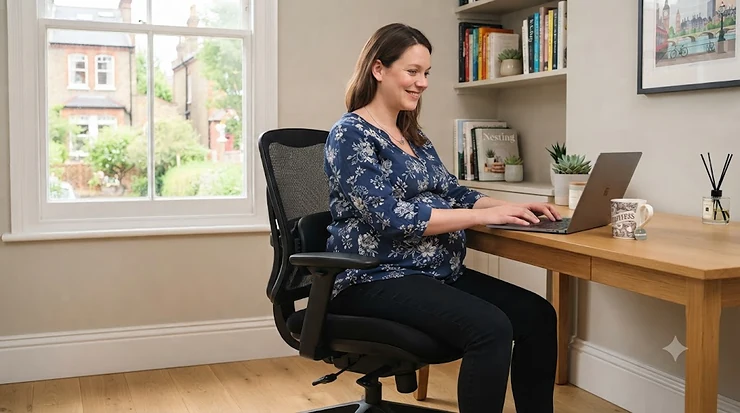
Somewhere around week sixteen, the office chair that felt perfectly fine for years quietly turns against you. The lumbar bump that used to sit in the right place now pokes uncomfortably into a growing bump of your own, the armrests feel too far away, and getting up without an audible groan becomes its own small achievement. An office chair for pregnancy isn’t a gimmick or a nursery-adjacent purchase — it’s a genuinely different set of engineering priorities, built around a body that’s changing shape, weight distribution and centre of gravity roughly every few weeks.
So, what makes a chair pregnancy-friendly? At its core, it’s an ergonomically designed seat that offers adjustable seat depth, a lumbar or sacral support that can be softened or repositioned as the bump grows, breathable material to manage pregnancy-related overheating, and a stable, easy entry and exit as balance shifts in later trimesters. NHS guidance on back pain in pregnancy notes that the natural curve of the spine increases to cope with the extra weight of a growing baby, which is precisely why a chair built for a pre-pregnancy body often stops working well by the third trimester.
This guide reviews seven genuine chairs currently sold in the UK, spanning honest budget picks through to specialist and premium options, with the kind of practical detail a product listing tends to skip: what actually helps with pelvic girdle pain, what to check before buying an office chair while pregnant on Amazon, and how to adjust the same chair as your bump grows through each trimester.
Quick Comparison Table
| Product | Key Support Feature | Price Range | Best For |
|---|---|---|---|
| Sihoo M18 | Adjustable headrest and lumbar | around £100-£150 | Tight budgets, shorter pregnancies at desk |
| HOMCOM Ergonomic Office Chair | Seat height AND depth adjustment | around £150-£200 | Growing bump needing seat depth changes |
| Duramont Ergonomic Office Chair | 4D adjustable lumbar support | around £180-£250 | Taller users wanting head-to-toe support |
| Sihoo M57 | 3D armrests, adjustable headrest | around £180-£230 | Balanced all-rounder for most desks |
| Sihoo Doro C300 | Dynamic lumbar that moves with you | around £280-£350 | Changing shape across trimesters |
| HAG Capisco 8106 | Open hip-angle saddle seat | around £800-£1,000 | Pelvic girdle pain, alternating postures |
| Herman Miller Aeron | PostureFit SL sacral support | around £1,200-£1,600 | Long-term investment beyond pregnancy |
Reading across this table, there’s a genuine trade-off between adjustability and price, but not always in the direction you’d expect. The HOMCOM chair’s seat depth adjustment — a feature many premium chairs skip entirely — makes it disproportionately useful for a changing pregnant body despite its budget price tag. Meanwhile, the two priciest chairs on this list, the HAG Capisco and Herman Miller Aeron, earn their place for very different reasons: one for a specific pelvic girdle pain use case, the other as a chair that will outlast pregnancy by a decade or more.
💬 Just one click — help others make better buying decisions too!😊
Top 7 Office Chairs for Pregnancy: Expert Analysis
1. Sihoo M18 — cheapest genuine entry into ergonomic seating
The Sihoo M18 is the chair most UK buyers land on when searching a budget office chair while pregnant on Amazon, and it earns that position honestly. Key specs with real-world meaning: a mesh backrest with adjustable headrest and lumbar support, 2D armrests, and a tilt-lock recline between roughly 90° and 125°, all rated to support users between 5’6″ and 6’2″. Based on the spec comparison, the lumbar support here is fixed in position rather than dynamic, meaning it won’t automatically track a growing bump the way pricier chairs do — you’ll need to manually loosen or reposition it as your midsection expands. Aggregated review sentiment is broadly positive on comfort and value, though several reviewers flag inconsistent armrest height symmetry during assembly and a tilt mechanism that can feel finicky at extremes. This is a sensible chair for someone who mainly needs to get through the first two trimesters at a desk without overspending, rather than a long-haul, all-pregnancy solution.
Pros:
✅ Lowest realistic entry price for genuine ergonomic seating
✅ Adjustable headrest supports changing sitting posture
✅ Breathable mesh helps with pregnancy-related overheating
Cons:
❌ Lumbar support is fixed rather than dynamic
❌ Armrest symmetry can be fiddly during assembly
At around £100-£150, this is worth checking current price on if your budget is the binding constraint and you don’t expect to need the chair much beyond the second trimester.

2. HOMCOM Ergonomic Office Chair — best for a genuinely adjustable seat depth
Seat depth adjustment is the single most underrated feature for a growing bump, and it’s rare to find it at a budget price point — which is exactly why this HOMCOM model earns its spot. What most buyers overlook about this design is that the 114-122cm seat height range comes paired with actual seat depth adjustment, not just height, letting you shift the seat pan forward as your centre of gravity moves and your legs need a shorter distance to the floor. The chair also includes a 3D armrest adjustable up/down, forward/backward and left/right, a 135° reclining back with three lockable positions, and a manual footrest — genuinely useful when swelling makes elevating the legs during a break more than a nice-to-have. Reviewers consistently note good value for the adjustability on offer, with the most common critique being that assembly instructions could be clearer for some of the finer adjustments.
Pros:
✅ Rare seat depth adjustment at a budget price point
✅ Manual footrest helps with leg elevation and swelling
✅ 135° recline with three lockable positions for breaks
Cons:
❌ 120kg maximum load may be tight for some larger frames
❌ Assembly instructions less clear for fine adjustments
Typically found around £150-£200, this is the pick worth checking current price on if seat depth adjustment matters more to you than brand recognition.
3. Duramont Ergonomic Office Chair — best for head-to-toe adjustable support
The Duramont’s defining feature is genuinely 4D adjustable lumbar support that moves up, down, in and out — a level of lumbar positioning flexibility that budget rivals simply don’t offer. Here’s what to weigh: this matters specifically during pregnancy because the point on your lower back that needs support shifts as your posture compensates for extra weight, and a lumbar pad that only moves vertically can’t follow that change the way a 4D system can. The chair pairs this with an integrated headrest, breathable mesh back, and a thick memory foam seat cushion, reclining to roughly 120° with adjustable tilt tension. Independent testing labs have rated it as middling on outright comfort compared with premium rivals, and several reviewers note the seat cushion is firmer than expected initially, softening over the first few weeks of use. One recurring theme worth flagging honestly: taller users report the lumbar support sitting too low to reach the middle of the back comfortably, so this suits users on the shorter-to-average side better than very tall frames.
Pros:
✅ Genuine 4D lumbar adjustment tracks changing posture
✅ Integrated headrest supports neck through recline
✅ 5-year warranty reflects manufacturer confidence
Cons:
❌ Seat cushion firm initially, needs a break-in period
❌ Lumbar support sits too low for some taller users
Sitting around £180-£250, this is a strong mid-tier pick specifically for buyers who know lumbar positioning is their main pain point.
4. Sihoo M57 — best balanced all-rounder for most desks
Where the M18 covers the basics, the M57 adds meaningfully more adjustability without a dramatic price jump. On paper this means a back tilt, adjustable lumbar support, fully adjustable 3D armrests, gas-lift height adjustment, and a genuinely useful headrest — a feature not always included at this price bracket. Reviewers who’ve tested the M57 alongside pricier rivals consistently describe the mesh design as keeping users cooler through long sessions than foam-backed alternatives, which matters more during pregnancy when body temperature tends to run higher. The recurring criticism across owner feedback is aesthetic rather than functional — some reviewers note it doesn’t carry the polished look of premium brands — but on comfort, features and ease of use, independent testers have rated it highly across the board. For a pregnant desk worker who wants meaningfully more adjustability than a rock-bottom budget chair without stepping into premium pricing, this is a sensible middle ground.
Pros:
✅ Fully adjustable 3D armrests, unusual at this price
✅ Included headrest supports neck during recline
✅ Mesh design keeps users cooler through long sessions
Cons:
❌ Styling seen as less polished than premium brands
❌ Some price fluctuation reported around promotional periods
Expect a price range around £180-£230, positioning this as the natural step up once the M18’s fixed lumbar support starts to feel limiting.
5. Sihoo Doro C300 — best for a changing shape across trimesters
The Doro C300 takes lumbar support a step further with a genuinely dynamic system rather than a fixed or manually repositioned pad. Based on the spec comparison, the dual dynamic lumbar support uses independently sprung frames that compress and adjust as you shift position, rather than staying rigid in one spot — a meaningful difference from earlier Sihoo models when your lower back’s support needs are quite literally moving month to month. Independent reviewers who tested the Doro range specifically praised how the dual lumbar frames worked for lower back comfort, though the same testers flagged concerns about overall frame rigidity for users at the higher end of the weight range, noting the arms could flex under load when pushing up out of the seat. This is worth factoring in honestly: smaller and lighter users report a genuinely comfortable, supportive fit, while larger users may find the frame feels less substantial than the price suggests.
Pros:
✅ Dual dynamic lumbar support adjusts as you move
✅ Breathable mesh weave keeps users cool for long sessions
✅ Distinctive design borrows cues from premium rivals
Cons:
❌ Frame feels less substantial for users at the top of the weight range
❌ Armrests can flex when used to push up out of the seat
At around £280-£350, this suits buyers specifically prioritising dynamic lumbar movement over raw frame heft.
6. HAG Capisco 8106 — best for pelvic girdle pain seating
The Capisco takes a fundamentally different approach from every other chair on this list, and it’s included specifically because of that difference. Designed by Peter Opsvik in 1984 around an active, perching posture rather than static sitting, its saddle seat opens the hip angle in a way that closely mirrors physiotherapy advice for pelvic girdle pain seating — encouraging you to sit tall with hips higher than knees rather than sinking back into a fixed 90-degree position. What most buyers overlook about this chair is that it isn’t designed to be a full eight-hour, back-supported seat; the backrest is intentionally narrow and unsupportive by conventional standards, meaning it works best for buyers who already alternate between sitting and standing through the day rather than those needing continuous back support. Reviewers consistently describe the cushion as surprisingly comfortable despite its compact, firm appearance, and long-term owners report it helping with general back discomfort, though it takes a genuine adjustment period to feel natural. Given the narrower saddle seat, some manufacturer guidance specifically notes the standard Capisco suits users with a narrower pelvis best, with alternative narrower-saddle variants available for those it doesn’t fit.
Pros:
✅ Open hip angle mirrors physiotherapy posture advice
✅ Encourages active, varied sitting rather than static slump
✅ Highly durable design with decades-long product history
Cons:
❌ Narrow backrest offers minimal continuous back support
❌ Premium price for what is a specialist, not all-day, seat
At around £800-£1,000, this is a considered purchase rather than an impulse buy — genuinely worth exploring alongside advice from a midwife or physiotherapist given its specialist nature, rather than buying blind based on a product description.
7. Herman Miller Aeron — best long-term investment beyond pregnancy
The Aeron is the chair every “best ergonomic chair” list eventually arrives at, and for pregnancy specifically it earns its premium position through PostureFit SL — a dual-pad system that supports the pelvis and lower lumbar independently, engineered to stabilise the base of the spine in the exact region that pregnancy-related pelvic girdle pain most often affects. The 8Z Pellicle mesh runs across the entire seat and back, which independent testing has repeatedly highlighted as the standout feature for temperature regulation during long sessions — genuinely useful given how much pregnancy raises baseline body temperature. Here’s the honest trade-off worth flagging clearly: the Aeron ships in three fixed sizes with no seat depth adjustment within any size, meaning the front of the seat frame can’t be moved to accommodate a changing leg length need the way seat-depth-adjustable rivals can. For a buyer whose body shape is actively changing month to month, this is a genuine limitation worth weighing against the chair’s otherwise excellent spinal support and 12-year warranty, which effectively make this a purchase that outlasts pregnancy by a decade or more rather than a chair bought for nine months alone.
Pros:
✅ PostureFit SL specifically targets pelvis and lower lumbar
✅ Breathable mesh excels at temperature regulation
✅ 12-year warranty makes this a genuine long-term investment
Cons:
❌ No seat depth adjustment within any of the three sizes
❌ Firm seat feel rated lower for comfort than some rivals
Priced around £1,200-£1,600, the Aeron makes most sense for buyers planning to use the chair for years after pregnancy too, not solely for the nine months it covers.
Practical Usage Guide: Setting Up Your Pregnancy Friendly Desk Chair
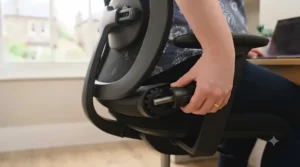
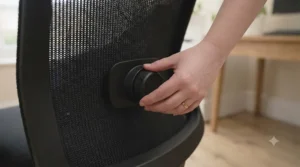
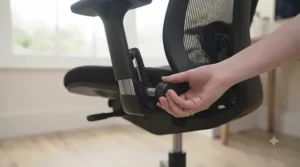
Getting the chair itself right is only half the job — how you set it up in the first month shapes whether it actually solves the discomfort it was bought to fix. Start with seat height: your hips should sit level with or very slightly above your knees, with both feet flat on the floor, adjusting the gas lift rather than compensating with posture. Next, position any lumbar or sacral support around belt height rather than higher up the back — as the bump grows, many pregnant users find lowering the support slightly and focusing on the sacral region, rather than a pronounced lumbar curve, feels noticeably more comfortable, since a highly pronounced curve can create localised pressure against an expanding midsection.
Set armrests so elbows form roughly a 90-100 degree angle; armrests set too low encourage the shoulders to roll forward and hike upward, adding upper back and neck tension that compounds pregnancy fatigue. A genuinely underused first-month habit: revisit these settings every few weeks rather than assuming a single setup will carry you through nine months — what feels supportive at week fourteen frequently needs adjusting again by week twenty-six. Finally, build in a habit of standing and moving every 30-45 minutes; even the most pregnancy-friendly desk chair works best paired with regular position changes rather than static sitting, which independent ergonomics guidance consistently identifies as becoming problematic earlier in pregnancy than many expectant mothers anticipate.
Real-World Scenarios: Matching an Ergonomic Chair to Pregnant Women at Different Stages
Picture three different desk workers, because the right ergonomic chair for pregnant women genuinely depends on which stage and situation applies. First, someone in the first trimester with a desk-based job, budget around £150, still deciding whether they’ll need dedicated pregnancy seating at all. For this buyer, the Sihoo M18 or HOMCOM Ergonomic Office Chair make sense — enough adjustability to get comfortable now without overcommitting before symptoms are even clear.
Second, someone in the second trimester experiencing early pelvic girdle pain, working from home three days a week, budget around £300, wanting genuine dynamic support rather than a fixed pad. The Sihoo Doro C300 or Duramont’s 4D lumbar system suit this stage well, offering support that can be repositioned as the bump changes shape week to week.
Third, someone in the third trimester with confirmed pelvic girdle pain under physiotherapy guidance, working full-time at a desk, budget upwards of £800, prioritising genuine postural relief over cost. Here the HAG Capisco’s open hip angle, used alongside a standard supportive chair for longer stretches, or the Herman Miller Aeron’s PostureFit SL sacral support, both offer meaningfully more targeted relief than a standard budget chair — though either is worth discussing with a midwife or physiotherapist given the specificity of third-trimester discomfort.
How to Choose an Office Chair for Pregnancy
Choosing between genuinely different chairs gets easier with a structured process rather than guesswork. Follow these steps in order:
- Check seat depth adjustment first, not lumbar support. A growing bump changes how far forward you sit more than it changes your lumbar curve — seat depth is the feature most buyers skip and most regret skipping.
- Prioritise breathable materials over cushioned comfort. Pregnancy raises baseline body temperature, and mesh backs consistently outperform foam-and-fabric builds for long sessions.
- Test armrest range, not just height. Elbows need to sit near the body without the shoulders rolling forward, which matters more as the bump pushes you further from the desk.
- Favour dynamic or repositionable lumbar support over fixed pads. A pad that can move down toward the sacrum as pregnancy progresses avoids the “poking” sensation many pregnant users report from fixed lumbar curves.
- Confirm weight capacity honestly. Several budget chairs cap around 120kg, which is worth checking against your own comfort margin regardless of your pre-pregnancy weight.
- Consider whether you need the chair beyond pregnancy. A premium long-term investment like the Aeron makes more financial sense if it’ll still be in use years later, not just for nine months.
- Involve your employer where relevant. Under UK law, HSE guidance on common risks for pregnant workers specifically flags postural problems as something employers must assess and control, so a workplace-funded chair upgrade is often a reasonable request rather than a personal expense.
Office Chair While Pregnant Amazon: What to Check Before You Buy
Searching “office chair while pregnant” on Amazon throws up an overwhelming mix of genuine ergonomic chairs, generic budget task chairs relabelled with pregnancy keywords, and accessories like lumbar cushions that aren’t full chairs at all. A few checks separate the useful listings from the noise. First, read the actual specification list rather than the marketing bullet points — “ergonomic” and “pregnancy-friendly” are unregulated marketing terms, while seat depth range, weight capacity and lumbar adjustment mechanism are concrete, checkable facts. Second, check aggregated review sentiment specifically for assembly quality and armrest symmetry, since these are the most commonly reported issues across budget chairs in this category. Third, be wary of standalone lumbar cushions and back supports marketed for pregnancy — genuinely useful as an add-on to an existing chair, but not a substitute for a chair with proper seat depth and height adjustment if you’re starting from scratch. Finally, check the return window before ordering; given how much comfort needs can shift even within a single trimester, a chair that felt right in week eighteen might need returning or adjusting differently by week twenty-four, and a generous return policy is worth more here than in most other purchase categories.
✨ Don’t Miss These Exclusive Deals!
🔍 Take your home office setup to the next level with these carefully selected chairs. Click on any highlighted item to check current pricing and availability. The right seat can make a genuine difference to how comfortable the months ahead feel!
Pelvic Girdle Pain Seating: What Actually Helps
Pelvic girdle pain affects a genuinely significant proportion of pregnancies, and seating choices can meaningfully help or worsen it. NHS physiotherapy guidance consistently emphasises keeping the pelvis stable and avoiding prolonged static positions, which is precisely why the seating advice here differs from standard ergonomic guidance. What most buyers overlook is that an aggressive, fixed lumbar curve — often marketed as the gold standard ergonomic feature — can actually worsen pelvic girdle pain by creating localised pressure that pushes the pelvis into an uncomfortable, asymmetric tilt. Instead, physiotherapy-aligned seating guidance points toward sacral support rather than pronounced lumbar support, an open hip angle that keeps hips level with or slightly above the knees, and — critically — the ability to change position frequently rather than remaining fixed in one posture for hours. This is exactly where a chair like the HAG Capisco’s saddle design, or a conventional chair with genuinely dynamic lumbar support like the Sihoo Doro C300, can outperform a chair that simply has “more” cushioning or a bigger fixed lumbar bulge. If pelvic girdle pain has already been diagnosed, seating adjustments are worth discussing directly with a midwife or physiotherapist, since individual presentations vary considerably and general product advice can only go so far.
Common Mistakes When Buying an Office Chair for Pregnancy
The most common and costly mistake is buying based on lumbar cushioning alone, without checking seat depth adjustment — a chair that feels supportive in the second trimester can start pressing uncomfortably by the third once the bump has grown considerably. A close second is assuming a kneeling chair is automatically pregnancy-friendly because it “improves posture”; several manufacturers explicitly advise against kneeling chair use during pregnancy due to the sustained pressure they place on the knees and shins, and independent chiropractic guidance notes they can worsen posture unless used correctly, making them a genuinely poor default choice despite their popularity in general ergonomic advice. Buyers also regularly underestimate how much comfort needs shift between trimesters, buying once and expecting the same settings to work for nine months rather than budgeting time to readjust every few weeks. Another recurring pattern: choosing armrests based on style rather than adjustability, then discovering months later that fixed armrests can’t accommodate a growing midsection comfortably. Finally, several reviewers across multiple pregnancy-specific product searches noted disappointment after buying a chair based on marketing language like “pregnancy-friendly” alone, without checking the underlying specification — a reminder that the word “pregnancy” on a listing is a marketing choice, not a certification.
What to Expect: Real-World Performance Trimester by Trimester
Specs on a page rarely translate directly into how a chair actually feels as pregnancy progresses, so here’s the honest transformation from numbers to lived experience. In the first trimester, most standard ergonomic chairs — even ones not specifically marketed for pregnancy — perform adequately, since body shape hasn’t changed dramatically yet; this is the stage where budget picks like the Sihoo M18 genuinely earn their price. By the second trimester, seat depth and lumbar positioning start to matter considerably more, as the bump begins pushing the torso further from the desk and changing how weight distributes through the seat — this is typically when reviewers across multiple product lines report needing to readjust settings they’d previously left untouched for months. By the third trimester, getting in and out of the chair becomes its own consideration; chairs with stable, wide bases and smooth-gliding armrests to push up from are reported as noticeably easier to use than narrow-based or low-armrest designs. Throughout all three stages, reviewers consistently note that breathability becomes more valued as pregnancy progresses, with mesh-backed chairs rated more comfortable in later trimesters than earlier ones, likely reflecting the cumulative rise in body temperature many pregnant users report.
Pregnancy Posture Support: Features That Actually Matter (And Those That Don’t)
Marketing copy loves to list features, but not all of them meaningfully affect pregnancy posture support. Features that genuinely matter: seat depth adjustment (tracks a changing torso-to-desk distance), dynamic or repositionable lumbar support (avoids the fixed-curve pressure problem), breathable mesh construction (manages pregnancy-related overheating), and a stable wide base with accessible armrests (helps with balance and getting up safely in later trimesters). Features that matter considerably less than marketing suggests: built-in massage functions (pleasant but not a substitute for proper postural support), headrests on chairs primarily used for desk work rather than reclining, and cosmetic colour options marketed specifically at “mum-to-be” ranges, which rarely differ functionally from the standard version of the same chair. If a listing leads with “pregnancy” in bold marketing language rather than listing concrete seat depth and lumbar adjustment specifications, treat that as a prompt to dig further rather than a genuine differentiator.
Growing Bump Desk Comfort: Adjusting Your Chair as You Change
A single chair setting rarely lasts an entire pregnancy, and treating growing bump desk comfort as a one-time adjustment rather than an ongoing process is one of the more common oversights buyers make. In practical terms, this means revisiting seat depth roughly every four to six weeks from the second trimester onward, since the distance your torso needs from the desk changes incrementally rather than all at once. It also means being willing to reduce lumbar support intensity as the midsection grows, even if that feels counterintuitive against standard ergonomic advice built for a non-pregnant body — several ergonomics specialists specifically recommend shifting focus from the lumbar curve to sacral support in later pregnancy for exactly this reason. Desk height matters too: as posture shifts to accommodate the bump, a desk that felt correctly positioned in month three can start feeling too low or too high by month seven, so treating the chair and desk as a system that needs periodic rechecking, rather than a one-off setup, pays off across the full nine months.
Long-Term Cost & Value of a Pregnancy-Friendly Office Chair
A genuinely adjustable office chair is rarely a nine-month-only purchase, and the value calculation looks different depending on whether you view it that way. A budget chair costing £120-£200 pays for itself in comfort within weeks if it prevents even a handful of missed or reduced working days due to back pain, and can reasonably be repurposed or resold afterwards. A premium chair like the Herman Miller Aeron, by contrast, only makes strong financial sense when viewed across a much longer horizon — its 12-year warranty and strong resale value (chairs several years old commonly retain roughly half their original price on the used market) mean the effective cost per year of ownership drops considerably if it remains in daily use well beyond pregnancy.
| Ownership Horizon | Budget Chair (£150) | Mid-Range Chair (£300) | Premium Chair (£1,400) |
|---|---|---|---|
| Cost during pregnancy alone (9 months) | £150 | £300 | £1,400 |
| Cost per year if used 3 years | £50/year | £100/year | £467/year |
| Cost per year if used 10 years | £15/year | £30/year | £140/year |
Looking at the numbers above, budget and mid-range chairs are the more sensible choice for buyers who genuinely expect to switch chairs after pregnancy or maternity leave, while premium chairs only become cost-competitive for buyers planning years of continued use. Neither approach is wrong — it depends entirely on whether the purchase is solving a nine-month problem or a decade-long one.
Safety, Regulations and Workplace Rights Guide
UK employers carry specific legal obligations toward pregnant employees regarding workplace seating and posture. Under the Management of Health and Safety at Work Regulations 1999, employers must carry out an individual risk assessment once an employee has informed them in writing that they are pregnant, and this assessment specifically covers postural problems that can occur at different stages of pregnancy. In practice, this means an employee experiencing genuine discomfort at a standard office chair has a reasonable basis to request an assessment and, where appropriate, a chair better suited to their changing needs — this isn’t a favour from a considerate employer, it’s a legal responsibility. Beyond workplace obligations, sensible home-office practice matters too: ensure any chair is on a stable, level surface, check that wheels lock or roll smoothly on your specific flooring type to avoid slips during the balance changes of later pregnancy, and avoid any seating — including several kneeling and exercise-ball chair designs — that manufacturers or physiotherapy guidance specifically flag as unsuitable during pregnancy, regardless of how appealing the general posture benefits sound. If pain persists despite seating changes, that’s a signal to speak with a midwife, GP or physiotherapist rather than continuing to adjust equipment alone.
Problem → Solution: Common Pregnancy Seating Issues
Even a well-chosen chair develops the occasional discomfort, and most issues have straightforward fixes. Problem one: lumbar support feels like it’s poking the bump. Solution: lower the support and reduce its prominence, shifting focus toward sacral rather than lumbar contact, which several ergonomics specialists specifically recommend as pregnancy progresses. Problem two: getting up from the chair feels increasingly difficult. Solution: check armrest height and position — armrests set slightly higher and closer to the body give more leverage to push up from, and a stable wide base reduces wobble during the transition. Problem three: swelling in the legs and feet worsens through the workday. Solution: use a footrest or low stool to elevate the legs periodically, and prioritise standing breaks every 30-45 minutes rather than remaining seated continuously. Problem four: the chair that felt right in the second trimester now feels wrong. Solution: this is expected rather than a fault — revisit seat depth, height and lumbar position rather than assuming the chair itself has failed. Problem five: overheating during long sessions. Solution: prioritise mesh-backed designs over foam-and-fabric alternatives, which consistently perform better for temperature regulation in reviewer feedback.
Buyer’s Decision Framework
If budget is your binding constraint, choose the Sihoo M18, because it delivers genuine ergonomic adjustability at the lowest realistic UK price point in this comparison. If a changing bump is your main concern, choose the HOMCOM Ergonomic Office Chair or Sihoo Doro C300, because both offer the seat depth or dynamic lumbar movement that tracks a body changing shape month to month. If pelvic girdle pain has been diagnosed, discuss the HAG Capisco’s open hip-angle design with a physiotherapist, because its structural approach specifically addresses the posture pattern that pelvic girdle pain guidance recommends. If you’re planning to use the chair for years beyond pregnancy, choose the Herman Miller Aeron, because its long-term value and PostureFit SL sacral support justify the premium price across a decade-long horizon rather than a nine-month one.
FAQ
❓ Is a normal office chair bad for pregnancy?
❓ What is the best chair position for pelvic girdle pain?
❓ How much should I spend on an ergonomic chair for pregnancy?
❓ Can my employer be asked to provide a pregnancy-friendly chair?
❓ Are kneeling chairs safe to use while pregnant?
Conclusion
Choosing between seven genuinely different chairs comes down to matching honest specifications — seat depth, lumbar adjustability, breathability and stability — to your own stage of pregnancy and budget, rather than chasing marketing language that says “pregnancy-friendly” without backing it up. The Sihoo M18 and HOMCOM Ergonomic Office Chair open the door affordably for early pregnancy and changing seat depth needs; the Duramont and Sihoo M57 offer a sensible mid-tier step up in adjustability; the Sihoo Doro C300 tracks a genuinely changing shape through dynamic lumbar support; and the HAG Capisco and Herman Miller Aeron cover specialist pelvic girdle pain seating and long-term investment respectively, each for a distinctly different reason. Whichever chair fits your situation, the underlying principle holds throughout: comfort needs during pregnancy are not static, and the right chair is the one you’re willing to keep readjusting as your body changes, not the one you set once and forget.
Recommended for You
- Best Office Chair to Improve Blood Flow to Legs: 7 Top UK Picks (2026)
- Best Office Chair for Poor Circulation: 7 Top UK Picks (2026)
- 7 Best Office Chair for Hip Pain UK 2026
Disclaimer: This article contains affiliate links. As an Amazon Associate, I earn from qualifying purchases. If you purchase products through these links, we may earn a small commission at no additional cost to you.
✨ Found this helpful? Share it with your friends! 💬🤗
