
In This Article
You know the one. It’s half two in the afternoon, you’ve been glued to your desk since nine, and your legs have quietly stopped working. Not dramatically — no collapsing, no fanfare — just that creeping numbness starting somewhere behind your knees, spreading outward until your feet feel like they belong to someone else entirely. You stand up. The blood rushes back in a thoroughly unpleasant flood of pins and needles. You do a little shuffle around the office looking vaguely unhinged, and then you sit back down and repeat the whole cycle.
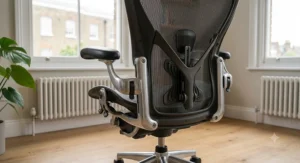
If that sounds grimly familiar, the culprit probably isn’t your posture, your hydration, or even the questionable chair your employer sourced from a catalogue in 2009. It’s a specific design flaw — one that a proper office chair for poor circulation can actually fix.
An office chair for poor circulation is, at its core, a chair engineered to stop the front edge of the seat from compressing the underside of your thighs. That compression is what cuts off venous return — the blood trying to travel back up from your legs to your heart. According to research published in the journal Thrombosis Research, prolonged work-related seated immobility is a genuine risk factor for deep vein thrombosis (DVT). That’s not a minor inconvenience. That’s a blood clot. The good news is that getting the right chair — one with a waterfall seat edge, proper seat depth adjustment, and breathable materials — goes a long way toward keeping your circulation where it belongs: moving.
This guide covers seven real products available on Amazon.co.uk right now, with honest commentary on what each one actually does for leg blood flow — not just what the listing claims.
Quick Comparison: Best UK Office Chairs for Poor Circulation at a Glance
| Chair | Key Circulation Feature | Price Range | Best For |
|---|---|---|---|
| SIHOO M57 | Full mesh + waterfall seat | £150–£220 | Everyday home office use |
| Eucladoceros High Back | Moulded foam waterfall edge | £80–£110 | Budget buyers, longer legs |
| Durrafy Ergonomic | 7 cm cushion + waterfall design | £70–£100 | Compact spaces, 150 kg capacity |
| FLEXISPOT OC3 Pro | W-shaped seat + waterfall front | £180–£260 | Adjustability enthusiasts |
| Karl Home Ergonomic | Double-layer waterfall cushion | £80–£120 | Remote workers, small flats |
| SONGMICS Mesh (OBN91BK) | Contoured seat + waterfall arms | £90–£130 | Mixed-use / gaming crossover |
| Herman Miller Aeron | 8Z Pellicle suspension mesh | £700–£1,500+ | Professionals, long-term investment |
Analysis: The budget tier (under £120) offers solid waterfall seat geometry that genuinely reduces thigh compression — good enough for most people. The mid-range options add adjustability and better materials, which matters if you’re sitting eight or more hours daily. The Aeron sits in a different universe entirely on price, but its suspension seat distributes weight in a way that padded chairs simply cannot replicate. If you suffer from significant varicose veins or have been told by a GP to manage your leg circulation at the desk, the mid-range or premium bracket is worth the stretch.
💬 Just one click — help others make better buying decisions too! 😊
✨ Don’t Miss These Exclusive Deals!
🔍 Take your home office to the next level with these carefully selected chairs. Click on any highlighted product to check current pricing and availability on Amazon.co.uk — your legs will genuinely thank you.
Top 7 Office Chairs for Poor Circulation: Expert Analysis
1. SIHOO M57 Ergonomic Mesh Office Chair — Best All-Rounder for UK Home Offices
The M57 is the chair that appears on nearly every UK ergonomics shortlist in 2026, and there are good reasons for that — some of which the product page actually undersells.
The standout feature for circulation is the waterfall-edge seat cushion, which slopes gently downward at the front. This prevents the seat from digging into the popliteal area (the hollow behind the knee), which is where most standard office chairs quietly strangle your leg circulation without you noticing until the numbness arrives. Pair that with a full breathable mesh construction — both back and seat — and you get a chair that doesn’t create the trapped, clammy heat that causes you to fidget and shift position every twenty minutes.
The dual-adjustable lumbar support is genuinely useful for UK users who tend to slump by mid-afternoon during short winter days when energy dips. You can adjust it both vertically and horizontally, which is rarer in this price range than it should be. The 3D armrests also move inward, outward, forwards, and backwards — important for keeping your shoulders relaxed, which has a knock-on effect on the whole chain of tension running down your back and into your hips.
UK buyers report positive experiences with the mesh durability and customer support, though a few shorter users (under 162 cm/5’4″) note the seat depth can feel slightly generous. Worth checking the seat depth against your leg measurement before purchasing.
✅ Full mesh for year-round breathability
✅ Waterfall edge reduces knee compression
✅ Dual-adjustable lumbar for afternoon slouch prevention
❌ Seat depth may be too generous for shorter frames
❌ Headrest can feel too high for users under 165 cm
Price range: around £150–£220 | Available on Amazon.co.uk with Prime delivery. A strong value proposition in the mid-range that comfortably outperforms its price bracket.
2. Eucladoceros High Back Mesh Office Chair — Best Budget Pick for Taller UK Users
Don’t be put off by the unusual brand name. This chair appeared on Amazon.co.uk in 2025 and has quietly built an impressive reputation among UK buyers who describe it with the kind of specific, observational praise that reviewers reserve for things that actually work.
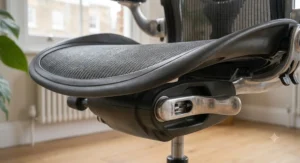
One British reviewer put it well: the waterfall seat edge keeps the blood flowing in lanky legs, and after sitting through a full day of calls, the front edge stays firm, meaning your legs keep their circulation without the embarrassing leg-shake that sets in when a chair starts cutting off blood flow. That is a useful data point. The seat cushion is thick moulded foam that spreads weight across the hips and thighs rather than letting it pool in one spot — exactly what you want when the goal is maintaining circulation during long sessions.
The 2D adjustable headrest and 2D armrests won’t match the SIHOO M57’s 3D range of motion, but for a chair in the under-£110 range, the adjustability is genuinely respectable. The 120° recline is smooth and lockable. Build quality feels dense — no tell-tale wobble, no creak when leaning sideways.
For UK workers in terraced houses with spare-room offices who want proper circulation support without spending mid-range money, this is probably the most pragmatic choice on this list.
✅ Moulded foam waterfall seat that maintains firmness over a full day
✅ Silent castors (important in compact flats and shared houses)
✅ Easy 15-minute assembly
❌ 2D adjustments less precise than 3D alternatives
❌ Mesh back on the firmer side — some users prefer softer
Price range: £80–£110 | Prime-eligible on Amazon.co.uk. Genuinely excellent value for taller or longer-legged UK buyers who need circulation support on a restricted budget.
3. Durrafy Ergonomic Office Chair — Best for Compact Spaces and Heavier Users
The Durrafy does one specific thing particularly well: the 7 cm high-density sponge cushion with waterfall design distributes hip pressure evenly, which the listing correctly credits with avoiding numbness from prolonged sitting. What the listing doesn’t spell out is why this matters in practice — the extra cushion depth means your body weight is spread over a larger surface area, which directly reduces the point-pressure that compresses blood vessels behind the thighs.
The full breathable nylon mesh back is a sensible choice for UK office environments where central heating creates dry, warm air from October to April. The chair supports up to 150 kg and the 4D lumbar support — adjustable in four directions — lets you find a genuinely personalised lower back position rather than making do with a fixed lump in approximately the right place.
For UK buyers in smaller properties — the kind of urban flat in Manchester, Leeds, or Birmingham where the “home office” is a corner of the bedroom — the flip-up armrests are a practical touch: you can slide the chair fully under the desk when you’re done, saving meaningful floor space. Assembly takes fifteen to twenty minutes with the included tools.
✅ 7 cm waterfall cushion with strong pressure distribution
✅ Flip-up armrests — useful for small UK flats
✅ 150 kg capacity, broader than many competitors
❌ Seat depth adjustment is fixed — not ideal for very petite frames
❌ Rocking function requires more body weight to engage fully
Price range: £70–£100 | Available on Amazon.co.uk, often Prime-eligible. Solid choice for buyers who need generous weight capacity and breathability without paying mid-range prices.
4. FLEXISPOT OC3 Pro Ergonomic Office Chair — Best for Maximum Adjustability
If you want to fine-tune your sitting position with the precision of someone fitting a space suit, this is your chair. FLEXISPOT’s OC3 Pro offers an 8-level adjustable lumbar support, a 3D headrest, fold-up PU armrests, and a 135° backrest adjustment range — all of which contribute to circulation health, because the single biggest enemy of blood flow is a fixed, unadaptable position that you’re stuck in for eight hours.
The W-shaped seat design is worth understanding. Rather than a flat base, the seat’s geometry automatically nudges you toward the centre of the chair and supports the natural curve of your lumbar spine. The waterfall front edge then slopes downward, keeping the seat from pressing into the back of your thighs — the compression point that creates the familiar numb-leg experience. BIFMA-certified and tested at a 1,136 kg static pressure load, the structural integrity is not in question.
The breathable mesh is made from elastic nylon fibres — it flexes with your movement rather than creating pressure points as you shift position throughout the day. UK reviewers report genuine back pain relief and overall positive comfort feedback, with minor comments around the headrest wobbling under certain pressures.
This is the chair for the remote worker in the Scottish Highlands or a Bristol suburb who sits from eight in the morning until six at night with minimal reason to get up and walk around. In that scenario, every one of those eight adjustment levels matters.
✅ 8-level lumbar adjustment — genuinely personalised support
✅ W-shaped seat + waterfall edge for comprehensive thigh pressure relief
✅ 135° recline with tilt tension control
❌ Headrest wobble reported by some users at certain angles
❌ Higher price point than budget alternatives
Price range: £180–£260 | Prime-eligible on Amazon.co.uk. Justifies the premium if adjustability is your priority.
5. Karl Home Ergonomic Office Chair — Best for Remote Workers Who Want Customisable Lumbar
The Karl Home stands out in one specific way: its inflatable lumbar airbag. Pump it up or release air until the lumbar support fills the natural curve of your spine — not an approximation, but your actual shape. For people with poor circulation that is linked to or exacerbated by lower back tension (the two often go hand in hand — a compressed lumbar spine affects posture, which affects how your thighs sit against the seat), this is a meaningful feature rather than a gimmick.
The double-layer waterfall edge cushion is the headline circulation feature. The seat transitions from firmer support in the centre to a softened, downward-sloping front, which systematically reduces pressure on the back of the knees. The padded flip-up armrests are genuinely soft — not hard plastic pretending to be padded — and raising them lets you push the chair under a desk in the kind of compact spare-room-office common in UK terrace houses.
What the Karl Home doesn’t offer is the breadth of adjustment you get from the FLEXISPOT or SIHOO M57. The backrest rocks rather than reclines independently, which suits some people and frustrates others. If you need precise lumbar dialling paired with waterfall seat geometry on a mid-budget, it earns its place on this list. If you’re taller than 185 cm, check the seat depth specification carefully.
✅ Inflatable lumbar airbag — truly personalised support
✅ Double-layer waterfall cushion with genuine softness at the front edge
✅ Padded flip-up arms — rare at this price
❌ Rocking mechanism, not an independent recline
❌ Backrest height not individually adjustable
Price range: £80–£120 | Available on Amazon.co.uk. A unique circulation-focused choice for those who prioritise lumbar personalisation.
6. SONGMICS Ergonomic Mesh Office Chair (OBN91BK) — Best Mixed-Use Option
The SONGMICS has been around long enough that there’s meaningful real-world data on how it holds up — and the news is generally positive. The contoured seat reduces pressure on your legs through its moulded shape rather than relying purely on a waterfall edge, and the curved backrest follows the spine’s natural “S” curve. The waterfall armrests (arms that curve gently downward at the front) contribute to upper body relaxation, which reduces the chain of tension that eventually reaches your hips and affects your sitting position.
The mesh back is highly resilient — SONGMICS note it’s passed BIFMA X5.1 testing, which is the relevant industry standard for office chairs in terms of structural safety. The 150 kg load capacity and four lockable reclining positions give you flexibility for different tasks. Two spare castors are included in the box, which is a thoughtful inclusion that speaks to SONGMICS’ understanding of long-term ownership — not just the initial sale.
For UK users who want a chair that works equally well for focused desk work and more relaxed video-watching or gaming sessions in the evening, this is a practical pick. It handles both modes without forcing you to compromise on either. Assembly requires two people for the seat portion, which is worth planning for.
✅ BIFMA X5.1 certified structural integrity
✅ Contoured seat and mesh combination for all-day breathability
✅ Spare castors included — useful on hard laminate floors
❌ Two-person assembly recommended for seat installation
❌ 49 × 49 cm seat may feel narrow for broader frames
Price range: £90–£130 | Prime-eligible on Amazon.co.uk. A reliable, tested option for users who want flexibility between work and leisure.
7. Herman Miller Aeron Chair (Renewed/Refurbished) — Best Long-Term Investment for Serious Circulation Issues
Let’s be honest about the Aeron’s price tag. New, it sits well above £1,000 — a sum that makes most people’s eyes water before they’ve even sat down. But the refurbished and renewed versions available on Amazon.co.uk through certified sellers bring it into the £400–£700 range, and that changes the calculation considerably.
The Aeron’s circulation advantage is structural rather than cosmetic. Its 8Z Pellicle suspension system — a tensioned mesh that stretches across both the back and seat — means your body weight is distributed across a web of elastic material rather than compressed against a foam block. There’s no seat edge cutting into your thighs because the seat itself moves with you. Venous return from your legs isn’t being impeded by a fixed platform — it’s being supported by a material that responds dynamically to your position. It comes in three sizes (A, B, and C — small, medium, and large), which is something almost no other chair does. Getting the size right matters enormously for circulation: a seat that’s too deep will push you forward and leave your back unsupported; too shallow and the Pellicle tension changes.
The Aeron has been a landmark in ergonomic design since 1994, designed by Bill Stumpf and Don Chadwick, and backed by a 12-year warranty on new purchases. For UK professionals with significant circulation concerns — varicose veins, a history of DVT, or jobs that genuinely require eight-plus hours of sitting — the Aeron renewed is a genuinely sensible investment.
✅ 8Z Pellicle suspension eliminates seat-edge compression entirely
✅ Three sizes — the only mainstream chair that fits bodies rather than expecting bodies to fit the chair
✅ 12-year warranty on new models; renewed versions often include 12-month seller warranty
❌ Premium price — even refurbished, it’s a significant outlay
❌ No traditional lumbar pad — PostureFit SL takes adjustment to master
Price range: £400–£700 (renewed/refurbished on Amazon.co.uk); £1,100–£1,500+ new. A long-term investment that pays off in comfort, longevity, and genuine vascular health support.
Why Your Chair Is Quietly Strangling Your Legs
Here’s the thing most office furniture manufacturers don’t put on the box: the standard flat-fronted office chair is a minor physiological hazard for anyone sitting in it for more than three or four hours at a stretch.
When the front edge of a seat presses into the underside of your thighs — the area just above the back of your knees — it compresses the popliteal artery and the femoral vein. These are the vessels responsible for carrying blood back up from your lower legs to your heart. Compress them for long enough and blood pools in your calves. That’s why your legs feel heavy by mid-afternoon. It’s why your ankles swell. And in more serious cases, it’s a contributing factor to varicose veins and, at the extreme end, deep vein thrombosis.
Research confirms that desk workers face significantly elevated risks of vein problems compared to people in active professions — with sedentary workers showing a roughly 40% higher risk of venous insufficiency. The calf muscles, which normally act as a natural pump pushing blood back upward, become largely inactive during prolonged sitting. Without that pump action, venous pressure builds.
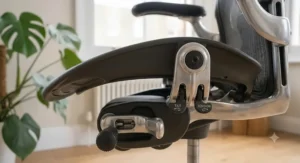
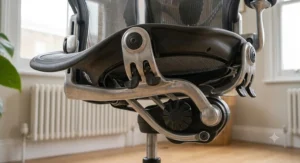
The waterfall seat edge design — where the front of the seat curves downward rather than ending in a horizontal edge — is the primary engineering response to this problem. It redistributes pressure away from the popliteal zone, reduces thigh compression, and allows blood to move more freely through your lower legs. It won’t replace getting up and walking around (which remains the single best thing you can do), but it makes the time between those movement breaks significantly less damaging.
How to Set Up Your Chair for Maximum Circulation Benefit
Getting the right chair is step one. Setting it up correctly is step two, and it’s the step that most people skip entirely after the first ten minutes.
Step 1: Seat height. Adjust so your feet rest flat on the floor or a footrest, with your knees at approximately 90° and your thighs parallel to the ground. Knees significantly above hip level, or a seat so high your feet are dangling, both impede circulation. The ideal seat height range for most UK adults is between 42–53 cm from the floor.
Step 2: Seat depth. You should have approximately two to three finger-widths of space between the front edge of the seat and the back of your knees. Too deep, and you’ll inevitably pitch forward to compensate, putting you back in compression territory. This is the adjustment most people ignore and most cheap chairs don’t offer.
Step 3: Lumbar support. Position it at the curve of your lower back — typically between your hip bones and the bottom of your ribcage. A supported lumbar means your spine maintains its natural curve, which keeps your pelvis in a forward tilt, which in turn opens up the hip flexors and reduces compression at the thigh.
Step 4: Armrests. Drop them low enough that your shoulders aren’t raised, and position them so your elbows rest at roughly 90° without your upper arms pulling inward. Tension in the shoulders has a downstream effect on posture, which eventually affects how you’re sitting on the seat.
Step 5: Movement breaks. The NHS recommends breaking up prolonged sitting regularly, and the evidence strongly supports movement every 30 to 60 minutes as the most effective circulation strategy, even in an ergonomically perfect chair. Set a reminder. Walk to the kettle. Do ankle circles at your desk. The chair is the foundation — movement is what keeps the system working.
How to Choose an Office Chair for Poor Circulation in the UK
Not all ergonomic chairs are created equal when circulation is the specific concern. Here’s what to look for:
- Waterfall seat edge (essential). The single most important feature for leg circulation. The seat should curve downward at the front, not end in a sharp horizontal edge. If you can’t find this on the product listing, look for it in customer reviews.
- Adjustable seat depth. Allows you to position the front edge correctly relative to the back of your knees. Fixed seat depths are a compromise — they work for the “average” person, who largely doesn’t exist.
- Breathable materials. Foam and leather trap heat, which causes you to fidget, shift position, and inadvertently lose the correct sitting alignment. Mesh backs and seats maintain airflow — particularly relevant in centrally heated UK offices between October and April.
- Adjustable lumbar support. Not just present, but moveable. Fixed lumbar pads serve a statistical average rather than your specific spinal curve. Dual-adjustable lumbar (vertical and horizontal) is worth seeking out.
- Seat height range appropriate for your body. Most UK office chairs adjust between 42 cm and 53 cm from the floor. Taller users (over 185 cm) should check the maximum height; shorter users (under 160 cm) the minimum.
- Weight capacity with appropriate margin. Don’t buy a chair rated for 100 kg if you weigh 90 kg. Sitting on a chair at the edge of its rated capacity affects the seat cushion density and edge support over time, both of which compromise the waterfall geometry you bought it for.
- Armrest adjustability. At minimum, height-adjustable. 3D or 4D adjustability (which also moves inward/outward and forward/back) makes a meaningful difference to shoulder tension and its downstream effects on posture.
UK Buyer Profiles: Which Chair Matches Your Situation?
The Remote Worker in a Terraced House (Leeds, Bristol, Cardiff…)
Budget: around £80–£150. Space is tight, the home office is a corner of the spare bedroom, and the chair needs to tuck under the desk when not in use. The Durrafy or Karl Home are natural fits — both have flip-up armrests and stay compact when stowed. The waterfall cushion on the Durrafy is particularly strong for its price point.
The Hybrid Worker, Three Days Home (London, Manchester, Edinburgh)
Budget: £150–£250. You’re sitting six-plus hours on the days you’re at home and want genuine adjustability to find the exact position that works for your body. The SIHOO M57 or FLEXISPOT OC3 Pro are the right tier. The SIHOO is more popular; the FLEXISPOT offers finer lumbar calibration.
The Full-Time Desk Professional with Existing Circulation Concerns
Budget: £400+. If you’ve been told by a GP that you have venous insufficiency, early varicose veins, or a history of DVT, this is not where to economise. A refurbished Herman Miller Aeron in the right size is the most defensible choice — the suspension seat eliminates thigh compression in a way that foam-based alternatives can only approximate.
Features That Actually Matter — and Marketing Fluff to Ignore
Matters:
- Waterfall seat edge geometry (measurable and real)
- Seat depth adjustability (directly affects popliteal compression)
- Lumbar support that actually adjusts to your spine shape (not a fixed pad)
- Breathable mesh that doesn’t trap heat
Probably fine but overstated:
- “Memory foam” seat cushions — memory foam conforms initially but compresses over time, reducing the waterfall effect; not ideal for long-term use
- “Massage function” — a pleasant novelty, not a circulation substitute
- Chair weight — heavier often signals better materials, but it’s not a reliable proxy
Often irrelevant for circulation:
- Leather or PU leather upholstery (looks expensive; worse for breathability)
- High-back design in itself — relevant for shoulder support, not directly for leg circulation
- Armrest padding — contributes to comfort, not circulation
One thing that often goes unmentioned: seat width matters for circulation too. If the seat is narrow and pinches the outer thighs, you’re adding a new compression point. The ideal seat width allows your legs to rest comfortably without the sides of the seat pressing inward. Most standard UK office chairs measure between 48–52 cm wide — check this against your own measurements if you’re on the broader side of average.
✨ Ready to Stop Sitting in Silence?
🔍 Every chair on this list is available to check right now on Amazon.co.uk. Click any highlighted product, verify current pricing and delivery, and give your legs what they’ve been waiting for all afternoon.
Common Mistakes UK Buyers Make When Choosing a Circulation-Friendly Chair
Buying by price alone. The cheapest chair in the waterfall-seat category often uses that seat geometry as its only concession to ergonomics — fixed lumbar, non-adjustable seat depth, and minimal height range. For many UK bodies, those fixed compromises defeat the benefit of the waterfall edge.
Ignoring seat depth. This is the single most overlooked specification in online chair shopping. Seat depth — the distance from the front of the seat to the backrest — determines whether your chair actually positions the waterfall edge correctly behind your knees, or just creates a gentle decorative slope at the front while the real compression happens further back.
Trusting “ergonomic” as a meaningful label. In the UK, the term “ergonomic” carries no regulated definition. A chair can legally call itself ergonomic while having none of the features that actually protect circulation. The Health and Safety Executive provides Display Screen Equipment guidance for UK workplaces, but individual product claims are not governed by that standard.
Overlooking size. The average UK adult is not the average any chair is designed for. If you’re taller than 185 cm, shorter than 160 cm, or broader than a size 14-16, the standard sizing of most office chairs creates a poor fit that negates the ergonomic features entirely.
Expecting the chair to do everything. No chair, at any price, substitutes for movement. Humanscale’s ergonomics research consistently shows that movement breaks every 30 to 60 minutes are more protective of circulatory health than any static equipment investment alone. The chair creates the conditions; movement does the work.
Long-Term Value: What Your Chair Really Costs Over Time
A budget chair at around £80 sounds sensible. Over three years of daily use — 220 working days per year — that’s roughly 5,000 hours of sitting. The foam in most budget seats begins to compress and lose its waterfall geometry within twelve to eighteen months of heavy use. Suddenly your £80 chair is a flat-seated chair with a decorative curve that no longer functions as intended. You buy another one. You’ve now spent £160 and have produced twice the packaging waste.
A mid-range chair at £180–£250 uses denser foam or mesh-based seating that holds its shape for three to five years. The upfront cost is higher; the per-hour cost over a product lifetime often works out lower.
The Herman Miller Aeron, with its 12-year warranty and Pellicle suspension system that doesn’t compress or degrade like foam, has a per-hour cost over a decade that compares favourably to replacing two or three mid-range chairs. For UK buyers who take a long-term view of total cost of ownership — particularly those who work from home full-time — refurbished Aeron chairs available in the £400–£700 range represent the most cost-effective serious option.
UK prices on Amazon.co.uk include 20% VAT, which is worth factoring in when comparing against international listings. Some EU-manufactured chairs may carry slightly higher UK prices post-Brexit due to import adjustments, but you benefit from UK consumer protection under the Consumer Rights Act 2015, including a 14-day cooling-off period for online purchases and two-year minimum statutory guarantee.
Frequently Asked Questions
❓ What is the best type of office chair for poor circulation in the UK?
❓ Can an ergonomic office chair prevent deep vein thrombosis (DVT)?
❓ How does a waterfall seat edge improve blood flow in the legs?
❓ Are there NHS-recommended office chairs for leg circulation problems?
❓ Is the Herman Miller Aeron available on Amazon.co.uk and worth the price for circulation?
Conclusion: Stop Suffering in Silence at Your Desk
The numb-leg shuffle at 3pm isn’t an inevitable part of desk life. It’s the predictable consequence of sitting on a chair designed without your circulation in mind — and it’s entirely fixable.
For most UK buyers, the SIHOO M57 represents the clearest value proposition: proven waterfall seat geometry, full mesh breathability, dual-adjustable lumbar, and a price range that doesn’t require a month’s deliberation. The Eucladoceros and Durrafy are credible budget alternatives for those who need to keep things under £110. The FLEXISPOT OC3 Pro earns its premium through adjustment depth. And the refurbished Herman Miller Aeron is the chair to choose if you’re serious about long-term vascular health and willing to treat the purchase like the investment it genuinely is.
Whatever you choose, remember: the chair sets the foundation, but movement is what actually keeps your circulation healthy. Set that timer. Walk to the kitchen. Your legs — and, frankly, your afternoon energy levels — will be measurably better for it.
✨ Ready to Find Your Perfect Chair?
🔍 Every product in this guide is available to check right now on Amazon.co.uk. Compare current pricing, check Prime delivery availability for your postcode, and start giving your legs the support they’ve been asking for. Your circulation is worth it.
Recommended for You
- 7 Best Office Chair for Hip Pain UK 2026
- Best Chair After Coccyx Injury: 7 Top UK Picks for 2026
- Best Office Chair for Coccyx Pain: 7 UK Picks That Work (2026)
Disclaimer: This article contains affiliate links. As an Amazon Associate, I earn from qualifying purchases. If you purchase products through these links, we may earn a small commission at no additional cost to you.
✨ Found this helpful? Share it with your mates! 💬🤗
