
In This Article
You’ve bruised it, fractured it, or landed on it rather ungracefully — and now every time you attempt to sit down, your coccyx makes its displeasure loudly known. You’re not alone. Coccydynia (the medical term for tailbone pain) is far more common than people admit, and the British tendency to soldier on without complaint means thousands of us are perched miserably at work desks, on sofas, and in car seats with absolutely no idea what a proper chair after coccyx injury should actually look like.
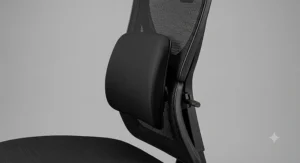
Here’s the uncomfortable truth: the standard office chair you’ve had since 2019 — the one that was “fine, I suppose” — is probably making things considerably worse. Flat, firm seat pans create a concentrated pressure point directly on your tailbone. When that tailbone is injured, bruised, or fractured, that pressure isn’t just uncomfortable. It actively impedes healing.
According to the NHS, one of the most straightforward things you can do during recovery is use a specially designed coccyx cushion when sitting. That advice sounds simple enough. But knowing which cushion, on which chair, for what stage of your recovery? That’s where this guide earns its keep.
A coccyx injury typically involves damage to the small triangular bone at the very base of your spine — three to five fused bones that bear a surprising amount of body weight whenever you sit. A bruised coccyx heals in roughly four weeks; a fracture may take eight to twelve weeks. Getting your seating right during that window makes a genuine difference to both your comfort and your recovery timeline. This article will walk you through seven of the best options available right now on Amazon.co.uk, plus the expert insight that no product listing will ever give you.
Quick Comparison Table: Chair After Coccyx Injury — At a Glance
| Product | Type | Key Feature | Best For | Price Range |
|---|---|---|---|---|
| iamcomfi Coccyx Cushion (Medium) | Cushion | U-shaped cut-out, heat-sensitive foam | Office & home desks | Under £35 |
| Smith Hillman Orthopaedic Memory Foam Cushion | Cushion | Rollable, breathable 3D mesh | Travel, commuting, multiuse | Under £40 |
| Smith Hillman Orthopaedic Donut Ring Cushion | Ring cushion | Full suspension ring design | Post-surgery, severe acute pain | Under £30 |
| Everlasting Comfort Memory Foam Seat Cushion | Cushion | U-cut, non-slip base, washable cover | Long-distance driving & car commutes | Under £40 |
| ComfiLife Gel-Enhanced Coccyx Cushion | Gel-foam hybrid | Cooling gel layer, ergonomic contour | Hot weather sitting, extended office hours | Under £45 |
| Feagar Orthopaedic Memory Foam Cushion | Cushion | Non-slip base, contoured U-shape | Budget-conscious buyers | Under £25 |
| 5 STARS UNITED Ergonomic Seat Cushion | Cushion | OEKO-TEX® certified materials, broad support | Eco-conscious, sensitive skin | Under £35 |
The table above gives you a quick lay of the land, but don’t make your final decision from it alone. The difference between a cushion that transforms your recovery and one that sits gathering dust under your desk is almost always in the details — foam density, cut-out depth, whether the cover breathes well enough for a warm summer’s day in your south-facing flat. The sections below dig into all of that.
💬 Just one click — help others make better buying decisions too! 😊
✨ Don’t Miss These Exclusive Deals!
🔍 Take your post-injury recovery to the next level with these carefully selected products. Click on any highlighted item to check current pricing and availability on Amazon.co.uk. These picks will help you find exactly what you need!
Top 7 Chairs and Cushions After Coccyx Injury: Expert Analysis
1. iamcomfi Coccyx Cushion for Tailbone Pain Relief — Medium Hardness
The iamcomfi cushion has quietly become one of the best-selling orthopaedic seat pads on Amazon.co.uk, and for good reason. Made from high-density, heat-sensitive memory foam (approximately 46.5 cm × 36.5 cm × 7 cm), it features the now-standard U-shaped rear cut-out — a channel carved into the back of the cushion that means your tailbone never actually makes contact with the seat surface. That cut-out isn’t just a gimmick; it’s the fundamental principle of pressure redistribution in post-injury seating.
What sets this cushion apart in practical terms is the medium-hardness foam grade. In my experience, this strikes the right balance during the mid-recovery phase — firm enough to keep your pelvis properly aligned, but soft enough not to aggravate acute sensitivity. The heat-responsive material moulds gradually to your body shape, which matters enormously if you’re someone who fidgets or shifts weight frequently (a natural instinct when in pain). iamcomfi is a UK-based company, which also means customer support is straightforward and returns are hassle-free under the Consumer Rights Act 2015.
UK reviewers consistently praise its versatility across car seats, office chairs, and sofas, with several noting it made a “world of difference” during long work-from-home sessions. The machine-washable cover is a genuine practical bonus — recovery takes weeks, and hygiene matters throughout. One minor note: on smooth leather or faux-leather chair surfaces, the anti-slip dots on the base can migrate slightly, so you may want to check its position every few hours on sleeker seats.
✅ Medium-density foam suitable for mid-recovery
✅ Machine-washable, breathable cover
✅ Carry handle and storage bag included
❌ May shift on leather or vinyl surfaces
❌ Could be too soft for those preferring firm support
Available on Amazon.co.uk, typically Prime-eligible with next-day delivery. Price range: under £35.
2. iamcomfi Coccyx Cushion — Firm Hardness
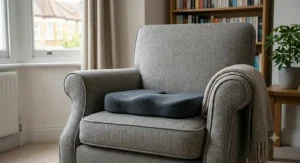
The firm version of the same cushion deserves its own entry, because the difference matters more than you might think. If you’re returning to work after a coccyx fracture — back at the desk for seven or eight hours a day — the firmer foam grade gives your pelvis better structural support over prolonged periods. Softer cushions, counterintuitively, can allow your pelvis to tilt backwards over time, which actually increases coccyx pressure during extended sitting.
Think of it this way: a soft sofa feels lovely for twenty minutes and dreadful for three hours. The firm iamcomfi variant maintains its shape without bottoming out, meaning the tailbone cut-out continues doing its job even after four or five hours at your desk. The firmness also helps with posture — it gently encourages a slight forward pelvic tilt, which takes weight off your sacral region and transfers it to your sitting bones (the ischial tuberosities) where it belongs.
Best suited for those who have passed the acute phase of injury (typically four-plus weeks post-injury), or for heavier users for whom a medium-density cushion compresses too readily. UK reviewers with longer-term coccydynia — including those who’ve had physiotherapy and been advised to use a supportive cushion indefinitely — tend to prefer this version over the medium hardness. Both versions are sold through the same UK-based supplier on Amazon.co.uk.
✅ Maintains shape over long sitting sessions
✅ Better pelvic alignment for extended desk work
✅ Washable cover, portable carry bag
❌ Can feel uncomfortable during the most acute stage of injury
❌ Less suited to soft-surface seating like sofas
Price range: under £35. Prime eligible.
3. Smith Hillman Coccyx Orthopaedic Memory Foam Seat Cushion
Smith Hillman is a small UK family business, and their coccyx cushion has accumulated an impressive following precisely because it was designed with British users in mind from the start. The contoured shape features a rear cut-out for tailbone pressure relief and a raised front edge that promotes healthy blood circulation in the legs — particularly useful during long commutes on National Rail or the Tube, where hard, fixed seats are genuinely punishing for coccyx sufferers.
What genuinely distinguishes this cushion is its rollability. It can be compressed, rolled into luggage or a rucksack, and springs back to its original shape — a feature that sounds trivial until you’re a teacher in Leeds or a solicitor in Manchester who needs to move between multiple working locations in a day. The 3D breathable mesh cover handles perspiration better than most competitors, which is more relevant during a muggy British summer than it might first sound.
The NHS lists coccyx cushions as a recommended home management tool for tailbone pain, and this product is specifically designed with that guidance in mind. UK buyers appreciate the company’s one-year hassle-free return guarantee — well beyond the statutory 14-day cooling-off period under the Consumer Contracts Regulations. Strong marks from verified UK reviewers who note meaningful improvement in sitting comfort within the first week.
✅ Rollable and portable — ideal for hybrid workers
✅ Excellent breathable mesh cover
✅ UK-based small business, strong returns policy
❌ Slightly thinner than some competitors at comparable price
❌ Roll-up design may feel less structured than a traditional pad
Price range: under £40. Prime eligible.
4. Smith Hillman Orthopaedic Donut Ring Cushion
If your injury is in the acute phase — the first two to four weeks after a fall or fracture — a U-shaped cushion may still allow some residual pressure on the tailbone. A donut ring (or doughnut ring, as any good British person should spell it) eliminates that problem entirely. The circular design suspends your entire coccyx region in mid-air, which is precisely what NHS and physiotherapy guidance recommends for particularly painful episodes.
Smith Hillman’s donut ring uses a medical-grade foam core that maintains its structure without flattening with daily use — a critical distinction, because cheaper foam ring cushions collapse within weeks and become useless. The soft, washable cover keeps things hygienic throughout a recovery that may span several months. Lightweight and compact enough to carry between a home office and a living room chair, it also works well on wheelchair frames for those whose mobility is more significantly affected.
One honest caveat: some users find that the ring shape, while superb for acute pain relief, doesn’t provide sufficient structural support for the broader pelvis once the initial injury begins to settle. This is best viewed as a Phase 1 recovery tool — excellent for weeks one through four — with a transition to a U-shaped cushion as healing progresses. Think of it as the high-dependency care before the rehabilitation ward.
✅ Full coccyx suspension — ideal for acute phase
✅ Medical-grade foam, washable cover
✅ Works on wheelchairs, hard chairs, car seats
❌ Less structural support for long-term use
❌ Ring shape less effective once acute pain subsides
Price range: under £30. Available on Amazon.co.uk.
5. Everlasting Comfort Memory Foam Seat Cushion
American in origin but well established on Amazon.co.uk, the Everlasting Comfort cushion is particularly popular among UK drivers — and this is a category worth taking seriously. Coccyx injuries don’t confine themselves to office hours. Getting in and out of a car, sitting through a forty-minute motorway commute, or enduring the journey home from a hospital appointment can all be genuinely miserable without proper support.
The U-cut design is generous in its depth, and the non-slip base holds reliably on both fabric and leather car seats — a common frustration with lesser cushions. The machine-washable cover is a thoughtful practical touch for a product you’ll be using daily, possibly sweating on, for weeks. At roughly 10 cm in depth, it does raise your seated height noticeably, so shorter drivers may need to readjust their seat and mirror positions (and, yes, this is worth doing properly rather than just squinting at the road).
For those working in urban areas with longer commutes — think a daily drive across Greater London or the M60 into central Manchester — this cushion earns its keep in both the car and at the desk. It doubles neatly across both settings, which is sound value at the price. UK reviewers note it as a solid everyday companion through the intermediate recovery phase.
✅ Excellent for car and office chair use
✅ Non-slip base reliable across seat surface types
✅ Deep U-cut for meaningful tailbone suspension
❌ Adds noticeable height — may need seat re-adjustment
❌ Can run warm during long car journeys
Price range: under £40. Prime eligible on Amazon.co.uk.
6. ComfiLife Gel-Enhanced Non-Slip Coccyx Memory Foam Seat Cushion
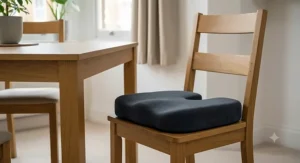
If you tend to run warm — or if you’re recovering through British summer and working in a poorly ventilated home office — the ComfiLife gel-enhanced cushion is genuinely worth the slight premium over standard memory foam options. A cooling gel layer sits atop a memory foam base, drawing heat away from the body and keeping the surface temperature noticeably lower during prolonged sitting. This isn’t a gimmick for fair-weather comfort; excessive heat at the base of the spine can actually increase tissue inflammation, so cooler sitting genuinely has a physiological benefit.
The contoured U-shape provides reliable tailbone suspension, and the gel-foam combination gives a slightly different feel to pure memory foam — more responsive, less “sinking.” For those who find standard memory foam feels too enveloping or claustrophobic around the pelvis, this hybrid may feel more precise and controlled. Highly rated across multiple UK review platforms for sciatica and coccyx pain specifically.
The non-slip base performs consistently well across fabric office chairs, which is where this cushion really shines. Less portable than the Smith Hillman options — no carry bag or roll-up capability — but if you’re primarily desk-bound in one location, that’s rarely a problem.
✅ Cooling gel layer reduces heat build-up
✅ Ideal for extended desk work in warmer conditions
✅ Premium feel at a moderate price
❌ Less portable than some competitors
❌ Gel layer adds slight weight
Price range: under £45. Prime eligible on Amazon.co.uk.
7. Feagar Orthopaedic Memory Foam Coccyx Cushion
Not everyone recovering from a coccyx injury has a generous budget, and there is nothing wrong with acknowledging that. The Feagar cushion is the strongest budget option on Amazon.co.uk for tailbone pain relief — a non-slip memory foam seat pad with a contoured U-shape, available well under £25, that delivers the core functionality you actually need during recovery.
The foam density is acceptable rather than exceptional, and experienced users of premium cushions will notice the difference. However, for someone in the early stages of their recovery journey — unsure how long they’ll need a cushion, or trying one before committing to a higher-end product — Feagar represents a sensible entry point. It does what it says, holds its shape reasonably well for several months of regular use, and the washable cover keeps hygiene manageable.
Worth noting: the Feagar is particularly well-suited to supplementary use — keeping one at work and one at home, for instance, without the financial sting of buying two premium products. UK reviewers describe it as “does the job” rather than “transformative,” which is precisely the honest verdict you’d want before spending your money.
✅ Excellent value under £25
✅ Core U-shape and non-slip base functionality
✅ Solid entry point for recovery beginners
❌ Foam density lower than premium options
❌ Not ideal for all-day heavy use
Price range: under £25. Available on Amazon.co.uk, often Prime-eligible.
Comparison Table: Cushion Types vs Recovery Phase
| Recovery Phase | Cushion Type | Why It Works |
|---|---|---|
| Acute (Weeks 1-4) | Donut / full ring | Complete tailbone suspension, zero contact pressure |
| Intermediate (Weeks 4-8) | U-shaped memory foam, medium density | Pressure redistribution, posture support begins |
| Late (Weeks 8-12+) | U-shaped firm foam or gel-hybrid | Structural pelvic support for return to full working days |
| Long-term / chronic | Firm foam or specialised ergonomic chair | Sustainable postural correction and pain management |
This table reveals something important: there is no single best cushion for all stages of coccyx recovery. The donut ring that brings enormous relief in week one is actively insufficient for a nine-hour work day in week ten. Matching the product to your recovery phase — rather than simply buying whatever has the most Amazon reviews — is the single most impactful decision you can make.
How to Actually Sit With a Coccyx Injury: A Practical Usage Guide
The cushion alone will not save you if you’re sitting incorrectly. This sounds obvious, and yet the most common mistake people make is dropping a coccyx cushion onto a poorly adjusted chair and expecting it to do all the work.
Guidance from the British Association of Spine Surgeons emphasises that sitting position is every bit as important as the seat itself. Here’s what that means in practice:
Lean slightly forward. Not a pronounced hunch — just a gentle anterior pelvic tilt that shifts weight from your tailbone to your sitting bones. This is the posture a skilled physiotherapist will teach you, and it works on any chair with any cushion. You can reinforce it by placing the cushion very slightly towards the front of the seat rather than pushed back against the backrest.
Keep your feet flat. If you’re shorter than average (and a great many of us are), a cushion will raise your seated height by 7-10 cm. This may mean your feet no longer rest flat on the floor, and dangling feet create compensatory tension all the way up through the pelvis. A simple footrest — even a stack of A4 paper in an emergency — can make a significant difference.
Stand up every 30-40 minutes. The NHS explicitly recommends avoiding sitting for extended periods during recovery. Even standing for two minutes at the kitchen counter is enough to relieve the accumulated pressure on the tailbone. If you work from home (as many of us still do, at least partially), this is far easier to manage. Set a timer. Be ruthless about it.
In the car, position the coccyx cushion flush against the seat back and consider a small lumbar support to stop the lower back from rounding — rounded lumbar posture drives the pelvis backwards and increases tailbone contact pressure exactly when you want the opposite.
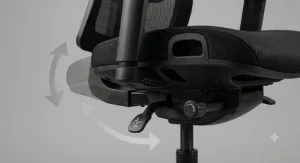
Real-World Scenarios: Which Chair After Coccyx Injury is Right for You?
Recovery looks quite different depending on where you live and how you work. Here are three realistic UK profiles.
Profile 1: Sarah, secondary school teacher in Sheffield. On her feet most of the day, but marking at a kitchen table each evening and sitting during staff meetings. Her priority is a lightweight, portable cushion that moves with her. The Smith Hillman rollable cushion suits her perfectly — she carries it in her bag between classrooms and home without fuss. The washable mesh cover handles a busy school environment.
Profile 2: James, graphic designer working hybrid from a flat in Bristol. Three days a week at home, two in a city-centre studio. He sits at a desk for eight or more hours most days. For James, the ComfiLife gel-enhanced cushion at home (where he sits longest) and the Feagar at the studio makes financial sense — premium comfort where it matters most, functional backup elsewhere. Bristol’s hills mean his commute by car is unavoidable, so the Everlasting Comfort cushion in the car rounds things off.
Profile 3: Margaret, retired in rural Norfolk. Her injury came from an icy step in February — a story familiar to anyone who’s navigated a British winter on an ungritted path. She primarily sits in an armchair to watch television and read. The donut ring cushion is her acute-phase friend; she’ll transition to the medium iamcomfi as healing progresses. She ordered both through Amazon.co.uk with Prime next-day delivery, which reached her rural postcode without difficulty.
The point isn’t that these products are one-size-fits-all. It’s that the right chair after coccyx injury is the one that fits your life — not a generic recommendation from a product listing.
How to Choose a Chair After Coccyx Injury in the UK: 6 Expert Criteria
Making the right choice means asking the right questions before you buy. Here’s a numbered framework based on what actually matters:
1. Know your recovery phase. Acute injuries need full coccyx suspension (donut ring). Intermediate recovery benefits from medium-density U-shaped foam. Long-term management calls for firmer structural support. Buying the wrong type for the wrong phase is the most common and most costly mistake.
2. Assess foam density honestly. High-density foam (typically 60-80 kg/m³) doesn’t compress flat under your body weight. Low-density foam (under 40 kg/m³) will flatten within weeks and stop doing anything useful. The product listing rarely tells you the density directly — check the thickness and weight of the cushion as a proxy, and read longer-term UK reviews that mention durability.
3. Check the U-cut depth. Shallow cut-outs may leave residual pressure on the tailbone, particularly for users with a more prominent coccyx. Deeper cut-outs provide genuine suspension. This is difficult to assess online, which is why the returns policy (14-day cooling-off period under Consumer Contracts Regulations — your legal right for any online purchase) matters. Buy, try, return if necessary.
4. Consider the cover material. You’ll be sitting on this cushion for weeks or months. A removable, machine-washable cover isn’t a luxury — it’s a hygiene requirement. Mesh covers breathe better; velour covers feel softer initially but trap heat in warmer weather.
5. Think about where you’ll use it. Office chair, car seat, sofa, and dining chair all have different surface textures and depths. A non-slip base that works brilliantly on fabric office chair fabric may slide on a leather car seat. Match the base texture to your most-used surface.
6. Don’t ignore your chair’s existing support. A £30 coccyx cushion on a broken office chair with no lumbar support is fighting with one hand tied behind its back. If your chair lacks basic adjustability, a cushion will help — but you may also need to address the underlying chair. The UK Health and Safety Executive notes that even good ergonomic accessories cannot compensate for a fundamentally poorly set-up workstation.
What Most UK Buyers Get Wrong
There are several predictable mistakes worth flagging before you spend your money.
Mistake 1: Buying the softest option available. The instinct after injury is to reach for maximum softness — surely that means less pain? But cushions that are too soft allow the pelvis to sink and tilt backwards, which actually increases pressure on the coccyx. You want cushioning and support, not just padding.
Mistake 2: Using the cushion on only one chair. If you’re recovering from a coccyx fracture, pressure relief needs to be consistent across all your sitting surfaces, not just the office chair. The hours you spend on the sofa in the evening and the twenty minutes in the car matter just as much.
Mistake 3: Ignoring postural advice. A cushion paired with poor sitting habits delivers half the benefit. The forward lean, the regular standing breaks, the properly adjusted seat height — these are not optional extras. Leicester NHS guidance specifically recommends leaning forward while sitting to reduce coccyx contact pressure.
Mistake 4: Stopping too early. A bruised coccyx heals in about four weeks; a fracture in eight to twelve. Many people stop using a coccyx cushion the moment the acute pain subsides, only to find symptoms return when they go back to an unsupported chair for long stretches. Continue using cushion support until your GP or physiotherapist advises otherwise.
Mistake 5: Not consulting a professional. Cushions are excellent self-management tools, but they’re not a substitute for proper assessment. If your pain hasn’t improved after six to eight weeks of home management, it’s time to speak to your GP and ask about NHS musculoskeletal (MSK) physiotherapy — often accessible without a GP referral through community MSK services.
✨ Don’t Miss These Exclusive Deals!
🔍 Whether you’re in week one of recovery or managing long-term coccydynia, these carefully selected products can transform your day-to-day comfort. Click any highlighted product to check current pricing and availability on Amazon.co.uk.
Coccyx Cushion vs Specialist Orthopaedic Chair: Which Do You Actually Need?
Here’s a comparison that’s worth having frankly, because specialist orthopaedic chairs — built with integrated coccyx cut-outs and memory foam seats — are also available in the UK, typically in the £300-£600+ range.
| Factor | Coccyx Cushion (£20-£45) | Orthopaedic Chair with Cut-Out (£300-£600+) |
|---|---|---|
| Upfront cost | Low | Significant |
| Portability | ✅ Excellent | ❌ Fixed location |
| Immediate availability | ✅ Next-day Amazon delivery | ⏳ May require specialist order |
| Adjustability | Limited | Full ergonomic adjustment |
| Long-term durability | 1-3 years (foam degrades) | 5+ years |
| Best for | Short-term recovery / budget-conscious | Chronic coccydynia, long-term office workers |
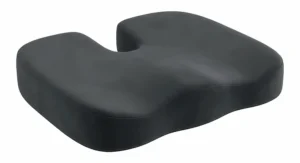
A dedicated coccyx chair — such as those built in the UK with integrated memory foam and coccyx cut-outs — makes excellent sense if you’re managing long-term or chronic tailbone pain, or if you’re an employer under the Equality Act 2010 with a duty to provide adapted workstation equipment for an employee with a musculoskeletal condition. For most people recovering from a standard coccyx injury, however, a quality cushion on an otherwise decent office chair is the practical, cost-effective solution — and Amazon.co.uk’s 30-day return window (plus your 14-day legal right) gives you the comfort of being able to try before committing.
The cushion wins for recovery. The chair wins for chronic management. Know which category you’re in.
FAQ: Chair After Coccyx Injury — Your Questions Answered
❓ How long do I need to use a coccyx cushion after a tailbone injury?
❓ Can a coccyx cushion make a fracture worse?
❓ Are coccyx cushions available on NHS prescription?
❓ Is a donut cushion or a U-shaped cushion better for a broken tailbone?
❓ Can I use a coccyx cushion in my car after an injury?
Conclusion: Recovery Starts With What You Sit On
A coccyx injury is one of those injuries that demands patience in a world that rewards urgency. You cannot rush it. You cannot grit your teeth through twelve weeks of sitting on an unsupported chair and expect it to heal properly — though knowing the British, several of us have tried. The right chair after coccyx injury isn’t a luxury. It’s a recovery tool, as medically logical as the ice pack the A&E nurse told you to use.
The iamcomfi cushions offer the most complete range for different stages of recovery; the Smith Hillman options are the strongest choice for portability and acute care; the ComfiLife gel-hybrid earns its keep for anyone dealing with heat and extended sitting; and the Feagar represents honest value when budget is a genuine constraint. Match the product to your recovery phase, combine it with the postural habits outlined in this guide, and give your body the time it’s asking for.
And if things aren’t improving after six to eight weeks? Put the cushion aside for a moment and pick up the phone to your GP. Some tailbone pain needs more than good seating — and the sooner that’s identified, the better.
✨ Don’t Miss These Exclusive Deals!
🔍 Ready to sit more comfortably during your recovery? Click any highlighted product above to check current pricing and availability on Amazon.co.uk — and give your tailbone the break it genuinely deserves.
Recommended for You
- Best Office Chair for Coccyx Pain: 7 UK Picks That Work (2026)
- Best Office Chair to Improve Posture: Top 7 UK Picks (2026)
- 7 Best Posture Correcting Chairs UK 2026 – Fix Bad Posture Fast
Disclaimer: This article contains affiliate links. As an Amazon Associate, I earn from qualifying purchases. If you purchase products through these links, we may earn a small commission at no additional cost to you. All recommendations are based on independent research and genuine editorial judgement — not paid placement.
✨ Found this helpful? Share it with your mates! 💬🤗
