
In This Article
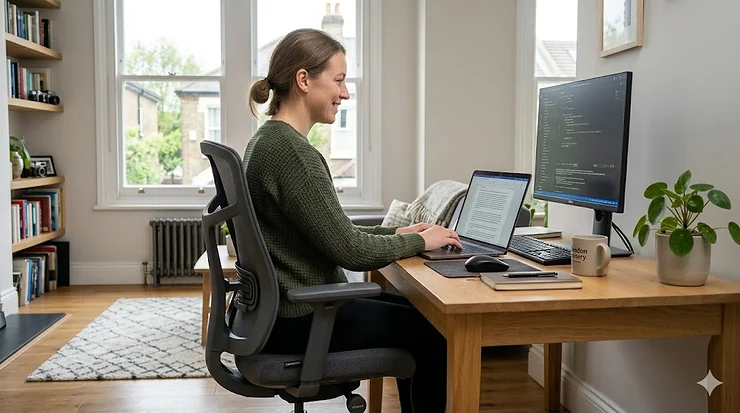
Your back knows something your brain is still ignoring. That dull ache setting in around 3pm, the stiffness when you finally stand up, the way you catch yourself slumped forward like a question mark by mid-afternoon — your chair is doing you no favours. And if you’re spending seven, eight, nine hours a day seated at a desk, the right office chair to improve posture isn’t a luxury. It’s arguably the single most impactful purchase you’ll make for your long-term health.
According to the Health and Safety Executive (HSE), work-related musculoskeletal disorders remain one of the most common causes of workplace illness in Great Britain, affecting hundreds of thousands of workers annually. A significant proportion of those cases are rooted in poor seating and workstation setup — not heavy lifting, not industrial accidents, but simply sitting badly, day after day, in the wrong chair.
So what makes an office chair actually good for posture? In short, it needs to support the spine’s natural S-curve — that gentle inward curve at the lumbar region and outward curve at the thoracic spine. Lose that shape and your postural muscles take over, slowly fatiguing over the course of a workday until you collapse into the seated slouch that’s quietly contributing to your neck pain, shoulder tension, and lower back misery.
In this guide, I’ve researched and analysed seven of the best ergonomic office chairs available right now on Amazon.co.uk — from sensible budget picks to investment-grade seats that will outlast most office furniture you’ll ever own. Every recommendation includes honest, practical commentary on what each chair actually delivers in the context of a typical British working day. Let’s get into it.
Quick Comparison: Office Chairs to Improve Posture at a Glance
| Chair | Price Range | Lumbar Support | Best For |
|---|---|---|---|
| Sihoo M57 | Under £250 | Adjustable (manual) | Budget buyers, home offices |
| Boulies EP200 2026 | £210–£280 | Adjustable + depth control | Everyday all-day use |
| Sihoo Doro C300 | £280–£350 | Self-adaptive (auto) | Long hours, multi-device workers |
| FlexiSpot C7 | £350–£420 | Adjustable stiffness | Taller users, back pain sufferers |
| Sihoo Doro S300 | £450–£550 | Dual dynamic system | Premium-feel without luxury prices |
| Steelcase Series 2 | £550–£750 | Air LiveBack (dynamic) | Serious ergonomics, office use |
| Herman Miller Aeron | £1,200–£1,700 | PostureFit SL (sacrum + lumbar) | Long-term investment, severe back issues |
Analysis: The table above reveals something important: the jump from budget to mid-range (Sihoo M57 to Boulies EP200) delivers a substantial improvement in adjustability and build quality for a relatively modest difference in price. The premium tier (Steelcase, Herman Miller) earns its cost through dynamic adaptive systems that simply cannot be replicated at lower price points — but for most UK home workers, the £280–£420 sweet spot offers excellent posture support without requiring a second mortgage.
💬 Just one click — help others make better buying decisions too! 😊
✨ Don’t Miss These Exclusive Deals!
🔍 Ready to transform your working posture? Click on any highlighted chair name in this guide to check current pricing and availability on Amazon.co.uk. Prime members enjoy free next-day delivery on most of these picks — well worth the convenience when you’ve got a 20-kilo flat-pack chair inbound.
Top 7 Office Chairs to Improve Posture: Expert Analysis
1. Sihoo M57 Ergonomic Mesh Office Chair — Best Budget Pick
The Sihoo M57 is the chair that quietly dismantles the assumption that decent posture support has to cost a fortune. With a breathable mesh back and seat, 3D adjustable armrests, a height-adjustable lumbar support, and a headrest — a feature that would cost you extra elsewhere — it delivers a genuinely impressive feature set at a price that won’t require a stern conversation with your bank manager.
The lumbar support adjusts vertically to find your natural lumbar curve, which is the essential mechanism for spinal S-curve maintenance — and it stays put once you’ve set it, rather than drifting mid-afternoon. The mesh back promotes airflow, which matters more than you’d think when British summer decides to show up for three days in July and your home office becomes a greenhouse. Weight capacity sits around 150 kg (approximately 23.5 stone), making it unusually inclusive for this price bracket.
What most UK buyers overlook about this model is that the headrest genuinely adds value for posture — it encourages you to actually lean back slightly, taking strain off your cervical spine, rather than perching forward like you’re trying to hear a secret. At around 8–9 kg for delivery, it’s also manageable for carrying up a flight of stairs in your typical British terraced house.
UK reviewers frequently highlight the straightforward assembly and solid build quality, with Expert Reviews UK describing it as the best budget ergonomic pick for home offices.
✅ Breathable mesh on back and seat
✅ 3D armrests and headrest included
✅ High weight capacity
❌ Lumbar support is manual, not adaptive
❌ Armrest padding is modest compared to pricier rivals
Price range: under £250 — strong value for money at this tier.
2. Boulies EP200 2026 Ergonomic Office Chair — Best Value Overall
Boulies is a UK-based seating brand, which matters when you’re thinking about warranty support and parts availability — no grey-market headaches, no dealing with overseas returns. The EP200 2026 is a significant upgrade on its predecessor, featuring a re-engineered cold-cured foam seat cushion that provides three times the support of the original and an expanded seat width of 51 cm, accommodating a wider range of body types without the usual “one-size-fits-none” compromise.
The hybrid mesh backrest is the defining feature here: it combines the breathability of traditional mesh with a softer, smoother surface that doesn’t leave your back feeling like it’s been grilled. For active sitting engagement — the small postural shifts that keep your core muscles gently working throughout the day — the flexible backrest responds naturally to movement rather than fighting you into one rigid position.
The adjustable seat depth is genuinely underrated for posture. Most people don’t realise that sitting with the seat too long pushes you into a posterior pelvic tilt — the root cause of that lumbar slouch. Sorting your seat depth can, on its own, dramatically improve your sitting posture. The EP200 2026 makes this easy. Available on Amazon.co.uk and backed by UK consumer protections under the Consumer Rights Act 2015.
TechRadar’s reviewer, after 12 months of daily use, called it “the archetypal office chair for most people.”
✅ UK-based brand with local support
✅ Excellent seat depth adjustment for posture
✅ Upgraded mesh — twice as durable as previous version
❌ Not as feature-rich as chairs in the £350+ bracket
❌ 2-year warranty is shorter than FlexiSpot’s 5-year offering
Price range: £210–£280 — arguably the best pounds-per-posture-improvement on this list.
3. Sihoo Doro C300 Ergonomic Office Chair — Best for Long Hours
The Sihoo Doro C300 is where the ergonomics get genuinely clever. The standout feature is the self-adaptive BM Tracking lumbar support system, which automatically adjusts as you recline, lean, or shift position — maintaining contact with your lumbar spine rather than leaving the familiar “gap” that plagues fixed lumbar pads the moment you move. For anyone who works across multiple screens or devices and naturally shifts position throughout the day, this is rather useful.
The weight-sensing recline chassis distributes your bodyweight to control recline tension automatically, so the chair responds to you rather than requiring you to faff about with levers mid-flow. The 3D coordinated armrests pivot, raise, lower, and slide — essential for chair improve sitting posture at desk scenarios where your keyboard and mouse position determines shoulder health.
Sihoo rates the C300 for users between 150 and 180 cm tall. Taller users (above 183 cm or so) may find it a touch compact — worth noting if you’re north of six foot. Assembly is straightforward enough, though UK reviewers note it takes patience: budget 30–40 minutes and follow the numbered bag system.
UK buyers report high satisfaction with the lumbar support particularly; one Birmingham reviewer praised how it reduced their daily lower back fatigue within two weeks of switching from a basic office chair.
✅ Genuinely adaptive lumbar — stays in contact as you move
✅ Weight-sensing recline is a premium touch at this price
✅ 3D coordinated armrests
❌ Plastic-heavy build feels lighter than metal-frame alternatives
❌ Sized for users up to 180 cm — less ideal for taller frames
Price range: £280–£350 — excellent ergonomic chair posture improvement per pound spent.
4. FlexiSpot C7 Ergonomic Office Chair — Best for Taller Users and Back Pain
The FlexiSpot C7 takes a different philosophical approach to lumbar support: manual control with lockable stiffness adjustment. Rather than the automatic adaptation of the Doro C300, the C7 lets you pump up the lumbar pressure to your precise preference and lock it there. This level of control is rare and particularly valuable for anyone managing chronic lower back pain, where “close enough” lumbar support simply isn’t good enough.
The seat height range of 47.5–56 cm accommodates users up to approximately 195 cm (about 6’5″), making it one of the more height-inclusive options in this bracket. The 4D armrests offer forward/backward, inward/outward, up/down, and pivot adjustment — which sounds excessive until you spend a week typing with properly positioned forearms and notice your shoulder tension has quietly disappeared.
The spec sheet won’t tell you this, but the C7’s main weakness is its complexity: Expert Reviews found that adjusting the lumbar support requires contorting your arm into a slightly awkward position, and the instruction manual earns its place as bedside reading. Once you’ve cracked the setup, though, it delivers. TechRadar rated it 4.5 stars and included it as their top mid-range pick in the 2026 update. It’s available on Amazon.co.uk, and FlexiSpot UK offers a 60-day trial with free returns — meaningful consumer protection that goes beyond the statutory 14-day cooling-off period.
✅ Lockable lumbar stiffness — precise control for back pain users
✅ Excellent height range, great for taller UK users
✅ 60-day trial from FlexiSpot UK
❌ Adjustment system is initially confusing
❌ At this price, some find similar value in the Steelcase entry tier
Price range: £350–£420 — justified for taller users and those managing back pain.
5. Sihoo Doro S300 Ergonomic Office Chair — Best Premium-Feel Mid-Range
The Doro S300 is Sihoo going properly ambitious. Winner of a German Design Award, it features an anti-gravity recline mechanism, a floating adjustable headrest, and 6D coordinated armrests that move in six directions — forward, back, up, down, pivot, and width. The dual dynamic lumbar support system operates both automatically and manually, giving you the responsiveness of adaptive support without sacrificing the precision of manual control when you want it.
What makes the S300 particularly interesting for spinal S-curve maintenance is the anti-gravity recline, which positions your body in a gentle reclining posture that actually reduces lumbar disc pressure compared to upright sitting. Research from Cambridge University Hospitals NHS Foundation Trust has highlighted the benefits of varied sitting postures in preventing muscle strain — the S300’s recline system encourages exactly that postural variety throughout the day.
The Italian velvet mesh option offers a softer, more tactile feel than standard nylon mesh, which some UK buyers find more pleasant against the forearms during summer months. Available on Amazon.co.uk and the UK Sihoo official site.
UK reviewers praise the premium feel and the ease of the recline mechanism, noting that it encourages proper resting posture during video calls and focused work alike.
✅ Anti-gravity recline reduces lumbar disc pressure
✅ 6D armrests — comprehensive positional freedom
✅ Dual lumbar system: adaptive + manual
❌ Larger footprint — may be tight in compact UK home offices
❌ Assembly is involved; professional help worth considering
Price range: £450–£550 — the sweet spot for anyone who wants premium ergonomics chair posture improvement without Aeron pricing.
6. Steelcase Series 2 Ergonomic Office Chair — Best for Serious Ergonomics
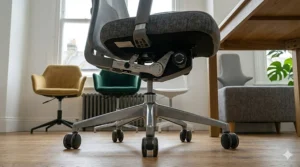
Steelcase has been manufacturing task seating since 1912 and it shows — not in the design (the Series 2 is cleanly contemporary) but in the engineering details that more fashionable brands still haven’t cracked. The Air LiveBack backrest is the headline feature: a geometric patterned mesh that flexes in multiple directions as you shift position, providing consistent lumbar contact regardless of whether you’re leaning forward to type, sitting back to read, or rotating to grab your mug of tea. You don’t have to think about it. It simply works.
The high-density foam seat is another meaningful differentiator. Cheap foam flattens. Steelcase’s doesn’t — after years of daily use, the seat retains its support profile. For postural muscle fatigue reduction, a seat that doesn’t compress unevenly under pressure is genuinely important for long-term comfort.
TechRadar named the Steelcase Series 2 their best office chair overall in 2026, describing it as delivering full ergonomic comfort at a price below the premium tier. Available through Amazon.co.uk and specialist UK office furniture retailers including Office Chairs UK, which offers same-day dispatch on most configurations.
One honest caveat: the Series 2 doesn’t feature a lockable recline angle — the backrest springs back when you release pressure. For those who prefer a fixed reclined position for reading, this can be frustrating.
✅ Air LiveBack adapts dynamically to every movement
✅ Foam seat that won’t flatten with extended use
✅ Excellent pedigree and build quality
❌ No lockable recline angle
❌ Not ideal for users above 185 cm — the backrest runs slightly short
Price range: £550–£750 — excellent long-term value; this chair will likely outlast two or three budget alternatives.
7. Herman Miller Aeron Remastered Office Chair — Best Long-Term Investment
The Herman Miller Aeron is the chair that other chairs are compared against. Designed in 1994 by Bill Stumpf and Don Chadwick and comprehensively remastered in 2016, it remains the reference standard for ergonomic seating — the chair that sits (quite literally) in the permanent collection of New York’s Museum of Modern Art. When a chair earns a place in an art museum, you know something unusual is going on.
What actually makes the Aeron exceptional for posture isn’t mystique but science. The 8Z Pellicle mesh divides the backrest into eight zones, each tensioned differently to match the varying support needs of different body regions — your sacrum needs firm support; your shoulder blades need more freedom. The PostureFit SL system addresses both the sacrum and the lumbar region with individual adjustable pads, promoting healthier pelvic positioning than generic lumbar adjustments alone. This is ergonomic chair better posture at a molecular level.
The “Remastered” version now incorporates ocean-bound plastics in its construction — same performance, slightly improved conscience. Available in three sizes (A, B, C) — measure your height and weight carefully or visit an authorised UK showroom. Office Chairs UK offers UK stock with immediate dispatch. UK buyers note the 12-year warranty covering parts and labour; refurbished Aeron Classics start in the £350–£450 range from specialist UK suppliers if the new price gives you pause.
✅ 8Z Pellicle mesh — differentiated support across 8 zones
✅ PostureFit SL: sacrum and lumbar both addressed
✅ 12-year warranty — exceptional long-term assurance
❌ Significant investment — not for the budget-conscious
❌ Must choose correct size — measure before buying
Price range: £1,200–£1,700 — justifiable if you sit for 7+ hours daily and your back is telling you it matters.
How to Set Up Your New Chair Correctly — The Bit Everyone Skips
Buying the right chair is only half the story. The other half — the bit most people skip in the excitement of unboxing — is actually setting it up for your specific body. A £1,500 Herman Miller Aeron set at the wrong height will not improve your posture. A £250 Sihoo M57 set up correctly might genuinely transform how you feel by 5pm.
Step 1: Seat height first. Sit with your feet flat on the floor, thighs roughly parallel to the ground, knees at approximately 90 degrees. If your feet dangle, lower the seat or add a footrest. If your knees are above your hips, raise the seat. This single adjustment is the foundation of everything else.
Step 2: Seat depth. Slide the seat so there’s approximately a 2–3 finger gap between the front edge of the seat and the back of your knee. Too long and it pushes you into a posterior pelvic tilt; too short and you’re not getting proper thigh support.
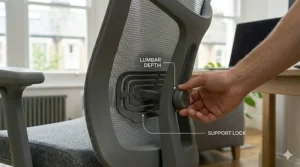
Step 3: Lumbar support. Position it so it fills the natural inward curve of your lower back when you’re sitting upright — not so high it’s hitting your mid-back, not so low it’s pushing at your tailbone. You should feel it gently supporting you without forcing an exaggerated arch.
Step 4: Armrests. Set them so your forearms rest horizontally, shoulders relaxed — not raised, not slumped. Move them inward until they’re just under your elbows. If your chair has forward/backward adjustment, position them so your elbow is supported without your forearm pressing down at an angle.
Step 5: Monitor height. Not technically your chair, but critically connected to your posture. Your screen should sit at eye level — you shouldn’t be looking up or craning down. A books-under-monitor solution costs nothing; a monitor arm is worth considering for a more permanent fix.
Give yourself at least two weeks before judging the chair. It takes time for your body to adjust to a properly supported sitting position, especially if you’ve spent years compensating with postural habits that are now being gently corrected.
Which Chair Suits Your UK Working Style? Real-World Scenarios
Not everyone sits the same way, works in the same space, or has the same budget. Here are three UK profiles that capture the most common buying scenarios, and which chair from this list suits each one best.
The London Hybrid Worker: You’re desk-based three days a week in a South London flat, two days in a shared office in Farringdon. Your spare room doubles as a home office, your desk is about 60 cm wide, and space is genuinely tight. Budget: around £300. You need a chair that’s compact enough not to dominate the room, delivers solid lumbar support without faff, and doesn’t need a team of engineers to assemble. The Sihoo Doro C300 is your answer — adaptive lumbar support, 3D armrests, a footprint that won’t swallow your spare room, and excellent value at its price point.
The Manchester-Based Freelancer with Back Problems: You work from home full-time, you’ve been through two physio referrals for lower back pain, and you’re done compromising. Budget: up to £450. You need precise lumbar control, good height adjustment, and a chair that provides active sitting engagement over eight-hour days. The FlexiSpot C7 delivers exactly this — manual lockable lumbar stiffness means you can dial in the precise support your back needs, and the 60-day trial means you can assess it properly before committing.
The Edinburgh Office Professional: You sit at a corporate desk five days a week, your employer has suggested ergonomic equipment is available on request, and you’ve decided to make the case for a serious chair. Budget is flexible; longevity matters. The Steelcase Series 2 is your chair — it will handle daily office use without degradation, the Air LiveBack system requires zero daily adjustment, and its build quality justifies the conversation with your facilities manager.
How to Choose an Office Chair to Improve Posture: 6 Key Criteria
Choosing the right office chair for better posture isn’t complicated, but it does require some honest self-assessment before you scroll to the buy button.
1. Lumbar support quality. This is non-negotiable. The lumbar region — your lower back — bears the greatest load in seated posture. Look for chairs that specify height and depth-adjustable lumbar support. Adaptive systems (like the Sihoo C300’s) are convenient; manually lockable systems (like the FlexiSpot C7’s) give greater precision. Fixed lumbar pads are fine for some body types and actively unhelpful for others.
2. Seat depth adjustment. Undervalued and under-discussed. The ability to adjust seat depth means you can accommodate the distance from your lower back to the back of your knee, preventing the posterior pelvic tilt that’s the silent enemy of good lumbar posture. If a chair doesn’t offer seat depth adjustment, approach with caution.
3. Armrest adjustability. 3D armrests (up/down, in/out, forward/back) are the minimum for proper shoulder support. 4D adds pivot; 6D adds further freedom. More dimensions means more ability to position your forearms correctly relative to your keyboard, which directly impacts shoulder and neck tension.
4. Material and breathability. Mesh beats foam for long British summers (both of them). More seriously, a breathable seat prevents the heat buildup that causes fidgeting and postural breakdown, particularly during afternoon focus sessions. Full mesh — back and seat — is worth prioritising.
5. Seat height range. Standard chairs accommodate roughly 160–185 cm users. If you’re outside this range — shorter or taller than average — check the specific height range carefully. The FlexiSpot C7 accommodates up to 195 cm; some budget chairs cap out at 175 cm.
6. Weight capacity and durability signals. A higher weight capacity often signals a more robust frame. Chairs rated to 130+ kg generally have stronger aluminium or steel bases. Check the warranty: 2 years suggests confidence; 5 years suggests real confidence; 12 years (Herman Miller) suggests the manufacturer expects you to still be using it when your children start secondary school.
The Wikipedia article on ergonomics provides useful background on the principles underpinning these features if you’d like to go deeper.
Common Mistakes When Buying an Office Chair to Improve Posture
Even well-researched buyers make these errors. Avoid them.
Buying a chair that looks ergonomic. Mesh, curves, and a headrest do not automatically equal good posture support. Some chairs use ergonomic aesthetics as marketing rather than engineering. Always check whether the lumbar support is actually adjustable — not just a fixed foam pad glued to a mesh back.
Ignoring your height and body type. Most chairs are designed for the 160–185 cm range. If you’re 155 cm or 195 cm, you need to check the seat height range, seat depth, and backrest height explicitly. An ill-fitting chair actively damages posture rather than improving it.
Buying US voltage models. Less common with chairs than electronics, but not unheard of: always confirm Amazon.co.uk availability rather than redirecting from a .com listing. UK buyers are protected by the Consumer Contracts Regulations (14-day cooling-off period on online purchases) — use them if a product arrives unexpectedly.
Setting and forgetting. Unboxing, assembling, and sitting down without adjusting anything is the most common mistake of all. A chair with six adjustment options and five of them at factory defaults is basically a stationary bicycle with the seat too high: technically functional, actively counterproductive.
Underestimating the adjustment period. If your new ergonomic chair feels slightly uncomfortable for the first week, that’s often normal — your body is being encouraged into a supported posture it hasn’t maintained in years. Give it two to three weeks before concluding the chair doesn’t suit you.
Ergonomic Chair vs Standard Office Chair: Does It Actually Make a Difference?
| Feature | Standard Chair | Ergonomic Chair |
|---|---|---|
| Lumbar support | Fixed or absent | Adjustable (height + depth) |
| Seat depth | Fixed | Adjustable |
| Armrests | Fixed height (often) | 3D–6D adjustable |
| Recline | Basic tilt or none | Multi-position with tension |
| Material | Often foam only | Mesh or hybrid options |
| Long-term durability | 2–4 years typical | 5–12+ years typical |
| Posture impact | Passive | Active support |
Analysis: The comparison above illustrates why ergonomic office chairs for better posture deliver genuine value — and it’s not just about comfort. A standard chair is passive; it holds you in whatever position you happen to adopt. An ergonomic chair is active, designed to guide your body toward supported alignment. The NHS guidance on back pain prevention makes clear that maintaining the natural lumbar curve during extended sitting is a primary preventative measure. Ergonomic seating is the mechanical means of doing exactly that. A standard chair for a fraction of the price might feel like a sensible saving; after two years of physio appointments, it rarely is.
Long-Term Cost and Value in the UK
| Chair | Price Range | Warranty | Est. Lifespan | Cost Per Year (est.) |
|---|---|---|---|---|
| Sihoo M57 | Under £250 | 2 years | 3–5 years | £50–£80/yr |
| Boulies EP200 2026 | £210–£280 | 2 years | 4–6 years | £40–£70/yr |
| Sihoo Doro C300 | £280–£350 | 3 years | 5–7 years | £40–£70/yr |
| FlexiSpot C7 | £350–£420 | 5 years | 6–8 years | £45–£70/yr |
| Steelcase Series 2 | £550–£750 | 12 years | 10–15 years | £37–£75/yr |
| Herman Miller Aeron | £1,200–£1,700 | 12 years | 12–20 years | £60–£140/yr |
Analysis: The cost-per-year perspective reframes the buying decision considerably. The Steelcase Series 2, despite its higher upfront price, may well cost you less annually than a budget chair you’ll replace twice in the same period. The Herman Miller Aeron, at the premium end, is most cost-effective when used daily for 10+ years — which, based on build quality, is entirely reasonable. The Which? consumer advice team consistently notes that ergonomic chairs represent significantly better long-term value than entry-level alternatives once total ownership cost is factored in. Budget options still make sense for occasional use or genuinely tight financial situations, but for daily full-time use, investing more upfront is usually the rational choice.
Frequently Asked Questions
❓ Can an office chair really improve posture, or is that just marketing?
❓ How long does it take for a new ergonomic chair to improve my posture?
❓ Is there a difference between ergonomic chairs sold on Amazon.co.uk and Amazon.com?
❓ My home office is small — will an ergonomic chair fit?
❓ What's the return policy on office chairs bought through Amazon.co.uk?
Conclusion: Stop Putting Up With a Chair That’s Working Against You
The truth about choosing an office chair to improve posture is that there isn’t one perfect answer for everyone — but there is a right answer for you, based on your height, your working hours, your budget, and what your back is currently telling you. A London freelancer logging 8-hour days needs something different from a part-time home worker in a compact Edinburgh flat.
What unites every chair on this list is that each one, properly adjusted, will do more for your postural health than any amount of stretching performed in the wrong chair. The Sihoo M57 proves you don’t need to spend a fortune; the Herman Miller Aeron proves that sometimes spending more is genuinely worth it. The chairs in between — the Boulies EP200, the Sihoo Doro C300, the FlexiSpot C7 — prove that the most interesting territory in ergonomic seating is exactly where most sensible UK buyers are likely to land.
Your back has been sending polite signals for long enough. It’s time to actually listen.
✨ Don’t Miss These Exclusive Deals!
🔍 Click any highlighted chair in this guide to check current pricing and delivery options on Amazon.co.uk. Prime members: most of these chairs qualify for free next-day delivery — rather useful when you want to get started on that posture improvement immediately.
Recommended for You
- 7 Best Posture Correcting Chairs UK 2026 – Fix Bad Posture Fast
- Office Chair With Headrest: 7 Best UK Picks for 2026
- Best Office Chair With Neck Support UK: 7 Expert Picks (2026)
Disclaimer: This article contains affiliate links. As an Amazon Associate, I earn from qualifying purchases. If you purchase products through these links, we may earn a small commission at no additional cost to you.
✨ Found this helpful? Share it with your mates! 💬🤗
