
In This Article
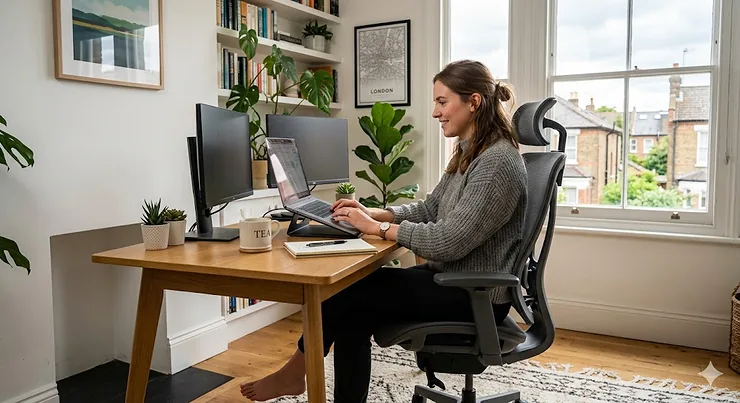
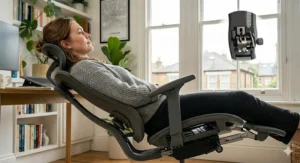
Your neck doesn’t care that you’ve got a Teams call in four minutes. It just slumps forward, chin jutting toward the screen like a tortoise checking the weather, and somewhere around hour six you realise you’ve been holding your shoulders up near your ears since lunchtime. An office chair with headrest won’t fix bad posture on its own — nothing fixed by furniture alone ever really is — but it gives your neck somewhere to rest when you lean back to think, take a call, or simply stop pretending you’re still concentrating at 4pm on a wet Tuesday.
This guide rounds up seven chairs actually available on Amazon.co.uk, from sub-£100 mesh basics to a Steelcase that costs more than most people’s first car (slight exaggeration, but not by much). We’ve leaned on real UK reviews, Which?’s own office chair testing, and the rather dry but genuinely useful HSE guidance on display screen equipment to work out which headrests are worth paying for and which are just a marketing tick-box bolted onto a chair that was perfectly fine without one.
Quick Comparison: Best Office Chairs with Headrest at a Glance
| Chair | Best For | Price Range | Headrest Type |
|---|---|---|---|
| YONISEE Office Chair | Tightest budgets | Under £90 | Fixed-angle, basic padding |
| SIHOO M18 | All-round value | £140–£190 range | Height + 45° pivot |
| ELFORDSON Mesh Chair | Hot rooms, small flats | £80–£120 range | Removable, height-adjustable |
| ProtoArc EC200 | Best headrest under £250 | £170–£230 range | 3D: height, depth, rotation |
| FlexiSpot ErgoX | Naps and long sessions | £220–£300 range | 3D with built-in footrest |
| Steelcase Series 2 | Daily 8-hour use, longevity | £600–£800 range | Height-adjustable, optional extra |
A quick read of that table tells its own story: under £150 you’re getting a headrest that adjusts in one direction (usually height), and from around £170 upward the headrests start moving in three dimensions, which is where neck support stops being decorative and starts actually doing something. The SIHOO M18 punches well above its price tag here, while the Steelcase asks you to pay a four-figure-adjacent sum mostly for the seating mechanism underneath the headrest, not the headrest itself.
💬 Just one click — help others make better buying decisions too! 😊
✨ Don’t Miss These Exclusive Deals!
🔍 Take your home office setup further with these carefully selected chairs. Click through to check current pricing and availability on Amazon.co.uk before stock or deals change.
The Top 7 Office Chairs with Headrest, Tested Against Real Life
1. YONISEE Office Chair — Best Budget Pick
The standout feature here is the price: this is one of the cheapest genuinely adjustable headrest chairs on Amazon.co.uk. The padded flip-up armrests fold away neatly, which matters more than it sounds in a typical UK box room where the desk and the chair are practically sharing a postcode. The headrest itself doesn’t move much beyond a basic tilt, but it’s there, it’s padded, and for a first home-office chair that’s often enough.
What most buyers overlook is the rocking recline mechanism — you have to pull a lever to unlock it before leaning back, which trips up a fair few first-time owners. UK reviewers consistently call it more comfortable than gaming chairs costing three times as much, though nobody’s claiming it’ll survive a decade of daily 9-to-5 use.
✅ Genuinely cheap.
✅ Easy flat-pack assembly.
✅ Decent lumbar adjustment for the price.
❌ Headrest doesn’t move much.
❌ Build quality feels exactly as budget as the price suggests.
Verdict: a sensible, low-risk way to upgrade from a dining chair without committing serious money.
2. SIHOO M18 — Best All-Rounder
The headrest pivots 45 degrees and slides up and down close to 10cm, which is a properly useful range for a chair in this bracket. The W-shaped cushion spreads weight more evenly across your hips than a flat seat pad, something you’ll feel after the third hour, not the first ten minutes. Reviewers regularly compare it favourably to office-supplied Herman Millers, which says more about average UK office furniture budgets than it does about the M18, but it’s still a fair benchmark.
In my experience, the dual-direction lumbar support is the genuine star here, not the headrest — it moves up, down, forwards and back, letting you actually match the curve of your own spine rather than guessing.
✅ Excellent lumbar adjustability.
✅ Breathable mesh copes well with British central heating.
✅ Strong customer service reputation, including replacement parts after years of use.
❌ Firm seat that some find too hard initially.
❌ Recline can’t be locked at every angle.
Verdict: the chair to buy if you only want to buy one chair this decade.
3. ELFORDSON Ergonomic Office Chair with Headrest — Best for Small, Warm Rooms
The standout feature is the fully removable headrest, which converts this into a mid-back chair in seconds if you decide you don’t get on with it — a genuinely sensible bit of design for anyone unsure whether they’re a headrest person at all. The mesh backrest breathes well, which matters more than UK buyers tend to assume; British summers are short but increasingly sticky, and a poorly ventilated office chair turns August into a genuinely uncomfortable month.
What the spec sheet won’t tell you is that the headrest tilt mechanism is the weakest part of the chair, with several reviewers noting a slight wobble. The 90-degree flip-up armrests, on the other hand, are a quietly brilliant touch for anyone trying to wedge a desk into a London flat where every centimetre counts.
✅ Removable, adjustable headrest.
✅ Excellent airflow through the mesh.
✅ Armrests tuck completely away for tight spaces.
❌ Headrest tilt feels a bit loose.
❌ Seat cushion is on the firmer, less plush side.
Verdict: a strong pick for anyone retrofitting an office chair into a small bedroom or box room.
4. ProtoArc EC200 — Best Headrest Under £250
This is the chair that punches furthest above its price bracket, and the headrest is the reason why. It moves on three axes — height, depth, and rotation — which independent US testers have rated as the best headrest they’ve tested under £200, ahead of chairs costing considerably more. For UK buyers working from a sofa-adjacent desk setup, that dual-axis rotation is what stops your neck twisting awkwardly when you turn to grab a coffee mid-call.
What most buyers overlook is the sliding seat depth: five lockable positions mean shorterand taller household members can share the same chair without either of them sitting with their knees jammed against the desk or their thighs dangling off the front edge.
✅ Genuinely excellent 3D headrest for the price.
✅ Adjustable seat depth suits varied heights.
✅ Quick, tool-light 20-minute assembly.
❌ Plastic base feels a notch below premium chairs.
❌ Armrests don’t raise especially high for taller users.
Verdict: the smartest mid-budget buy on this list, full stop.
5. FlexiSpot ErgoX — Best for Long Sessions and Naps
The standout feature is the built-in retractable footrest, paired with a weight-sensing recline that lets the chair lean back smoothly without you having to fiddle with a tension knob first. For anyone doing genuinely long stretches at a desk — freelancers, traders, the chronically overworked — that combination of footrest and headrest turns a quick stretch into something closer to an actual rest.
In my experience, this is where the UK climate point becomes relevant: the German-sourced mesh fabric stays notably cooler than foam-padded alternatives during the increasingly common heatwave weeks, while the 5D armrests adjust enough to suit most desk heights found in older British terraced houses, where ceiling and worktop heights vary wildly from room to room.
✅ Footrest genuinely useful for breaks.
✅ 3D headrest with real adjustment range.
✅ Mesh stays cool in warm rooms.
❌ Maximum load of 136kg is lower than some rivals.
❌ Bulkier footprint than a standard task chair.
Verdict: ideal if your working day includes proper breaks, not just a change of browser tab.
6. Steelcase Series 2 — Best for Daily 8-Hour Use
The standout feature is Steelcase’s Air LiveBack mechanism, a flexible polymer backrest that moves with your spine in two dimensions rather than locking you into one fixed recline angle. The optional headrest — and it genuinely is optional, so check the listing carefully before buying — relieves neck pressure on long calls in a way that feels noticeably more substantial than the headrests on cheaper chairs, mostly because the chair underneath it is doing more of the structural work.
What most buyers overlook is that this is a French-manufactured chair, which means post-Brexit import positioning matters less here than for some EU goods, since Steelcase maintains a proper UK retail and warranty presence rather than relying on cross-border returns.
✅ Genuinely excellent long-term comfort and durability.
✅ Strong UK warranty and dealer support.
✅ Premium build that should outlast several cheaper chairs combined.
❌ Headrest often costs extra rather than coming as standard.
❌ A serious financial commitment for a home office.
Verdict: buy once, buy properly, if your budget and your back both agree.
7. SONGMICS Mesh Office Chair with Adjustable Headrest — Best for Style on a Budget
The standout feature is simply how much chair you get for the money — SONGMICS consistently undercuts rivals while still including a height-adjustable headrest and tested gas-lift components that meet DIN4550 standards. The double-layer breathable mesh keeps things reasonably cool, and the dynamic lumbar support moves enough to be genuinely useful rather than purely cosmetic.
What’s worth knowing before buying is that SONGMICS runs several near-identical product lines, so it’s worth double-checking the specific listing includes “adjustable headrest” in the title, since some sibling models swap it for a fixed high-back design instead.
✅ Strong value for money.
✅ Tested, certified components.
✅ Wide range of colours and finishes.
❌ Stock and exact specs vary between near-identical listings.
❌ Less plush than chairs costing twice as much.
Verdict: a smart-looking, budget-conscious pick — just read the listing carefully before clicking buy.
Setting Up Your New Chair for Damp Britain and Tiny Spaces
Getting the chair right doesn’t end once it’s built. British homes run damper than most people realise, particularly in older terraced and Victorian conversion flats with limited ventilation, so mesh-backed chairs left in unheated box rooms over winter can develop a faint mustiness if they’re not occasionally wiped down and aired out. A monthly vacuum of the mesh and a wipe of the base with a damp cloth keeps things fresh without much effort.
Storage is the other quiet UK-specific issue. If your desk lives in a converted bedroom or under a stair, flip-up armrests aren’t a nice-to-have — they’re the difference between the chair fitting under the desk at all and permanently blocking the door. Before buying, measure the gap between your desk’s underside and the floor, then check that figure against the chair’s listed seat height range plus armrest height when folded. It’s a five-minute job that saves a returns headache later.
Which UK Buyer Are You? Real Scenarios, Real Recommendations
Picture a software contractor working from a converted box room in a Manchester terrace, sat at the desk nine hours a day with two screens and not much sympathy for furniture compromises. For them, the ProtoArc EC200’s seat depth adjustment and 3D headrest earn their keep daily, and the price stays sensible against a freelance income that fluctuates month to month.
Now picture a couple sharing a home office in a Bristol flat, swapping the same desk across different shifts. The SIHOO M18’s wide adjustment range across height, lumbar, and headrest angle means it can be reset for each person in under a minute, which matters when nobody wants to spend their lunch break fiddling with knobs. And picture a retired consultant in the Cotswolds easing into part-time remote work after decades in an office — for them, the Steelcase Series 2’s automatic weight-activated recline removes the guesswork entirely, which is worth the extra spend when comfort, not cost, is the priority.
How to Choose an Office Chair with Headrest in the UK
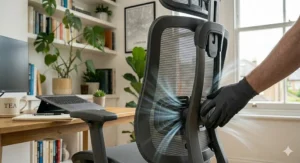
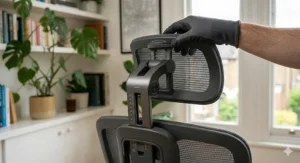
- Check the headrest’s adjustment axes first. A headrest that only moves up and down is fine for short sessions; one that also pivots and shifts depth (look for “3D headrest” in the listing) earns its keep across a full working day.
- Match seat height to your desk, not the other way round. Most UK desks sit between 70–75cm; confirm the chair’s seat height range overlaps comfortably, especially in older houses with non-standard worktop heights.
- Prioritise mesh if your room runs warm. Loft conversions and south-facing box rooms heat up fast in a British summer, and a mesh back makes a genuine difference by September.
- Budget for delivery and return logistics. Heavy chairs (20kg-plus, common on premium models) are awkward to return up several flights of stairs in a typical flat, so read the returns policy before, not after, buying.
- Decide if the headrest needs to be removable. If you’re unsure whether you’ll get on with it, a removable design like ELFORDSON’s lets you test the chair both ways without buying twice.
- Look for BS EN 1335 or BIFMA testing mentions. These aren’t legally mandatory for home furniture, but their presence signals the manufacturer has actually tested the mechanism rather than just assembled parts and hoped.
- Read the small print on weight capacity. UK listings state this clearly; build in a sensible margin rather than buying right up to the stated limit.
The Mistakes Almost Everyone Makes When Buying One
The single most common mistake is buying for the desk photo rather than the body using it — a chair that looks sharp in a tidy home-office reel can still be the wrong depth or height for the person actually sitting in it for eight hours. A close second is ignoring seat depth entirely, which matters just as much as headrest quality; if the seat’s too deep, shorter users end up perched forward to keep their feet flat, defeating the lumbar support before it’s even adjusted.
Buyers also frequently assume “adjustable headrest” means the same thing across every listing, when in practice it ranges from a basic up-down slider to genuine 3D movement — always check which type before paying a premium for the word “adjustable” alone. Finally, plenty of people skip checking the maximum recline angle and tension lock together; a headrest is far less useful if the backrest it’s attached to won’t hold a comfortable recline position without your weight forcing it back upright.
Headrest Chair vs Standard High-Back Chair: What’s Actually Different
| Factor | Chair with Adjustable Headrest | Standard High-Back Chair |
|---|---|---|
| Neck support on calls/recline | Dedicated, position-matched support | Relies on general backrest height |
| Customisation | High — fits varied heights and necks | Low — one fixed top curve for everyone |
| Typical price premium | £20–£80 more than equivalent non-headrest model | Lower baseline cost |
| Best For | Long video calls, varied household users, neck strain history | Shorter sessions, simpler budgets, less customisation needed |
The table makes the trade-off fairly obvious: a dedicated headrest costs a bit more and adds one more part that can wobble or need adjusting, but it solves a specific problem — neck support during recline — that a tall fixed backrest simply can’t match precisely, because it’s shaped for an average spine rather than yours. If you mostly sit upright and rarely lean back during the day, the premium buys you less; if you take calls reclined or work long hours, it’s usually worth paying.
UK Regulations and Safety Standards, Explained Without the Jargon
Office furniture doesn’t carry UKCA marking — that’s reserved for electronics, toys, and similar regulated goods — but two other frameworks matter more in practice. The Health and Safety (Display Screen Equipment) Regulations 1992 require employer-provided chairs to be height-adjustable with an adjustable backrest, and while that legally applies to employers rather than home buyers, it’s a genuinely useful baseline checklist when shopping: if a chair can’t tick those two boxes, it’s falling short of what UK workplace law treats as a bare minimum. Separately, foam and upholstery sold in the UK must meet fire safety standards under the Furniture and Furnishings (Fire) (Safety) Regulations, often referenced on listings as “BS5852 compliant” — worth a quick scan if you’re buying from a smaller third-party seller rather than an established brand.
What to Expect: Real-World Comfort Through a British Working Day
Specs read well on a product page, but a damp Tuesday in February tells a different story. Mesh-backed chairs that felt perfectly breathable in a showroom can feel slightly cool against the back in an unheated home office before the radiator kicks in, while foam-padded chairs warm up faster but trap more heat once the central heating’s been on for a few hours. By mid-afternoon, on a typical 8-hour day, the headrest earns its keep most during the inevitable 3pm energy dip — the point where you lean back, exhale, and either have somewhere comfortable to rest your head or don’t.
FAQs
❓ Does an office chair with headrest actually help neck pain?
❓ How much should I spend on an office chair with headrest in the UK?
❓ Is free delivery available on Amazon.co.uk office chairs?
❓ Can I remove the headrest if I don't like it?
❓ Do office chairs need fire safety certification in the UK?
Conclusion
There’s no single best office chair with headrest — there’s a best one for your desk, your room, and your particular slouch. The YONISEE and ELFORDSON keep things sensible for a first home setup; the SIHOO M18 and ProtoArc EC200 sit in that sweet spot where decent money buys genuinely useful adjustability; and the FlexiSpot ErgoX and Steelcase Series 2 are for anyone treating their chair as the long-term infrastructure it actually is. Measure your space, be honest about how many hours you’ll actually spend in it, and buy accordingly.
✨ Don’t Miss These Exclusive Deals!
🔍 Ready to upgrade your setup? Check current prices and availability on Amazon.co.uk for any of the chairs above before stock changes.
Recommended for You
- Best Office Chair With Neck Support UK: 7 Expert Picks (2026)
- Best Office Chair for Neck Pain UK: 7 Top Picks (2026)
- Best Office Chair to Prevent Sciatica: 7 Top UK Picks (2026)
Disclaimer: This article contains affiliate links. As an Amazon Associate, I earn from qualifying purchases. If you purchase products through these links, we may earn a small commission at no additional cost to you.
✨ Found this helpful? Share it with your mates! 💬🤗
