
In This Article
Here’s a truth nobody in the office furniture industry wants you to know: the chair you’re sitting in right now is probably destroying your lower back. Slowly. Quietly. With the patient ruthlessness of British damp working its way through an old stone wall.
The good news? You do not need to spend £800 on a Herman Miller to fix it. The better news? The market for an office chair under £200 in 2026 is genuinely, surprisingly good — and I’ve spent weeks sifting through Amazon.co.uk listings, testing real models, and reading thousands of UK reviews so you don’t have to.
What is a good office chair under £200? In simple terms, it’s any task chair priced below that threshold that provides proper lumbar support, adjustable seat height, and enough build quality to last beyond the first national bank holiday. That used to be a tall order. At this price in 2026, it’s entirely achievable.
According to the Health and Safety Executive, musculoskeletal disorders account for nearly a third of all work-related illness in the UK — and poor seating is a primary culprit. Most of us are working from home some or all of the week now, perched on dining chairs or whatever was nearest when the pandemic upended everything. That chair was not designed for eight hours of focused work. It was designed to survive Christmas dinner.
This guide covers seven real products available on Amazon.co.uk, with honest commentary on who each one suits, what the spec sheet won’t tell you, and how to get the most from your purchase once it arrives. We’re cutting through the marketing noise. Let’s begin.
Quick Comparison: Best Office Chairs Under £200 (UK, 2026)
| Chair | Price Range | Lumbar Support | Headrest | Best For |
|---|---|---|---|---|
| Sihoo M18 | £150–£170 | Dual-adjustable (2D) | No | All-day home workers |
| SIHOO M57 | £160–£190 | 3D adjustable | Yes | Tall users, long hours |
| Boulies EP200 | £180–£200 | Fixed contour | No | Comfort-first buyers |
| FlexiSpot BS8 | £150–£180 | 5cm vertical adjust | Yes (arch) | Back pain sufferers |
| IKEA Markus | £130–£150 | Fixed lumbar pad | Yes (fixed) | Minimalists, longevity seekers |
| Hbada P3 Pro | £150–£175 | 2D lockable | 3D adjustable | Tweakers & customisers |
| Amazon Basics Ergonomic | £60–£85 | Fixed curve | No | Students, occasional use |
From the table above, the Sihoo M18 and FlexiSpot BS8 represent the best ergonomic value in the sub-£200 bracket — both offer adjustable lumbar support in a price range where many rivals settle for a moulded foam bump. If budget is the primary concern, the Amazon Basics option is serviceable for light use, but I’d temper expectations: it is a chair you tolerate, not one you enjoy.
💬 Just one click — help others make better buying decisions too! 😊
✨ Don’t Miss These Exclusive Deals!
🔍 Take your home office comfort to the next level with these carefully selected chairs. Click on any highlighted product name to check current pricing and availability on Amazon.co.uk. Your back will thank you.
Top 7 Office Chairs Under £200: Expert Analysis
1. Sihoo M18 Ergonomic Office Chair
The Sihoo M18 is the chair that consistently tops UK round-ups for good reason — it brings features you’d typically find on £300+ models down to a genuinely accessible price. The full-mesh backrest promotes airflow throughout the day, which matters more than you might think in a British home office where the central heating is cranked up from October through April and the windows stay firmly shut.
The standout feature is the dual-adjustable lumbar support: you can shift it vertically to match your spine’s position and adjust its depth to increase or reduce the pressure it applies. That’s a 2D lumbar system for under £170, and it’s genuinely rare at this price. The W-shaped seat cushion distributes weight across the thighs and hips rather than concentrating pressure at a single point — meaning you’re significantly less likely to feel that familiar afternoon ache just above the tailbone. The recline goes to 126°, useful for a quick breathing moment between video calls.
The M18 is best suited to home workers who are at their desk for six or more hours daily and have previously been using a dining chair or an old foam-padded office relic. UK reviewers frequently cite improved lower back comfort within the first fortnight of use. It won’t flatter a spare bedroom with its corporate look, but it will absolutely do the job it’s designed for.
✅ 2D adjustable lumbar support at this price is exceptional value
✅ Breathable mesh — no more damp-back by mid-afternoon
✅ 136kg weight capacity accommodates most users comfortably
❌ No headrest — if neck support is a priority, look elsewhere
❌ Assembly takes around 30-45 minutes; instructions could be clearer
Price range: Around £150–£170 | A strong all-rounder and arguably the default recommendation for most UK buyers in this bracket.
2. SIHOO M57 Ergonomic Mesh Office Chair
The M57 is the M18’s more feature-complete sibling, and the extra investment buys you something the M18 lacks: a 3D adjustable headrest and significantly more adjustable armrests. For taller users — say, 180cm and above — the M18 can leave the neck slightly unsupported during recline, and the M57 solves that problem comprehensively.
The full-mesh construction (seat and back) makes this one of the most breathable chairs available under £200 on Amazon.co.uk. The 3D lumbar support adjusts horizontally, vertically, and in depth — more nuance than you’ll find on many chairs at twice the price. The armrests move in multiple directions, which sounds like a minor detail until you’ve spent six months with armrests at the wrong angle and developed that dull ache in your right shoulder that no amount of ibuprofen quite shifts.
This is the one I’d recommend if you’re tall, if you spend long hours at your desk, or if you’re moving from a premium office chair and want to preserve that level of adjustability without the premium price. UK reviewers particularly note the build quality feeling more solid than expected at this price point.
✅ 3D headrest is a genuine differentiator at this price
✅ Full mesh — exceptional airflow, particularly useful in smaller home offices
✅ Multiple armrest adjustment directions for precise positioning
❌ The mesh seat isn’t for everyone — those who prefer padded seats should look at the Boulies EP200
❌ Slightly bulkier than the M18; consider desk space in compact UK home setups
Price range: Around £160–£190 | Worth the step up from the M18 if you’re tall or a heavy daily user.
3. Boulies EP200 Ergonomic Office Chair
The Boulies EP200 is interesting — it approaches comfort from a different angle than most chairs at this price. Where competitors obsess over lumbar adjustment points, the EP200 focuses on getting the fundamental sitting experience right: a contoured mesh back that cradles rather than pushes, a seat depth that actually accommodates proper thigh positioning, and a stability that makes you feel planted rather than perched.
The seat depth adjustment (49–54cm in the foam version) is something rarely offered this cheaply, and it matters enormously for anyone shorter than average who typically ends up sitting with their knees digging into the front edge of the seat. For someone around 160–165cm, this single feature can transform an uncomfortable chair into a genuinely supportive one. The 120kg weight capacity is on the lower side compared to some rivals, so larger users should note this.
The EP200 is available in mesh and cold-cured foam versions on Amazon.co.uk; the mesh is the better choice for a home office environment unless you specifically run cold and want the extra warmth of foam. TechRadar described it as “a supremely comfortable and breathable mesh office chair” in their review — and for once, that’s not marketing fluff.
✅ Seat depth adjustment is rare and genuinely valuable at this price
✅ Exceptionally stable base — feels premium underfoot
✅ Available in both mesh and foam variants on Amazon.co.uk
❌ Lumbar support is fixed, not adjustable — a meaningful compromise
❌ 120kg maximum weight capacity may not suit all users
Price range: Around £180–£200 for the mesh version | An excellent all-rounder that prioritises comfort over feature count.
4. FlexiSpot BS8 Ergonomic Office Chair
FlexiSpot has spent two decades in the ergonomic furniture space — their standing desks are well-regarded among UK remote workers — and the BS8 brings that institutional knowledge to a chair that punches noticeably above its price. The nine-position adjustable backrest is a practical feature that lets you dial in your preferred recline angle with a locking mechanism rather than relying on tension-based systems that tend to creep over time.
The lumbar support provides 5cm of vertical adjustment, and it’s shaped to follow the natural S-curve of the spine rather than simply pressing a flat pad into your lower back. For those with existing back pain, that distinction matters. The arch-shaped oversized headrest provides genuine neck relief during extended sessions — it doesn’t just touch the back of your skull, it wraps around slightly to take the load off the cervical spine. The backrest reclines to 135° with three-level locking, which covers everything from full concentration mode to a more relaxed reading position.
UK buyers with back pain or those who tend to fidget and shift position throughout the day will get the most from the BS8. It’s also worth noting: FlexiSpot offers UK-based customer service, which simplifies returns and warranty claims considerably.
✅ Nine-position lockable backrest is a standout practical feature
✅ Oversized arch headrest — genuinely supports the neck, not just decorative
✅ UK-based customer support for after-sales peace of mind
❌ On the heavier side — moving it between rooms requires effort
❌ The mesh seat may feel firm initially; allow a few weeks to soften
Price range: Around £150–£180 | A particularly strong choice for back pain sufferers and anyone who values adjustability over aesthetics.
5. IKEA Markus Office Chair
The IKEA Markus is, by any measure, an anomaly. It’s not the most adjustable chair on this list. It offers no headrest you can meaningfully position, and its lumbar support is a fixed foam pad rather than an adjustable mechanism. And yet — it has a 10-year guarantee, a 4.4-star average from nearly 3,000 UK reviews on IKEA’s site, and a loyal following that borders on cultish among people who have owned one for five or more years.
The secret is longevity and simplicity. Where many budget chairs start creaking, wobbling, or losing gas-lift pressure around the 18-month mark, the Markus is built to IKEA’s commercial furniture standards — the same standards that survive schools, hotels, and their own notoriously packed showrooms. The mesh backrest allows airflow, the height adjusts smoothly, and the adjustable tilt tension means you can set the recline to feel appropriately firm or looser depending on the day. It’s not complicated. It just works, year after year.
If you want maximum longevity, prefer simplicity over a cockpit of adjustments, or are furnishing a home office that needs to look presentable rather than purely functional, the Markus deserves serious consideration. You can pick one up at IKEA directly, though it also appears on Amazon.co.uk via third-party sellers.
✅ 10-year guarantee — exceptional for this price bracket
✅ Battle-tested durability through years of real-world use
✅ Clean, minimal design suits home offices that double as guest rooms
❌ Fixed lumbar pad won’t suit everyone — no vertical or depth adjustment
❌ Arms are fixed, limiting customisation for precise positioning
Price range: Around £130–£150 | The tortoise of this comparison — slower to impress, but still running long after others have given up.
6. Hbada P3 Pro Ergonomic Office Chair
The Hbada P3 Pro is the chair for people who genuinely enjoy customising their setup. If you’re the type who spent 20 minutes adjusting the position of your monitor stand before finally committing, you’ll appreciate what Hbada has built here. The 2D lockable lumbar support adjusts both vertically and front-to-back, and critically, it locks in position — so it doesn’t silently migrate back to neutral position after a week of use, which is a frustrating habit of many budget lumbar mechanisms.
The 3D headrest adjusts in height, rotation, and surface angle — more flexibility than you’ll find on chairs at twice the price. The armrests move in three directions. The recline goes to 135° with stepless adjustment, meaning you set the exact angle rather than choosing between three or four fixed positions. Three-layer mesh on the back improves breathability and creates that satisfying visual layering effect. The overall build quality feels solid rather than plasticky, which isn’t always a given at this price.
The P3 Pro is available on Amazon.co.uk in black and is Prime-eligible, making delivery quick and straightforward. It suits methodical buyers who want to dial in their ergonomics precisely, and particularly those who have found that fixed lumbar pads on other chairs hit them in slightly the wrong spot.
✅ 2D lockable lumbar — stays where you put it, unlike many budget mechanisms
✅ 3D headrest with genuine range of adjustment
✅ Stepless 135° recline for precise angle control
❌ Assembly is more involved than most — allow a full hour
❌ The extensive adjustability can feel overwhelming if you just want to sit and work
Price range: Around £150–£175 | The adjustability-obsessive’s pick — a genuinely impressive feature set for the price.
7. Amazon Basics Ergonomic Adjustable Office Chair
Let’s be honest about what this chair is and is not. The Amazon Basics Ergonomic Chair is not a chair you’ll write home about. It won’t transform your posture or eliminate back pain after years of dubious seating choices. What it will do is provide a functional, comfortable place to sit for a few hours a day, arrive quickly, assemble without incident, and come with Amazon’s typically reliable returns process if anything goes wrong.
The curved lumbar support is fixed rather than adjustable — it will either hit the right spot for your back or it won’t, and there’s no mechanism to change that. The padded fabric seat is more comfortable than mesh options for people who run cold, particularly in the months between October and April when a British home office can feel like a particularly draughty waiting room. The Amazon’s Choice designation reflects genuine customer satisfaction for occasional use, particularly among students working part-time from a bedroom desk.
Don’t expect this chair to survive eight hours daily of demanding professional use. But for a student, a part-time home worker, or someone who needs a spare desk chair for a guest room that occasionally doubles as a workspace, it represents exceptional value.
✅ Extremely competitive price for a functional ergonomic design
✅ Quick delivery and Amazon’s straightforward returns process
✅ Fabric seat works well in cooler home office environments
❌ Fixed lumbar support — no adjustment for body type
❌ Foam cushioning compresses over time with heavy daily use
Price range: Around £60–£85 | Entry-level and honest about it — the right chair for the right budget.
Setting Up Your New Chair: A Practical Guide for UK Home Workers
Buying the right chair is step one. Setting it up correctly is step two — and it’s the one most people skip, then wonder why their back still aches three weeks later.
Start with seat height. Your feet should rest flat on the floor with your knees at roughly 90°. If you’re on carpet — as many UK homes are — account for the slight height reduction the pile gives you. Your thighs should be roughly parallel to the floor, not angled steeply downward.
Set your lumbar support before anything else. The support should sit in the hollow of your lower back, roughly between your waist and your trouser belt-line. If it’s hitting your mid-back, it’s too high. If you can barely feel it, it’s too low or too shallow. On adjustable models like the M18, M57, or P3 Pro, spend ten minutes getting this right — it’s worth every second.
Adjust your armrests to elbow height. Your elbows should rest naturally on the armrests with your shoulders relaxed and untensed. Many UK home workers set their armrests too high, which creates gradual tension in the trapezius muscles — that familiar tightness between the shoulders after a long day.
UK climate tip: In winter, if your home office is on the cold side, a mesh-back chair may leave your lower back feeling chilled during the first hour of the day. A thin lumbar pillow or even a folded wool blanket draped over the backrest solves this immediately and doesn’t affect the ergonomic function of the chair. Come summer — or whenever the UK unexpectedly delivers three warm weeks in a row — you’ll be grateful for that same mesh.
Assembly note: Most chairs on this list arrive with tools included and require 20–45 minutes to assemble. Do it on carpet or a towel to avoid scratching hardwood or laminate floors during the process. Attach the gas lift cylinder before attaching the base — not after.
Which Chair Suits Your Situation? UK Buyer Profiles
The London Flat Worker: You’re renting a one-bedroom flat and your “home office” is a corner of the bedroom with a small desk. Space is limited, the chair needs to tuck under the desk fully, and you don’t want something that looks aggressively corporate when guests come over. The IKEA Markus is your chair — clean lines, compact footprint, and the durability to outlast the tenancy. The Amazon Basics is a fallback if budget is truly tight.
The Manchester Home Office Regular: You’ve converted a spare room and you’re at your desk five days a week, eight hours a day. Back pain is a current or looming concern. You want genuine ergonomics, not a chair that merely looks ergonomic. The Sihoo M18 or FlexiSpot BS8 are the right calls here. Both provide adjustable lumbar support that genuinely works, and both are Prime-eligible for next-day delivery. If you’re tall (over 180cm), move directly to the SIHOO M57.
The Edinburgh Remote Worker Who Runs Cold: Scotland’s winters are a different category of grey entirely, and mesh chairs can feel uncomfortable in a cold spare room. The Boulies EP200 foam version is worth considering here — cold-cured foam seat rather than mesh, warmer in use, and still ergonomically solid. Alternatively, any chair on this list combined with a lumbar cushion from Amazon works reasonably well.
The Student or Part-Time Worker: Budget is a hard constraint, and you’re not at your desk all day every day. The Amazon Basics chair is honest value. If you can stretch to £130, the IKEA Markus offers a meaningful jump in long-term quality and a 10-year guarantee that will outlast undergraduate, postgraduate, and possibly doctoral study.
The Detail-Obsessed Techie: You’ve already researched standing desk converters and blue-light glasses. You want to dial in your ergonomics with precision. The Hbada P3 Pro rewards that inclination — more adjustability per pound than anything else on this list.
How to Choose an Office Chair Under £200 in the UK
Buying a chair online is one of the more annoying consumer decisions precisely because you can’t sit in it first. Here’s how to navigate it methodically.
1. Prioritise lumbar adjustability above everything else. A fixed lumbar bump is only comfortable if it happens to align with your spine. Adjustable lumbar support — even basic 1D vertical adjustment — dramatically increases the likelihood of a good fit. At this budget, any chair offering 2D lumbar (vertical + depth) is worth prioritising.
2. Know your height. Most budget ergonomic chairs are optimised for the 165–185cm range. If you’re shorter, check minimum seat height carefully (ideally below 43cm). If you’re taller, look for extended seat height range and a proper headrest — the M57 and Hbada P3 Pro are the better options.
3. Mesh vs foam: make a deliberate choice. Mesh offers superior breathability — important for long sessions and warmer months. Foam retains warmth and often feels more immediately cushioned. In a consistently heated UK home office, mesh is usually the better long-term choice. In a cold conservatory conversion or uninsulated loft office, foam has a real practical advantage.
4. Check the weight capacity. Most chairs in this range support 100–136kg. The Boulies EP200 mesh version tops out at 120kg — worth noting if you’re on the higher end of that range.
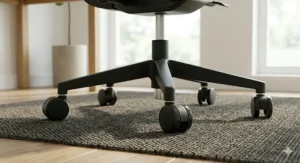
5. Consider your floor type. Standard plastic castors scratch hardwood and laminate flooring surprisingly quickly. If your home office has real wood or high-quality laminate, budget an extra £10–£15 for soft roller-blade style replacement castors from Amazon — they’re a five-minute swap and make a noticeable difference to both floor protection and the quiet smoothness of movement.
6. Assembly complexity matters. If you dread flat-pack furniture, the IKEA Markus is arguably the most straightforward assembly on this list. The Hbada P3 Pro is the most involved. Most others fall somewhere between 20 and 45 minutes.
7. Check Amazon Prime eligibility. Prime members get free next-day delivery, which effectively extends the value of the purchase — a chair you can return easily if it doesn’t suit is a lower-risk purchase than one that requires scheduling a courier.
Features That Actually Matter (And Those That Don’t)
Let’s separate ergonomic function from spec-sheet theatre.
Matters enormously: Adjustable lumbar support. Seat height range. Seat depth (underrated). Armrest height. Quality of the gas lift cylinder (cheap ones sink within a year — look for SGS-certified cylinders). Castor quality for your floor type.
Matters meaningfully for some users: Headrest (essential for tall users and reclining; unnecessary for those who sit upright and forward). Recline tension adjustment (useful if you shift between active work and reading or calls). Mesh vs foam distinction based on your environment.
Largely decorative: The number of “D” suffixes appended to adjustment descriptions on Amazon listings. “6D armrests” and “3D armrests” can describe similar functionality depending on the manufacturer’s counting methodology — always read the actual description rather than the number. Carbon fibre effect finishes. Lumbar “massage” features on budget chairs (these are marketing; they don’t replicate a massage). Integrated footrests on chairs under £200 (typically awkward to position correctly and rarely used after the first week).
Actively misleading: Chairs described as “orthopedic” without any certification. The NHS guidance on back pain notes that no single chair design is universally “orthopedic” — proper support depends on correct setup and fit for the individual, not a marketing label.
Common Mistakes When Buying a Budget Office Chair
Buying purely on star rating. Amazon ratings are useful but imperfect. A chair rated 4.3 stars from 15,000 reviews has survived substantial real-world scrutiny. A chair rated 4.7 stars from 200 reviews may be riding a promotional launch wave. Filter reviews by “critical” first to identify recurring complaints before committing.
Ignoring seat height range. If you’re under 165cm or over 190cm, this specification deserves careful attention. A chair with a minimum seat height of 46cm will leave shorter users with dangling feet, poor circulation, and a gradual ache in the backs of the thighs. The Amazon listing usually lists this, albeit inconsistently — check the product dimensions tab directly.
Conflating “ergonomic” with “good.” “Ergonomic” is not a regulated term in the UK. Any chair can claim it. What you’re looking for is adjustable — a chair you can tune to your body is ergonomic; a chair that merely has contours is marketing.
Overlooking the returns window. Consumer Contracts Regulations give UK online shoppers a 14-day cooling-off period for returns, regardless of the seller’s own stated policy. That’s a meaningful safety net when buying a chair you can’t try before purchase. Use it without hesitation if the chair doesn’t suit you.
Buying the wrong chair for your floor. Standard office chair castors are designed for carpet. On hardwood or laminate flooring, they move too freely, scratch the surface, and feel unsettlingly slide-y underfoot. The fix costs about £12 and five minutes, but many buyers don’t discover the problem until after assembly.
Real-World Performance in British Home Offices: What to Expect
British home offices come with a particular set of conditions that don’t appear in the product specs. Here’s what to actually expect.
Warmth retention: UK homes are typically warmer indoors than their European counterparts — we’ve been vigorously heating our draughty Victorian and Edwardian housing stock for decades and we’re not stopping. Mesh chairs handle this well. Fabric chairs, including the Amazon Basics option, can feel noticeably warmer after a few hours, which some users find comforting in January and others find uncomfortable in July.
Assembly in a small space: Most UK spare rooms are, frankly, not spacious. Assembly of these chairs typically requires a clear floor space of about 1.5m × 1.5m — doable in most rooms, but worth clearing the area before the delivery arrives rather than wrestling with a mesh backrest wedged against the wardrobe.
Longevity in daily use: Budget chairs vary significantly in durability. The IKEA Markus and FlexiSpot BS8 have track records suggesting multiple years of reliable daily use. The Amazon Basics chair is best regarded as a two-to-three year proposition with moderate use. Premium budget options like the Sihoo M18 and M57 sit comfortably in the three-to-four year range based on accumulated UK reviewer feedback.
Noise: A quality gas lift cylinder should operate silently. A quality mechanism should not creak under movement. If a chair starts squeaking within the first few months, the usual culprit is the connection between the seat plate and the backrest — a small application of WD-40 to the mechanism typically resolves it immediately.
Long-Term Cost & Value: Making £200 Work Harder
A chair at £170 used for five years costs roughly 9p per working day — less than a third of a Tesco meal deal. Framed that way, the investment becomes rather more rational.
The real cost of a bad chair isn’t the purchase price. The CIPD’s 2025 Health and Wellbeing report found that musculoskeletal issues remain one of the top causes of UK workplace absence — and while a chair isn’t the only factor, it’s the one variable most home workers have complete control over.
In terms of total cost of ownership: most chairs under £200 don’t require any consumable replacement parts within their useful life. The gas lift cylinder is the component most likely to fail in years three to five — replacement cylinders cost around £10–£20 and are straightforward to swap. Castor replacements, as noted, are cheap and recommended from day one if you have hard floors.
Warranty coverage varies significantly. The IKEA Markus’s 10-year guarantee is genuinely exceptional. The FlexiSpot BS8 comes with FlexiSpot’s standard warranty via their UK operation. Most Amazon.co.uk chair listings carry a 12–24 month manufacturer warranty — check the listing details carefully, and note that your Consumer Rights Act 2015 protections exist independently of any manufacturer warranty, covering defects in materials and workmanship for up to six years from purchase.
Frequently Asked Questions
❓ Can you get a genuinely ergonomic office chair under £200 in the UK?
❓ Is the IKEA Markus worth buying, or are there better options on Amazon.co.uk?
❓ Do Amazon office chairs qualify for free delivery in the UK?
❓ What's the best budget office chair for back pain in the UK?
❓ How do I know if an office chair on Amazon.co.uk is safe and suitable for UK use?
Conclusion: Your Spine, Your Budget, Your Decision
The ergonomic office chair market has moved remarkably in the past few years. The gap between “budget” and “genuinely good” has narrowed considerably, and spending north of £500 is no longer the only path to a properly supported working day.
If I had to put a single recommendation in front of every British home worker: the Sihoo M18 at around £150–£170 is the starting point. Adjustable lumbar, breathable mesh, solid build quality, and a price that doesn’t require advance apology to your bank account. For taller users, step up to the SIHOO M57. For back pain specifically, consider the FlexiSpot BS8. For simplicity and longevity above all else, the IKEA Markus remains one of the most sensible purchases in the entire category.
What you shouldn’t do is continue working eight hours a day in a chair that wasn’t designed for the purpose. The discomfort you’re experiencing isn’t inevitable. It’s a furniture problem, and it’s a solvable one.
✨ Don’t Miss These Exclusive Deals!
🔍 Ready to upgrade? Click any highlighted product name in this article to check current pricing and availability on Amazon.co.uk — and take your home office comfort from “fine, I suppose” to genuinely excellent.
Recommended for You 📚
- Guest Room Desk Chair: 7 Best UK Picks for 2026
- Best Office Chair for Living Room: 7 Stylish UK Picks (2026)
- 7 Best Silent Office Chairs UK 2026 | Noise-Free Desk Chairs
Disclaimer: This article contains affiliate links. As an Amazon Associate, I earn from qualifying purchases. If you purchase products through these links, we may earn a small commission at no additional cost to you.
✨ Found this helpful? Share it with your mates! 💬🤗
