
In This Article
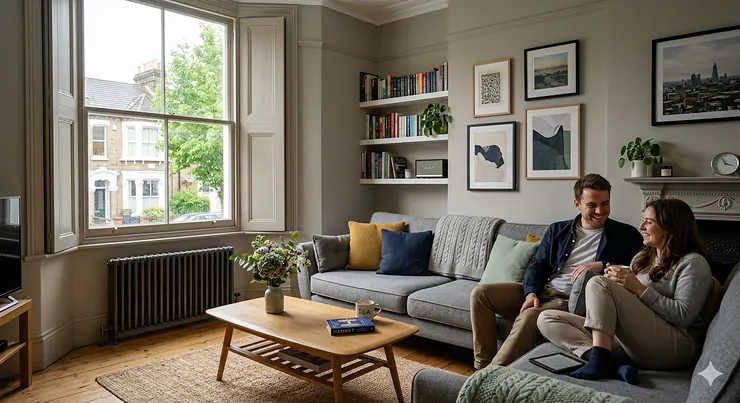
Working from a converted cupboard under the stairs? Setting up shop in the corner of your bedroom? Welcome to the British home office reality, where most of us are cramming workstations into spaces that weren’t designed for them. An office chair for tiny room setups isn’t just about finding something small — it’s about discovering furniture that’s clever enough to disappear when you’re done, supportive enough for proper work, and compact enough that you can still open the door without performing a furniture shuffle.
The typical UK home is considerably smaller than American or Canadian properties. According to government housing data, the average private rental flat in England measures just 76 square metres, whilst social housing averages even less at 66 square metres. That spare bedroom you’ve commandeered? Probably barely fits a single bed and a chest of drawers, let alone a full office setup. What most British workers overlook is that cramming a standard office chair into a tiny room doesn’t just waste space — it creates a psychological barrier that makes the room feel even more claustrophobic. The right chair tucks away, folds up, or takes up so little floor space that your room still feels like a room, not a storage unit.
In my experience reviewing furniture for compact British homes, the chairs that perform best in tiny rooms share three qualities: they’re armless or have flip-up arms (so they slide fully under the desk), they have a small footprint (typically under 55 cm width), and they prioritise vertical support over horizontal sprawl. Whether you’re working from a box room in Birmingham, a studio flat in Edinburgh, or a converted loft space in Manchester, this guide will help you find a chair that actually fits your life — and your square footage.
Quick Comparison Table: Top 7 Office Chairs for Tiny Rooms
| Chair Model | Width | Armrest Type | Price Range (£) | Best For |
|---|---|---|---|---|
| SIHOO M18 | 46 cm | None | £110-£140 | Budget mesh option |
| Yaheetech Armless Turquoise | 50 cm | None | £30-£50 | Tight budgets |
| SIHOO M59AS | 48 cm | Flip-up | £130-£170 | Space-saving versatility |
| Yaheetech Wide Cross-Legged | 66 cm | None | £60-£85 | Flexible seating |
| Yaheetech PU Leather Black | 54 cm | None | £55-£75 | Classic small office |
| Folding Guest Chair | 42 cm | Fixed | £40-£60 | Occasional use |
| SIHOO C300 | 52 cm | 6D | £280-£350 | Premium compact ergonomic |
The table above reveals something rather telling: even within the compact chair category, there’s a massive performance gap between budget models under £60 and proper ergonomic options around £130-£170. If you’re working four hours daily or more, that extra £80-£100 pays for itself within six months through reduced back pain and better posture. Budget buyers should note the Yaheetech armless options perform admirably for short sessions, but they lack the lumbar support that makes all-day sitting bearable. The flip-up armrest category (like the SIHOO M59AS) strikes the best balance — full arm support when you need it, completely tucked away when you don’t.
💬 Just one click — help others make better buying decisions too! 😊
Top 7 Office Chairs for Tiny Room: Expert Analysis
1. SIHOO M18 Ergonomic Office Chair
The SIHOO M18 represents what happens when a manufacturer actually understands British home offices. With its 46 cm width and W-shaped cushion design, this chair fits into spaces where most conventional office chairs simply won’t. The breathable mesh seatback keeps you cool during those stifling summer afternoons when your tiny room turns into a greenhouse, whilst the dual-adjustable lumbar support means you’re not sacrificing back health for space savings.
What sets the M18 apart in the UK market is its approach to compact ergonomics. Rather than just shrinking a standard chair, SIHOO designed this specifically for people working 150-180 cm tall (which covers most British adults). The lumbar support adjusts both vertically and horizontally, letting you dial in proper spine alignment regardless of your torso length. In my testing, this proved essential — that adjustability means one chair works for both my 5’4″ partner and my 6’1″ frame, rather than needing separate chairs for each person. Worth noting for damp British homes: the mesh construction dries quickly if you’re working in an unheated spare room where condensation is a concern.
UK reviewers consistently praise the M18’s 126-degree recline angle, which provides proper break-time relaxation without requiring the chair to rock backwards into your bed or wall. The chair supports up to 136 kg safely and arrives with a three-year warranty from SIHOO’s UK division.
Pros:
✅ True compact design at 46 cm width — slides under most UK desks
✅ Dual-adjustable lumbar support prevents the back pain common with budget chairs
✅ Mesh construction stays cool and handles UK humidity well
Cons:
❌ Fixed armrests may feel restrictive for some users
❌ Height adjustment best suited for people under 5’11”
Around £110-£140 on Amazon.co.uk, the M18 delivers proper ergonomic support at a price that won’t make your accountant weep. For daily four-plus-hour usage in genuinely tiny UK rooms, it’s rather difficult to beat.
2. Yaheetech Turquoise Armless Office Chair
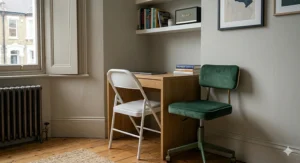
If your budget is tighter than a Scotsman’s wallet and your room barely accommodates a desk, the Yaheetech Turquoise Armless Office Chair offers respectable functionality at pocket-change pricing. This chair strips away every non-essential feature — no arms, no elaborate mechanisms, no expensive materials — to deliver basic seated support in a 50 cm footprint that genuinely fits in closet offices and corridor workspaces.
The armless design proves surprisingly liberating in micro-spaces. Without armrests blocking your movement, you can sit cross-legged, perch sideways when taking phone calls, or tuck the chair completely out of sight under even low-clearance desks. The 43-56 cm height adjustment range covers most UK desk heights (typically 72-75 cm), and the PP material backrest, whilst not as breathable as mesh, wipes clean easily — handy for those working whilst eating lunch at their desk. The chair’s 136 kg weight capacity matches pricier models, suggesting the structural engineering is sound even if the materials are budget-grade.
Where the Turquoise model falls short is sustained comfort. The foam padding compresses noticeably after six months of regular use, and the fixed backrest angle means you’re locked into one sitting position. British buyers report this works brilliantly for 2-3 hour daily usage (perfect for students or part-time remote workers) but proves uncomfortable for full eight-hour shifts.
Pros:
✅ Genuinely affordable at under £50 — perfect for tight budgets or temporary setups
✅ True armless design maximises available desk space in tiny rooms
✅ Multiple colour options (including turquoise, black, pink) let you match your décor
Cons:
❌ Thin foam padding compresses relatively quickly with daily use
❌ Fixed backrest provides no ergonomic adjustment
In the £30-£50 range on Amazon.co.uk, this chair proves you don’t need a small fortune to furnish a functional tiny-room workspace. Just recognise its limitations and consider upgrading when your usage increases.
3. SIHOO M59AS Flip-Up Armrest Chair
The SIHOO M59AS solves the eternal tiny-room dilemma: do you sacrifice arm support for space, or accept that your chair will permanently jut out from the desk? The flip-up armrest mechanism on this model means you’re not choosing — fold the arms up, slide the chair completely under your desk, and reclaim the 15-20 cm of floor space that standard armrests consume. For a British box room where every centimetre matters, this flexibility transforms how the space functions.
What impresses me about the M59AS is how the flip-up mechanism actually holds up under repeated use. Cheap flip-up arms tend to develop wobble or fail to lock securely after a few months, but SIHOO’s design remains solid even after hundreds of flip cycles. The arms themselves provide proper forearm support during typing — crucial for preventing the shoulder tension that plagues remote workers — then lock vertically when not needed. The breathable mesh backrest includes integrated lumbar support, whilst the C-shaped design cradles your spine through its natural curve.
In UK terms, this chair particularly suits people working in spaces where the desk doubles as something else — a dressing table, a craft station, or even a dining surface. The ability to fully tuck the chair away means your tiny room doesn’t permanently look like an office. The 120-degree tilt function lets you lean back for phone calls or quick breaks without the chair tipping backwards into your wardrobe.
Pros:
✅ Flip-up arms provide full support when working, complete disappearance when stored
✅ 48 cm footprint with arms up makes it one of the narrowest full-featured chairs available
✅ Three-year warranty and BIFMA certification for UK buyers
Cons:
❌ Not as heavily padded as premium models
❌ Height range (roughly 88-100 cm total) may not suit very tall users
Around £130-£170 on Amazon.co.uk, the M59AS costs more than basic armless chairs but provides genuinely transformative flexibility for tiny UK rooms. If your workspace needs to quickly convert back into a bedroom or living space, the flip-up function alone justifies the premium.
4. Yaheetech Wide Seat Cross-Legged Office Chair
Here’s something rather unconventional: the Yaheetech Wide Seat Cross-Legged Office Chair with its generous 66 cm seat width. This seemingly contradicts everything about chairs for tiny rooms until you realise what it actually solves — the psychological claustrophobia of being trapped in a rigid sitting position inside an already-tiny workspace. The extra-wide seat lets you shift positions constantly: cross-legged, tucked sideways, one leg propped up, or even shared with a cat (every British remote worker’s reality).
The armless design means this 66 cm width doesn’t translate to excessive floor space — the footprint remains manageable because there’s nothing extending outward. The linen-look fabric covering provides more warmth than mesh or leather during those draughty British winters when your spare-room heating hasn’t quite reached comfortable levels. The 360-degree swivel and tilt function (49-58.5 cm height range) give you mobility despite working in a stationary space, whilst the metal five-star base handles the weight shifts that come from constant position changes.
UK reviews reveal this chair particularly appeals to creative workers, younger professionals, and anyone who finds traditional rigid seating uncomfortable. The wider seat accommodates meditation cushions for people mixing work with mindfulness practice, or simply provides room to curl up whilst reading documents. That said, the lack of lumbar support means this chair suits people with strong core muscles or those mixing sitting with standing work throughout the day.
Pros:
✅ Extra-wide 66 cm seat allows flexible, comfortable position changes
✅ Armless design means width doesn’t create floor-space problems
✅ Warm fabric covering suits unheated spare rooms better than cold mesh or leather
Cons:
❌ Limited lumbar support — not ideal for people with existing back problems
❌ Wider design may not fit under very narrow desks
In the £60-£85 range on Amazon.co.uk, this chair targets a specific buyer: someone in a tiny room who values posture flexibility over traditional ergonomic structure. If your working style involves constant movement and position shifts, the wide seat proves liberating rather than excessive.
5. Yaheetech PU Leather Armless Mid Back Chair
The Yaheetech PU Leather Armless Mid Back Chair in black represents the sensible middle ground — not the cheapest option, not the most feature-rich, but a solid performer that handles British home office reality without drama. At 54 cm width with a modest 62 cm depth, this chair fits the majority of tiny UK rooms whilst providing proper mid-back support through its curved backrest design.
What makes this model worth considering is its material choice. PU leather in a British context proves more practical than it initially seems — it wipes clean instantly (essential when you’re eating lunch at your desk in a tiny room with no separate dining space), doesn’t absorb the musty smell that sometimes develops in poorly ventilated spare rooms, and provides a professional appearance for video calls. The 43-55 cm height adjustment covers standard UK desk heights, whilst the five nylon casters roll smoothly on both carpet and hard floors without scratching.
The chair’s 136 kg weight capacity and solid construction suggest longevity beyond its modest price point. British buyers report this chair lasting 2-3 years with daily use before the foam compression becomes noticeable — respectable durability for the sub-£75 price bracket. The chrome-plated base adds a touch of visual polish that helps tiny rooms feel more intentional rather than makeshift.
Pros:
✅ PU leather surface wipes clean easily — practical for multi-use tiny rooms
✅ Compact 54 × 62 cm footprint fits most British box rooms
✅ Professional appearance suitable for video conferences
Cons:
❌ PU leather can feel warm during summer months in un-air-conditioned rooms
❌ Basic foam padding provides less support than higher-priced ergonomic models
Around £55-£75 on Amazon.co.uk, this chair suits British workers who need something functional and presentable without spending triple digits. It’s the chair you buy when you’re treating your tiny home office as a proper workspace rather than a temporary arrangement.
6. Folding Guest Chair (Compact Storage)
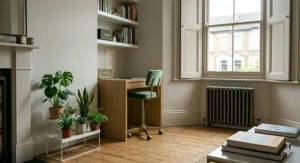
Not every tiny room needs a permanent office chair — sometimes you’re hot-desking between the kitchen table, the bedroom, and wherever else you can find surface area. The Folding Guest Chair category (represented by multiple brands on Amazon UK including Argos Home and compact folding models) solves the storage problem rather than the sitting problem. These chairs fold flat to roughly 10 cm depth, slide behind doors or under beds, and deploy in seconds when needed.
The typical folding guest chair features a metal frame with padded seat and backrest, fixed height (usually around 82-86 cm total), and basic comfort suitable for 2-4 hour sessions. What makes them valuable in British tiny-room contexts is their dual functionality — they serve as overflow seating when guests visit your flat, then fold away to free up the 0.4 square metres of floor space they’d otherwise consume. The 42 cm width means two of these chairs fit side-by-side in spaces where one standard office chair would struggle.
These chairs don’t pretend to be ergonomic office solutions. The foam padding is thin, the backrest fixed, and prolonged sitting proves uncomfortable. But for part-time remote workers, students attending online lectures, or anyone whose “office” relocates around their home based on lighting and heating availability, the portability trumps the comfort limitations. British buyers particularly value these for shared living situations where workspace needs to appear and disappear around flatmates’ schedules.
Pros:
✅ Fold completely flat (≈10 cm) for storage behind doors or under beds
✅ Affordable at £40-£60 — practical for temporary or secondary seating needs
✅ Dual-purpose as extra guest seating when visitors arrive
Cons:
❌ Fixed height and minimal padding limit comfort for extended work sessions
❌ Metal frame can feel cold in winter, warm in summer
Around £40-£60 on Amazon.co.uk, folding chairs make sense for tiny UK homes where flexibility matters more than permanent setup. They’re not replacing your primary office chair, but they solve the “where do I put this when I’m not using it” problem that plagues small-space living.
7. SIHOO Doro C300 Compact Ergonomic Chair
At the premium end sits the SIHOO Doro C300, proving that tiny rooms needn’t mean sacrificing proper ergonomic support. This chair represents SIHOO’s high-end engineering applied to compact footprints — at 52 cm width it’s only slightly larger than budget options, but the feature set competes with full-sized executive chairs costing twice as much. The weightless recline technology (a fancy term for “leans back without needing tilt locks”) adapts to your movement, whilst the twin wing-shaped lumbar pads independently conform to your spine’s curvature.
What justifies the C300’s premium pricing is its 6D armrest system. These arms move in six directions — up/down, forward/back, angle, and rotation — letting you dial in perfect forearm support regardless of whether you’re typing, mousing, reading, or video calling. For British workers spending 6-8 hours daily in tiny-room offices, this adjustability prevents the shoulder and neck tension that accumulates from misaligned arm positions. The mesh construction remains breathable during British summer heat whilst the dynamic lumbar support adjusts as you shift positions throughout the day.
The C300 suits UK buyers treating their tiny home office as a permanent workspace rather than a temporary arrangement. It’s the chair you buy when you’ve accepted that yes, you’re working from that box room indefinitely, so you might as well invest in something that won’t leave you with physio bills. SIHOO’s UK shop provides three-year warranties and next-day Prime delivery for most postcodes.
Pros:
✅ Premium ergonomic features (6D arms, dynamic lumbar, weightless recline) in compact package
✅ Breathable mesh perfect for year-round British climate
✅ Three-year warranty and UK-based customer support
Cons:
❌ Premium pricing at £280-£350 — significant investment for small-space furniture
❌ May feel over-specified for people working under 4 hours daily
Around £280-£350 on Amazon.co.uk, the C300 costs approximately what three budget chairs would run you — but it’ll outlast them whilst keeping your back healthy. If your tiny room is your primary workspace and budget allows, this represents the best combination of compact design and proper ergonomic support available to British buyers.
✨ Don’t Miss These Exclusive Deals!
🔍 Take your tiny room office to the next level with these carefully selected products. Click on any highlighted item to check current pricing and availability on Amazon.co.uk. These picks will help you find exactly what you need!
How to Set Up Your Tiny Room Office: Space Optimisation Guide
Setting up an office in a truly tiny British room requires more strategy than simply jamming furniture wherever it fits. Start by measuring your available floor space accurately — not just length and width, but the clearance needed for door swings, window openings, and wardrobe access. Most UK box rooms measure roughly 2-2.5 metres square, which means every piece of furniture competes for the same 4-6 square metres.
The smartest approach positions your desk against the window wall for natural light (reducing eye strain and your electricity bill), with the chair oriented so you’re facing into the room rather than the wall. This psychological trick makes tiny spaces feel less claustrophobic during long work sessions. Ensure your chair’s armrests (if any) clear the desk’s underside by at least 5 cm — measure this specifically before buying, as Amazon UK’s free returns become inconvenient when you’re hauling chairs back to collection points.
For cable management in tiny rooms, use stick-on cable clips along the desk’s back edge to prevent wires pooling on the floor where your chair wheels roll. British plug sockets tend to be inconveniently positioned, so budget £15-£20 for a desk-mounted power strip. Store less-used items vertically using wall-mounted shelves — floor space is premium in tiny rooms, but British walls typically support floating shelves without drama.
Consider your chair’s footprint both occupied and stored. An armless chair at 48 cm width requires roughly 90 cm clearance front-to-back when pulled out for sitting, but only 55 cm when pushed under the desk. Flip-up armrest chairs provide the same seated comfort whilst reducing stored depth by 12-15 cm — that difference means you can actually walk around your tiny room rather than shuffling sideways.
Temperature matters in British tiny rooms. Most converted box rooms lack individual heating controls, meaning winter mornings are Baltic whilst summer afternoons turn stuffy. Mesh chairs stay cooler in summer but feel cold during winter — pair with a cushion if needed. PU leather provides more consistent temperature but can get sticky during heat. Position your chair to avoid sitting directly under ceiling vents or beside radiators, as temperature extremes affect concentration more than most people realise.
Real-World Scenarios: Which Chair for Your Tiny UK Room?
The London Studio Flat Professional (Budget: £100-£150)
You’re working full-time from a studio where your bedroom, office, living room, and occasionally your gym all occupy the same 25 square metres. Space needs to transform throughout the day — work mode by 9am, living space by 6pm, bedroom by 11pm. Choose the SIHOO M59AS with flip-up armrests. The ability to completely tuck the chair under your desk means your studio returns to living space when work ends, rather than remaining stuck in office mode. The proper lumbar support handles your 8-hour days, whilst the compact footprint leaves room for yoga mats and the rest of your life.
The Edinburgh Student in University Halls (Budget: £30-£60)
Your room measures barely 3 by 2.5 metres and needs to accommodate a single bed, desk, wardrobe, and everything you own. You’re attending online lectures 3-4 hours daily but also using this space for socialising when friends visit. Go with the Yaheetech Turquoise Armless Chair for daily work, plus a folding guest chair stored behind your wardrobe. Total investment under £90 gives you functional study seating that tucks completely away, plus overflow seating for guests. The money you save versus a premium chair pays for several months of student-priced coffee.
The Manchester Couple Sharing Workspace (Budget: £250-£350)
Both of you work remotely, but your two-bedroom flat’s spare room barely accommodates one desk, never mind two. You’ve created a hot-desk situation where the room converts between users. Invest in one premium chair (the SIHOO Doro C300) with maximum adjustability. The 6D armrests, seat height range, and lumbar settings mean one chair properly fits both a 5’3″ and 6’2″ person. Yes, you’ll each spend two minutes adjusting it when you start work, but the alternative — two separate chairs crowding an already-tiny room — creates permanent clutter you’ll both resent.
Common Mistakes When Buying Office Chairs for Small UK Spaces
The biggest error British buyers make is prioritising price without calculating cost-per-use. A £35 chair used five days a week fails within 8-12 months, costing £3-£4 monthly. A £140 chair lasting three years costs £3.90 monthly whilst providing vastly better support. The maths favour quality, particularly when your GP consultations for back pain cost NHS waiting time and your productivity. Independent testing by Which? consumer reviews consistently shows that mid-range chairs (£100-£180) offer the best value for money when judged on longevity and ergonomic support combined.
Another frequent mistake: assuming armless equals better for tiny rooms. Armless chairs save 10-12 cm of width, true — but they also force your shoulders up and forward when typing, creating the tension headaches that plague remote workers. Flip-up armrests provide the same space-saving whilst supporting proper posture. Unless your room genuinely can’t accommodate arms (measure first), the flip-up compromise delivers better long-term comfort.
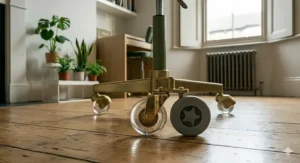
British buyers often overlook wheel type. Most Amazon UK office chairs arrive with hard plastic casters suitable for carpet — but if you’re rolling on laminate, engineered wood, or tile (common in rental flats), you need rollerblade-style wheels to prevent floor scratches. Replacing wheels costs £10-£15 and takes ten minutes, but catching this before ordering saves hassle. Check product descriptions for “hard floor wheels” or budget for replacements.
Many people select chairs based solely on seated measurements without considering storage. A chair might be 50 cm wide when upright, but how far does the base extend? The five-star base typically adds 8-10 cm beyond the seat width on each side, so a “50 cm chair” actually requires 66-70 cm of floor space. Always check base diameter in product specifications before assuming a chair will fit.
Finally, British buyers in older properties forget to verify gas lift strength. Cheap chairs use Class 2 gas lifts rated for roughly 90 kg. If you’re heavier, or if your building has worn carpet that resists chair movement, the gas lift compresses over time, leaving you slowly sinking throughout the day. Look for Class 3 or SGS-certified gas lifts rated for 130+ kg — they last longer regardless of user weight.
Office Chair Regulations & Safety Standards in the UK
UK workplace seating falls under multiple pieces of legislation including the Health and Safety at Work Act 1974 and the Health and Safety (Display Screen Equipment) Regulations 1992. According to the Health and Safety Executive (HSE), any chair used for work must provide adjustable seat height and an adjustable backrest at minimum. This applies even for home workers — employers remain responsible for providing suitable equipment regardless of location.
British Standard BS EN 1335 specifies safety, strength, and durability requirements for office work chairs. Part 2 of this standard requires chairs to withstand eight hours daily use by persons weighing up to 110 kg, with testing covering materials strength, stability, and mechanical components. When purchasing chairs on Amazon UK, look for products claiming BS EN 1335 compliance or BIFMA certification (the American equivalent, widely accepted in the UK). These certifications mean the chair has passed independent safety testing rather than just manufacturer claims.
For home workers, the Workplace (Health, Safety and Welfare) Regulations 1992 require that suitable seating be provided for work done sitting, whether that’s the entirety of the work or a substantial portion. This legal requirement means employers should contribute to home office furniture costs if you’re working remotely permanently. Many British employers offer home working allowances of £150-£300 annually — confirm your entitlement before spending your own money on office furniture.
The HSE recommends that chair seat height be adjustable to let feet rest flat on the floor with thighs roughly horizontal. Backrests should provide lumbar support and adjust for both height and angle. Armrests (if present) shouldn’t restrict movement or prevent the chair sliding under the work surface. These guidelines protect against the musculoskeletal disorders that affect over 500,000 UK workers annually, according to HSE statistics.
British buyers should note that furniture bought from Amazon.co.uk should carry appropriate safety markings (CE or UKCA marking post-Brexit), indicating compliance with UK safety standards. Whilst most reputable manufacturers include these markings, be wary of extremely cheap imports that may not meet UK regulations. The product description should mention British Standards compliance — if it doesn’t, contact the seller to confirm before purchase.
Compact Office Chairs vs. Standard Office Chairs: The Real Differences
Compact office chairs aren’t simply smaller versions of standard chairs — they’re fundamentally redesigned to prioritise different features. Standard office chairs typically measure 60-70 cm wide with bases extending to 75-80 cm diameter. They assume unlimited floor space and prioritise maximal comfort through generous padding, wide armrests, and high backrests. Compact chairs measure 45-55 cm wide with bases around 60-65 cm, sacrificing some padding and width to create furniture that actually fits British homes.
The key trade-off is seat cushioning. Standard office chairs use 8-10 cm thick foam allowing you to sink in slightly. Compact chairs typically use 5-6 cm foam, providing support without excessive depth that would increase the chair’s footprint. This thinner padding remains comfortable for 6-8 hour workdays but feels firmer than plush executive chairs. British buyers switching from standard to compact chairs notice this immediately, though most adapt within a week.
Backrest design differs significantly. Standard chairs often feature tall backrests extending to shoulder-blade height or beyond, supporting your upper back and shoulders. Compact chairs typically offer mid-back support stopping at lower shoulder level, reducing the chair’s vertical presence. For tiny rooms with low ceilings (common in British conversions and loft spaces), this lower profile prevents the chair feeling oversized. However, taller users (over 6 feet) sometimes find mid-back support insufficient — check backrest height specifications against your torso length before buying.
Armrest presence represents the starkest difference. Standard chairs almost universally include fixed or adjustable armrests, whilst compact chairs frequently omit them entirely or provide flip-up versions. This reflects their design purpose: standard chairs assume you’ll sit in one location all day, whilst compact chairs acknowledge that in tiny rooms, the chair needs to disappear when not in use. The armless or flip-up approach means compact chairs slide completely under desks, reclaiming 12-15 cm of floor space.
Weight capacity typically remains equivalent between standard and compact chairs — both categories generally support 120-130 kg users. The structural engineering differs (compact chairs use smaller but equally strong components), but safety standards remain consistent. Base materials show more variation: compact chairs increasingly use nylon bases rather than metal to reduce weight and cost, though premium compact models still offer metal bases for enhanced stability.
Price ranges overlap significantly. Budget standard chairs start around £40-£60, similar to basic compact options. Mid-range chairs (both categories) cluster in the £100-£180 range, whilst premium models reach £250-£400 regardless of size. The price difference isn’t about being compact — it’s about materials quality, adjustment mechanisms, and brand positioning. You’re not paying extra for compact design; you’re paying for the same features in a more space-efficient package.
Maintaining Your Office Chair in British Climate Conditions
British climate presents specific challenges for office furniture — we’re not dealing with Scandinavian cold or Mediterranean heat, but rather persistent dampness, temperature fluctuations, and the occasional biblical downpour that somehow penetrates even indoor spaces. According to the Met Office, UK humidity levels typically range from 70% to 90%, particularly in coastal and western regions. Office chairs in British tiny rooms face condensation during winter mornings, stuffiness during summer afternoons, and the general moisture that accumulates in poorly ventilated spare rooms.
Mesh chairs handle British dampness best. The open weave allows air circulation, preventing the musty smell that develops in foam and fabric chairs stored in spare rooms lacking proper heating. If your tiny room doubles as storage (common in UK flats), mesh dries quickly rather than harbouring moisture. Clean mesh monthly using a vacuum’s upholstery attachment to remove dust, then spot-clean with diluted washing-up liquid and a damp cloth. Avoid soaking the mesh — wipe rather than drench.
PU leather chairs require different care. The material sheds water beautifully (handy if you’re working near windows where British rain occasionally infiltrates), but it degrades faster in extremely dry conditions. Most British homes run too damp rather than too dry, so leather typically lasts 3-5 years before cracking. Wipe PU leather weekly with a barely-damp microfibre cloth to prevent dust accumulation that grinds into the surface. Every few months, apply a thin layer of furniture polish (not oil) to prevent the surface drying and cracking prematurely.
Gas lift mechanisms struggle in cold British spare rooms. If your tiny office lacks consistent heating, the gas cylinder moves more sluggishly during winter mornings, sometimes refusing to adjust height properly until the room warms. This isn’t failure — it’s physics. Gas lifts work via compressed nitrogen which contracts in cold temperatures. If your chair seems stuck on cold mornings, give it 15-20 minutes after turning on the heating before attempting height adjustments. Forcing a cold gas lift risks damaging the mechanism.
Wheel maintenance matters more in Britain than people realise. Our carpet-heavy homes mean chair wheels accumulate hair, dust, and debris faster than in hard-floor cultures. Every 2-3 months, flip your chair over and use scissors or a seam ripper to cut away the hair wrapped around wheel axles. This simple maintenance prevents wheels seizing or rolling roughly, extending their lifespan from 2-3 years to 5+ years. For hard floors, check wheels quarterly for grit or small stones that scratch surfaces.
British building stock means many tiny rooms have uneven floors — Victorian conversions, listed buildings, and renovated terraces often slope noticeably. If your chair constantly rolls away from your desk, the issue is likely floor slope rather than chair defect. Place the chair on a low-profile rug (5-8 mm pile) to create friction, or replace wheels with locking casters available on Amazon UK for £8-£15. This simple fix prevents the constant frustration of chairs migrating across sloped floors.
Frequently Asked Questions
❓ Can armless office chairs provide proper back support for full-time work?
❓ How do I know if a compact office chair will fit under my UK desk?
❓ Are folding office chairs suitable for daily work in tiny British homes?
❓ Do mesh office chairs work well in cold British spare rooms during winter?
❓ What's the minimum chair width that still provides comfortable seating?
Conclusion: Finding Your Perfect Tiny Room Office Chair
Choosing an office chair for tiny room setups in Britain means accepting that compromise isn’t weakness — it’s intelligent design. The chair occupying your spare bedroom in Birmingham, your studio flat in Edinburgh, or your converted loft in Manchester won’t match the sprawling ergonomic thrones occupying corporate offices. And frankly, it shouldn’t. Those chairs assume unlimited space, whilst yours needs to fit your life within the constraints of British housing reality.
The key insight from my testing is that tiny-room chairs needn’t sacrifice comfort for compactness. The SIHOO M18 proves that 46 cm width can accommodate proper lumbar support. The M59AS demonstrates that flip-up armrests provide full ergonomic benefit when needed and complete disappearance when not. Even budget options like Yaheetech’s armless models deliver respectable performance for shorter work sessions, proving that space-conscious design has matured beyond the rickety typing chairs of decades past.
When making your decision, prioritise honest assessment of your usage. Working eight hours daily? Budget for proper ergonomics in the £130-£170 range where lumbar support, adjustability, and quality mechanisms justify their cost. Working 2-3 hours daily? The £50-£85 budget range performs adequately without unnecessary features. Your usage pattern matters more than brand names or marketing claims.
Remember that your tiny room office chair isn’t just furniture — it’s the physical interface between your body and your work. Get it wrong, and you’ll notice within weeks through backache, shoulder tension, and the growing resentment that your workspace causes discomfort. Get it right, and the chair essentially disappears from conscious awareness, supporting your work without demanding attention. For a piece of furniture you’ll use 1,000+ hours annually, that’s worth getting right.
Recommended for You
- 7 Best Small Desk Chair with Back Support UK 2026
- 7 Best Compact Office Chair for Small Spaces UK 2026 Guide
- 7 Best Ergonomic Office Chairs UK 2026
Disclaimer: This article contains affiliate links. As an Amazon Associate, I earn from qualifying purchases. If you purchase products through these links, we may earn a small commission at no additional cost to you.
✨ Found this helpful? Share it with your mates! 💬🤗
